


Your Shopify store is growing, but the experience still feels blunt. Every visitor sees the same homepage banner. Your email flows rely on broad segments. One shopper wants premium skincare, another wants the cheapest refill pack, and both get the same promotion. You can feel the waste in that gap.
Operations start to feel the same way. You reorder stock based on instinct, then a product sells out early while a slower item sits on the shelf. Your team checks cart abandonment, repeat purchase behavior, and top-selling products, but the answers arrive after the moment has passed. You're working hard, yet the store still reacts more than it predicts.
That's where machine learning for ecommerce becomes useful. Not as a buzzword, and not as a giant all-or-nothing rebuild. It's a practical way to help a Shopify store learn from behavior patterns, then act on them faster than a manual workflow can. It can recommend products, adjust pricing logic, flag suspicious orders, personalize content, and improve forecasting.
The part many guides skip is the reality for smaller and mid-sized brands. You might not have a data scientist, a custom data warehouse, or years of clean customer history. You still need a workable path. In many cases, the right move isn't building a complex model from scratch. It's starting with low-data tactics, pre-trained tools, and a narrow pilot that solves one valuable problem well.
Introduction to Machine Learning for Ecommerce
A familiar Shopify scenario goes like this. Orders are coming in, traffic is growing, and the store looks healthy from the outside. Yet inside the business, the same friction keeps showing up. The founder wants better repeat purchase rates. The marketer wants shoppers to find the right products faster. The operations lead wants fewer stock surprises and less guesswork.
Now look at one shopper. She clicks an Instagram ad for linen shirts, browses a few neutral tops, adds one item to cart, leaves, and returns three days later from an email. A basic store still greets her with generic best sellers and the same sitewide discount. A machine learning system can treat that return visit more like a skilled sales associate would. It can recognize the pattern and surface similar styles, likely sizes, or a useful bundle instead of making her start over.
That shift is important in ecommerce because shopper intent changes quickly, catalogs grow, and manual merchandising rules age fast. For Shopify brands, the primary question is not whether machine learning sounds impressive. Rather, the concern is where it can save time or improve decisions with the data you already have.
Where Shopify brands usually get stuck
The first roadblock is usually practical, not technical. Teams can see the potential, but they are unsure where to begin and whether they have enough data to make the effort worthwhile.
Common questions come up early:
- What should we apply it to first? Recommendations, search, forecasting, pricing, or fraud checks?
- Do we have enough data? Or will the output be too noisy to trust?
- Should we use an app first? Or build through Shopify APIs later?
- Who should own it? Ecommerce, growth, operations, or a shared team?
A good first project is rarely the fanciest one. It is usually one repeated decision your team makes too broadly, too slowly, or too inconsistently.
For some stores, that is product recommendations. For others, it is reorder planning, discount timing, or identifying high-intent visitors. The best starting point is often a narrow use case with clear upside and low data demands. That is the part many ML guides skip. Smaller Shopify brands do not need a custom model for everything. They often need a practical tool, a clean feed of store data, and one pilot that proves value quickly.
Why this is worth learning
Machine learning for ecommerce is pattern recognition applied to store decisions. Your shop generates clues all day through searches, clicks, carts, purchases, returns, and browsing paths. A person can review some of that after the fact. Software can use those patterns while the decision still matters.
That makes ML useful for more than personalization. It can help a store decide what to recommend, which products are likely to run low, which visitors look ready to buy, and which orders deserve a fraud check. Even better, many early wins do not require massive datasets. Pre-trained tools, rule-assisted models, and focused Shopify app integrations can produce useful results long before a brand has enterprise-scale data.
Once you see machine learning this way, it becomes easier to judge what is realistic. You can separate helpful tools from vague promises, choose a first use case that fits your current store size, and build from a low-risk starting point instead of treating ML like a full rebuild.
Understanding Machine Learning Basics
A shopper lands on your Shopify store, views two product pages, adds one item to cart, leaves, then comes back from email three days later and buys a bundle. To a human, that path can look messy. To a machine learning system, it looks like a pattern that can be used again.
Machine learning works like a store team that keeps getting better at spotting repeat behavior. It reviews past examples, looks at what is happening right now, and estimates what is likely to happen next. In ecommerce, that usually means predicting which product a visitor may want, which order deserves review, or which customer is likely to buy again.
The useful part is simple. ML turns store activity into better guesses.
The three learning styles that matter most
You do not need a computer science background to understand the main categories. For Shopify brands, it helps to treat them as three different ways of learning from store behavior.
Supervised learning learns from examples with known outcomes. You feed it past sessions, orders, or customers along with the result you care about, such as purchased, refunded, clicked, or churned. It then looks for combinations that tend to lead to that outcome. A common Shopify example is predicting which visitors are likely to convert based on page views, traffic source, cart value, and device type.
Unsupervised learning groups things without a predefined answer key. It is useful when your team can see that customer behavior varies, but cannot neatly define the segments yet. A store might use it to find clusters such as gift buyers, repeat replenishment customers, or discount-sensitive shoppers. That can shape merchandising, email flows, or bundle strategy without requiring a huge labeled dataset.
Reinforcement learning improves by testing actions and learning from feedback over time. This approach fits cases where the system keeps adjusting a decision, such as ranking products, pacing offers, or tuning search results. Smaller brands usually do not start here, and that is fine. It often needs tighter controls and more volume than an early ML pilot.
Plain English versions of common ML terms
A lot of ML confusion starts with the language. The ideas are usually more familiar than the terms.
- Features: the inputs a model uses, such as product views, cart value, collection visited, device type, referral source, or order history.
- Model: the logic that turns those inputs into a score, prediction, or recommendation.
- Training: the step where the system learns from past examples.
- Inference: the live moment when the system applies what it learned to a real shopper, session, or order.
- Label: the known outcome in supervised learning, such as purchased, returned, or clicked.
One caution helps here. A model does not understand a customer the way your support team or merchandiser does. It spots repeat patterns and assigns probabilities.
That is why results depend so much on setup. If a recommendation block underperforms, the issue is often ordinary. The store may be feeding weak product data into the app, tracking the wrong goal, or asking the model to solve a problem that simpler rules could handle better.
For many Shopify merchants, the practical path is not building a custom model from scratch. It is starting with a tool that already includes trained logic, then improving the inputs. Clean product tags, accurate inventory status, consistent collections, and basic customer event tracking can do more for early performance than chasing advanced ML features. That is one reason low-data strategies matter so much for growing brands. You can get useful predictions from narrow, well-structured store data long before you have enterprise scale.
If you want a broader view of where these tools show up in day-to-day retail operations, this guide to AI applications in ecommerce gives useful examples beyond recommendations alone.
A short video can help make these ideas more concrete before you look at implementation.
Why ecommerce teams are adopting it faster
Adoption is rising for a practical reason. Online stores make the same decisions again and again, and manual review does not scale well. Teams need help choosing what to recommend, which shoppers to prioritize, how to flag risk, and when to reorder.
For Shopify brands, that does not mean becoming an AI company. It means identifying a store decision that happens often, affects revenue or margin, and can be improved with the data you already collect. In many cases, the first useful version is a Shopify app, a lightweight integration, or a rule-assisted model instead of a fully custom system. That is the gap many guides miss, especially for brands with modest traffic and lean teams.
Exploring Top Machine Learning Use Cases
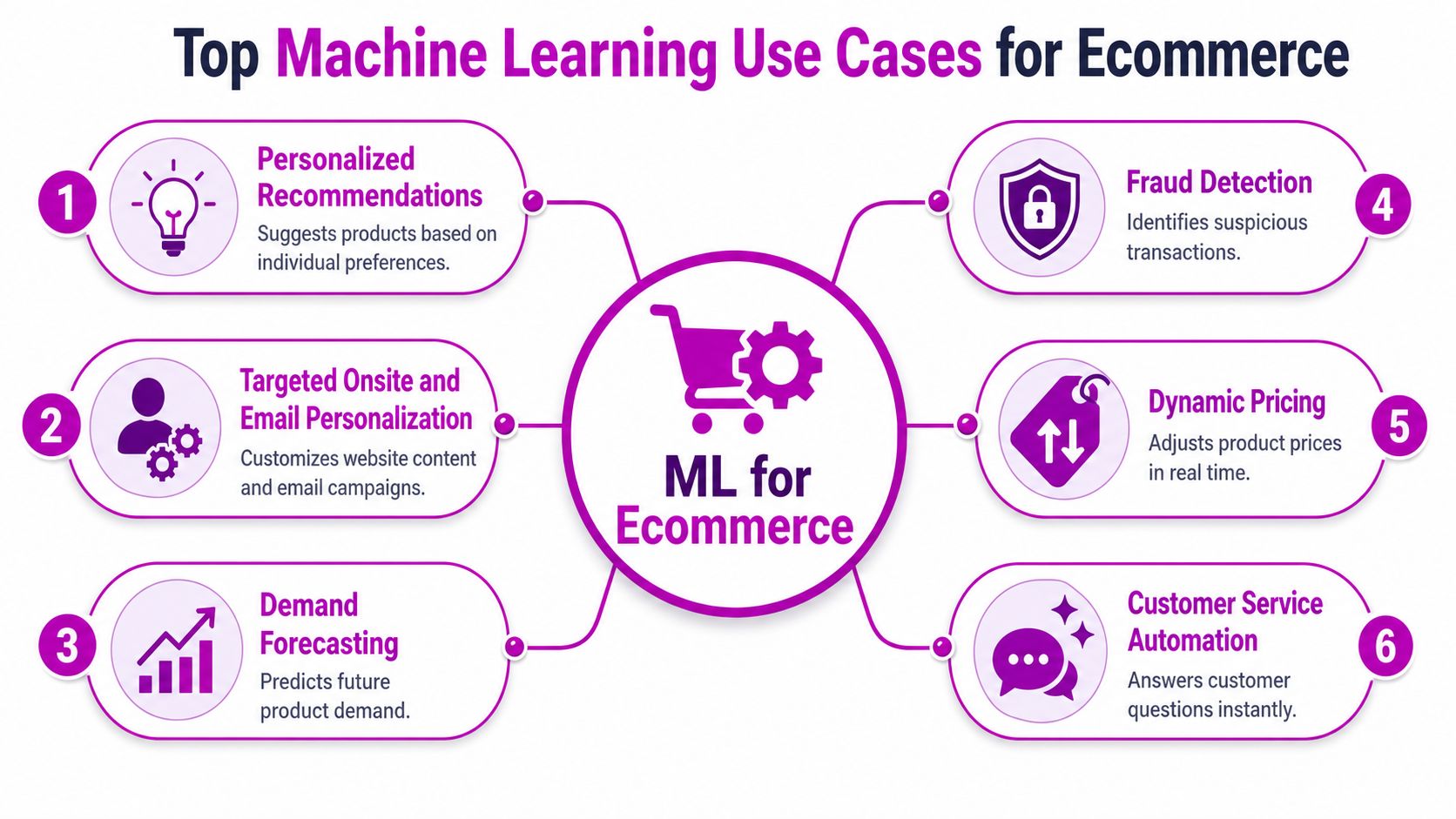
A Shopify store makes hundreds of small decisions every day. Which product should appear next. Which visitor needs a different message. Which order looks risky. Which SKU is likely to run out first. Machine learning is useful because it helps with those repeat decisions at a scale a team cannot manage by hand.

For smaller brands, the important point is practical. You do not need to start with a custom model trained on millions of sessions. Many high-value use cases can begin with Shopify data you already have, such as orders, product tags, cart contents, customer segments, and basic browsing events. The best first project is usually the one that improves one repeated decision with the least setup.
Personalized recommendations
Recommendations are often the clearest place to start because the business case is easy to see. A shopper views a candle. The store can suggest the matching wick trimmer, a refill, or another scent in the same price range. That decision happens over and over, so even a modest improvement matters.
According to SellersCommerce's roundup of AI in ecommerce statistics, product recommendations can increase revenue by up to 300%, while AI-driven personalization can boost it by 40%.
The common mistake is assuming every recommendation block uses machine learning. Many Shopify stores show a hand-picked collection under labels like “You may also like.” That can still be useful, but it is different from a system that learns from co-purchases, browsing paths, product similarity, and repeat buying patterns.
Low-data brands can still start here. A simple version might use bestsellers within a collection, “frequently bought together” based on recent orders, or rules shaped by product type and price band. That is often enough to beat generic featured products.
Targeted onsite and email personalization
Personalization is broader than recommendations. It covers what content a shopper sees, in what order, and at what moment.
A first-time visitor should not get the same experience as a repeat customer who buys every six weeks. A shopper coming from a paid ad may need a simpler path to purchase than someone who already knows the brand well. On Shopify, this can start with audience-based content blocks, Klaviyo flows triggered by behavior, or app-based segmentation rather than a large custom build.
If you want a wider view of where these tools fit across merchandising, support, and retention, this guide to AI applications in ecommerce gives useful examples beyond recommendations alone.
Demand forecasting
Forecasting usually gets less attention than personalization, but it often solves a more expensive problem. If a store keeps running out of a fast seller, overbuying a slow variant, or reacting late to seasonal demand, margin suffers.
Machine learning helps by combining signals that are hard to weigh manually. Past sales matter, but so do promotion timing, product substitutes, repeat purchase cycles, and recent traffic shifts. For a Shopify brand with limited history, forecasting does not have to start at the full catalog level. It can begin with a narrow group of important SKUs, such as top sellers, seasonal products, or replenishment items.
That makes the project smaller and easier to judge.
Fraud detection
Fraud tools are useful once order volume reaches the point where manual review creates delays or inconsistent decisions. The model looks for patterns across checkout behavior, device signals, basket composition, shipping mismatches, prior disputes, and account history.
The goal is not only to catch bad orders. It is also to approve more legitimate ones without making good customers wait. For lean teams on Shopify, this often starts with built-in risk signals or an app that scores orders, then adds human review only for the gray area.
Dynamic pricing
Pricing deserves caution. In some categories, frequent price changes can hurt trust or train shoppers to wait for a better deal. In others, especially where competition moves fast or inventory risk is high, pricing logic can improve margin and sell-through.
A practical starting point is not fully automated price changes across the entire catalog. It is a narrower setup. For example, you might adjust discount depth for aging inventory, protect margin on products with strong demand, or test price sensitivity in one collection before expanding further.
That approach fits the low-data reality better and reduces brand risk.
Search and visual discovery
Search is a decision engine in disguise. Every query asks the store, “What does this shopper mean, and what should we show first?”
Machine learning improves search by handling misspellings, ranking results by likely intent, and connecting related items even when the product title does not match the exact words used. Visual discovery helps in categories like fashion, furniture, and beauty, where shoppers often recognize what they want before they know its name.
For Shopify brands, this use case can be especially practical because the lift often comes from better catalog structure plus smarter ranking. You do not always need huge traffic volume to improve it.
Which use case should come first
Start with the use case that meets three tests. The decision happens often. The outcome affects revenue, margin, or team time. The data needed already exists in a reasonably clean form.
A simple prioritization guide looks like this:
- Start with recommendations if shoppers struggle to discover more of the catalog.
- Start with personalization if repeat traffic is meaningful but the experience is still one-size-fits-all.
- Start with forecasting if stockouts, overstock, or unstable purchasing create regular operational pain.
- Start with fraud detection if manual order review slows fulfillment or blocks too many valid orders.
- Start with pricing if your category has room for price movement and your team can monitor brand impact.
For many Shopify brands, the best first win is not the most advanced use case. It is the one that is easiest to connect to current store data, easiest to test, and easiest to measure within a few weeks.
Assessing Data Requirements and ROI Metrics
A Shopify team decides to add machine learning to the store. The demo looks impressive. Then the actual work starts. Product tags are inconsistent, return reasons live in a spreadsheet, and browse events disappeared after a theme change. The project stalls before any model has a fair chance to help.
That pattern is common because machine learning depends less on buzzwords and more on whether your store records the right signals in a dependable way. For most brands, the first question is simple: what data do we already collect well enough to support one business decision?

What counts as usable ecommerce data
Useful ecommerce data works like store signage. If labels are clear and placed in the right spots, shoppers find what they need. If labels are missing or inconsistent, even a smart system makes bad guesses.
For Shopify brands, four data groups usually matter most:
- Customer data: purchase history, repeat order patterns, location, tags, and lifecycle stage
- Behavior data: product views, collection browsing, cart actions, session depth, and traffic source
- Catalog data: product type, price, vendor, variant structure, inventory status, and attributes
- Order data: average order patterns, discount use, returns, cancellations, and fulfillment outcomes
Quality matters as much as volume. A smaller store with clean product attributes and reliable event tracking is often in better shape than a larger store with broken pixels, messy tags, and duplicate customer records.
The low-data reality many Shopify brands face
This is the part many machine learning guides skip. A large share of Shopify brands do not have enough clean historical data to train a custom model from scratch with confidence.
That does not block adoption. It changes the starting point.
A low-data brand usually gets better results from practical setups such as:
- Pre-trained tools that already learned broad commerce patterns across many stores
- Rules plus ML hybrids where simple business logic covers sparse cases and the model handles the rest
- Lightweight models trained on a narrow task, such as predicting likely bestsellers within one category
- Better instrumentation first so the next 60 to 90 days of store activity create a usable training set
A good mental model is learning to cook from a recipe versus inventing one from scratch. If your team has limited ingredients and limited history, a proven recipe is safer. In ML terms, that often means starting with an app, API, or hybrid workflow instead of a fully custom model.
Diagnostic question: If a merchandiser looked at your inputs for ten minutes, would they trust them enough to make a pricing, recommendation, or inventory decision by hand?
If the answer is no, fix the inputs first.
A simple way to assess data readiness
Teams often overestimate readiness because the data exists somewhere. Availability is not the same as usability.
A quick check helps:
| Data readiness question | Why it matters |
|---|---|
| Are key events tracked consistently across devices and theme changes? | Models need stable behavior signals |
| Are product attributes structured the same way across the catalog? | Search, recommendations, and pricing depend on comparable product data |
| Can orders, customers, and products be joined without manual cleanup? | Disconnected records weaken analysis and slow implementation |
| Is there enough history for the specific use case? | Forecasting and personalization need repeated patterns, not one-off snapshots |
| Can the team explain what “good” looks like before launching? | Clear success criteria prevent vague AI projects |
You do not need perfect data to start. You need data that is reliable enough for one narrow use case.
Choosing ROI metrics by use case
ROI gets blurry when teams ask one ML project to improve every outcome at once. A better approach is to match each use case to one primary business metric, then track a few supporting signals.
| Use case | Strong primary KPI | Secondary signals |
|---|---|---|
| Recommendations | Average order value or conversion rate | Click-through on recommendation units, revenue per session |
| Personalization | Revenue per visitor | Return visits, engagement with tailored modules |
| Forecasting | Inventory accuracy or stock availability | Fewer stockouts, fewer overstocks |
| Fraud detection | Approval quality | Reduced manual review time, fewer false declines |
| Dynamic pricing | Revenue per visitor or margin | Cart completion, price elasticity patterns |
This keeps evaluation grounded. A recommendation model should not be judged by the same standard as a fraud tool. Each one changes a different decision.
Estimating ROI without overcomplicating it
For a first project, simple math beats a complicated forecast.
If a recommendation block raises average order value, estimate the monthly gain from that lift across the traffic that sees the block. If a forecasting model reduces stockouts, estimate the revenue recovered from products that stay available. If fraud automation saves analyst time, count the hours returned to the team plus the reduction in unnecessary order holds.
The practical formula is straightforward: expected gain minus tool cost, setup cost, and team time.
Start with a short test window. Four to eight weeks is often enough to see whether a use case is heading in the right direction, especially for storefront experiences with regular traffic.
Where dynamic pricing ROI is easier to measure
Dynamic pricing is easier to evaluate than some other ML use cases because it changes a visible business variable: price. Researchers in this IEEE paper on reinforcement learning in ecommerce pricing found that reinforcement learning approaches can outperform static rule-based pricing in controlled ecommerce settings.
That does not make dynamic pricing the right first project for every Shopify store. Brands still need pricing flexibility, clear guardrails, and close monitoring of margin and conversion. But from an ROI standpoint, the path is easier to define because the model's effect is tied to a direct commercial input.
Comparing Integration Approaches for Shopify
Once a use case is clear, the next decision is structural. Should you install an app or API-based tool that already includes ML, or should you build a custom system around your own store data?
For most Shopify brands, this isn't a technical purity contest. It's a trade-off between speed, control, cost, and data maturity.
The two main paths
An app-first approach uses an existing Shopify-compatible tool. That could mean a recommendation app, a search platform, a pricing engine, or a fraud tool with machine learning already built in. You configure it, connect your catalog and store events, and use the vendor's existing model.
A custom approach usually means exporting data from Shopify, cleaning it, training a model for a specific business problem, then pushing output back into the storefront, email stack, or internal systems. This path gives more flexibility, but it also creates more technical responsibility.
Comparison of Integration Approaches
| Approach | Pros | Cons | Ideal For |
|---|---|---|---|
| Shopify app or pre-trained API | Faster deployment, lower technical overhead, easier for low-data brands, vendor handles much of the model maintenance | Less control, possible feature limits, potential vendor lock-in | Emerging brands, lean teams, stores testing first ML use cases |
| Custom model built around Shopify data | More flexibility, tighter fit to business logic, better for unique catalog or operational needs | Longer setup, higher complexity, ongoing maintenance burden, stronger data requirements | Larger brands, mature data teams, stores with very specific use cases |
Where model choice enters the picture
If you do move toward a more custom recommendation setup, algorithm choice matters. Research summarized in the Semantic Scholar PDF on predictive analytics in ecommerce notes that Support Vector Machines and K-Nearest Neighbors outperform logistic regression and Naïve Bayes in recommendation precision, and can boost AOV by 12–18% when integrated into Shopify recommendation pipelines.
That sounds highly technical, but the store-level lesson is simple. Different models are better at different pattern types. You don't need to memorize the math. You do need to know that “AI recommendations” isn't one uniform capability.
A practical selection lens
If you're an emerging brand, an app-first setup is usually the safer move. It lets you test whether the use case itself works before you invest in heavier infrastructure.
If you're a larger Shopify Plus merchant with a strong data layer, a custom build may be worth it when your catalog logic, merchandising rules, or customer behavior are too specific for an off-the-shelf tool.
A third middle path also exists. Some teams use vendor tools for quick wins, then replace only the highest-value layer with a custom model later.
Implementation Roadmap and Governance
The best machine learning projects don't start with a giant rollout. They start with one narrow business problem, one measurable outcome, and one owner.
If you try to personalize the entire storefront, rebuild search, automate pricing, and forecast inventory all at once, your team will spend more time managing complexity than learning what works.
Phase one with a tightly defined pilot
A good first pilot should be specific enough to win or fail clearly. “Use ML to improve customer experience” is too vague. “Improve product recommendations on PDP and cart pages” is much better. So is “score suspicious orders for manual review.”
Use this checklist before launch:
- Pick one decision point: recommendation block, fraud review, forecast output, or pricing rule.
- Define the KPI clearly: choose one primary measure and a few support metrics.
- Set a control method: compare against current rules or historical baseline.
- Assign ownership: one person should own results, not just setup.
- Create a rollback plan: if output quality drops, your team needs a safe fallback.
Data preparation and operational setup
Most of the work happens before the model goes live. Your team needs to clean product data, standardize attributes, confirm event tracking, and decide how predictions will flow back into Shopify or connected tools.
For example, a recommendation project often depends on:
- Stable product metadata: categories, tags, collections, and variant relationships need structure.
- Reliable event tracking: product views, adds to cart, purchases, and returns should be recorded consistently.
- Channel mapping: know whether output will appear on-site, in Klaviyo flows, in support tools, or inside merchandising dashboards.
This is also the phase where many teams discover hidden store issues. Duplicate products, broken tags, inconsistent naming, and weak analytics setups become impossible to ignore when a model tries to learn from them.
Governance matters more than most teams expect
Machine learning isn't a “set it and forget it” layer. Customer behavior changes. Product assortments change. Promotions distort patterns. A recommendation model trained on one season can become less useful when catalog mix and traffic sources shift.
That's why governance should include:
- Scheduled reviews: check output quality regularly rather than waiting for a sales dip.
- Model drift monitoring: look for declining relevance, unusual recommendations, or unstable predictions.
- Human override rules: merchandisers should still be able to suppress bad pairings or protect strategic products.
- Access controls: only the right teams should edit model-related settings or data pipelines.
A healthy ML setup gives your team leverage, not less control.
Privacy and compliance in day-to-day practice
Customer data sits at the center of machine learning for ecommerce, so governance has to include privacy from the start. Teams need to know what data they collect, where consent applies, how long data is retained, and which vendors can access it.
In practical terms, that means documenting the data flow between Shopify and connected applications, reviewing customer-identifiable fields carefully, and making sure legal and operational owners agree on usage boundaries. Even if a tool is easy to install, that doesn't remove the need for internal accountability.
What scaling should look like
A strong rollout usually follows a calm pattern. First, solve one use case. Then validate the KPI movement. Then document the workflow, edge cases, and maintenance needs. After that, expand to the next adjacent area.
For example, a store might start with recommendation blocks, then extend learning into email personalization, and only later consider custom forecasting or pricing logic. Scaling works better when each layer builds on a cleaner data foundation than the one before it.
Vendor versus In-House Decision Framework
A Shopify team with 6,000 monthly orders usually does not need a custom machine learning stack. It needs a system that can make decent decisions with limited store history, fit the current team, and plug into Shopify without creating a maintenance project.
That is the choice.
The clearest way to decide is to look at two things together. First, how much usable data you have. Second, who will own the model after launch. A model in production works like a garden, not a one-time home improvement job. Someone has to maintain it, remove bad inputs, and check that it still produces sensible outputs as the catalog, traffic mix, and promotions change.
Start with maturity, not ambition
Use a simple matrix.
If your store has limited transaction history and no internal ML owner, start with pre-trained tools or vendor systems that already learned from patterns across many stores. If your data is improving but your technical bench is still thin, a configurable vendor platform usually gives you the best balance of speed and control. If you have strong data discipline, clear ownership, and a use case generic tools cannot handle well, an in-house build starts to make sense.
A practical shorthand:
- Low data, low internal expertise: start with pre-trained tools
- Growing data, lean team: choose a vendor with strong configuration and reporting
- Strong data, strong technical ownership: examine selective in-house builds
- Complex catalog logic or multi-store rules: add custom layers where packaged tools fall short
The low-data question decides more than brands expect
Earlier in the article, we noted that smaller brands often struggle when they try to train models only on their own store history. That matters here because many Shopify brands assume the vendor versus in-house question is mainly about budget. In practice, it is often about whether your store has enough signal for a custom model to perform reliably.
A small store can still use machine learning well. It just needs the right type of machine learning.
For example, a fashion brand with modest order volume may still have strong browse activity, add-to-cart events, product attributes, and merchandising rules. A vendor that can combine those signals with pre-trained models may outperform an internal project built only on orders. That is why low-data strategy deserves more attention than it usually gets in ecommerce guides.
Ask vendors direct questions:
- How do you handle sparse purchase history?
- Which signals do you use beyond completed orders?
- Can the system learn from browse and cart behavior inside Shopify?
- How much manual merchandising control does our team keep?
- How does performance hold up when products change quickly or seasonal items rotate in and out?
If your team also needs help choosing the right technical path around apps, middleware, and custom data flows, these Shopify integration services can help clarify what should stay packaged and what should be custom.
When in-house is worth it
Build in-house when the advantage comes from logic a vendor cannot model well. That might include unusual bundling rules, proprietary inventory constraints, highly specific margin logic, or cross-brand decisioning that depends on internal systems outside the normal Shopify app stack.
Even then, the hidden work matters. You are not only building a model. You are also taking responsibility for data preparation, monitoring, retraining, QA, failure handling, and internal documentation. If nobody owns those tasks, the model becomes shelfware fast.
When a vendor is the better call
Choose a vendor when the goal is to improve a decision quickly and reliably without creating a new technical function inside the business. For many Shopify brands, that is the better path for longer than expected.
A useful rule is simple. If the business value comes mostly from applying known ML patterns well, buy. If the business value comes from unique logic that reflects how your store operates, build. Many brands end up in the middle, where a vendor handles the model and the internal team controls inputs, rules, and exceptions. That hybrid path is often the smartest choice, especially when data is still growing.
Conclusion and Next Steps
Machine learning for ecommerce works best when it solves a real store problem, not when it gets treated like a trend project. For Shopify brands, the strongest starting points are usually the repeated decisions that already create friction: what to recommend, how to personalize, what to reorder, which orders to review, or when pricing rules should adapt.
The biggest mistake is overreaching early. A focused pilot gives you cleaner learning, lower risk, and a much better chance of proving value. If your data is still limited, that doesn't block adoption. It changes the approach. Pre-trained tools, transfer learning, and app-based integrations often make more sense than custom builds at that stage.
Start with three actions:
- Audit your data: check product structure, behavior tracking, and order history quality.
- Pick one use case: choose the most painful repeated decision in the store.
- Set one primary KPI: define success before you install anything.
A careful rollout beats an ambitious mess every time.
If you want a practical path for adopting ML on Shopify, ECORN can help you scope a focused pilot, align the integration with your existing stack, and connect machine learning use cases to CRO, personalization, and store operations without forcing an oversized build.



Shopify Theme Updater App: A Safe Update Playbook

Shopify Git Integration: A Developer's Guide to 2026
Headless Ecommerce Development Services Explained

How to Build a Shopify Clothing Website That Converts

How to Launch a Box Subscription Business in 2026

Luxury Skincare Branding Playbook That Converters

10 Best Podcast Ecommerce Shows for Store Growth in 2026
Shopify Developer Hourly Rate: What to Pay in 2026
Critical Shopify Setup Errors That Are Secretly Sabotaging Your Store
Ecommerce Conversion Tracking: The Complete How-To Guide

Shopify Design Agency: How to Pick the Right Partner
Mastering Multi Store Management on Shopify
Scale Shopify Store
10 Shopify App Ideas Worth Building in 2026
Conversion Rate Optimization for Landing Pages: The Playbook
Shopify Plus Automation: A Guide for 2026
10 Social Selling Platforms for Shopify Merchants

Shopify Website Design Examples: 7 Stores Worth Studying
7 Ecommerce Newsletter Examples for Shopify Brands
One Product Shopify Store: Build and Scale

Mobile Pop Up Strategy for Shopify Stores That Converts

Sitemap for Shopify: How to Find, Optimize, and Submit It

7 Single Product Websites Worth Emulating
Product Variants Shopify: The Complete 2026 Guide
Ecommerce Analytics Consulting for Growth
What Is AI Integration for eCommerce

How to Choose the Right eCommerce Website Development Firm
E Business Strategy Implementation
Conversion Tracking Setup for Shopify Stores
BigCommerce vs Shopify Plus Which Enterprise Wins in 2026
Shopify Theme Kit: Setup, Commands, and Migration Guide

Shopify Extension Development: A Practical 2026 Guide
Shopify Speed Score Explained and How to Improve It
Shopify Mobile Optimization: The 2026 Playbook

How to Add Subcategory in Shopify for Better UX
How to Implement Structured Data for Ecommerce in 2026

SEO App Mobile: Shopify Store Optimization Guide

Shopify Plus Support: What It Includes and How to Choose

Google Ads for Shopify: The Complete 2026 Playbook

Shopify New York: How to Find and Hire the Right Agency

Google Search Console for Shopify: The Complete Setup
First Party Data Collection for eCommerce Growth
FAQ Online Store Guide: Build and Measure It Right
Do FB Ads Work for eCommerce in 2026?

One Page Checkout for Shopify: Design and Implementation
Shopify GraphQL vs REST: The 2026 Developer Decision
Shopify Ecommerce Consulting: Strategy, Pricing &

Are Reddit Ads Worth It for eCommerce Brands

Shopify Title and Meta Description: A Practical 2026 Guide

Product Video Best Practices for Shopify Brands
Real-Time Inventory Management: A 2026 Guide
AI Chatbot Integration for Shopify Stores
Affiliate Program Management: A Shopify Guide
10 Best Performance Monitoring Tools for Shopify in 2026

Digital Asset Management for eCommerce Brands in 2026
Every Type of Facebook Ads Explained for eCommerce Growth
Product Information Management Explained for Shopify Brands
Support Ticket System: A Guide for Shopify Stores

10 Best Customer Service Tools for Shopify in 2026

Can I Start a Business with No Money? a 2026 Blueprint

What Sells Good on Etsy: Best Niches for 2026

Shopify Add to Cart Button: A Practical 2026 Guide

Customer Feedback Automation: A Practical eCommerce Guide

Critical Rendering Path: A Guide for Shopify Stores

How to Promote on TikTok for eCommerce in 2026

B2B eCommerce Consulting That Drives Real Revenue
10 Best Practices for Site Navigation in 2026
Return vs Refund for Shopify Stores: A Practical Guide
What Is Customer Lifetime Value and Why It Matters
What Is Voice of Customer Research for eCommerce

SMS Marketing for Ecommerce That Actually Converts

Master How to Improve Email Deliverability in 2026

Top 8 eCommerce Partners NYC for Shopify Brands in 2026

Beauty Market Research: Your 2026 Growth Guide

Shopify International Expansion: A 2026 Roadmap

What Does CRO Stand for in Business: Understanding CRO

Shopify Visual Merchandising: A Playbook for Higher Sales

Shopify Landing Page Design: Master Conversion in 2026
10 Best AI SEO Optimization Tools for Shopify in 2026

Agentic AI for Ecommerce: Boost Your Sales in 2026
Mastering Email Marketing Data for eCommerce Growth

Conversion Rate Optimisation Australia: Boost Your Sales
Conversion Rate Optimization AI: Your Shopify Store Guide

10 Product Bundling Strategies for Shopify in 2026
How to Increase Customer Lifetime Value: A Shopify Playbook
AI Customer Service Automation: Shopify Guide 2026

Clean Website Design: A Shopify Conversion Playbook

Omnichannel Retail Strategy: A Shopify Playbook

Product Data Enrichment: A Guide for Shopify Brands

Instagram Shopping Features a Guide for Shopify Stores
What Is Revenue Optimization: A Holistic RevOps Guide

Benefits of Conversion Rate Optimization: Boost Your
WordPress to Shopify Migration: Your 2026 Seamless Switch
Boost Sales: Ecommerce Payment Processing Guide 2026
Unified Commerce Platform: Benefits, KPIs & Shopify Guide

How to Reduce Bounce Rate eCommerce: Your 2026 Guide
Shopify API Integration: A Practical End-to-End Guide

How to Implement Data Governance: A 2026 Guide
Shopify Store Development Cost: A 2026 Breakdown
What Is Server Side Tracking: The Shopify Guide 2026


newsletter in your inbox