

You're in Shopify analytics, Meta Ads Manager, Klaviyo, and GA4 at the same time. Sales look decent. Branded search looks heroic. Retargeting looks efficient. Paid social looks expensive. Then someone asks the question that decides next month's budget: which channel drove the sale?
That's where organizations often get stuck. Each platform claims credit. Finance wants cleaner answers. Marketing wants to protect upper-funnel spend. Founders want confidence that paid media isn't just harvesting demand the brand would have captured anyway.
Attribution sits in the middle of that tension. Done well, it helps you decide where to push harder, where to cut, and which channels are assisting sales even when they don't get the final click. Done badly, it gives false certainty and makes you scale the wrong campaigns.
For Shopify brands in 2026, the hard part isn't learning model names. It's measuring performance when privacy changes reduce user-level visibility, customer journeys span multiple devices, and platform reporting tells only part of the story.
What Is Marketing Attribution Really
Marketing attribution is the data-driven practice of assigning credit for conversions or revenue to specific marketing touchpoints, such as ad clicks, email opens, or site visits, so you can understand what contributed to a sale, as described in Adobe's explanation of marketing attribution.
For a Shopify brand, that usually means one customer doesn't buy in a straight line. They might click a paid social ad, browse a few products, leave, join your email list later, and finally come back through branded search to purchase. Attribution tries to answer a simple operational question: how much credit should each of those touches get?
Think of attribution like assists, not just the final shot
If you only credit the last click, you're treating marketing like basketball where only the player who scored matters. That ignores the pass that created the open shot. It ignores the play that got the team into position. Marketing works the same way.
A branded search click may close the order. But the reason someone searched your brand in the first place might be TikTok, an influencer mention, an email flow, or a product page they visited three times over two weeks.
Different models assign that credit differently. Some give all credit to the first interaction. Others give it all to the last. More advanced approaches spread credit across the journey.
Attribution is less about finding one perfect answer and more about stopping obviously bad budgeting decisions.
What this means for a Shopify manager
If you've ever looked at paid social and thought, “This isn't converting, let's cut it,” attribution is the tool that helps you check whether that conclusion is wrong. It helps connect spend to conversion rate, ROI, and customer acquisition cost in a way that's more realistic than single-platform reporting.
This matters even more when you sell across channels. A customer might discover a product on TikTok Shop, browse your store later, and convert through email or search. If that's part of your mix, this HiveHQ on attribution for TikTok Shop is useful because it shows how channel-specific attribution questions get messy fast once commerce happens across platforms.
What is marketing attribution? It's your method for deciding which marketing touches deserve credit, so your budget reflects how people buy.
Why Attribution Is Your Most Powerful Budgeting Tool
A lot of teams treat attribution like reporting hygiene. It's not. It's a budgeting system.
When attribution is weak, brands usually overfund channels that capture existing intent and underfund channels that create it. That's how you end up protecting branded search while starving prospecting creative, content, and lifecycle campaigns that made branded search possible.

Better attribution changes what you cut and what you scale
Attribution software isn't niche anymore. The global marketing attribution software market is estimated at approximately $4.74 billion in 2024, and companies using advanced multi-touch attribution models report around 20% higher ROI than those using basic approaches, according to Summit Partners' analysis of attribution trends.
That's the practical reason to care. Better attribution doesn't just make dashboards prettier. It changes where money goes.
Consider how this affects the core numbers a Shopify brand watches:
- ROAS decisions: A channel can look weak in-platform while still influencing conversions that close somewhere else.
- CAC control: If you over-credit lower-funnel channels, your CAC by source looks cleaner than reality.
- Channel mix: Prospecting, retention, and search stop competing in separate silos when you can see how they work together.
- Creative strategy: If certain campaigns consistently start journeys but rarely finish them, you judge them differently.
What attribution prevents
The biggest budgeting mistake I see is simple. Teams pause what starts demand because they're staring at what captures demand.
For a practical understanding:
Budget questionWhat weak attribution doesWhat stronger attribution helps you seeShould we cut paid social?Judges it on last-click efficiency aloneShows whether it introduces new customersShould we raise branded search spend?Rewards it for closing demandChecks whether it's harvesting existing demandShould we invest in email?Counts only direct email conversionsReveals its role in moving hesitant shoppers backShould we back content or creators?Treats them as “awareness only”Connects them to later assisted revenue
If you want a finance-friendly lens on efficiency, this breakdown of marketing efficiency ratio is helpful because attribution becomes much more useful when it feeds a broader efficiency framework instead of living in a reporting vacuum.
Practical rule: If your attribution model consistently tells you that only the last touch matters, it's probably describing your reporting setup, not your customer behavior.
A Practical Guide to Marketing Attribution Models
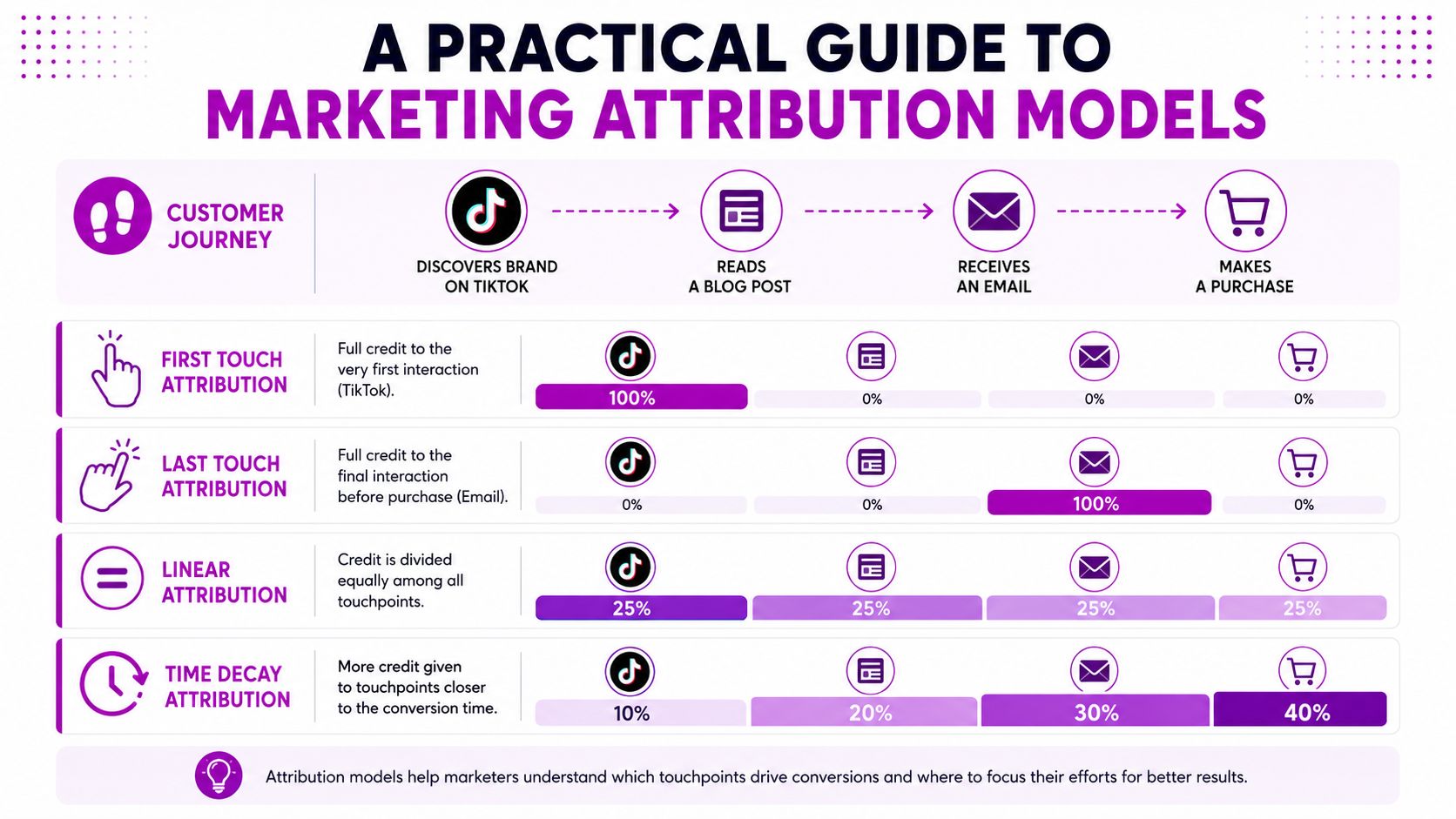
Most explanations make attribution models sound abstract. They're easier to judge when you run all of them against the same journey.
Use this simple Shopify path:
- A shopper discovers your brand through a TikTok ad.
- Two days later they click a Meta retargeting ad.
- They sign up to your email list for a welcome offer.
- A few days later they search your brand on Google, click a paid search ad, and buy.
That's a very normal eCommerce path. Discovery, reminder, nurture, capture.
The single-touch models
First-click attribution gives all credit to TikTok.
The logic is simple. Without TikTok, the customer never entered the funnel.
This model is useful when you want to understand what introduces new buyers to the brand. It's weak when you need to know what moved someone from interest to purchase.
Last-click attribution gives all credit to Google paid search.
This is why branded search and retargeting often look amazing. They tend to sit near the finish line.
Last-click is simple and fast. It's also biased toward bottom-funnel channels.
The shared-credit models
Linear attribution splits credit evenly across TikTok, Meta retargeting, email, and Google Ads.
Its strength is fairness. Its weakness is that it assumes every touch mattered equally, which usually isn't true.
Time-decay attribution gives more credit to the touches closest to conversion.
In this example, Google Ads and email get more weight than TikTok because they happened later. This can make sense for shorter consideration cycles, but it can still under-credit awareness.
Position-based attribution usually favors the first and last interactions, with less credit assigned to the middle touches.
That means TikTok and Google Ads get the largest share, while Meta retargeting and email receive smaller portions. This works when you believe introduction and close matter most.
Here's a quick comparison:
ModelWho gets most creditBest useMain biasFirst-clickTikTokFinding demand creatorsOvervalues discoveryLast-clickGoogle AdsMeasuring closersOvervalues final captureLinearEveryone equallySeeing full-path participationAssumes equal impactTime-decayLater touchesShorter buying cyclesUndervalues early influencePosition-basedFirst and lastBalanced funnel viewUses fixed logic, not observed behavior
A lot of founders understand these models faster when they see them outside eCommerce. This guide to SaaS referral attribution is worth a look because it shows how last-touch logic can distort decision-making in a different business model too.
Here's a visual walkthrough if you want the mechanics in another format:
Where data-driven attribution fits
Google Analytics supports models such as data-driven attribution, paid and organic last click, and Google paid channels last click, as explained in Adobe's overview of attribution concepts earlier. Data-driven attribution tries to move beyond fixed rules by using observed conversion paths to assign credit.
In practice, this is usually the best direction for a growing Shopify brand, but only if your tracking quality is decent. If your UTMs are messy, your server-side setup is weak, and half your channels sit in separate dashboards, a “smarter” model won't save you. It will just process bad inputs more elegantly.
Which model should a Shopify brand use
Use model choice to answer a question, not to find a universal truth.
- Use first-click when you want to know what creates new demand.
- Use last-click when you want a strict view of what closes.
- Use linear or position-based when you need a more balanced channel conversation.
- Use data-driven when your data quality is mature enough to support it.
The wrong move isn't choosing an imperfect model. It's using one model for every budget decision and pretending it tells the whole story.
Common Attribution Pitfalls and How to Avoid Them
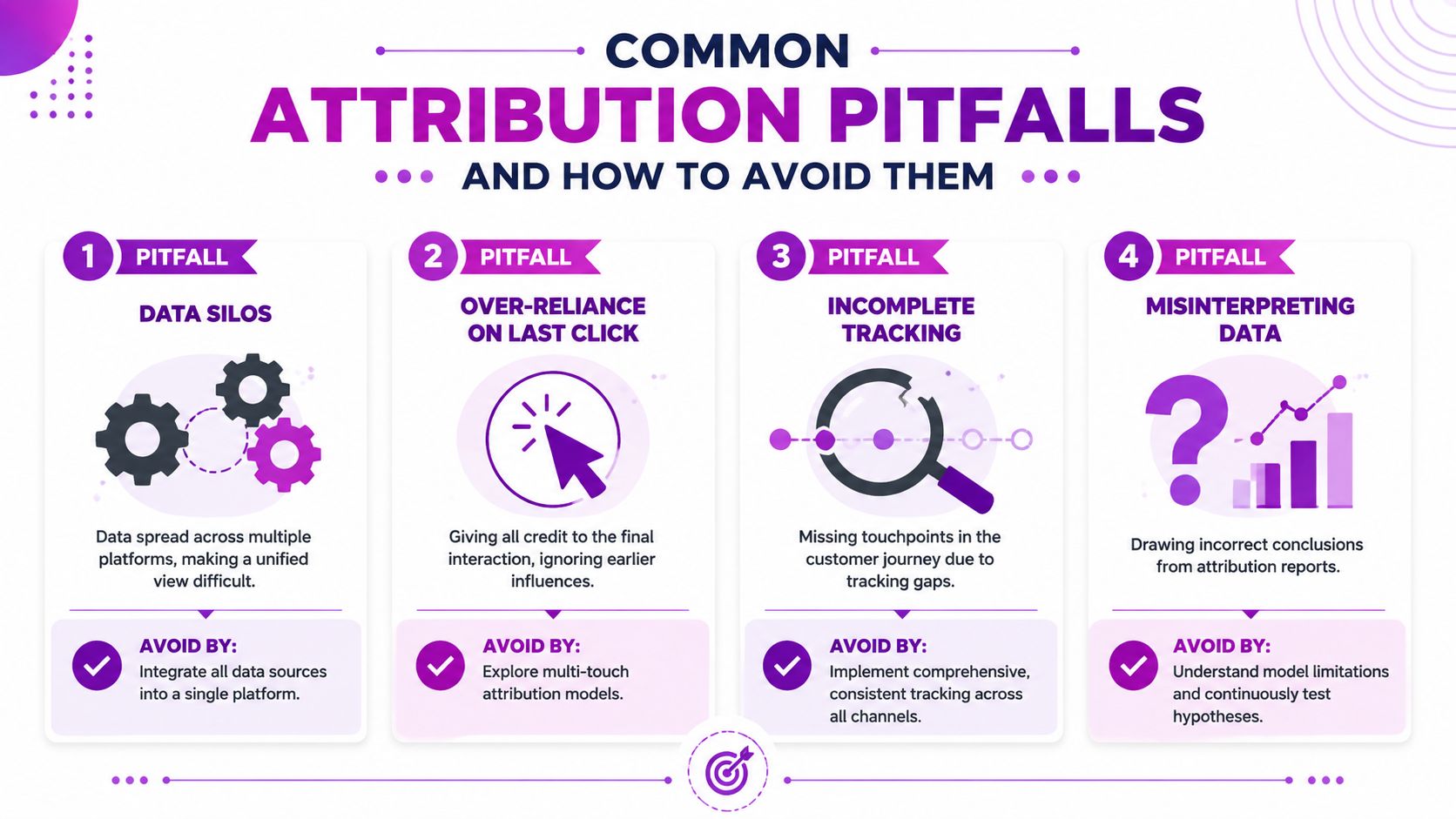
Most attribution problems don't come from model selection. They come from believing the report too quickly.
A channel can receive credit without causing the sale. That's the trap. Attribution often measures participation in a conversion path. It does not automatically prove incremental impact.
Credit is not the same as lift
One of the most important distinctions in modern measurement is whether you're measuring sales attribution or incrementality. A channel can show up on the path and still not be the reason the order happened. That's why mature teams often over-credit retargeting and branded search if they rely on attribution alone, as noted in Triple Whale's discussion of attribution versus incrementality.
Here's the plain-English version:
- Attribution asks: which touchpoints were involved?
- Incrementality asks: would this conversion have happened without that channel?
Those are not the same question.
Retargeting is the classic example. If a shopper was already coming back to buy, your retargeting ad may get credit for being nearby, even if it didn't change the outcome.
Privacy changes make the data messier
Shopify brands in 2026 have to work in a lower-signal environment. Third-party cookies are less reliable. Mobile identifiers are more limited. Platform-reported paths are incomplete.
That creates three common problems:
- Missing touchpoints: You don't see the full path, so the model overweights what remains visible.
- Cross-device breaks: A shopper sees your ad on mobile and buys later on desktop, but those interactions may not stitch together cleanly.
- Platform self-interest: Ad platforms report performance from their own vantage point, not from your whole business.
Recent industry guidance has moved toward first-party data, server-side tracking, and hybrid approaches that combine attribution with modeled measurement because deterministic user-path tracking has become harder in major markets. That's the operating environment now.
How to avoid the expensive mistakes
You don't fix attribution with one tool. You improve it by reducing obvious failure points.
- Stop using one dashboard as truth
Meta, Google, Shopify, and GA4 all answer slightly different questions. Reconcile them instead of expecting perfect agreement. - Treat branded search carefully
It often closes demand efficiently. It also frequently harvests demand created elsewhere. - Separate reporting from experimentation
Attribution reports show patterns. Lift tests tell you whether those patterns reflect causation. - Expect blind spots
If a customer journey includes creator content, word of mouth, or mobile-to-desktop behavior, some influence will be hard to track cleanly.
When your attribution says a channel is profitable, the next question should be: did this channel create demand, assist demand, or simply intercept it?
The teams that get attribution right aren't the ones with perfect tracking. They're the ones that understand where their measurement breaks and make budget calls with that uncertainty in mind.
How to Implement Attribution Tracking on Shopify
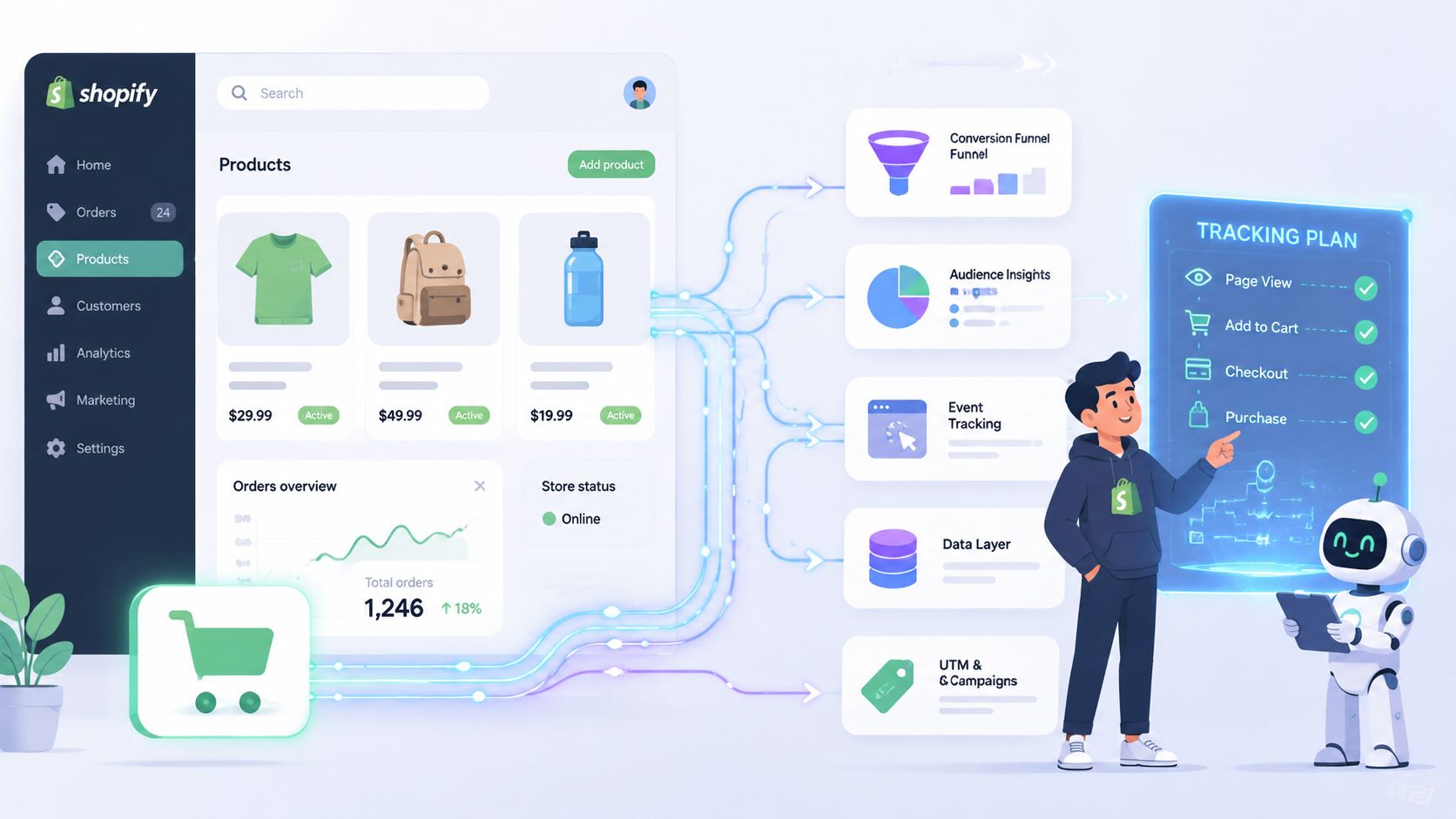
Attribution on Shopify works best when you treat it as a stack, not a single report. You need consistent campaign inputs, a clean analytics layer, and a way to preserve as much first-party signal as possible.
Start with the basics you can control
The first piece is disciplined UTM tagging. If campaign names are inconsistent, source and medium values drift, or creators and affiliates send traffic without proper parameters, attribution becomes muddy before the visitor even lands.
The second piece is GA4. It gives you a shared analytics environment that's more useful than relying on ad platform dashboards alone, especially once you configure conversions, channel grouping, and attribution views correctly. If your setup still feels shaky, this guide to GA4 migration and the Google Analytics update is a practical place to clean up the foundation.
Build a stack that survives signal loss
For mobile and cross-device environments, attribution serves as a matching and identity-resolution layer. Its value rises when you centralize data from as many channels as possible, because fragmented tracking hides the actual sequence of touchpoints and weakens budget decisions, as explained in Adjust's glossary entry on attribution.
That matters because Shopify shoppers don't behave in a single session. They bounce from Instagram to Safari, from email to desktop, from app to web.
A practical Shopify stack usually includes:
- GA4 for cross-channel analysis
Good for event tracking, conversion paths, and comparative attribution views. - Server-side tracking
Useful for preserving more first-party signal when browser-side tracking is blocked or degraded. - Platform pixels and conversion APIs
Meta, Google, TikTok, and others still need event feeds for optimization, even if they're not your sole source of truth. - CRM or lifecycle platform data
Klaviyo, Shopify customer records, and post-purchase behavior help connect acquisition quality to retention outcomes. - Attribution platform or MMP when needed
If you have meaningful app traffic or complex cross-device journeys, you may need a more dedicated identity and attribution layer. NestAds is one option built specifically for Shopify brands running paid social across Meta, TikTok, and Google.
What good implementation looks like
A strong setup doesn't try to measure everything with perfect precision. It creates reliable patterns you can use.
Use this checklist:
LayerWhat to set upWhy it mattersCampaign taggingConsistent UTMsClean source and campaign reportingSite analyticsGA4 events and conversionsShared behavioral viewSignal preservationServer-side trackingBetter resilience under privacy constraintsChannel optimizationPixel plus conversion API feedsKeeps ad platforms learningIdentity and stitchingCustomer data across toolsBetter journey reconstruction
The key implementation mindset is simple. Centralize what you can. Standardize what you name. Don't rely on any single platform to tell you the full story.
Key Metrics and Governance for Your Attribution Strategy
Attribution becomes useful when it changes recurring decisions. If it only lives in a slide deck, it won't improve spend quality.
Metrics worth watching regularly
For Shopify brands, the most practical view combines channel performance with customer quality. I'd keep the scorecard focused on:
- Blended ROAS so you don't optimize channels in isolation.
- New versus returning customer revenue by channel because acquisition channels and retention channels play different roles.
- First-touch versus last-touch CAC to spot channels that create demand versus channels that close it.
- Attributed revenue by campaign theme or creative angle so your team learns what message starts profitable journeys.
- Assisted conversions for channels like content, email, creators, and upper-funnel paid social.
Create one operating version of the truth
Your source of truth won't be perfect. That's fine. It needs to be consistent.
Teams often struggle because every stakeholder brings a different dashboard to the meeting. The paid media lead trusts platform numbers. CRM trusts lifecycle revenue. Finance trusts Shopify sales. The solution isn't perfect agreement. It's agreeing which system leads which decision.
A simple governance rhythm works better than a complex framework:
- Review attribution weekly for campaign moves.
- Review channel mix monthly for budget changes.
- Review incrementality questions separately from reporting.
- Document naming rules, conversion definitions, and exception handling.
If you want a good model for making search data more decision-ready, these Surnex's SEM reporting strategies are useful because they push reporting toward action instead of just output.
Good attribution governance means the team knows which numbers are directional, which are decision-grade, and which need testing before budget moves.
Your Next Steps in Mastering Attribution
The best way to improve attribution is to stop chasing a perfect system and build maturity in stages.
Crawl
Clean up UTMs. Audit your Shopify and GA4 conversion events. Compare first-touch and last-touch views so your team can see where single-touch logic is misleading you.
Walk
Add server-side tracking. Tighten campaign taxonomy across paid social, search, email, affiliates, and creators. Start using more than one attribution model for budget reviews. If branded search and retargeting dominate every conversation, challenge that with path analysis.
Run
Layer in more advanced attribution tooling when your store has enough complexity to justify it. Then pair attribution with incrementality testing for your biggest budget lines. That's where you get closer to business truth, especially in a privacy-constrained environment.
What is marketing attribution, in the end? It's not a fancy label for channel reporting. It's the operating system for deciding which marketing investments deserve more money, which ones only look efficient, and where your measurement is too weak to trust blindly.
Brands that treat attribution as a live decision process tend to make calmer, sharper calls. They don't panic when platform numbers conflict. They don't assume the last click caused the sale. And they don't let weak measurement dictate strong opinions.
If your Shopify team needs help cleaning up measurement, improving GA4, implementing server-side tracking, or turning attribution into smarter budget decisions, ECORN can help build the eCommerce setup and operating rhythm that makes your data more useful.


Ecommerce Loyalty Program Software How to Choose and Launch
Shopify Plans Comparison for Every Business Stage

How to Improve User Experience for eCommerce Growth
Shopify Checkout Optimization That Converts More
Shopify Inventory Sync: A Practical Setup Guide
Shopify App Integration Playbook That Scales
Shopify CMS Integration: Your 2026 Guide to Options

Shopify Store Audit: Find Hidden Conversion Leaks

Shopify Plus Experts: How to Hire the Right Team

Chargeback Protection Shopify: A Practical 2026 Guide
8 Examples of Conversion Rate Optimization
How to Conversion Rate Optimization for Shopify Stores

Shopify Design Essentials Every Store Owner Needs
Ecommerce Terms of Service: How to Draft and Implement
How to Implement Structured Data for Ecommerce in 2026

SEO App Mobile: Shopify Store Optimization Guide

Shopify Plus Support: What It Includes and How to Choose
Google Ads for Shopify: The Complete 2026 Playbook

Shopify New York: How to Find and Hire the Right Agency
Google Search Console for Shopify: The Complete Setup
First Party Data Collection for eCommerce Growth
FAQ Online Store Guide: Build and Measure It Right
Do FB Ads Work for eCommerce in 2026?

One Page Checkout for Shopify: Design and Implementation
Shopify GraphQL vs REST: The 2026 Developer Decision
Shopify Ecommerce Consulting: Strategy, Pricing &

Are Reddit Ads Worth It for eCommerce Brands

Shopify Title and Meta Description: A Practical 2026 Guide

Product Video Best Practices for Shopify Brands

Real-Time Inventory Management: A 2026 Guide
AI Chatbot Integration for Shopify Stores

Affiliate Program Management: A Shopify Guide
10 Best Performance Monitoring Tools for Shopify in 2026
Digital Asset Management for eCommerce Brands in 2026
Every Type of Facebook Ads Explained for eCommerce Growth
Product Information Management Explained for Shopify Brands
Support Ticket System: A Guide for Shopify Stores

10 Best Customer Service Tools for Shopify in 2026

Can I Start a Business with No Money? a 2026 Blueprint

What Sells Good on Etsy: Best Niches for 2026

Shopify Add to Cart Button: A Practical 2026 Guide

Customer Feedback Automation: A Practical eCommerce Guide
Critical Rendering Path: A Guide for Shopify Stores

How to Promote on TikTok for eCommerce in 2026

B2B eCommerce Consulting That Drives Real Revenue
10 Best Practices for Site Navigation in 2026
Return vs Refund for Shopify Stores: A Practical Guide

What Is Customer Lifetime Value and Why It Matters
What Is Voice of Customer Research for eCommerce

SMS Marketing for Ecommerce That Actually Converts

Master How to Improve Email Deliverability in 2026

Top 7 eCommerce Partners NYC for Shopify Brands in 2026

Machine Learning for Ecommerce: Boost Your Shopify Store

Beauty Market Research: Your 2026 Growth Guide

Shopify International Expansion: A 2026 Roadmap

What Does CRO Stand for in Business: Understanding CRO

Shopify Visual Merchandising: A Playbook for Higher Sales

Shopify Landing Page Design: Master Conversion in 2026
10 Best AI SEO Optimization Tools for Shopify in 2026

Agentic AI for Ecommerce: Boost Your Sales in 2026
Mastering Email Marketing Data for eCommerce Growth

Conversion Rate Optimisation Australia: Boost Your Sales
Conversion Rate Optimization AI: Your Shopify Store Guide

10 Product Bundling Strategies for Shopify in 2026
How to Increase Customer Lifetime Value: A Shopify Playbook
AI Customer Service Automation: Shopify Guide 2026

Clean Website Design: A Shopify Conversion Playbook

Omnichannel Retail Strategy: A Shopify Playbook

Product Data Enrichment: A Guide for Shopify Brands

Instagram Shopping Features a Guide for Shopify Stores
What Is Revenue Optimization: A Holistic RevOps Guide

Benefits of Conversion Rate Optimization: Boost Your
WordPress to Shopify Migration: Your 2026 Seamless Switch
Boost Sales: Ecommerce Payment Processing Guide 2026
Unified Commerce Platform: Benefits, KPIs & Shopify Guide

How to Reduce Bounce Rate eCommerce: Your 2026 Guide
Shopify API Integration: A Practical End-to-End Guide

How to Implement Data Governance: A 2026 Guide

Shopify Store Development Cost: A 2026 Breakdown
What Is Server Side Tracking: The Shopify Guide 2026
Marketing Automation Workflows: A Shopify Guide for 2026

Shopify: How to Reduce Technical Debt

Shopify UX Design Change: A Playbook for Growth

User Generated Content Strategy: Shopify Playbook

Shopify Pause and Build Plan Cost: A Complete 2026 Guide

Compare at Price on Shopify: A Complete Guide for 2026

Where Can I Sell My Prints? 10 Best Platforms for 2026
Shopify Order Management System: The Ultimate Guide 2026

10 Best Black Friday Sales Sheets for 2026

Discover the Top Social Media Marketing Agencies For

Consumer Confidence Definition for eCommerce in 2026
What Is Social Commerce? Your 2026 Guide to Boosting Sales

A Social Ad Campaign Playbook for eCommerce Growth

7 Best FAQ Page Examples for SaaS & eCommerce

Market Research in Fashion Industry: A Guide for Shopify

Shopify Migration Services: Expert Guide for 2026
Mastering FB Retargeting Ads for Shopify in 2026
What Is Omnichannel Ecommerce

Master Your Shopify Plus Migration: The 2026 Guide
Shopify Integration Services: A Merchant's 2026 Guide


newsletter in your inbox