

Most advice about chargeback protection Shopify treats Shopify Protect like a universal insurance policy. It isn't. Shopify Protect can reimburse certain fraudulent chargebacks, but only for eligible transactions, and the merchants who benefit most are the ones with disciplined fulfillment, clean records, and a response workflow that works before the deadline expires.
The practical risk is broader than the disputed payment. A chargeback can consume product cost, shipping, handling time, support capacity, and inventory even when reimbursement is available. Shopify's own documentation also makes chargeback monitoring an ongoing operating metric, not merely a post-dispute task. Merchants can review disputes and chargeback-rate reporting inside Shopify Payments and Analytics, including disputes that they ultimately win, as explained in Shopify's chargeback protection documentation.
Why Shopify Chargeback Protection Is Not the Safety Net Most Merchants Think It Is
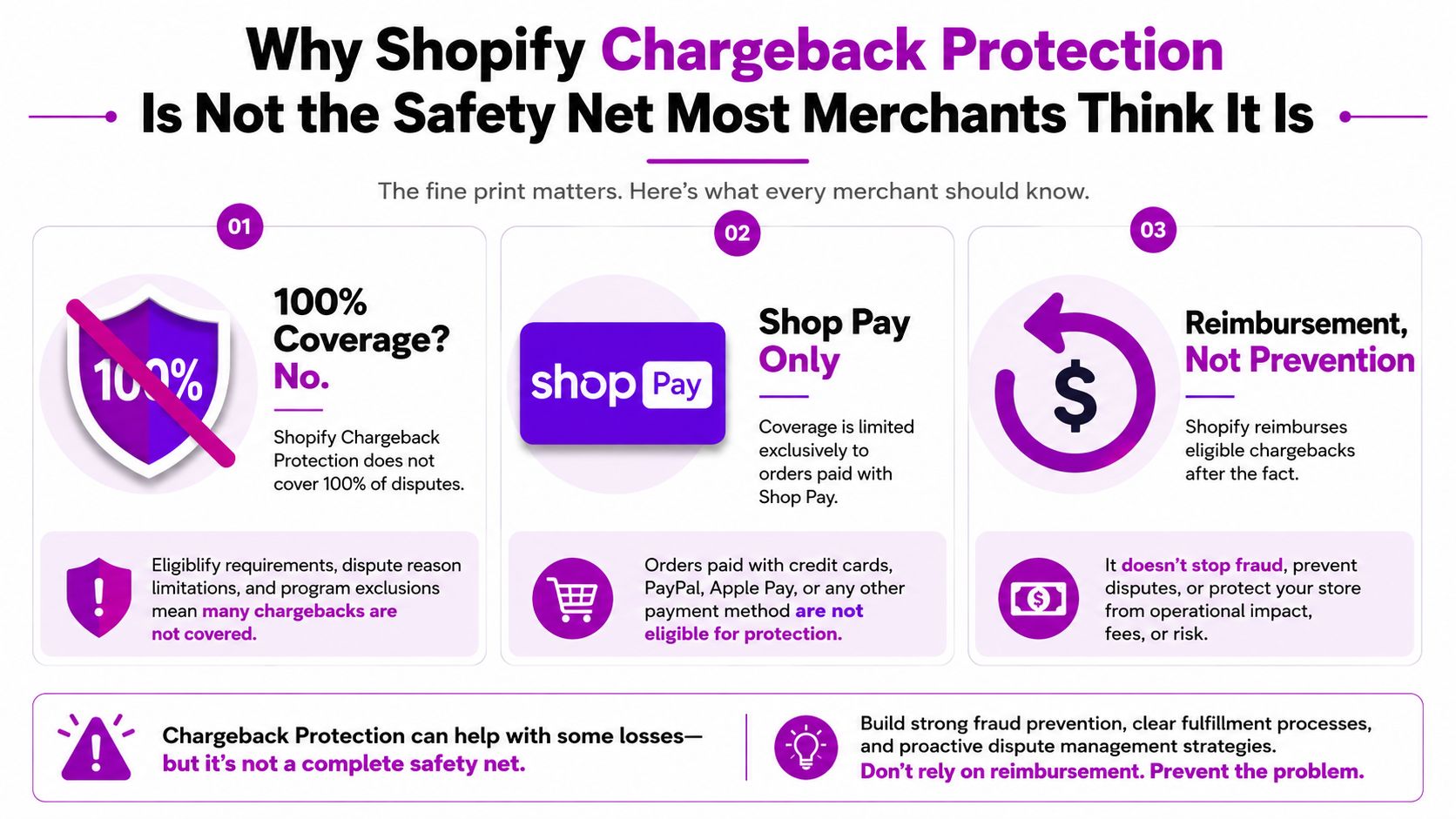
Shopify Protect doesn't eliminate chargeback losses. It's a reimbursement program attached to a narrow transaction path, primarily eligible Shop Pay orders, rather than a blanket shield for every payment accepted by a Shopify store. An order processed through Shopify Payments but paid outside Shop Pay doesn't automatically receive the same protection.
That distinction is where many operators misread the product. Shopify states that eligible transactions are those processed through Shopify Payments, while its Protect workflow has additional requirements around the checkout method, merchant location, product type, and fulfillment. Coverage depends on the order meeting the rules, not on the store merely having Shopify Protect enabled.
The two gaps merchants underestimate
First, non-Shop-Pay orders can remain exposed. That includes payment volume from customers who enter card details directly and transactions routed through other payment arrangements. Second, Protect isn't a prevention system. It doesn't stop a stolen card from being used, prevent a customer from misunderstanding a billing descriptor, or resolve a delivery complaint before the customer contacts the issuer.
Coverage also isn't a guarantee that every commercial consequence disappears. Shopify's guidance notes that reimbursed disputes can still count toward chargeback monitoring, and a later reversal by the issuer can create recovery exposure. The merchant may receive reimbursement under the program, but the payment network still observes dispute activity.
The deadline is the real operating test
Merchants typically have 7 to 21 days to submit evidence, depending on the network and dispute type, according to Chargeflow's Shopify fraud and chargeback guide. That window is short enough to expose weak operations. If tracking is buried in a carrier portal, customer emails sit in a separate inbox, and risk signals aren't stored against the order, the team can lose valuable time before anyone starts writing the response.
Protect can reimburse an eligible fraud dispute, but it won't recover the margin lost to avoidable fulfillment, service, or inventory mistakes. Treat it as one layer in a control system. The merchants who capture its value verify eligibility at order level, fulfill on time, preserve evidence automatically, and maintain a separate plan for everything Protect excludes.
What Chargeback Protection Actually Means for Shopify Merchants
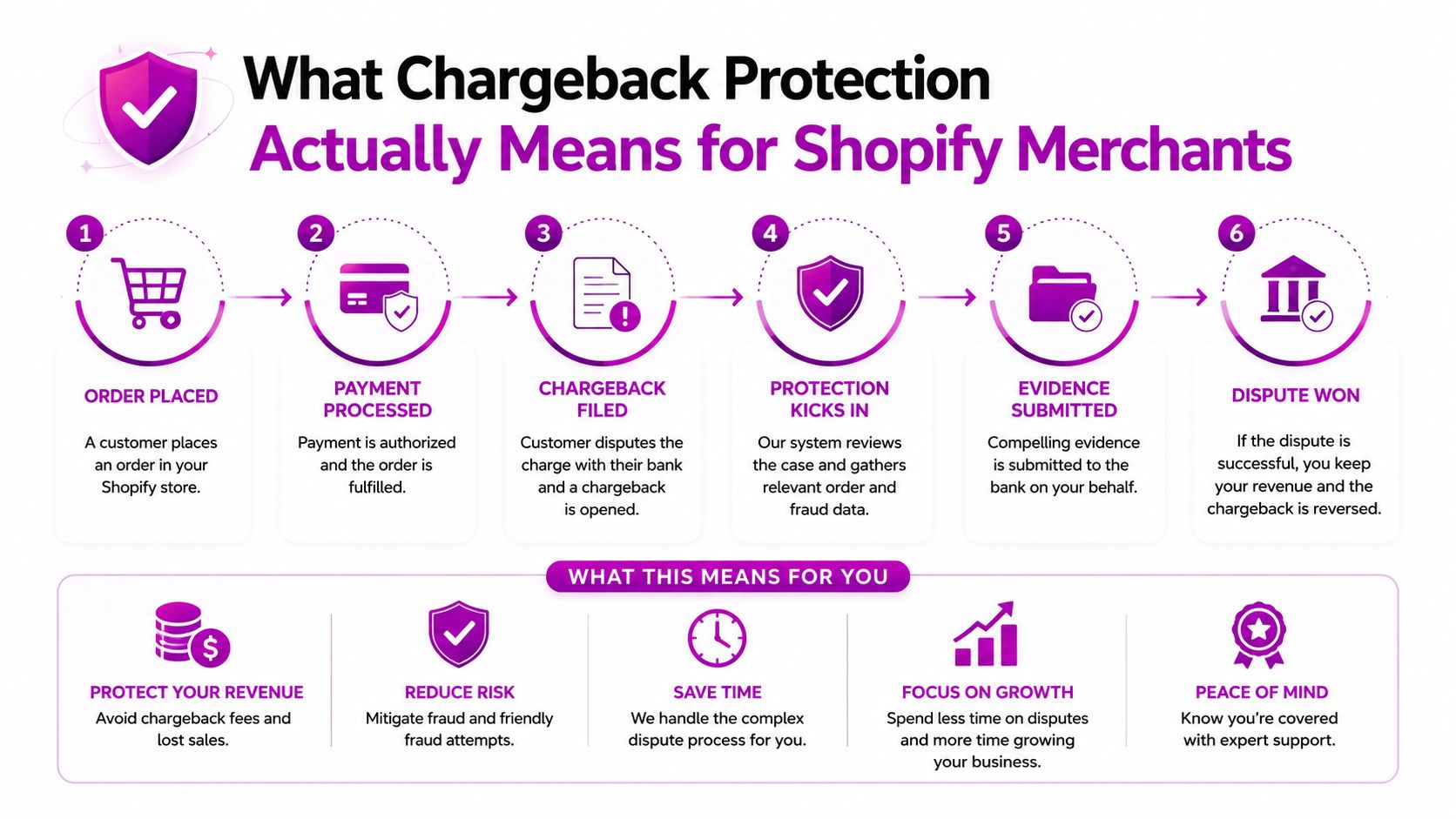
Chargeback protection and chargeback management solve different problems. Protection addresses financial liability, while management covers the operational work of identifying a dispute, gathering evidence, submitting a response, and tracking the result.
Consider a $120 order paid through Shop Pay. The order is shipped, the customer receives it, and the cardholder later tells the bank the transaction wasn't authorized. The issuer opens a fraud dispute, and Shopify routes the case into its dispute workflow. If the order meets Shopify Protect's eligibility rules, Shopify can handle the dispute process and reimburse the merchant if the case qualifies under the program.
That isn't the same as proving the transaction was legitimate. Visa reason code 10.4 describes a card-not-present fraud dispute where the cardholder claims an online, phone, or mail-order transaction was unauthorized, as outlined in Visa reason code guidance from Chargebacks911. The issuer still applies its own evidentiary standard to the information available.
What the merchant receives
On an eligible order, the merchant receives a financial backstop for the covered fraudulent or unrecognized chargeback. Shopify's documentation describes automatic reimbursement for protected orders, which removes much of the manual representment burden for that narrow class of disputes.
That convenience has a trade-off. Shopify takes over the dispute response rather than asking the merchant to build the case in the usual way. The store still needs accurate order, fulfillment, and customer records because those records support the platform's handling of the case and remain important for broader risk monitoring.
What the merchant still owns
The merchant remains responsible for operating a store that can produce reliable evidence. That means preserving:
- Fulfillment records, including shipment status and carrier tracking.
- Customer communications, especially delivery, cancellation, refund, and policy discussions.
- Transaction context, including order history and verification signals.
- Policy records, showing what the customer accepted and when.
Shopify Protect belongs in the protection bucket. Fraud screening, customer-service recovery, evidence collection, and representment belong in the management bucket. A strong Shopify setup uses both, because the product label doesn't cover non-eligible orders or non-fraud disputes.
Shopify Protect Eligibility, Coverage, and the Fine Print
Shopify Protect is useful when the store's transaction mix matches its rules. It isn't a general benefit of being on a particular Shopify plan, and it doesn't turn every payment into a protected payment.
The merchant should assess the order path before switching on a workflow or assuming reimbursement is available. United States eligibility, Shop Pay checkout, physical fulfillment, and compliant tracking are central conditions, while subscriptions, digital products, and other excluded transaction types require separate controls.
Eligibility checklist
Use this checklist before treating Protect as a meaningful part of your risk budget:
- Merchant location: Confirm that the business uses an eligible U.S. Shopify Payments setup.
- Checkout method: Measure whether customers use Shop Pay, rather than assuming the payment option's availability equals adoption.
- Product type: Separate physical shippable goods from digital products, services, gift cards, and other non-physical orders.
- Fulfillment discipline: Verify that warehouse teams can fulfill eligible orders within Shopify's required timing.
- Tracking quality: Ensure supported-carrier tracking is added correctly and reflects movement to the customer.
- Dispute category: Expect protection to focus on fraudulent or unrecognized chargebacks, not product-quality, delivery-service, or cancellation complaints.
- Subscription exposure: Treat recurring renewals as a separate dispute program because Shopify Protect doesn't cover subscription renewals.
- Payment architecture: Review every gateway and payment method, since chargeback eligibility is tied to the qualifying Shopify Payments and Shop Pay path.
Merchants reviewing their broader payment architecture should also understand how payment-method choices affect operational ownership. This guide to payment gateways in Shopify is useful when mapping which processor owns alerts, evidence deadlines, and dispute reporting.
Eligibility at a glance
| Eligibility Factor | Requirement | Common Rejection Reason |
|---|---|---|
| Merchant account | Eligible U.S. Shopify Payments setup | Store or transaction outside the supported market |
| Checkout | Qualifying Shop Pay order | Customer paid by entering card details directly |
| Merchandise | Physical goods that require shipping | Digital goods, services, or excluded products |
| Fulfillment | Order meets Shopify's timing conditions | Warehouse ships late or status remains incomplete |
| Tracking | Valid supported-carrier tracking | Tracking is missing, invalid, or added too late |
| Dispute type | Fraudulent or unrecognized chargeback | Dispute concerns quality, delivery, or another service issue |
| Recurring billing | Qualifying rules for the initial order | Subscription renewal is disputed |
| Order status | Order carries eligible Protect status | Merchant assumes all Shop Pay orders qualify |
Don't publish internal coverage limits that aren't confirmed in the merchant's current Shopify settings. The reliable approach is to inspect the order-level Protect status, then build a separate policy for every order that falls outside it.
How a Shopify Chargeback Dispute Flows From Alert to Resolution
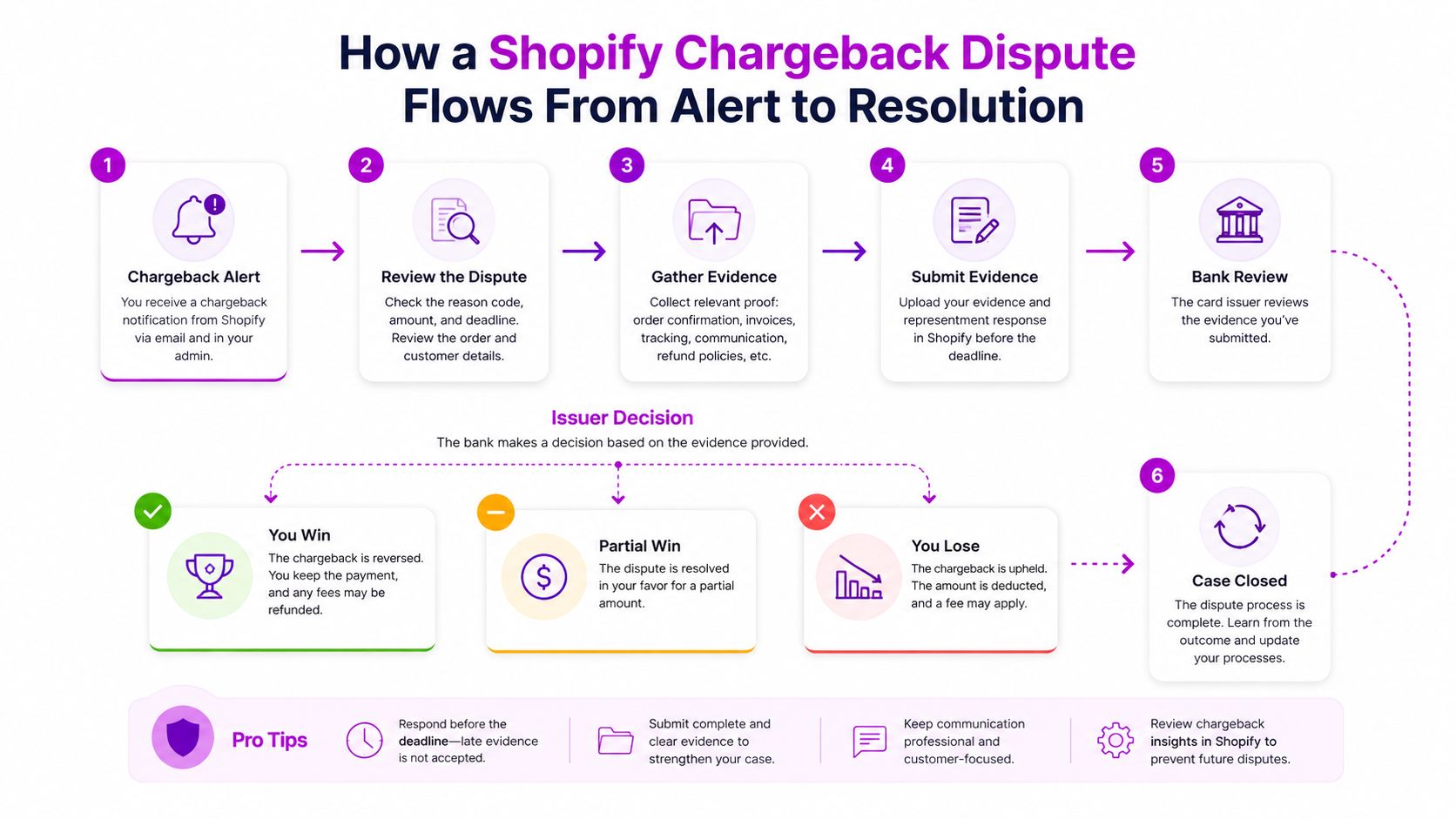
A Shopify Payments dispute follows a sequence, and each stage creates a different failure point. The issuer opens the case, Shopify displays it in the admin, the merchant or Shopify assembles evidence, and the issuer decides based on the submission.
Five stages of the workflow
1. The cardholder contacts the issuer.
The customer's bank opens a dispute under a reason code. In a card-not-present fraud case, the customer claims the online transaction wasn't authorized. Shopify then reflects the dispute in the relevant payment workflow.
2. Shopify flags the order.
The merchant sees the case in the Shopify admin and receives the response deadline. This is the moment to identify the transaction, confirm whether it carries Protect eligibility, and determine whether the dispute should be accepted or answered.
3. Evidence is assembled.
For a contested case, build the response around the reason code. Useful records can include AVS and CVV results, 3-D Secure confirmation, IP and device information, order history, tracking, delivery confirmation, signed delivery evidence where available, refund records, customer correspondence, and billing-descriptor history.
4. The case is handled under the relevant path.
For an eligible protected Shop Pay order, Shopify can manage the case and reimburse the merchant under Protect. For an unprotected order, the merchant follows the normal dispute process and submits evidence through Shopify Payments.
5. Funds are credited or the loss stands.
The issuer reviews the submitted material and determines the outcome. A win can return disputed funds, while a loss leaves the chargeback and applicable consequences in place.
The most common operational mistake is treating the deadline as an administrative detail. Merchants typically have 7 to 21 days to submit evidence, as documented in the earlier Chargeflow guidance. A late response, an unreadable delivery document, or missing device data can weaken a legitimate case even when the order was fulfilled correctly.
Build the evidence file before the dispute
Don't ask the warehouse, support team, and payment analyst to reconstruct an order after the alert arrives. Store the evidence at order creation and fulfillment, then make it retrievable from one record.
A persuasive submission follows Shopify's evidence hierarchy. Start with direct proof such as delivery confirmation or refund logs, add customer acknowledgment and policy documentation, then use order history and verification results as context. More files aren't automatically better. Relevant, readable evidence submitted on time is better than an unstructured archive.
Comparing Shopify Protect With Third-Party Dispute and Fraud Tools
Shopify Protect is strongest when the merchant wants a native reimbursement layer for eligible Shop Pay fraud disputes. It becomes less useful as the primary control when the store relies heavily on other payment methods, sells subscriptions or digital products, operates internationally, or needs automated evidence across several processors.
Third-party tools address different parts of the problem. Chargeflow focuses on alerts, prevention, recovery, and evidence automation. Kount, MidMetrics, and Ravelin are better evaluated as risk and fraud-control options rather than assumed reimbursement products. Stripe Dispute Management and Adyen Risk make the most sense when those payment ecosystems are central to the merchant's stack. Signifyd is typically considered when a merchant wants decisioning paired with a financial guarantee.
Compare the operating model, not just the feature list
| Tool | Coverage Scope | Fee Model | Evidence Automation | Shopify Integration | Approx. Cost per Protected Order |
|---|---|---|---|---|---|
| Shopify Protect | Eligible Shop Pay fraud disputes | Reimbursement model | Shopify-managed handling for eligible cases | Native | Not publicly established in the provided data |
| Chargeflow | Prevention, alerts, and dispute recovery | Vendor-specific, often tied to recovery or protection | Strong automation focus | Shopify-connected | Depends on agreement and order eligibility |
| Kount | Fraud and identity risk controls | Vendor-specific SaaS or enterprise pricing | Risk data and workflow support | Integration dependent | Vendor quote required |
| MidMetrics | Dispute and payment analytics, where supported | Vendor-specific | Depends on configuration | Integration dependent | Vendor quote required |
| Ravelin | Fraud decisioning and risk controls | Vendor-specific enterprise pricing | Workflow dependent | Integration dependent | Vendor quote required |
| Stripe Dispute Management | Stripe payment disputes | Stripe's applicable payment fees | Native Stripe workflow | Shopify use depends on payment setup | Processor pricing applies |
| Adyen Risk | Adyen payment risk and dispute operations | Adyen's applicable commercial model | Native Adyen workflow and risk tooling | Integration dependent | Processor pricing applies |
| Signifyd | Guaranteed decisioning for approved transactions | Vendor-specific guarantee or service pricing | Automated decision support | Shopify integration available | Vendor quote required |
The table deliberately avoids invented price comparisons. A merchant should request pricing based on order value, geography, payment mix, covered categories, chargeback volume, and whether the vendor charges for screening, recovery, alerts, or guaranteed approvals.
A practical selection rule
If Shop Pay represents only a small part of gross merchandise volume, Protect should be treated as one signal layer, not the primary shield. The exact mix matters more than the feature headline. Map the percentage of orders and revenue handled through each payment method, then assign a control to every uncovered lane.
A growing team also needs an escalation process when fraud, fulfillment, and support teams disagree. The practical principles in handling escalation in community management apply here too: define ownership, route urgent cases quickly, and record the decision so the next dispute doesn't restart the same argument.
Choose a third-party platform when the gap is financial coverage. Choose a fraud engine when the gap is pre-fulfillment decisioning. Choose a representment specialist when valid disputes are being lost because the team can't produce evidence fast enough. Don't buy three overlapping tools before documenting the payment mix and the specific failure you need to correct.
Fraud Prevention Habits That Actually Lower Your Chargeback Rate
Reimbursement is downstream. Prevention protects revenue before the order reaches the warehouse, and customer-service recovery can stop a legitimate complaint from becoming a bank dispute.
Industry research places card-not-present ecommerce chargebacks typically between 0.6% and 1% of transactions, while friendly fraud can represent 40% to 80% of ecommerce fraud losses, according to Chargeflow's ecommerce fraud prevention research. Those benchmarks make one point clear: a store needs controls for both stolen-card activity and disputes from genuine customers.
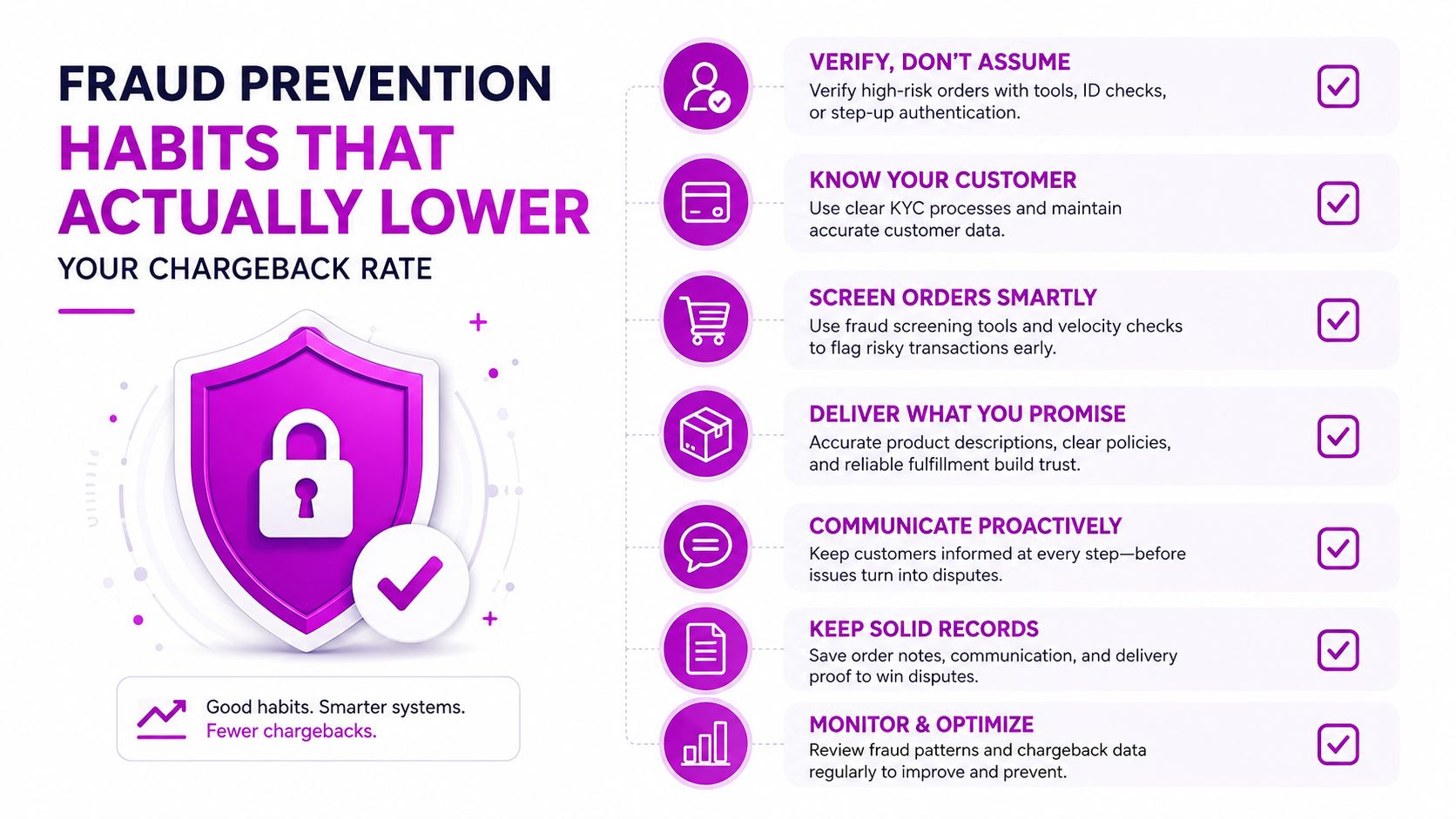
Build controls around the order lifecycle
- Use authentication selectively but decisively: Apply 3-D Secure where risk justifies the added verification step, particularly for unusual orders or payment behavior.
- Score velocity and identity mismatches: Review repeated attempts, BIN and IP inconsistencies, unusual device patterns, and address conflicts before fulfillment.
- Make the billing descriptor recognizable: Customers dispute charges they don't recognize. The descriptor, receipt, and support contact should point clearly to the store.
- Validate shipping addresses: Don't send high-risk orders to an address that conflicts with payment or customer information without a documented review.
- Add delivery confirmation for valuable orders: Use appropriate carrier tracking and signed delivery when the product value makes a lost dispute expensive.
- Store correspondence against the order: Customer emails, refund promises, cancellation requests, and delivery conversations should be available to the dispute operator without searching multiple systems.
- Review refunds and credits as prevention tools: A fast, policy-consistent resolution can cost less than a formal dispute and the operational work that follows.
The key habit is a monthly dispute autopsy. Tag each case as true fraud, friendly fraud, service failure, product issue, delivery failure, or merchant error. Then fix the root cause that produced the largest avoidable group instead of celebrating a recovery rate while the same problem keeps generating new cases.
Treat descriptors and support as fraud controls
A customer who sees an unfamiliar merchant name may call the bank before contacting support. A subscription customer who can't find cancellation instructions may do the same. Clear receipts, delivery updates, renewal notices, and visible support paths reduce confusion before it turns into an issuer inquiry.
For a broader operating checklist, use this ecommerce fraud prevention best-practices guide. The best stack combines Shopify's order-risk signals, payment authentication, fulfillment discipline, customer-service intervention, and automated evidence collection.
Operational rule: Shopify Protect can reimburse a covered loss, but only an upstream control can prevent the order, shipment, and support costs from occurring.
A Practical Action Plan for Growing Shopify Brands in 2026
Start with coverage mapping, not software shopping. Export your payment mix, identify which orders use Shop Pay, separate physical goods from subscriptions and digital products, and list every processor that can open a dispute. The result should be a simple exposure map showing which orders have native reimbursement, which require manual evidence, and which need third-party coverage.
For emerging brands
Prioritize the basics before adding enterprise tooling:
- Enable Shop Pay where it fits the customer experience.
- Review AVS, CVV, and order-risk indicators before fulfillment.
- Create one evidence template with order details, policies, tracking, delivery records, and customer messages.
- Assign one person to check dispute alerts and deadlines.
- Track chargeback count, dispute reason, and outcome by month.
The first operational KPI is on-time evidence submission. A perfect template has no value if nobody submits it before the deadline.
For growing brands
Add a broader dispute layer when non-Shop-Pay volume becomes material. Network alert services, dispute automation, and representment support can cover payment lanes that Shopify Protect leaves outside its rules. Benchmark performance against the 0.65% Visa fraud-to-sales reference threshold, using the context provided by Chargeflow's ecommerce fraud research and confirming the metric that applies to your processor and region.
Your core KPI should be net recovered revenue, not gross wins. Subtract fees, refunds, labor, and the cost of preventable operational errors.
For Shopify Plus operations
Assign a disputes owner, create service-level tracking for every response deadline, and connect payment, fulfillment, support, and fraud data. Adaptive risk scoring, issuer communication, and processor-specific reporting become more valuable as the payment stack expands.
Use a 30/60/90-day sequence:
- First 30 days: Audit policies, descriptors, payment methods, fulfillment timing, and existing evidence.
- By 60 days: Build the evidence template, connect alerts, automate order tagging, and define escalation ownership.
- By 90 days: Review win rate, net recovery, root-cause tags, uncovered payment volume, and deadline performance.
A strong 2026 plan doesn't promise zero chargebacks. It makes every dispute visible, every eligible order verifiable, every response timely, and every uncovered payment lane assigned to a deliberate control.
ECORN helps Shopify brands strengthen the systems behind chargeback prevention, from Shopify development and payment workflows to CRO and Shopify Plus consulting. Visit ECORN to discuss a focused project or an ongoing support package for building a more resilient, scalable store.


8 Examples of Conversion Rate Optimization
How to Conversion Rate Optimization for Shopify Stores

Shopify Design Essentials Every Store Owner Needs
Ecommerce Terms of Service: How to Draft and Implement
How to Implement Structured Data for Ecommerce in 2026

SEO App Mobile: Shopify Store Optimization Guide
Shopify Plus Support: What It Includes and How to Choose

Google Ads for Shopify: The Complete 2026 Playbook

Shopify New York: How to Find and Hire the Right Agency

Google Search Console for Shopify: The Complete Setup
First Party Data Collection for eCommerce Growth
FAQ Online Store Guide: Build and Measure It Right
Do FB Ads Work for eCommerce in 2026?

One Page Checkout for Shopify: Design and Implementation
Shopify GraphQL vs REST: The 2026 Developer Decision
Shopify Ecommerce Consulting: Strategy, Pricing &

Are Reddit Ads Worth It for eCommerce Brands
Shopify Title and Meta Description: A Practical 2026 Guide

Product Video Best Practices for Shopify Brands
Real-Time Inventory Management: A 2026 Guide
AI Chatbot Integration for Shopify Stores
Affiliate Program Management: A Shopify Guide
10 Best Performance Monitoring Tools for Shopify in 2026
Digital Asset Management for eCommerce Brands in 2026

Every Type of Facebook Ads Explained for eCommerce Growth
Product Information Management Explained for Shopify Brands
Support Ticket System: A Guide for Shopify Stores

10 Best Customer Service Tools for Shopify in 2026

Can I Start a Business with No Money? a 2026 Blueprint

What Sells Good on Etsy: Best Niches for 2026

Shopify Add to Cart Button: A Practical 2026 Guide

Customer Feedback Automation: A Practical eCommerce Guide
Critical Rendering Path: A Guide for Shopify Stores

How to Promote on TikTok for eCommerce in 2026

B2B eCommerce Consulting That Drives Real Revenue
10 Best Practices for Site Navigation in 2026
Return vs Refund for Shopify Stores: A Practical Guide

What Is Customer Lifetime Value and Why It Matters
What Is Voice of Customer Research for eCommerce

SMS Marketing for Ecommerce That Actually Converts

Master How to Improve Email Deliverability in 2026

Top 7 eCommerce Partners NYC for Shopify Brands in 2026

Machine Learning for Ecommerce: Boost Your Shopify Store

Beauty Market Research: Your 2026 Growth Guide
Shopify International Expansion: A 2026 Roadmap

What Does CRO Stand for in Business: Understanding CRO

Shopify Visual Merchandising: A Playbook for Higher Sales

Shopify Landing Page Design: Master Conversion in 2026

10 Best AI SEO Optimization Tools for Shopify in 2026

Agentic AI for Ecommerce: Boost Your Sales in 2026
Mastering Email Marketing Data for eCommerce Growth

Conversion Rate Optimisation Australia: Boost Your Sales
Conversion Rate Optimization AI: Your Shopify Store Guide

10 Product Bundling Strategies for Shopify in 2026

How to Increase Customer Lifetime Value: A Shopify Playbook
AI Customer Service Automation: Shopify Guide 2026

Clean Website Design: A Shopify Conversion Playbook

Omnichannel Retail Strategy: A Shopify Playbook
Product Data Enrichment: A Guide for Shopify Brands

Instagram Shopping Features a Guide for Shopify Stores

What Is Revenue Optimization: A Holistic RevOps Guide

Benefits of Conversion Rate Optimization: Boost Your
WordPress to Shopify Migration: Your 2026 Seamless Switch
Boost Sales: Ecommerce Payment Processing Guide 2026
Unified Commerce Platform: Benefits, KPIs & Shopify Guide
How to Reduce Bounce Rate eCommerce: Your 2026 Guide
Shopify API Integration: A Practical End-to-End Guide
How to Implement Data Governance: A 2026 Guide
Shopify Store Development Cost: A 2026 Breakdown
What Is Server Side Tracking: The Shopify Guide 2026
Marketing Automation Workflows: A Shopify Guide for 2026
Shopify: How to Reduce Technical Debt

Shopify UX Design Change: A Playbook for Growth
User Generated Content Strategy: Shopify Playbook

Shopify Pause and Build Plan Cost: A Complete 2026 Guide
Compare at Price on Shopify: A Complete Guide for 2026

Where Can I Sell My Prints? 10 Best Platforms for 2026
Shopify Order Management System: The Ultimate Guide 2026
What Is Marketing Attribution? an eCommerce Guide for 2026

10 Best Black Friday Sales Sheets for 2026

Discover the Top Social Media Marketing Agencies For
Consumer Confidence Definition for eCommerce in 2026
What Is Social Commerce? Your 2026 Guide to Boosting Sales

A Social Ad Campaign Playbook for eCommerce Growth

7 Best FAQ Page Examples for SaaS & eCommerce

Market Research in Fashion Industry: A Guide for Shopify
Shopify Migration Services: Expert Guide for 2026

Mastering FB Retargeting Ads for Shopify in 2026
What Is Omnichannel Ecommerce
Master Your Shopify Plus Migration: The 2026 Guide
Shopify Integration Services: A Merchant's 2026 Guide
Shopify Collection Description: A Guide to SEO & Sales

Shopify Plus Contact: Reach Sales & Support Effectively

Top Luxury Shopify Stores: Design & UX Strategies
How to Improve Customer Experience: A Shopify Roadmap

Creative Facebook Ads: 10 Examples for Shopify Brands

Remarketing with Facebook Ads: A Shopify Guide for 2026

SEO Linking Strategies for Shopify Stores
Top 7 Statistics YouTube Channels for eCommerce in 2026

Hiring Shopify Plus Designers: A Founder's Guide


newsletter in your inbox