

You've got a terms page in your Shopify footer, a return policy linked from the help center, and a checkout that processes orders without friction. Then a customer disputes a purchase, a payment processor asks how the buyer accepted your conditions, and your carefully written document suddenly looks less useful than expected. The problem usually isn't the absence of ecommerce terms of service. It's the gap between publishing terms and proving that a customer saw, understood, and accepted the relevant clauses.
For merchants, enforceability is an implementation problem as much as a drafting problem. Your terms need to match the way your store sells, appear at the right moment, and leave an evidence trail that connects a customer, an order, a version, and an affirmative action. The following approach focuses on what tends to hold up better in real disputes, and what commonly fails.
Why Most Ecommerce Terms of Service Fail to Protect Merchants
A merchant receives a $2,400 chargeback from a customer who says an order never arrived. The carrier record shows delivery, so the merchant opens the store's terms of service and finds a clause addressing shipping disputes. Confidence fades quickly. The clause sits in paragraph 14, the checkout never required the buyer to accept it, and the language appears to transfer every delivery risk to the customer regardless of the circumstances.
The store has terms. It may even have a clause that sounds protective. Yet those facts don't answer the questions a court, card network, or payment processor may ask:
- Was the customer given clear notice?
- Did the customer take an affirmative step to accept the agreement?
- Was the clause understandable and reasonably connected to the transaction?
- Did the terms reflect the store's actual shipping, refund, and fulfillment practices?
A footer link often creates access without creating strong evidence of assent. A customer can browse, buy, and leave without ever encountering the document. By contrast, a checkout checkbox paired with a visible link creates a clearer record of the customer's action, although the exact legal outcome still depends on the wording, presentation, transaction, and applicable law.
The three failure patterns
Poor presentation is the first breakdown. Merchants treat a terms page as a destination instead of part of the checkout experience. The document exists, but the buyer never sees it before paying.
Overreaching language is the second. A clause that says the merchant has no responsibility for any loss, delay, misrepresentation, or statutory remedy may sound broad, but broad language can create its own credibility problem. A limitation must be clear, proportionate, and compatible with mandatory consumer protections. Courts may preserve an agreement while refusing to enforce an individual clause, but merchants shouldn't assume every aggressive provision will survive review.
Operational drift causes the third failure. The business starts with one-off product sales, then adds subscriptions, international delivery, digital products, preorders, or third-party fulfillment. The terms still describe the original model. That mismatch gives a customer a strong argument that the document wasn't designed for the transaction in dispute.
Practical rule: A terms page protects the merchant only when the document, the checkout flow, and the store's actual operations tell the same story.
A 2022 litigation report found that online agreements had a 66% success rate in court in 2021, after reaching 97% in 2018, then falling to 80% in 2019 and 70% in 2020. The report also found that 58% of clickwrap cases involved standard website terms such as “terms and conditions,” “terms of use,” or “terms of service,” which shows how central these agreements are to digital commerce. See the PLOS ONE litigation analysis of online agreement enforcement for the underlying findings.
The lesson is practical. Don't wait until a chargeback, demand letter, or account review forces you to test whether your terms work. Audit consent and clause visibility while you can still change the experience.
Essential Clauses Every Online Store Needs
Good terms aren't a collection of intimidating paragraphs. They're an operating manual for the commercial relationship between your store and its customers. Each clause should answer a question your support, fulfillment, finance, or legal team might face.
Order acceptance and cancellation
State when an order becomes accepted, and reserve the ability to reject or cancel orders for genuine reasons such as inventory errors, pricing mistakes, suspected fraud, or failed authorization. The online retailer model contract guidance distinguishes a customer's order from the seller's acceptance, a distinction that matters when a product is accidentally listed at $5 instead of $500.
Avoid language that gives unlimited discretion without explaining how cancellation works. Tell the customer how you'll communicate a cancellation and how authorized payments will be handled.
Payment authorization
Explain accepted payment methods, authorization failures, recurring billing where applicable, taxes, currency treatment, and the customer's responsibility to provide accurate billing information. If you operate subscriptions, specify renewal timing, cancellation mechanics, failed-payment retries, and what happens when a subscription is paused or terminated.
Payment providers may examine whether your transaction terms align with the checkout and refund practices shown elsewhere in the store. Keep the wording consistent with your actual settings in Shopify, Stripe, or another processor.
Shipping and delivery
Your shipping clause should match carrier commitments rather than promise outcomes you can't control. Address dispatch windows, estimated delivery ranges, customs responsibilities, address errors, split shipments, lost packages, and the evidence customers should provide when reporting a problem.
Don't use a disclaimer to erase every delivery obligation. A fair process for investigation and escalation is more useful than a blanket statement that the merchant accepts no responsibility.
Returns and refunds
Link the terms directly to your return policy, then make the relationship between the documents clear. Explain eligibility, exclusions, return shipping, refund timing, exchanges, damaged goods, and the original payment method.
Customers understand delivery costs better than they understand withdrawal periods and delivery rights, according to the consumer research summarized in the terms-and-conditions attention analysis. Put the transaction-critical information where customers can find it before payment, not only in a long document after purchase.
Intellectual property
Claim ownership or licensed rights in product photography, copy, logos, designs, videos, and site content. Define what customers may do with product images and branding, especially if affiliates, resellers, or user-generated content are part of the model.
If a photographer, agency, or supplier created the content, confirm that your business holds the necessary rights. A terms clause can state your position, but it can't create rights you never obtained.
Limitation of liability
Tie limitations to realistic risks and applicable law. A provision linked to the value of the order may be more defensible than an attempt to exclude every possible category of loss, but the appropriate structure depends on the product, jurisdiction, and business model.
Preserve mandatory consumer rights explicitly. A limitation that conflicts with statutory protections can weaken the credibility of the entire risk allocation.
Dispute resolution
Choose a process and describe it plainly. That might include an initial support contact, informal escalation, court proceedings, or arbitration. If you use arbitration or a class action waiver, explain the procedure, forum, fees, applicable law, and exceptions rather than hiding the provision in general boilerplate.
Cross-border customers also need a practical escalation route. Government guidance across the U.S., France, Australia, and the U.K. commonly directs shoppers to contact the seller or platform first, then consider consumer agencies, ombudsman routes, or cross-border complaint systems if the issue remains unresolved. Your terms should identify the right contact and explain what happens next.
Account termination and abusive conduct
If customers create accounts, reserve the right to suspend or terminate access for fraud, harassment, abuse, payment misuse, or prohibited activity. State what happens to open orders, refunds, subscriptions, and stored data after termination.
The operational impact of missing clauses is easy to see:
| Clause | Protects Against | Risk If Missing |
|---|---|---|
| Order acceptance | Pricing errors, fraud, inventory mistakes | Pressure to honor an obvious listing error |
| Payment terms | Failed authorization and billing disputes | Confusion over charges, renewals, or payment responsibility |
| Shipping terms | Carrier delays, address mistakes, customs issues | Inconsistent support decisions and delivery disputes |
| Returns and refunds | Eligibility and refund disagreements | Chargebacks and complaints caused by unclear remedies |
| Intellectual property | Unauthorized use of images and branding | Weaker position in content and copyright disputes |
| Liability limits | Defined exposure for certain losses | Unstructured risk and overbroad arguments |
| Dispute resolution | Unclear escalation and forum questions | Higher friction when a dispute begins |
| Account termination | Fraudulent or abusive account activity | Difficulty restricting repeat misuse |
California, New York, and EU customers may trigger different requirements depending on the clause and transaction. Don't paste one jurisdiction's language across every market. Have counsel review consumer-facing provisions where your store sells internationally or uses subscriptions, digital goods, regulated products, or high-value orders.
The Enforceability Gap Between Having Terms and Winning Disputes
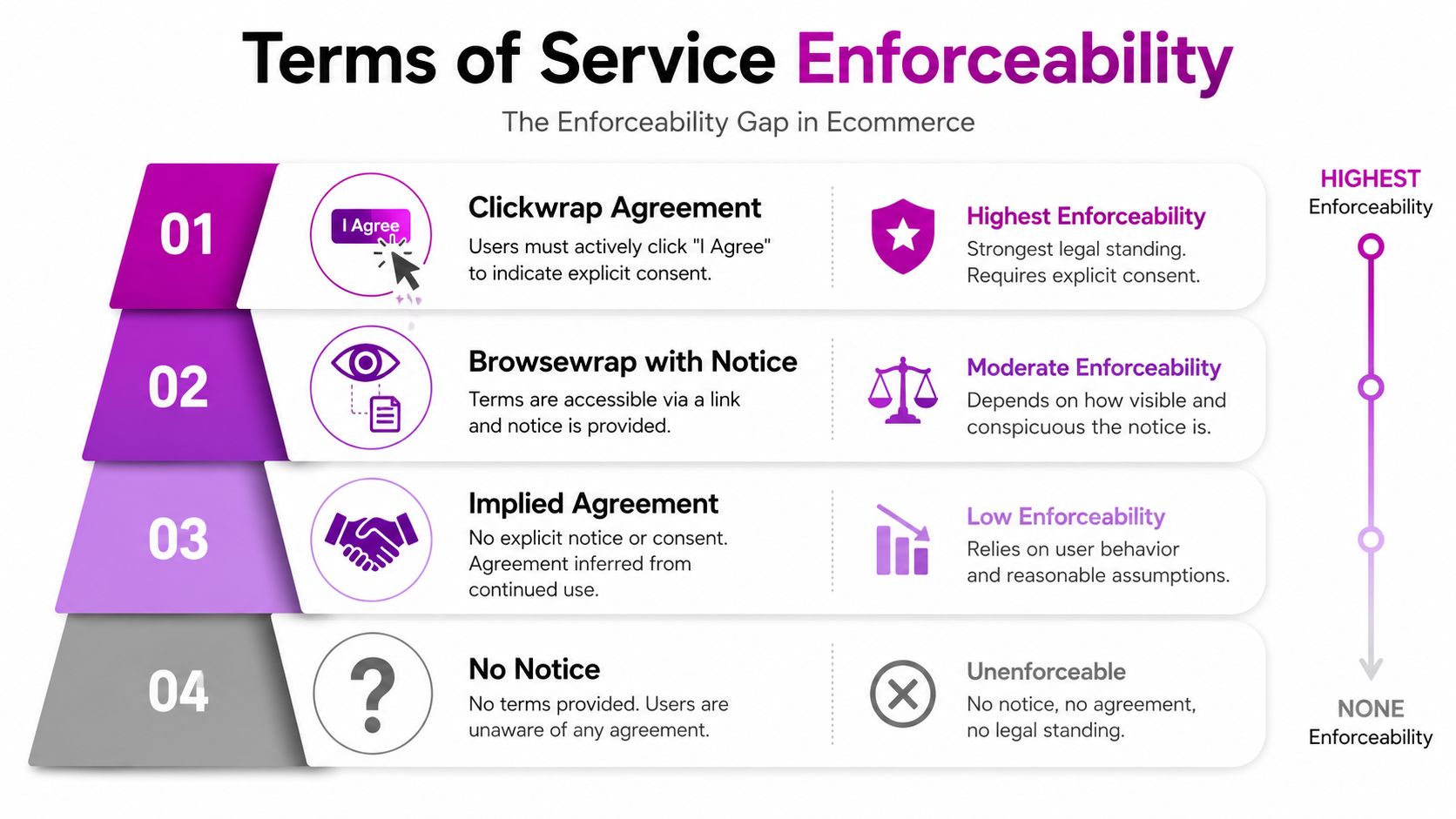
A court doesn't enforce a document merely because a merchant uploaded it. The decision turns on notice, assent, clarity, and the relationship between the clause and the transaction.
At the strongest end, a signed agreement records an explicit act. Clickwrap sits close behind, with an unticked checkbox, a clear statement, and a terms link placed beside the action that completes the purchase. Browsewrap relies on a footer or page link and assumes that continued use equals acceptance. That structure can establish access, but it makes affirmative assent harder to prove.
Notice is a design decision
Constructive notice depends on what a reasonable customer could see and understand. Courts may examine the link's placement, contrast, font size, surrounding text, proximity to the submit button, and whether the user had to interact with the terms before proceeding.
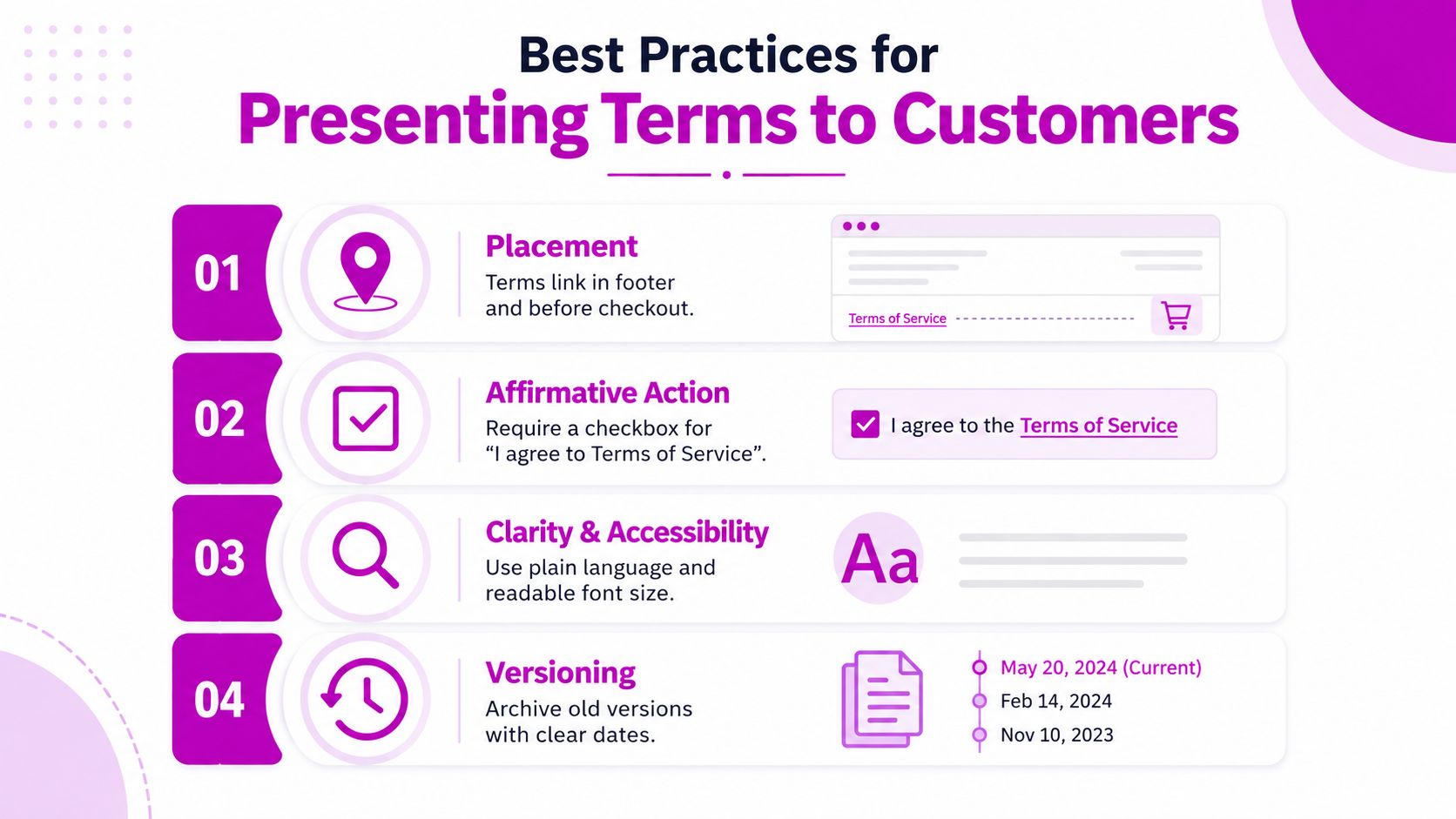
A link buried in a low-contrast footer is a weak substitute for a checkout statement such as “I agree to the Terms of Service,” with the words linked directly to the current document. The checkbox shouldn't be preselected, and the customer shouldn't be able to complete the relevant action without addressing it.
The user behavior evidence is sobering. In a study of older adults, 77.6% selected the clickwrap option and agreed to the privacy policy without opening it, while participants who read the documents spent an average of about 81.4 seconds on terms of service. The Google terms archive and related consent material provides the referenced document context. The practical conclusion isn't that customers will read longer terms. It's that the interface must make the important terms visible before assent.
Clause scope matters
Even strong clickwrap can't rescue an unfair or ambiguous provision. Courts may strike a particular clause while leaving the remaining agreement intact, often described as severing or “blue penciling” the defective language. That outcome is better than losing the entire document, but it still leaves the merchant without the protection it expected.
Copying a large retailer's arbitration, warranty, or liability language is especially risky. A major company may have different bargaining conditions, transaction volume, customer disclosures, and jurisdiction-specific drafting. A small store that imports the language without adapting it can create conflicts with its own refund policy or promise more than it intended.
Merchants should also separate post-purchase updates from new purchases. A silent change to a return window or arbitration provision doesn't automatically bind an existing customer. For material changes, give reasonable notice, identify what changed, and obtain fresh assent when the customer will be asked to accept new terms for a new transaction or continuing service.
This is also why merchants should document understanding platform enforcement rules alongside their own customer consent process. A payment processor's review is not the same as a court proceeding, but both settings reward clear records over confidence that a page existed.
Implementing Terms of Service on Shopify Stores
Shopify gives merchants a policy area, but a policy link in the footer isn't the same as transaction consent. Treat the implementation as a sequence of customer-facing checkpoints.
Start with the policy record
In Shopify admin, open Settings, then Policies, and add the current Terms of Service document. Shopify's built-in policy generator can provide a starting point, but it won't know whether you sell subscriptions, use third-party fulfillment, ship internationally, sell digital products, or accept preorders. Replace generic wording with language that matches your workflows, then have the appropriate legal professional review material risks.
Use a stable document title and display a clear “Last updated” date. Maintain an internal archive containing:
- Version identifier: Assign a simple version name to every published revision.
- Effective date: Record when the revision became active.
- Change summary: Describe changed clauses in plain language.
- Approval record: Keep the internal review and publication history.
- Acceptance evidence: Connect the order to the version presented at checkout.
This process matters because a dispute may concern what the customer saw on the purchase date, not what your terms say today.
Put consent beside the transaction
Shopify checkout configuration varies by plan and checkout setup, so confirm the available options in your admin. Where your checkout supports a terms checkbox or equivalent consent setting, require an unticked checkbox with a visible link before the customer completes the order. Don't rely on the footer link alone.
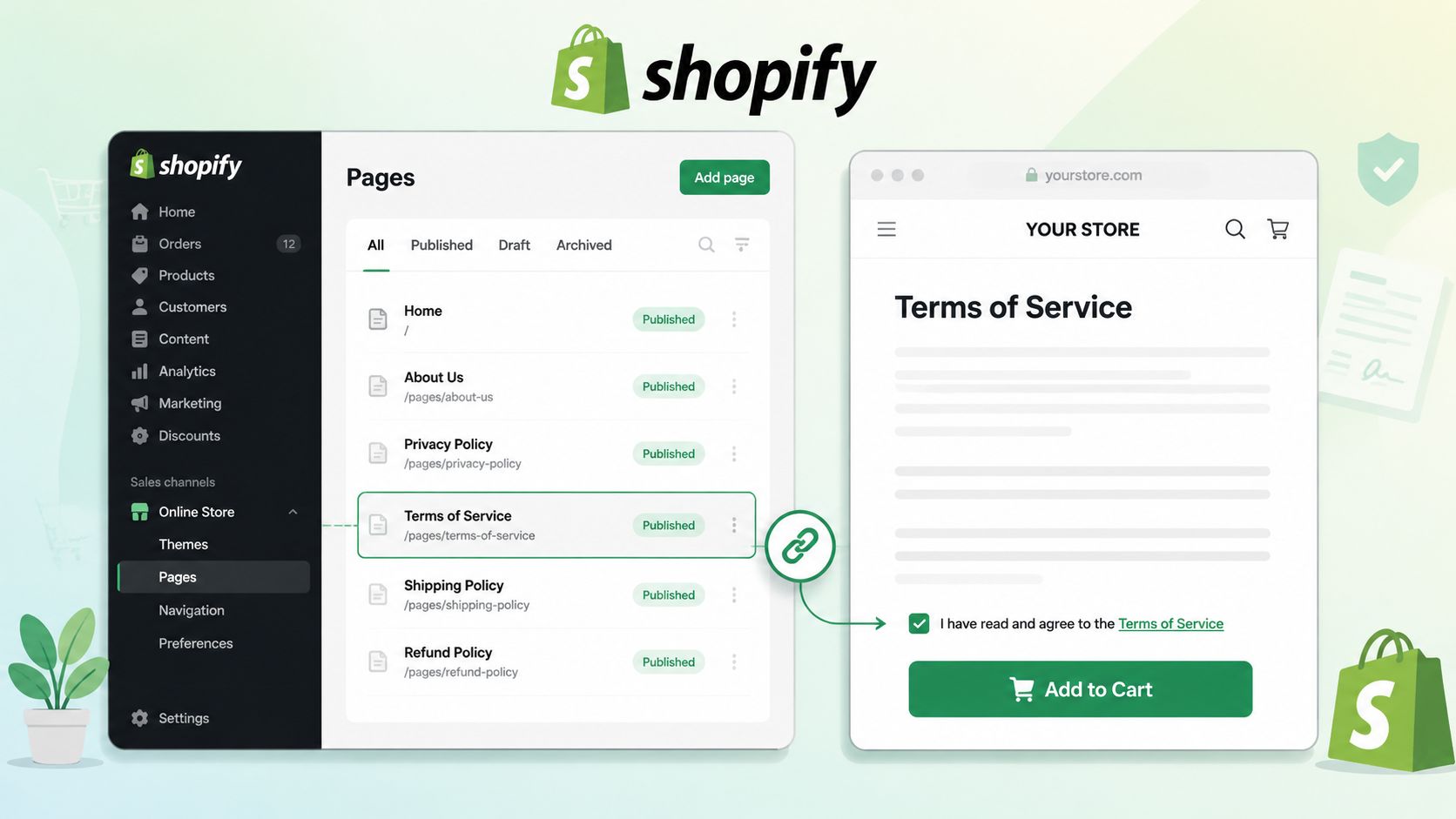
Place policy links in the storefront footer, cart, product information where a material restriction applies, checkout, and account creation flow. A custom theme can use Liquid sections or snippets to render the link consistently, but don't assume a visible link in the theme automatically creates a record of assent. The checkout interaction remains the key evidence point.
If you're configuring payment and checkout controls, review this PCI compliance guide for Shopify stores to keep the legal presentation aligned with the wider payment experience.
Build an update process
Classify changes before publishing them. A typo correction or formatting adjustment may need a dated notice, while a material change to returns, recurring billing, dispute resolution, or customer obligations may call for prominent notification and fresh consent.
For material revisions, use an announcement banner, account notification, and email message where appropriate. Link directly to the revised terms, summarize the practical effect, and preserve the prior version. For a new purchase after the update, require acceptance of the current version. For existing subscriptions or ongoing services, obtain legal advice on whether continued use, direct notice, or affirmative re-consent is suitable.
Test the entire flow on mobile and desktop, including the cart drawer, accelerated checkout options, guest checkout, customer accounts, and failed-payment paths. Then place a test order and confirm that the order record, confirmation message, and internal logs preserve enough information to identify the applicable version.
Choosing and Customizing a Terms Template
A template is a starting material, not a completed legal strategy. The right source depends on how complex your store is and how much operational detail it needs.
| Template Source | Cost Range | Customization Depth | Enforceability Risk | Best For |
|---|---|---|---|---|
| Shopify policy generator | Free starting option | Limited | High if used without edits | Simple stores needing a first draft |
| Termly | Varies by plan | Moderate | Medium if business details are incomplete | Merchants wanting guided template editing |
| TermsFeed | Varies by offering | Moderate | Medium if clauses remain generic | Stores building a broad policy baseline |
| Generic legal marketplace | Varies | Variable | Medium to high | Simple, low-complexity documents |
| Attorney-drafted terms | Varies by scope | High | Lower drafting risk when properly tailored | International, subscription, regulated, or high-value operations |
The cheapest document can become expensive if it misstates your process. Shopify's generator may omit the operational detail required for subscription billing, cross-border delivery, chargeback evidence, digital licensing, or third-party fulfillment. Commercial generators can improve coverage, but the merchant still has to answer questions accurately and remove clauses that don't apply.
Keep boilerplate narrow
Some provisions are often suitable for careful boilerplate treatment, including severability, entire agreement, notices, governing law, and waiver language. Even these should be checked for consistency with the rest of the document.
Other provisions need business-specific drafting:
- Returns: Match the actual return portal, exclusions, inspection process, and refund workflow.
- Subscriptions: Explain renewal, cancellation, failed payment, pauses, and price changes.
- Digital products: Define the license, delivery, access, and permitted use.
- Dropshipping: Address fulfillment relationships without promising more control than you have.
- High-ticket goods: Set out delivery verification, signature requirements, damage reporting, and fraud review.
- Print-on-demand: Explain production after ordering, customization limits, and non-returnable items where lawful.
Dangerous boilerplate often hides in broad promises. A sentence promising a full refund “for any reason” can conflict with customized products or opened goods. An arbitration clause copied from a large retailer may fail to explain consumer procedures or may unintentionally restrict the merchant's own ability to pursue fraud. A chargeback clause that says the customer waives all payment disputes may also conflict with card-network processes and consumer rights.
Audit the template against operations
Read the document with your support and fulfillment teams, not just your legal reviewer. Ask them to identify every sentence they couldn't follow in a live customer interaction. Then compare the terms with the product page, shipping policy, subscription settings, payment screens, order confirmation, and refund macros.
Templates commonly underdevelop chargeback evidence, third-party fulfillment responsibility, and inventory error protections. Those gaps rarely appear during drafting. They surface when a processor asks what the customer agreed to and how the store handled the order.
Best Practices for Presenting Terms to Customers
Presentation determines whether customers can make an informed choice and whether you can later demonstrate meaningful notice. A footer link helps people locate the document, but it shouldn't carry the entire consent burden.
Use a layered model. Keep the complete terms available through a persistent link, place a clear acceptance control beside the purchase action, and summarize the clauses most relevant to the order. Customers shouldn't need to search a dense document to learn whether a product is final sale, whether delivery charges apply, or how a cancellation works.
Design for comprehension
A readable checkout can include a short plain-language summary, expandable sections, and a link to the full legal document. Don't replace the agreement with a summary. Use the summary to direct attention to the clauses that affect the customer's immediate decision.
Mobile shoppers need the same access as desktop shoppers. Check that the terms link is visible without excessive scrolling, the checkbox label wraps cleanly, the contrast is adequate, and the full document remains usable on a small screen. A control that works in a desktop browser but disappears inside a mobile cart drawer creates an avoidable evidence problem.
Communicate after purchase
Include the terms link in the order confirmation email and retain the message template used for that transaction. The email shouldn't suggest that a customer is accepting new conditions after payment. It should identify the terms associated with the order and make support and escalation routes easy to find.
For help content that answers recurring customer questions, organize a clear FAQ and connect it to the relevant policies. A practical online store FAQ guide can help teams decide which questions deserve concise answers near the purchase path.
Run a quarterly presentation audit:
- Visibility check: Review footer, product, cart, checkout, and account screens.
- Consent check: Complete test orders on supported devices and verify the checkbox behavior.
- Version check: Confirm that the current document, effective date, and archive are accurate.
- Operations check: Compare shipping, returns, subscriptions, and payment language with actual settings.
- Support check: Ask agents to locate the relevant clause and explain it without legal translation.
- Evidence check: Verify that order records and confirmation emails identify the accepted version.
Customer trust improves when the store explains the rules before the customer has to challenge them.
Treat ecommerce terms of service as a maintained part of the buying experience, not a static legal page. Review the document when your business model changes, and review the presentation even when the wording doesn't.
ECORN helps Shopify brands turn legal and operational requirements into clearer storefront experiences, including policy implementation, checkout UX, Shopify development, and conversion-focused optimization. Visit ECORN to discuss a practical review of your store's terms presentation and customer journey.


How to Implement Structured Data for Ecommerce in 2026

SEO App Mobile: Shopify Store Optimization Guide
Shopify Plus Support: What It Includes and How to Choose

Google Ads for Shopify: The Complete 2026 Playbook
Shopify New York: How to Find and Hire the Right Agency

Google Search Console for Shopify: The Complete Setup
First Party Data Collection for eCommerce Growth
FAQ Online Store Guide: Build and Measure It Right
Do FB Ads Work for eCommerce in 2026?
One Page Checkout for Shopify: Design and Implementation
Shopify GraphQL vs REST: The 2026 Developer Decision
Shopify Ecommerce Consulting: Strategy, Pricing &

Are Reddit Ads Worth It for eCommerce Brands
Shopify Title and Meta Description: A Practical 2026 Guide

Product Video Best Practices for Shopify Brands

Real-Time Inventory Management: A 2026 Guide

AI Chatbot Integration for Shopify Stores
Affiliate Program Management: A Shopify Guide
10 Best Performance Monitoring Tools for Shopify in 2026

Digital Asset Management for eCommerce Brands in 2026
Every Type of Facebook Ads Explained for eCommerce Growth
Product Information Management Explained for Shopify Brands
Support Ticket System: A Guide for Shopify Stores

10 Best Customer Service Tools for Shopify in 2026

Can I Start a Business with No Money? a 2026 Blueprint

What Sells Good on Etsy: Best Niches for 2026

Shopify Add to Cart Button: A Practical 2026 Guide

Customer Feedback Automation: A Practical eCommerce Guide
Critical Rendering Path: A Guide for Shopify Stores

How to Promote on TikTok for eCommerce in 2026

B2B eCommerce Consulting That Drives Real Revenue

10 Best Practices for Site Navigation in 2026
Return vs Refund for Shopify Stores: A Practical Guide

What Is Customer Lifetime Value and Why It Matters
What Is Voice of Customer Research for eCommerce

SMS Marketing for Ecommerce That Actually Converts

Master How to Improve Email Deliverability in 2026

Top 7 eCommerce Partners NYC for Shopify Brands in 2026
Machine Learning for Ecommerce: Boost Your Shopify Store

Beauty Market Research: Your 2026 Growth Guide

Shopify International Expansion: A 2026 Roadmap

What Does CRO Stand for in Business: Understanding CRO

Shopify Visual Merchandising: A Playbook for Higher Sales

Shopify Landing Page Design: Master Conversion in 2026

10 Best AI SEO Optimization Tools for Shopify in 2026

Agentic AI for Ecommerce: Boost Your Sales in 2026
Mastering Email Marketing Data for eCommerce Growth

Conversion Rate Optimisation Australia: Boost Your Sales
Conversion Rate Optimization AI: Your Shopify Store Guide

10 Product Bundling Strategies for Shopify in 2026
How to Increase Customer Lifetime Value: A Shopify Playbook
AI Customer Service Automation: Shopify Guide 2026

Clean Website Design: A Shopify Conversion Playbook

Omnichannel Retail Strategy: A Shopify Playbook

Product Data Enrichment: A Guide for Shopify Brands
Instagram Shopping Features a Guide for Shopify Stores

What Is Revenue Optimization: A Holistic RevOps Guide

Benefits of Conversion Rate Optimization: Boost Your
WordPress to Shopify Migration: Your 2026 Seamless Switch
Boost Sales: Ecommerce Payment Processing Guide 2026
Unified Commerce Platform: Benefits, KPIs & Shopify Guide
How to Reduce Bounce Rate eCommerce: Your 2026 Guide
Shopify API Integration: A Practical End-to-End Guide

How to Implement Data Governance: A 2026 Guide
Shopify Store Development Cost: A 2026 Breakdown
What Is Server Side Tracking: The Shopify Guide 2026
Marketing Automation Workflows: A Shopify Guide for 2026
Shopify: How to Reduce Technical Debt

Shopify UX Design Change: A Playbook for Growth
User Generated Content Strategy: Shopify Playbook

Shopify Pause and Build Plan Cost: A Complete 2026 Guide
Compare at Price on Shopify: A Complete Guide for 2026
Where Can I Sell My Prints? 10 Best Platforms for 2026
Shopify Order Management System: The Ultimate Guide 2026
What Is Marketing Attribution? an eCommerce Guide for 2026

10 Best Black Friday Sales Sheets for 2026

Discover the Top Social Media Marketing Agencies For
Consumer Confidence Definition for eCommerce in 2026
What Is Social Commerce? Your 2026 Guide to Boosting Sales
A Social Ad Campaign Playbook for eCommerce Growth

7 Best FAQ Page Examples for SaaS & eCommerce

Market Research in Fashion Industry: A Guide for Shopify
Shopify Migration Services: Expert Guide for 2026
Mastering FB Retargeting Ads for Shopify in 2026
What Is Omnichannel Ecommerce

Master Your Shopify Plus Migration: The 2026 Guide
Shopify Integration Services: A Merchant's 2026 Guide
Shopify Collection Description: A Guide to SEO & Sales
Shopify Plus Contact: Reach Sales & Support Effectively

Top Luxury Shopify Stores: Design & UX Strategies

How to Improve Customer Experience: A Shopify Roadmap

Creative Facebook Ads: 10 Examples for Shopify Brands

Remarketing with Facebook Ads: A Shopify Guide for 2026

SEO Linking Strategies for Shopify Stores
Top 7 Statistics YouTube Channels for eCommerce in 2026

Hiring Shopify Plus Designers: A Founder's Guide

Shopify Product Variation: Master Your Variants for 2026

Leverage Ai Solutions Brands: Your 2026 Shopify Growth Guide
Filters in Shopify: A Guide for Growing Brands

Shopify Plus Developer: A Guide for Growing Brands


newsletter in your inbox