

A customer writes in about a sweater that arrived in the wrong color, and the clock starts immediately. Do you refund them now, ask for the item back first, offer store credit, send a replacement, or let them keep it and move on? In Shopify, that's not one decision. It's two. Return vs refund only looks like one support issue from the outside, but operationally it splits into a physical inventory event and a financial settlement event, and the difference changes how you handle cash flow, stock accuracy, and customer trust.
The cleanest way to think about it is simple, a return is about the product coming back, and a refund is about money going back out. Treat them as separate KPIs, separate workflows, and separate timestamps, or your reports will blur together the very problems you need to diagnose. If sizing is causing the issue, a fit tool like new tech for perfect fit can reduce the number of post-purchase problems before they turn into support tickets.
Core rule: a return without a refund is still a return, and a refund without a return is still a refund. If you model them as one event, you'll misread revenue leakage, inventory recovery, and customer experience.
The Moment a Customer Wants Their Money Back
The strongest operators don't panic when the message lands. They separate the customer's request into three questions right away, what happened to the item, what happened to the money, and what outcome preserves the relationship without creating accounting noise. That's the practical difference between “we got a return request” and “we issued a refund.”
A support inbox can hide very different problems. One customer wants the wrong-color sweater exchanged, another wants cash back because the fit is off, and a third just wants the issue resolved fast enough that they'll buy again. The right answer depends on margin, condition, policy, and jurisdiction, not on whatever phrasing the customer used in the email.
The same thinking applies when you're trying to reduce avoidable returns upstream. A better product page, clearer sizing, and tools like new tech for perfect fit can reduce friction before the post-purchase decision ever reaches your team. That matters because once the issue lands in support, every choice has a cost, whether it's shipping, restocking, goodwill, or lost revenue.
A lot of merchants collapse all of that into one “refund” bucket. That's where the damage starts. You lose visibility into whether the problem was product quality, fit, fulfillment error, or policy design.
What a Return Actually Means in Ecommerce
A return is the physical or logistical event of a customer sending merchandise back into your fulfillment flow. Money may change hands later, or not at all, but the defining feature is that the item re-enters your operational system for receiving, inspection, grading, restocking, liquidation, donation, or write-off.
That is why return handling belongs to operations and merchandising, not just finance. A returned jacket can go back into sellable inventory, move to a vendor, get marked for clearance, or be written off if the condition is too poor to recover. The item's final path depends on condition, category, and margin, which is why a single “returned” label never tells the full story.
For Shopify stores, that distinction matters more than most dashboards admit. Return volume tells you about product fit, sizing, quality, and expectation-setting. It does not automatically tell you how much cash left the business, because a return can end in an exchange, store credit, or no refund at all.
The benchmark data also makes clear that returns deserve their own KPI. Analysts cited in National Retail Federation retail-return coverage report that ecommerce return rates sit in the high-teens, while other industry coverage places online return rates higher than physical stores. A separate market estimate puts total U.S. retail returns in the hundreds of billions, which is why reverse logistics deserves more than a line item in a monthly report. National Retail Federation retail-return coverage
For the supply-chain side, the useful mental model is the reverse path, not the checkout path. If you want a cleaner operational frame, Understanding reverse supply chain is a useful lens because returns live in a different flow than sales.
What a Refund Actually Means in Ecommerce
A customer can send the item back and still not get cash back, or receive money back while keeping the item. That is why a refund belongs on the money side of the operation, not the merchandise side.
A refund is the financial resolution. It can mean money returned to the customer, store credit issued in place of cash, or another remedy that settles the complaint without changing whether the product comes back. In practice, that decision affects cash flow, net revenue, dispute handling, and the way your team measures service recovery.
The mechanics depend on policy and platform. A store may refund to the original payment method, issue store credit, send a gift card, or pair a partial refund with an exchange, replacement, or other resolution. A refund can also happen without a return label. A duplicate charge, a cancelled preorder, a damaged shipment, or a goodwill adjustment can all justify money leaving the business even when no merchandise is recovered.
Partial refunds matter because they sit between full reimbursement and full denial. Restocking fees, reimbursement for only part of an order, and complaint settlements all change the cash outcome without creating a clean yes-or-no event. For Shopify operators, that means refund tracking has to capture the amount paid back, the reason it was paid, and whether inventory ever re-enters the system.
The reverse is true as well. A customer can return an item and receive an exchange, repair, replacement, or store credit instead of cash. That is why refund rate and return rate should be tracked as separate KPIs in your reporting stack. One measures money leaving the business. The other measures merchandise coming back through the reverse flow.
This separation also matters in the legal and payment layer. Some charges must be reversed even when nothing comes back, while some returned items do not require cash back if your policy routes the customer into another remedy. The settlement choice affects the cost of the order, the customer experience, and how much inventory risk you recover. Industry coverage of ecommerce return and refund rates shows how large the settlement problem has become for merchants, which is why the refund decision cannot be treated as an afterthought. Industry coverage of ecommerce return and refund rates
Practical rule: if the item never comes back, you still may owe a refund. If the item comes back, you still may not owe cash.
Side by-Side Comparison of Returns and Refunds
| Criterion | Return | Refund |
|---|---|---|
| What moves | Merchandise moves back into the merchant's flow | Money moves back to the customer |
| Primary trigger | Physical receipt of the item, or a return request that becomes one | Financial resolution, approved complaint, duplicate charge, or policy decision |
| Main operational owner | Warehouse, receiving, inventory, merchandising | Finance, payments, customer support |
| Core KPI | Return rate, useful for diagnosing fit, quality, and fulfillment issues | Refund rate, useful for measuring cash leakage and customer-resolution cost |
| Inventory impact | Can restock, liquidate, donate, or write off | Usually does not change inventory by itself |
| Customer experience impact | Strongly tied to convenience and friction | Strongly tied to speed and trust |
| Can it happen alone | Yes, a return can end in exchange, repair, or store credit | Yes, a refund can happen without the item coming back |
The operational mistake is treating the two as one event in your dashboard. A return tells you something about the product and the promise you made on the PDP. A refund tells you something about revenue protection, service recovery, and cash outflow. Those are related, but they answer different questions.
This is why the best operators build separate views in Shopify, finance, and support reporting. You need one dashboard for product health and another for money leakage, or the same issue will look healthy in one report and broken in another. That's how teams argue about whether the business has a “returns problem” when the actual issue is a refund policy problem, a quality problem, or both.
Modern Retail notes that refunds are typically not restocked to inventory while returns are, and its integrator sends returns to POS but not refunds, which is exactly the kind of system-level separation that keeps reporting clean. For a broader view of how the workflow stack should sit together, the internal systems discussion in this Shopify order management guide is worth keeping in mind.
One transaction can touch both systems, but they are still separate decisions. Keep the physical event and the financial event apart.
How Returns and Refunds Flow Through a Shopify Store
A clean workflow starts with separate states, not one catch-all status. The most useful sequence is authorized return, item received, restockable, and refund settled. If you skip those distinctions, your warehouse, helpdesk, and accounting records will drift apart the first time a parcel arrives damaged or a refund is approved before the package lands.
Shopify merchants usually discover this the hard way. A customer may receive a refund immediately because the issue is obvious, but the return arrives days later in poor condition. If your system treats the refund and the return as the same record, you end up with mismatched timing, unclear ownership, and disputes that take too long to untangle.
That's why the OMS, helpdesk, warehouse, and accounting team each need a different role. Shopify admin may capture the customer-facing action, the warehouse confirms receipt, the OMS tracks status, and accounting closes the cash event. A single shared field can't do all of that without creating ambiguity.
Where the split happens in practice
- Customer support: approves the outcome, not just the request.
- Warehouse or 3PL: confirms whether the item arrived and whether it's restockable.
- Finance: records when cash leaves the business.
- Operations: reconciles whether the event is a return, a refund, both, or neither.
That structure matters when the refund is issued first. If the return later arrives missing parts, worn, or unsellable, you need an exception process, not a generic “resolved” tag. The same goes in the other direction, if the item is received but policy says no cash refund is due, your team still needs a separate state for the physical return.
The most useful design choice is to treat return and refund as independent events with their own owners and timestamps. Once you do that, disputes become easier to resolve because each team can answer its own question without contaminating the others' records.
Legal Rules That Force a Refund Without a Return
Consumer law breaks the tidy “item back, money back” model more often than merchants expect. In the UK, shoppers are generally entitled to a full refund for faulty, not-as-described, or non-functioning goods, and many online purchases can be cancelled within 14 days. In Australia, the rule set is different again, and the reason for the fault determines whether the merchant owes a refund, replacement, or repair.
The practical point is bigger than jurisdiction trivia. A Shopify policy cannot override consumer law, so your internal workflow has to recognize when the law already decided the outcome. If the problem is a major fault, the customer may choose the remedy. If it's a minor fault, repair may be the right answer instead of cash.
Australia's consumer guidance makes the distinction especially clear. Buyers can choose a refund, replacement, or repair for a major fault, while a minor fault can be limited to repair, which shows that refund entitlement does not always require a return. Australian consumer-rights guidance on refunds and returns
That means policy templates need regional logic. A store selling into multiple markets should not use one blanket “all returns must arrive before any refund” rule and assume it's enforceable everywhere. In some cases, the legal path demands a refund first, and the return becomes optional or unnecessary.
The operational takeaway is straightforward. Build market-specific rules into your support flow, your macros, and your order-status logic. If the issue is faulty, not as described, or non-functioning, your team should know immediately whether the law pushes you toward cash, replacement, or repair without forcing the customer into a return loop.
Returnless and Partial Refunds as Profit and Trust Tradeoffs
Returnless refunds are not a loophole, they're a business decision. The merchant refunds the customer without requiring the item back, which avoids pickup, transport, inspection, and restocking costs that can eat up the economics on low-value, bulky, heavy, or unsellable products.
That trade-off is often rational. If the cost of reverse logistics is higher than the recoverable value of the item, you're usually better off refunding and moving on. That choice also reduces friction for the customer, which matters because a fast and fair resolution can preserve trust better than a long exchange chain that makes the buyer feel stuck.
Partial refunds sit in the same family. They let you settle a problem without eating the full order value, which is useful when the item is usable but not perfect, or when a policy-based adjustment is more sensible than a full reversal. In practice, this can be the cleanest outcome for both margin and reputation.
What the policy needs to spell out
- Refund method: original payment method, store credit, or another form of settlement.
- Return window: how long the customer has to act.
- Return shipping responsibility: who pays to send the item back.
- Resolution options: refund, exchange, replacement, repair, or keep-the-item settlement.
That last point is where many brands underperform. If you only offer “send it back or fight with support,” you create unnecessary churn. If you want a deeper operational angle, how to reduce returns is the kind of tactical work that pairs well with a returnless-refund policy because the best refund is still the one you never have to issue.
The most useful mindset is to stop treating every refund as a failure. In some cases, it's the cheaper and smarter outcome. The merchant protects margin, the customer keeps trust, and your team avoids spending three times the item value on recovery steps.
Policy Templates and CRO Moves That Turn Refunds Into Retention
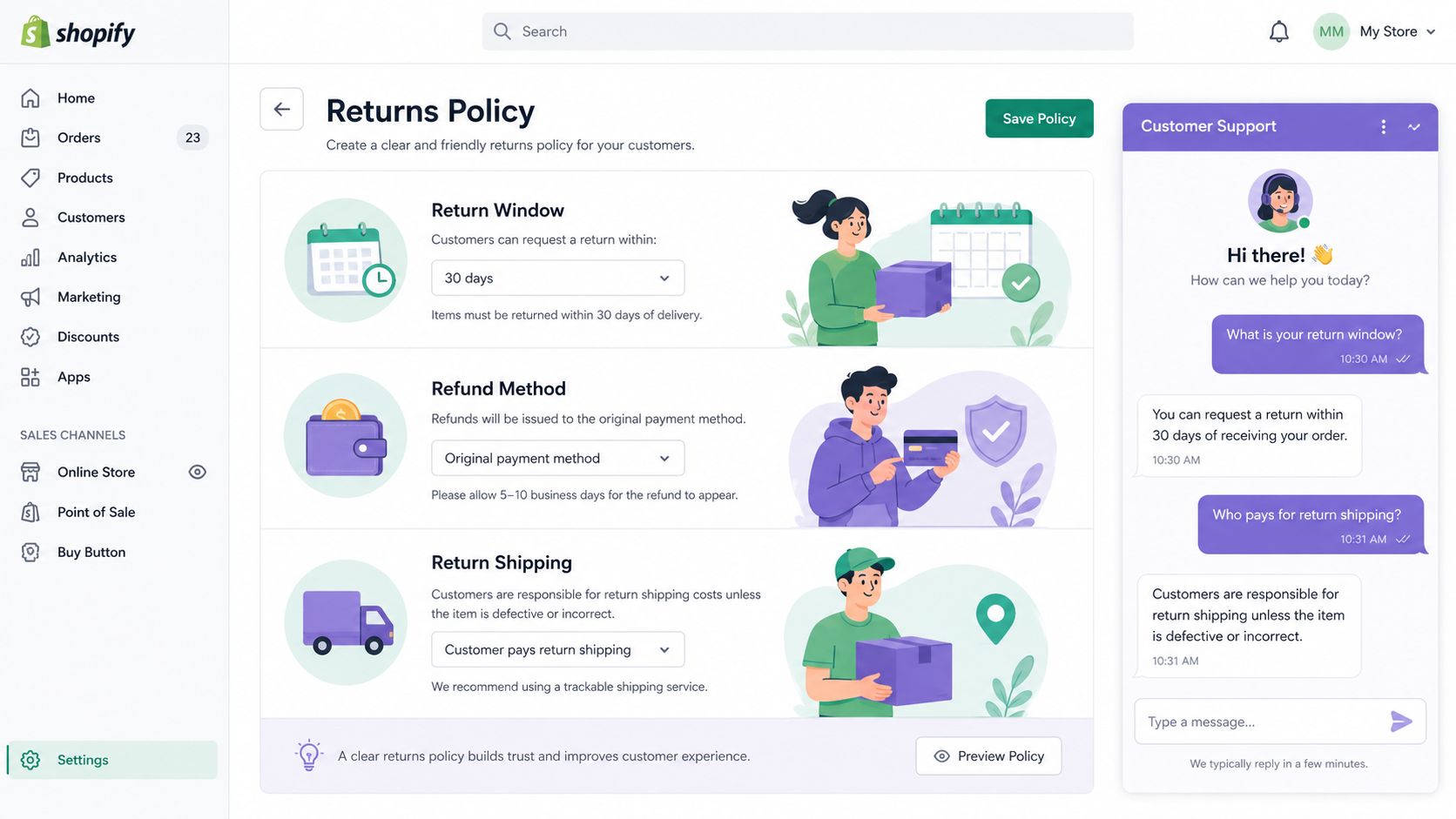
A Shopify-ready policy does a lot of work before support ever gets involved. It should name the return window, the refund method, who pays return shipping, and the exact resolution options available when the item is faulty, damaged, or just unwanted. If you sell across regions, it should also make room for market-specific consumer law so your team isn't forced to improvise at the worst possible moment.
The customer-facing pages matter just as much. Clear size charts, accurate product media, shipping expectation blocks, and a plain-language returns summary reduce the number of avoidable refund requests that start with confusion instead of defect. On the service side, your macros should ask for the minimum data needed to classify the issue, order number, condition, photos, and whether the customer wants exchange, credit, repair, or refund.
The KPI setup should mirror the workflow. Track return rate as a product and fulfillment diagnostic. Track refund rate as a revenue and cash-flow metric. Then wire both into separate dashboards so merchandising sees fit and quality issues while finance sees settlement pressure and leakage.
A practical decision checklist helps your team move faster:
- Is the item coming back? If yes, it's a return flow.
- Is cash leaving the business? If yes, it's a refund flow.
- Is the issue legal or policy-driven? If yes, check region-specific rules first.
- Would pickup and processing cost more than the item is worth? If yes, consider a returnless or partial refund.
- Can the customer be saved with an exchange, credit, or replacement? If yes, don't force a cash-only outcome.
The brands that win here don't just process tickets faster. They design the system so the right answer is obvious to the agent, visible in the dashboard, and predictable for the customer. That's where strong Shopify operations turn refunds into retention instead of leakage.
ECORN helps Shopify brands build that kind of operational clarity with design, development, and CRO support that fits how growing stores work. If you're tightening policy, fixing post-purchase friction, or separating return and refund reporting so your team can make better decisions, visit ECORN and talk through the workflow your store needs next.


Shopify Plus Ecommerce Agency: How to Pick the Right One

Shopify Themes Retina: How to Serve 2x Images

How to Cross Sell on Shopify Without Friction

Best Shopify Theme for Custom Products Compared
Multi Store Inventory Management: A Practical Guide

SEO Consulting for Ecommerce: A Practical Guide

Shopify Theme Updater App: A Safe Update Playbook
Shopify Git Integration: A Developer's Guide to 2026
Headless Ecommerce Development Services Explained

How to Build a Shopify Clothing Website That Converts

How to Launch a Box Subscription Business in 2026

Luxury Skincare Branding Playbook That Converters
10 Best Podcast Ecommerce Shows for Store Growth in 2026
Shopify Developer Hourly Rate: What to Pay in 2026
Critical Shopify Setup Errors That Are Secretly Sabotaging Your Store
Ecommerce Conversion Tracking: The Complete How-To Guide

Shopify Design Agency: How to Pick the Right Partner
Mastering Multi Store Management on Shopify
Scale Shopify Store

10 Shopify App Ideas Worth Building in 2026
Conversion Rate Optimization for Landing Pages: The Playbook
Shopify Plus Automation: A Guide for 2026
10 Social Selling Platforms for Shopify Merchants

Shopify Website Design Examples: 7 Stores Worth Studying
7 Ecommerce Newsletter Examples for Shopify Brands
One Product Shopify Store: Build and Scale

Mobile Pop Up Strategy for Shopify Stores That Converts

Sitemap for Shopify: How to Find, Optimize, and Submit It

7 Single Product Websites Worth Emulating
Product Variants Shopify: The Complete 2026 Guide
Ecommerce Analytics Consulting for Growth
What Is AI Integration for eCommerce
How to Choose the Right eCommerce Website Development Firm
E Business Strategy Implementation
Conversion Tracking Setup for Shopify Stores
BigCommerce vs Shopify Plus Which Enterprise Wins in 2026
Shopify Theme Kit: Setup, Commands, and Migration Guide
Shopify Extension Development: A Practical 2026 Guide
Shopify Speed Score Explained and How to Improve It
Shopify Mobile Optimization: The 2026 Playbook
How to Add Subcategory in Shopify for Better UX
How to Implement Structured Data for Ecommerce in 2026

SEO App Mobile: Shopify Store Optimization Guide

Shopify Plus Support: What It Includes and How to Choose

Google Ads for Shopify: The Complete 2026 Playbook

Shopify New York: How to Find and Hire the Right Agency

Google Search Console for Shopify: The Complete Setup
First Party Data Collection for eCommerce Growth
FAQ Online Store Guide: Build and Measure It Right
Do FB Ads Work for eCommerce in 2026?
One Page Checkout for Shopify: Design and Implementation
Shopify GraphQL vs REST: The 2026 Developer Decision
Shopify Ecommerce Consulting: Strategy, Pricing &

Are Reddit Ads Worth It for eCommerce Brands
Shopify Title and Meta Description: A Practical 2026 Guide

Product Video Best Practices for Shopify Brands
Real-Time Inventory Management: A 2026 Guide
AI Chatbot Integration for Shopify Stores
Affiliate Program Management: A Shopify Guide
10 Best Performance Monitoring Tools for Shopify in 2026
Digital Asset Management for eCommerce Brands in 2026
Every Type of Facebook Ads Explained for eCommerce Growth
Product Information Management Explained for Shopify Brands
Support Ticket System: A Guide for Shopify Stores

10 Best Customer Service Tools for Shopify in 2026

Can I Start a Business with No Money? a 2026 Blueprint

What Sells Good on Etsy: Best Niches for 2026

Shopify Add to Cart Button: A Practical 2026 Guide

Customer Feedback Automation: A Practical eCommerce Guide
Critical Rendering Path: A Guide for Shopify Stores

How to Promote on TikTok for eCommerce in 2026

B2B eCommerce Consulting That Drives Real Revenue

10 Best Practices for Site Navigation in 2026
What Is Customer Lifetime Value and Why It Matters
What Is Voice of Customer Research for eCommerce

SMS Marketing for Ecommerce That Actually Converts

Master How to Improve Email Deliverability in 2026

Top 8 eCommerce Partners NYC for Shopify Brands in 2026
Machine Learning for Ecommerce: Boost Your Shopify Store

Beauty Market Research: Your 2026 Growth Guide
Shopify International Expansion: A 2026 Roadmap
What Does CRO Stand for in Business: Understanding CRO

Shopify Visual Merchandising: A Playbook for Higher Sales

Shopify Landing Page Design: Master Conversion in 2026

10 Best AI SEO Optimization Tools for Shopify in 2026

Agentic AI for Ecommerce: Boost Your Sales in 2026
Mastering Email Marketing Data for eCommerce Growth

Conversion Rate Optimisation Australia: Boost Your Sales
Conversion Rate Optimization AI: Your Shopify Store Guide

10 Product Bundling Strategies for Shopify in 2026

How to Increase Customer Lifetime Value: A Shopify Playbook
AI Customer Service Automation: Shopify Guide 2026

Clean Website Design: A Shopify Conversion Playbook

Omnichannel Retail Strategy: A Shopify Playbook
Product Data Enrichment: A Guide for Shopify Brands

Instagram Shopping Features a Guide for Shopify Stores
What Is Revenue Optimization: A Holistic RevOps Guide

Benefits of Conversion Rate Optimization: Boost Your
WordPress to Shopify Migration: Your 2026 Seamless Switch
Boost Sales: Ecommerce Payment Processing Guide 2026


newsletter in your inbox