

Product Information Management is the system that keeps your product data clean, consistent, and ready to publish across every channel. For a Shopify brand, the outgrown-spreadsheet signal is simple, product updates start breaking on at least one channel, and your team keeps fixing the same listing in multiple places.
The global PIM market has already moved well beyond niche software, with estimates putting it at USD 12.2 billion in 2022 and projecting a 23.3% CAGR from 2023 to 2030, while another forecast places it at USD 17.56 billion in 2025 and USD 37.02 billion by 2030. Those numbers matter because they reflect a real operational problem, brands are no longer treating product content as a side task, they're treating it as core commerce infrastructure (industry market data).
The Catalog Chaos Every Growing Store Eventually Hits
A Shopify operator usually feels the problem before they can name it. One team member updates a jacket description in the store, another edits the same item for Amazon, and a third is trying to localize the title for a new market. By Friday, the sizes do not line up, one marketplace still shows an old material spec, and the translation file has already gone stale.
That drift is easy to ignore while the catalog is small. It gets expensive when product launches depend on people copying fields from spreadsheets, asset folders, and supplier emails into different systems, because one missed attribute can stall a launch or trigger a marketplace rejection. If inventory discipline is also slipping, pair catalog cleanup with a process to reduce overstock and stockouts, since product data and stock accuracy usually break together.
What the operator actually sees
The symptoms are rarely dramatic at first. A Shopify product page looks right, but the same SKU has a different title on a marketplace, or a variant image is attached to the wrong color. The more channels you add, the more often someone has to stop real work just to reconcile data.
A second spreadsheet is usually the warning sign. If your team needs one file to track the “real” title, another for marketplace copy, and another for translated attributes, manual catalog management has already stopped being manageable.
PIM exists because this kind of chaos does not stay contained. It spreads into content, merchandising, support, and paid media, because every downstream team starts working from a slightly different version of the same product. The problem is not just messy data. It is the same jacket, bundle, or SKU turning into five different versions as it moves through your stack.
The market reflects that pressure too. Analysts continue to treat product data management as core commerce infrastructure, not a side project tucked away in operations, because brands keep hitting the same failure points in richer catalogs and more channels.
What Product Information Management Means
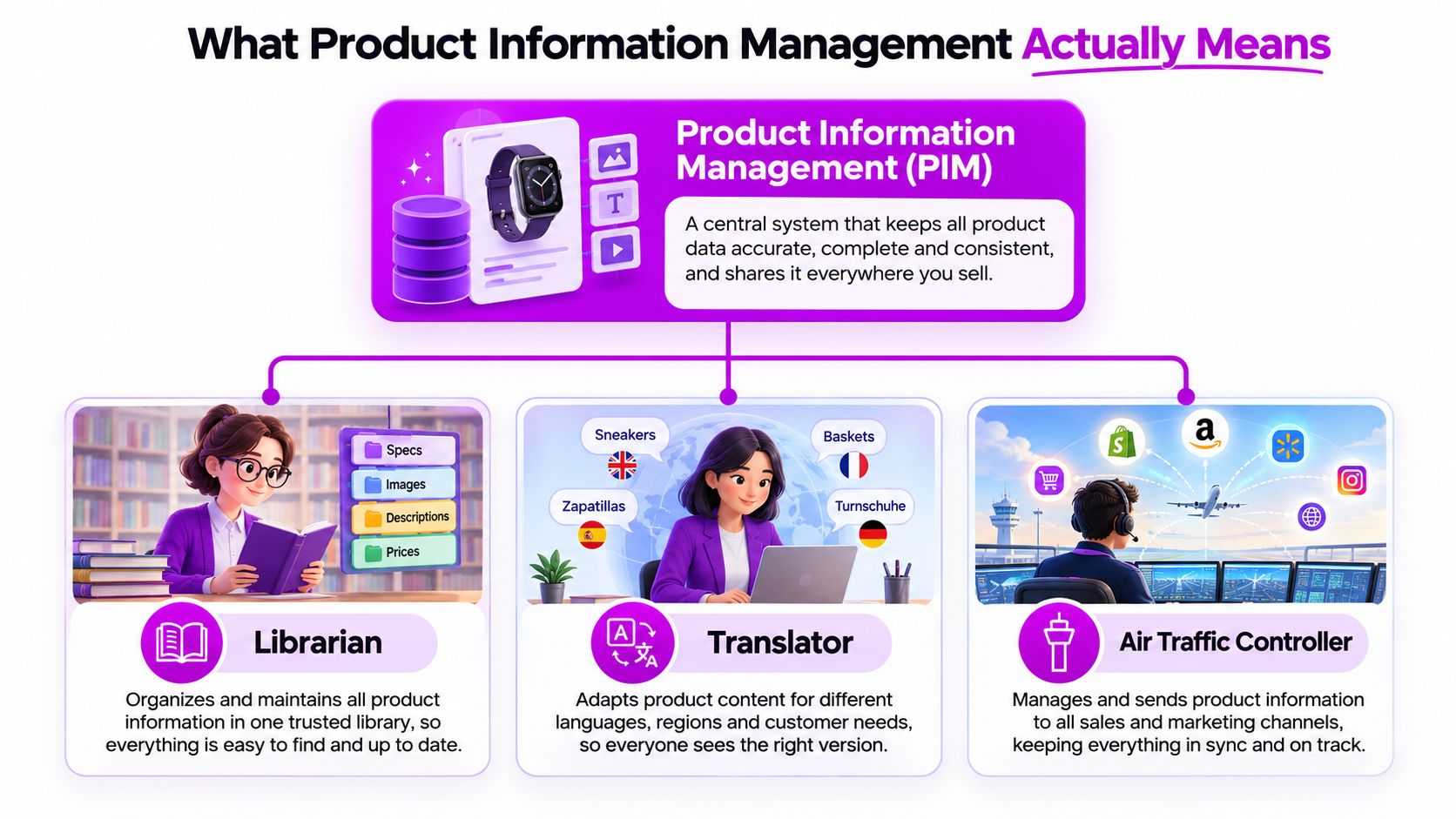
Product Information Management is the discipline and software layer that collects, structures, enriches, governs, and distributes product data from one authoritative place. A PIM system does more than store descriptions. It keeps the current version of every attribute, asset, and localized detail moving to the right channel in the right format, which is why architecture quality matters so much in practice (PIM architecture overview).
In a growing Shopify catalog, the role is easiest to see through failure modes. A variant title drifts on a marketplace, a translated attribute goes stale in one region, or a bundle description gets edited in two places and no longer matches the base SKU. PIM sits in the middle of those problems and gives the team one controlled place to resolve them before they spread.
The workflow is straightforward. Product data comes in from suppliers, merchandisers, and operations teams, then gets cleaned, enriched, approved, and published to the channels that need it. That matters because each channel wants the same product in a different shape. Shopify may need one structure, a marketplace another, and a print catalog another still.
What counts as product information
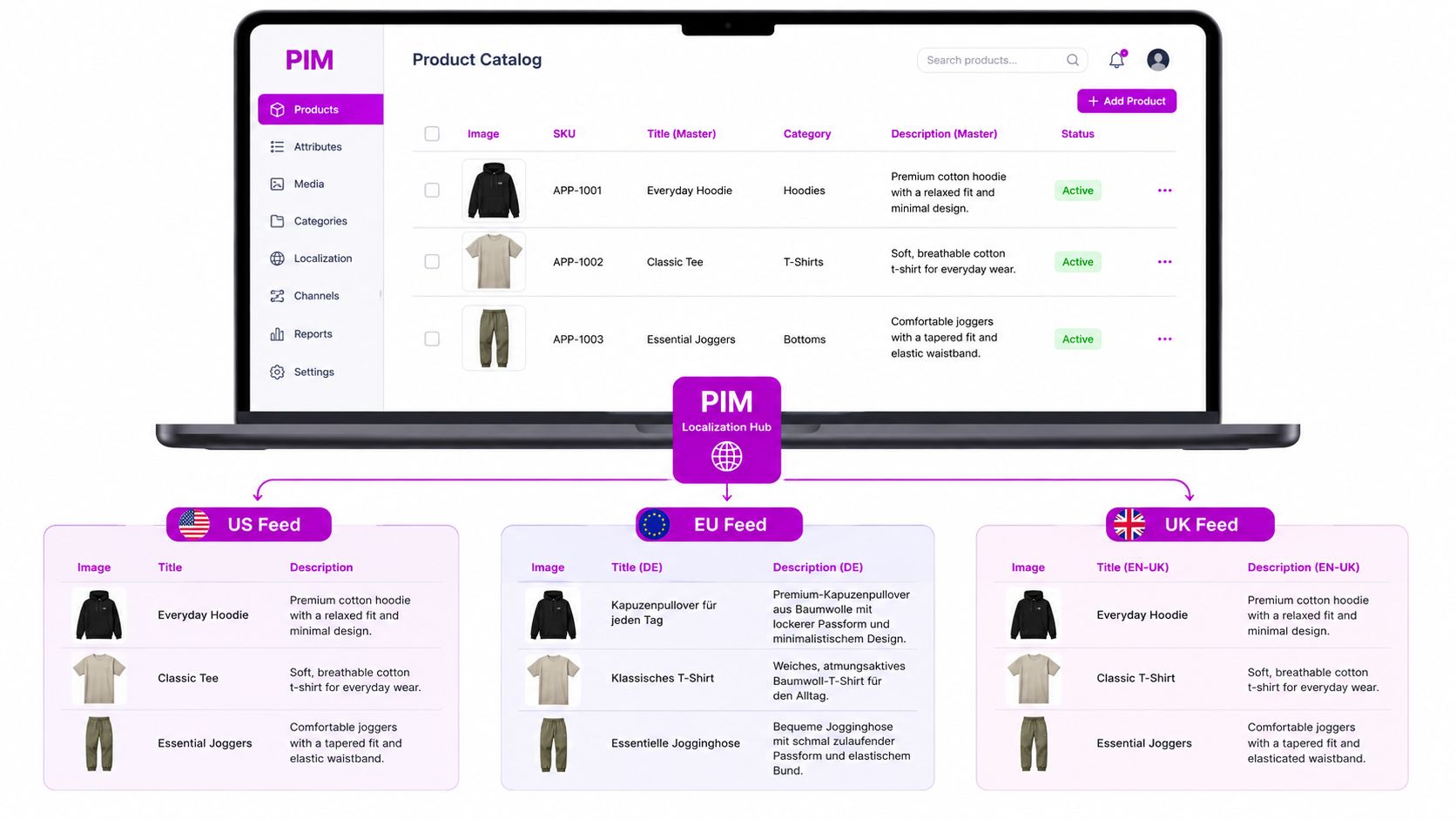
Product information is broader than a title and a description. It includes attributes like material, dimensions, and care instructions, plus media assets like images and manuals, and relationship data like what belongs in a variant family or what item sits inside a bundle. It also includes localization metadata, which tells your team which content belongs in which market and which units or language rules apply.
The catalog gets messy when those pieces are stored separately and edited by hand. A product detail page can look fine in Shopify while the same SKU carries a different color name in a marketplace feed, or a translated size attribute lands in the wrong field. A PIM keeps the shared record, the variant record, and the market-specific version connected instead of copied across spreadsheets.
That separation matters because product teams often need enrichment without losing control. If a merchandiser improves the copy for a campaign, that change should not overwrite the technical spec that operations depends on. If a localization team adapts the wording for one market, the base product identity should stay intact.
For teams building out catalog operations, product data enrichment guidance can help frame where human review belongs and where automation should carry the load.
ERP handles operational backbone data, like inventory and finance. CMS handles editorial experiences and web pages. PIM sits between them, owning the product record that needs to be precise enough for operations and persuasive enough for commerce.
PIM is the control layer for product content that has to survive multiple channels, distinct from website editors and warehouse systems.
Once that boundary is clear, implementation decisions get easier. The team can assign ownership by data type, decide which system should create each record, and define how product data moves without turning every update into a manual cleanup task.
Inside a PIM Core Components and Data Model
The power of PIM shows up in the data model. A mature system doesn't flatten everything into one giant spreadsheet. It separates entities, attributes, relationships, taxonomies, variants, and permissions so each part of the catalog can be managed without breaking the rest. IBM's product data modeling guidance has long emphasized that this structure is what supports variant management, localization, enrichment, and governance at scale (data model reference).
How a normalized model helps a real catalog
Take a fashion brand selling one sweatshirt in three colors and five sizes. A weak model often creates duplicate fields, one place for color, another for shade, another for variant name, and then a separate spreadsheet for translations. A normalized PIM model keeps the product, the SKU variants, the shared attributes, and the market-specific content connected instead of copied.
That matters because copy-paste logic breaks fast. If material details change, the team should update one controlled attribute and let the change flow to every relevant channel. If the product is renamed for a market, the system should store that localization cleanly without overwriting the base product identity.
Here's the practical vocabulary that usually helps implementation meetings go faster:
- Entities describe the thing you sell, such as a product, SKU, or bundle.
- Attributes hold the facts, such as size, color, fit, or care instructions.
- Relationships connect items, such as parent-child variants or bundled products.
- Taxonomies organize navigation, collections, and category hierarchies.
- Permissions control who can edit, approve, or publish specific records.
Why weak modeling causes expensive cleanup
A poor model doesn't just look messy. It creates duplicate attributes, inconsistent search behavior, and channel outputs that don't match the rules of each marketplace or storefront. That's why product onboarding becomes harder over time, especially when source systems, supplier feeds, and merchandising teams all define the same thing a little differently.
For teams evaluating software, the question isn't whether the interface looks polished. It's whether the model can absorb growth without forcing constant rework. If you're enriching products through a broader commerce stack, the best companion reading is this product data enrichment guide, because enrichment only works when the underlying structure is sound.
PIM vs ERP vs DAM vs CMS How They Fit Together
The easiest way to place PIM in your stack is to compare ownership. ERP owns operational truth, DAM owns assets, CMS owns page experience, and PIM owns the product record and its syndication. PIM is usually the bridge between operational systems and customer-facing channels, not a replacement for them.
| System | Primary job | Typical owner | Channel output |
|---|---|---|---|
| PIM | Product content, enrichment, and distribution | Ecommerce, merchandising, product ops | Shopify, marketplaces, feeds, partner channels |
| ERP | Finance, inventory, supply chain, operational records | Operations, finance, IT | Internal systems, replenishment, order flows |
| DAM | Images, video, documents, creative assets | Creative, brand, content teams | Asset libraries, campaign references, linked media |
| CMS | Editorial pages and web experience | Content, marketing, web teams | Landing pages, blog content, site experiences |
The most common mistake is trying to make Shopify behave like a PIM. Native fields are fine for simpler catalogs, but once the team needs channel-specific formatting, richer variant logic, or multi-market content governance, the store can't safely carry the whole burden. If your stack is already complex, a well-planned integration path matters, and this Shopify integration services overview is a useful reference point for thinking about system boundaries.
A simple rule of thumb
Use PIM when the same product needs to appear in many places, but not in exactly the same form. Let ERP own what's operational, let DAM own what's visual, and let CMS own what's editorial. Then let PIM assemble the channel-ready version that Shopify, marketplaces, and other endpoints can trust.
That separation also keeps implementation debates honest. If a team says it wants PIM to manage inventory, the answer is usually no. If it says it needs one controlled place for product names, attributes, translations, and distribution rules, that's exactly where PIM belongs.
The Business Case Why PIM Pays for Itself
The business case becomes clearer once PIM is framed around the costs it removes, not as a generic data hygiene project. The payback usually comes from revenue protection, operational efficiency, and risk reduction, because those are the places where weak product data creates visible cost. A 2024 RIWI survey found that 37% of respondents said bringing products to market is the biggest PIM pain point, and the same report pointed to data inconsistency and changing data formats as the main sources of complexity (RIWI survey).
Where costs leak
Revenue leakage shows up when a product goes live late, gets rejected by a channel, or appears with inconsistent content that weakens conversion. A launch can be technically ready in Shopify and still miss the mark if marketplace titles, bullets, or compliance fields do not match what each channel expects. Operational leakage shows up when teams spend hours cleaning spreadsheets, rebuilding descriptions, or chasing missing attributes across departments. Risk leakage shows up when localization, compliance copy, or audit trails are handled loosely and create avoidable exposure.
The hardest part of the business case is admitting that PIM also creates work before it saves work. Teams need modeling, integration, governance design, and training, because the system only pays off if it becomes the place everyone trusts for product data. If that setup is rushed, PIM becomes one more half-maintained layer sitting between systems. The upside is real, but so is the cost of doing it badly.
The best ROI model for PIM starts with failure cost, not feature count.
A practical way to justify the project
Start with the points where catalog mistakes already cost the team time or revenue. A SKU that needs rework for every channel is a direct signal. A product launch that stalls because assets, attributes, or translations are not ready is another. So are support tickets caused by inaccurate descriptions, missing sizing details, or inconsistent compliance notes.
Then translate that pain into a project cost that finance can review. Count how much time the team spends fixing the same record in more than one place. Review returns, support issues, and channel rejections tied to bad product content. Include data cleanup, integrations, governance setup, and change management in the implementation estimate, not just software licensing.
The category is also moving beyond simple centralization into syndication, contextualization, and effectiveness analytics. That shifts PIM away from being a content warehouse and toward a control layer for commerce operations, especially where assortment complexity and channel pressure are high (market context).
For brands with growing catalogs, the question is whether they want to keep paying for fragmented product data in staff time, missed launches, and channel rework. The cost shows up somewhere. PIM just makes it visible, and then reduces it.
When and How to Adopt PIM on Shopify
Shopify brands usually outgrow spreadsheets in a few recognizable moments. The catalog starts spanning multiple markets, product launches speed up, marketplaces require stricter formatting, and the team can't keep variant data aligned by hand. Manufacturers and multi-market operators face an even heavier version of that problem, because they often need to coordinate ERP, CRM, CAD, QMS, distributor portals, multilingual content, permissions, and audit trails at once (manufacturing PIM guidance).
Signals that it's time
If product updates regularly need manual rework before they can go live, you're already in PIM territory. If one SKU needs different copy, imagery, or compliance notes by channel, you're also in PIM territory. If you're expanding into marketplaces or new geographies and every new channel adds another spreadsheet, the store has become the bottleneck.
The adoption pattern usually starts with one category, not the whole catalog. Teams audit the messy product records first, decide what the product model should look like, and then connect the source systems that already own parts of the truth. After that, they roll out to more collections, more channels, and more users only after the governance rules hold up.
Common integration patterns
A Shopify brand usually places PIM in one of three patterns. A catalog app pattern works for simpler operations that mainly need better structure. A middleware pattern fits brands with ERP, OMS, and marketplace feeds that need orchestration. A headless pattern fits teams that want tighter control over how product content is assembled for storefronts and experiences.
The implementation sequence is more important than the tool choice:
- Audit the data, find the duplicated fields, stale translations, and broken variant structures.
- Design the model, decide what the canonical product, SKU, and channel fields should be.
- Pilot one category, prove the workflow on a segment that has real complexity but manageable risk.
- Build the connectors, wire Shopify and adjacent systems into the new product flow.
- Set governance, define who approves, who publishes, and what completeness means before go-live.
That sequence keeps the project grounded. It also makes it easier for internal teams to see that PIM is not a replacement for existing systems, it's the discipline that stops those systems from arguing with one another.
Real Shopify Use Cases and What to Copy
A DTC apparel brand entering three markets usually discovers that localization is the core catalog problem, not translation alone. The team needs currency-aware content, region-specific sizing notes, and variant structures that stay consistent while the language changes. The feature to copy is not just translation support, it's the ability to keep a single product core while attaching market-specific content cleanly.
A multi-brand Shopify Plus store that syndicates to Amazon, Meta, and TikTok Shop has a different problem. Each channel wants different field formatting, media rules, and title logic, so the catalog team needs PIM to enforce channel-specific outputs without rewriting the product from scratch. If you're exploring how AI and ecommerce growth intersect with content operations, this guide to AI-driven e-commerce growth is useful context for thinking about how product content and discoverability now overlap.
A fast-launching brand with weekly drops has the simplest lesson of all. Spreadsheet rush jobs create brittle launches, while PIM gives the team a repeatable path for onboarding products, checking completeness, and publishing the same record everywhere without last-minute scrambling.
What these examples have in common is not software sophistication. It's control. Brands that win with PIM are the ones that stop treating product content like a set of isolated tasks and start treating it like a managed system with clear owners, rules, and outputs.
If your Shopify catalog is already showing signs of variant chaos, marketplace mismatches, or localization drift, ECORN can help you map the product data flow, define the right integration points, and build a Shopify stack that scales without spreadsheet firefighting. Visit ECORN to talk through PIM, Shopify Plus development, and the operational gaps that keep product data from publishing cleanly.



E Business Strategy Implementation
Conversion Tracking Setup for Shopify Stores

BigCommerce vs Shopify Plus Which Enterprise Wins in 2026
Shopify Theme Kit: Setup, Commands, and Migration Guide

Shopify Extension Development: A Practical 2026 Guide
Shopify Speed Score Explained and How to Improve It

Shopify Mobile Optimization: The 2026 Playbook

How to Add Subcategory in Shopify for Better UX
How to Implement Structured Data for Ecommerce in 2026

SEO App Mobile: Shopify Store Optimization Guide

Shopify Plus Support: What It Includes and How to Choose

Google Ads for Shopify: The Complete 2026 Playbook

Shopify New York: How to Find and Hire the Right Agency

Google Search Console for Shopify: The Complete Setup

First Party Data Collection for eCommerce Growth
FAQ Online Store Guide: Build and Measure It Right

Do FB Ads Work for eCommerce in 2026?

One Page Checkout for Shopify: Design and Implementation

Shopify GraphQL vs REST: The 2026 Developer Decision
Shopify Ecommerce Consulting: Strategy, Pricing &

Are Reddit Ads Worth It for eCommerce Brands

Shopify Title and Meta Description: A Practical 2026 Guide

Product Video Best Practices for Shopify Brands
Real-Time Inventory Management: A 2026 Guide

AI Chatbot Integration for Shopify Stores

Affiliate Program Management: A Shopify Guide
10 Best Performance Monitoring Tools for Shopify in 2026

Digital Asset Management for eCommerce Brands in 2026

Every Type of Facebook Ads Explained for eCommerce Growth

Support Ticket System: A Guide for Shopify Stores

10 Best Customer Service Tools for Shopify in 2026

Can I Start a Business with No Money? a 2026 Blueprint

What Sells Good on Etsy: Best Niches for 2026

Shopify Add to Cart Button: A Practical 2026 Guide

Customer Feedback Automation: A Practical eCommerce Guide

Critical Rendering Path: A Guide for Shopify Stores

How to Promote on TikTok for eCommerce in 2026

B2B eCommerce Consulting That Drives Real Revenue

10 Best Practices for Site Navigation in 2026

Return vs Refund for Shopify Stores: A Practical Guide
What Is Customer Lifetime Value and Why It Matters
What Is Voice of Customer Research for eCommerce

SMS Marketing for Ecommerce That Actually Converts

Master How to Improve Email Deliverability in 2026

Top 7 eCommerce Partners NYC for Shopify Brands in 2026

Machine Learning for Ecommerce: Boost Your Shopify Store

Beauty Market Research: Your 2026 Growth Guide

Shopify International Expansion: A 2026 Roadmap

What Does CRO Stand for in Business: Understanding CRO

Shopify Visual Merchandising: A Playbook for Higher Sales

Shopify Landing Page Design: Master Conversion in 2026

10 Best AI SEO Optimization Tools for Shopify in 2026

Agentic AI for Ecommerce: Boost Your Sales in 2026
Mastering Email Marketing Data for eCommerce Growth

Conversion Rate Optimisation Australia: Boost Your Sales
Conversion Rate Optimization AI: Your Shopify Store Guide

10 Product Bundling Strategies for Shopify in 2026

How to Increase Customer Lifetime Value: A Shopify Playbook
AI Customer Service Automation: Shopify Guide 2026

Clean Website Design: A Shopify Conversion Playbook

Omnichannel Retail Strategy: A Shopify Playbook
Product Data Enrichment: A Guide for Shopify Brands

Instagram Shopping Features a Guide for Shopify Stores

What Is Revenue Optimization: A Holistic RevOps Guide

Benefits of Conversion Rate Optimization: Boost Your
WordPress to Shopify Migration: Your 2026 Seamless Switch
Boost Sales: Ecommerce Payment Processing Guide 2026

Unified Commerce Platform: Benefits, KPIs & Shopify Guide

How to Reduce Bounce Rate eCommerce: Your 2026 Guide
Shopify API Integration: A Practical End-to-End Guide

How to Implement Data Governance: A 2026 Guide

Shopify Store Development Cost: A 2026 Breakdown
What Is Server Side Tracking: The Shopify Guide 2026
Marketing Automation Workflows: A Shopify Guide for 2026

Shopify: How to Reduce Technical Debt

Shopify UX Design Change: A Playbook for Growth

User Generated Content Strategy: Shopify Playbook

Shopify Pause and Build Plan Cost: A Complete 2026 Guide
Compare at Price on Shopify: A Complete Guide for 2026

Where Can I Sell My Prints? 10 Best Platforms for 2026
Shopify Order Management System: The Ultimate Guide 2026
What Is Marketing Attribution? an eCommerce Guide for 2026

10 Best Black Friday Sales Sheets for 2026

Discover the Top Social Media Marketing Agencies For
Consumer Confidence Definition for eCommerce in 2026

What Is Social Commerce? Your 2026 Guide to Boosting Sales

A Social Ad Campaign Playbook for eCommerce Growth

7 Best FAQ Page Examples for SaaS & eCommerce

Market Research in Fashion Industry: A Guide for Shopify
Shopify Migration Services: Expert Guide for 2026

Mastering FB Retargeting Ads for Shopify in 2026
What Is Omnichannel Ecommerce

Master Your Shopify Plus Migration: The 2026 Guide
Shopify Integration Services: A Merchant's 2026 Guide

Shopify Collection Description: A Guide to SEO & Sales

Shopify Plus Contact: Reach Sales & Support Effectively

Top Luxury Shopify Stores: Design & UX Strategies

How to Improve Customer Experience: A Shopify Roadmap

Creative Facebook Ads: 10 Examples for Shopify Brands

Remarketing with Facebook Ads: A Shopify Guide for 2026


newsletter in your inbox