

Paid social is stable enough. Google is still bringing in intent. New customer volume looks fine in the dashboard. But profit feels tighter every month because you keep paying to replace customers who should have come back on their own.
That's the trap. A lot of Shopify brands are managing for first-purchase efficiency while the core business is won after checkout. If the second order is weak, the time-to-second-purchase is long, or repeat buyers behave no differently than one-time buyers, acquisition eventually stops scaling cleanly.
The brands that grow with less drama treat customers like assets, not transactions. That starts with customer lifetime value. It's the metric that tells you whether your retention, merchandising, lifecycle marketing, service, and channel strategy are producing durable value.
Moving Beyond First-Purchase Profitability
Most operators first see the CLV problem when acquisition costs rise faster than contribution margin. The instinct is usually to squeeze media buying harder, cut creative faster, or push the landing page conversion rate up another notch. Those things matter. They just don't fix a customer file that isn't compounding.
A more useful lens is this: a small group of customers usually drives the business far more than the average customer does. The Pareto Principle is a good example. 80% of a company's total revenue often comes from just 20% of its customers, as noted by Pragmatic Institute's CLV analysis. If that pattern is even directionally true in your store, equal treatment across the whole database is a budgeting mistake.
What changes when you manage for CLV
When a brand shifts from first-order thinking to lifetime value thinking, a few decisions change immediately:
- Retention gets funded earlier. You stop treating post-purchase as an afterthought and build flows, offers, and service around getting order two faster.
- Top cohorts get special treatment. High-value customers should get better onboarding, earlier product access, and more relevant communication than low-intent one-time buyers.
- Discounting gets more selective. Blanket promos often waste margin on customers who were already likely to buy again.
Practical rule: If your best customers are hidden inside an “all subscribers” email segment, you're leaving money on the table.
This also changes how you judge channels. A source that produces cheap first orders can still be a bad source of customers if those cohorts churn early, buy low-margin products, or never move past the initial discount. Revenue can look healthy while the customer base gets weaker underneath.
For Shopify brands, that's why learning how to increase customer lifetime value isn't a side project. It's the operating system for sustainable growth.
First Measure What Matters Calculating Your CLV
You can't improve CLV if the business only reports on daily sales, ROAS, and new customer revenue. Start with a baseline that's simple enough to calculate now, then make it more predictive once your team trusts the metric.
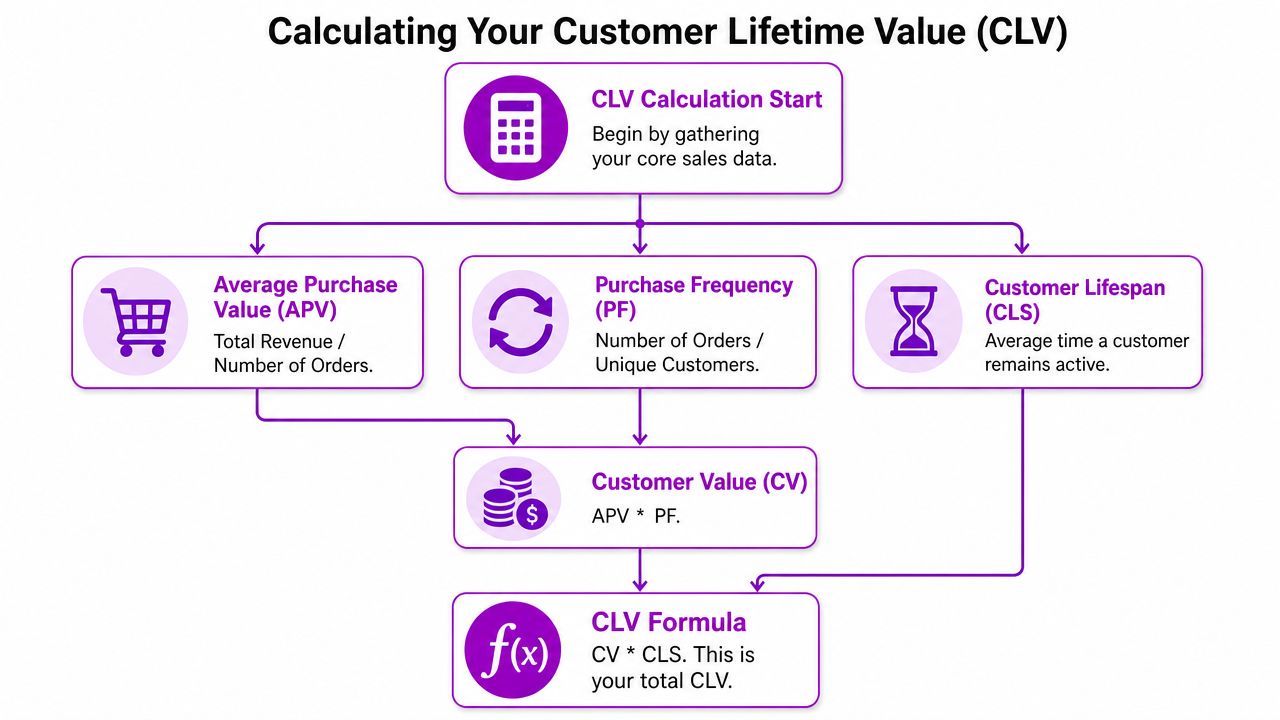
Start with the historical formula
For a Shopify store, the cleanest starting point is:
CLV = Average Purchase Value × Purchase Frequency × Customer Lifespan
Those three inputs are enough to build a usable baseline.
| Input | What it means | How to pull it |
|---|---|---|
| Average Purchase Value | Revenue per order | Shopify sales reports or exported order data |
| Purchase Frequency | Orders per customer over a period | Customers report plus order count |
| Customer Lifespan | How long customers stay active | First-order to last-order analysis in your customer export |
If you want a deeper walkthrough of the formulas and data structure, this guide to calculating customer lifetime value for data-driven growth is a good companion.
The mistake to avoid is using a single storewide average and calling it done. Storewide CLV is useful for orientation. It's weak for decision-making because it hides the differences between acquisition channels, entry products, and customer cohorts.
Build the baseline in segments
At minimum, calculate historical CLV for these slices:
Acquisition channel
Compare paid search, paid social, organic, affiliate, influencer, and direct.First product purchased
Some entry products attract strong repeat buyers. Others create one-and-done behavior.Discounted versus full-price first order
A lot of margin leakage often becomes apparent in this area.New versus returning customer paths
Returning customers often behave differently enough that they should not be judged by the same journey assumptions.
Your first useful CLV model usually comes from exported order data and disciplined segmentation, not from a fancy app.
Move from historical to predictive CLV
Historical CLV tells you what happened. Predictive CLV helps you decide what to do next. For Shopify brands, that means layering in customer signals that indicate likely future value, such as repeat purchase cadence, category depth, support behavior, subscription enrollment, and engagement with post-purchase messages.
A practical predictive model usually asks questions like these:
- Has the customer placed a second order quickly or slowly?
- Did they buy into a replenishable category?
- Are they purchasing across categories or only within one SKU family?
- Did they enter through a steep discount or through a standard offer?
- Has engagement dropped after onboarding?
You don't need a perfect data science model to get value. You need a working score that helps the team prioritize actions. If one cohort repeatedly develops into high-value customers, protect that channel and replicate its characteristics. If another cohort looks efficient only on first purchase, stop scaling it blindly.
Use the baseline as an operating metric
CLV belongs in weekly trading conversations, not in a quarterly strategy deck. Put it next to CAC, contribution margin, and cohort retention so the team can see where growth is durable and where it isn't.
The key is consistency. Use the same definitions every month. Rebuild the segmented view regularly. Once the team can trust the baseline, testing becomes far easier because everyone knows what success looks like.
The Three Levers for Driving CLV Growth
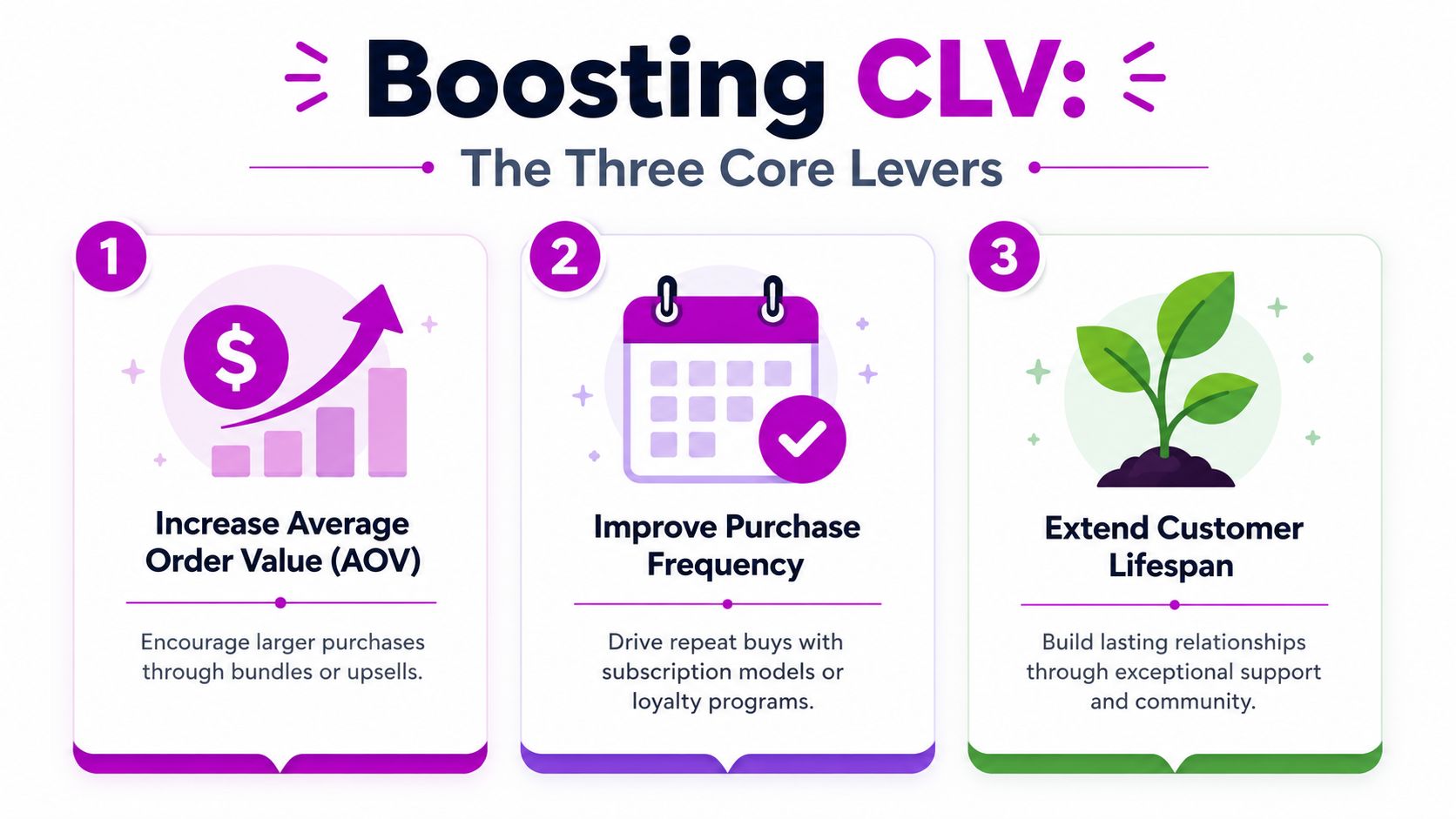
A Shopify brand can grow revenue while CLV stays flat. That usually happens when acquisition is doing all the work and retention is underbuilt. Once your baseline is reliable, the job is to improve the three variables that move customer value over time: average order value, purchase frequency, and customer lifespan. As noted earlier in the Rivo report, those are the core growth levers.
A short explainer helps frame the tactical work:
Increase average order value
AOV is usually the fastest lever to test because the feedback loop is short. You can change an offer, watch conversion rate, track contribution margin, and know within days whether the idea deserves more traffic.
The mistake is treating AOV as a merchandising problem only. It is really an offer design problem. If the added item improves the outcome of the original purchase, AOV tends to rise without hurting conversion. If it looks forced, customers ignore it or lose trust.
For Shopify brands, the strongest AOV tests usually fall into three buckets:
- Cart and checkout upsells tied to the original intent. Pair a hero SKU with the accessory, refill, or complementary product that makes the first order more complete.
- Use-case bundles such as starter systems, routines, travel kits, or refill packs. These work because the customer understands why the products belong together.
- Threshold offers that increase basket size without training shoppers to wait for discounts. Free shipping thresholds and value-add gifts often work better than blunt percentage-off promos.
Bundling can lift revenue, but only if the bundle is easy to understand and margin-safe, as noted earlier in the same Rivo report. Test AOV changes against conversion rate, gross margin, and refund rate together. A bigger basket is not a win if it creates more discount dependency or lower-quality orders.
Improve purchase frequency
Frequency is where CLV starts to compound. A customer who buys every 45 days is markedly different from one who buys once and goes quiet for six months, even if their first order looked identical in Meta reporting.
The best frequency programs are built from product reality. Reorder timing should reflect actual consumption, not whatever cadence fits the email calendar. Educational flows should help customers get value from the product faster, because usage is what creates the next order. For a useful reference point, our guide to eCommerce customer retention strategies for Shopify brands covers the retention mechanics that support repeat purchasing.
Tactically, focus on:
- Replenishment reminders based on expected depletion windows by SKU or bundle
- Post-purchase email and SMS flows that teach usage, answer objections, and introduce the next logical product
- Subscriptions where demand is recurring and cancellation friction is low
- Loyalty mechanics that reward repeat behavior, not only high one-time spend
Segmentation controls whether these programs work. A first-time buyer, a lapsed customer, and a high-value subscriber should not receive the same message sequence. If your team needs a practical refresher, this piece on segmentation for lead growth is useful because the logic carries directly into retention and reorder campaigns.
Extend customer lifespan
Lifespan is the hardest lever because it depends on the full operating model. Product satisfaction, support quality, shipping reliability, account experience, and post-purchase communication all shape whether a customer stays active long enough to become highly profitable.
That makes lifespan slower to improve, but more durable once fixed.
Here is where teams need discipline. Do not treat every retention issue as a loyalty issue. Points programs can increase engagement for customers who already like the brand. They do very little for customers dealing with late deliveries, confusing onboarding, poor product fit, or slow support.
A practical way to evaluate lifespan initiatives is to look at the trade-off each one creates:
| Tactic | What it can improve | What to watch |
|---|---|---|
| Tiered loyalty programs | More repeat engagement and higher spend from active customers | Margin erosion if rewards are too generous |
| VIP treatment for top cohorts | Better retention among customers driving disproportionate profit | Service complexity if qualification rules are unclear |
| Better support and self-service | Lower churn from avoidable frustration | Higher short-term operating cost |
| Education and community | More product adoption and stronger brand attachment | Slow payoff if content is not tied to reorder behavior |
The brands that grow CLV consistently do not run these levers as separate projects. They build a system. Order one increases AOV through a relevant bundle. The post-purchase flow increases product adoption. Reorder prompts increase frequency. Loyalty and service improvements extend lifespan. Then the team measures the effect by cohort, keeps what improves contribution margin, and cuts what only makes dashboard metrics look better.
Optimizing the Customer Journey for Retention
A customer doesn't think in terms of CLV. They think in terms of effort. Was the product easy to understand? Was the account login annoying? Did the returns flow feel like a fight? Did support solve the issue without a loop of canned responses?
Those moments decide whether the second order happens.
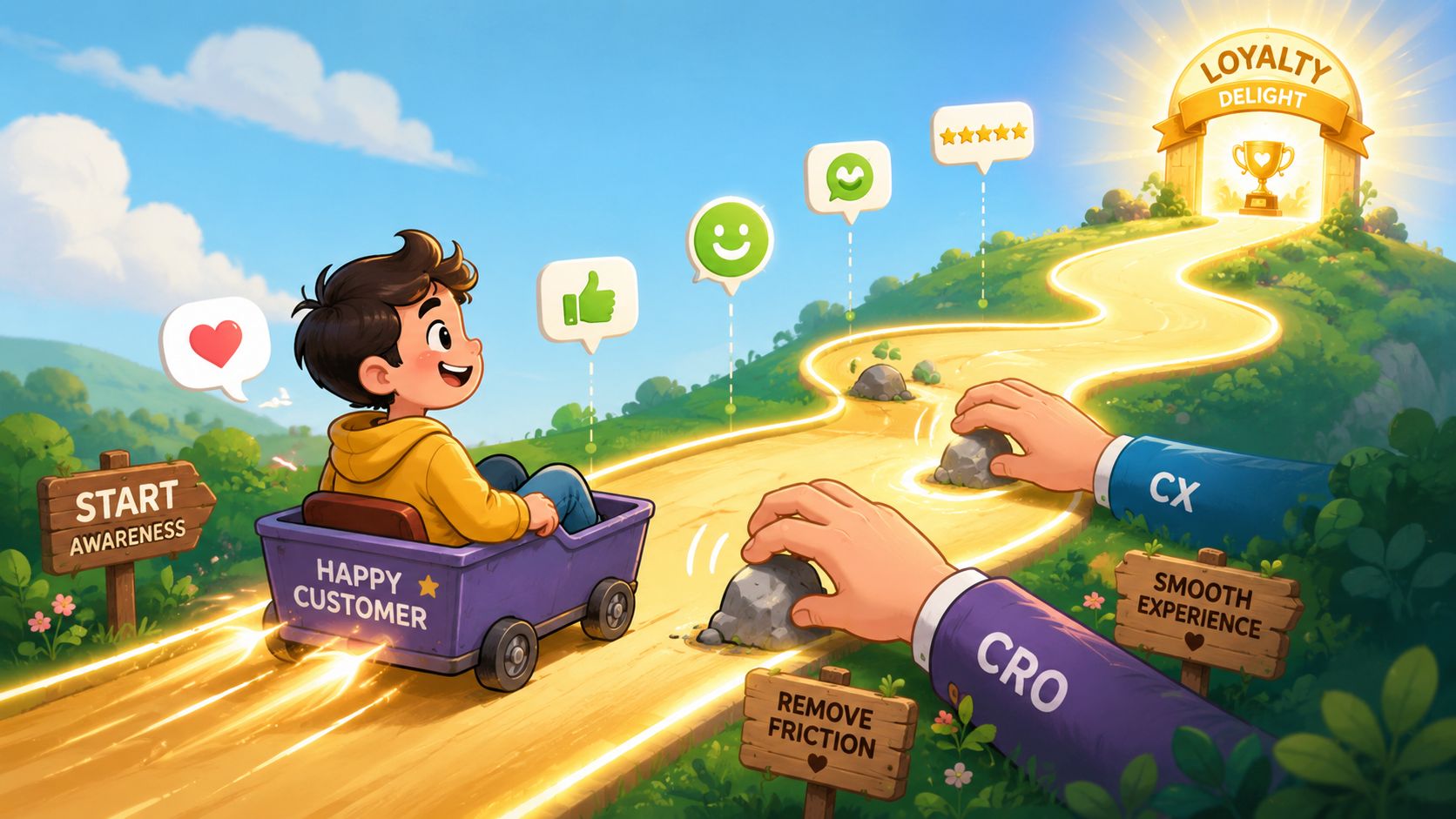
Follow the friction, not the opinion
A common pattern looks like this. The team sees acceptable conversion rates and assumes the journey is healthy. Then repeat purchase underperforms, customer support tickets rise, and account usage stays low. The issue often isn't the initial sale. It's hidden friction after the sale.
Contentsquare highlights a data-driven way to approach this: track frustration signals like rage clicks and hesitation moments, then use journey mappings and session replays to find where customers struggle and fix those points before they affect retention, as described in their guide to improving CLV through experience analytics.
That approach works because it shows behavior, not just outcomes.
What to inspect in a Shopify journey
For retention, review the customer path in this order:
Post-purchase confirmation and onboarding
Does the customer know what happens next, when shipping updates arrive, and how to get started with the product?Account and login experience
Returning customers shouldn't face unnecessary friction just to reorder or check status.Returns and exchanges
A painful return doesn't just risk one refund. It often kills the next order too.Reorder path
If someone wants to buy again, can they do it in a few clicks from email, SMS, account page, or subscription portal?
A lot of brands spend more time debating campaign creative than reviewing these fundamentals. That's backwards. The retention lift usually comes from removing friction that should never have been there.
Fix the journey points that customers repeatedly fight with. Don't start with cosmetic homepage tweaks if the reorder path is clumsy.
A strong companion read for this work is this ecommerce customer retention playbook, especially if your team is trying to connect lifecycle marketing with UX improvements rather than treating them as separate projects.
Personalization should reduce effort
Personalization is often misunderstood as “show more products.” The better use is to remove unnecessary choices. Show the refill, not the whole catalog. Send the care guide for the item purchased, not the monthly newsletter dump. Present a support article that matches the product issue, not a generic help center homepage.
That's how to increase customer lifetime value through experience. Not by adding noise, but by making the next step obvious.
Building a System for Experimentation and Tracking
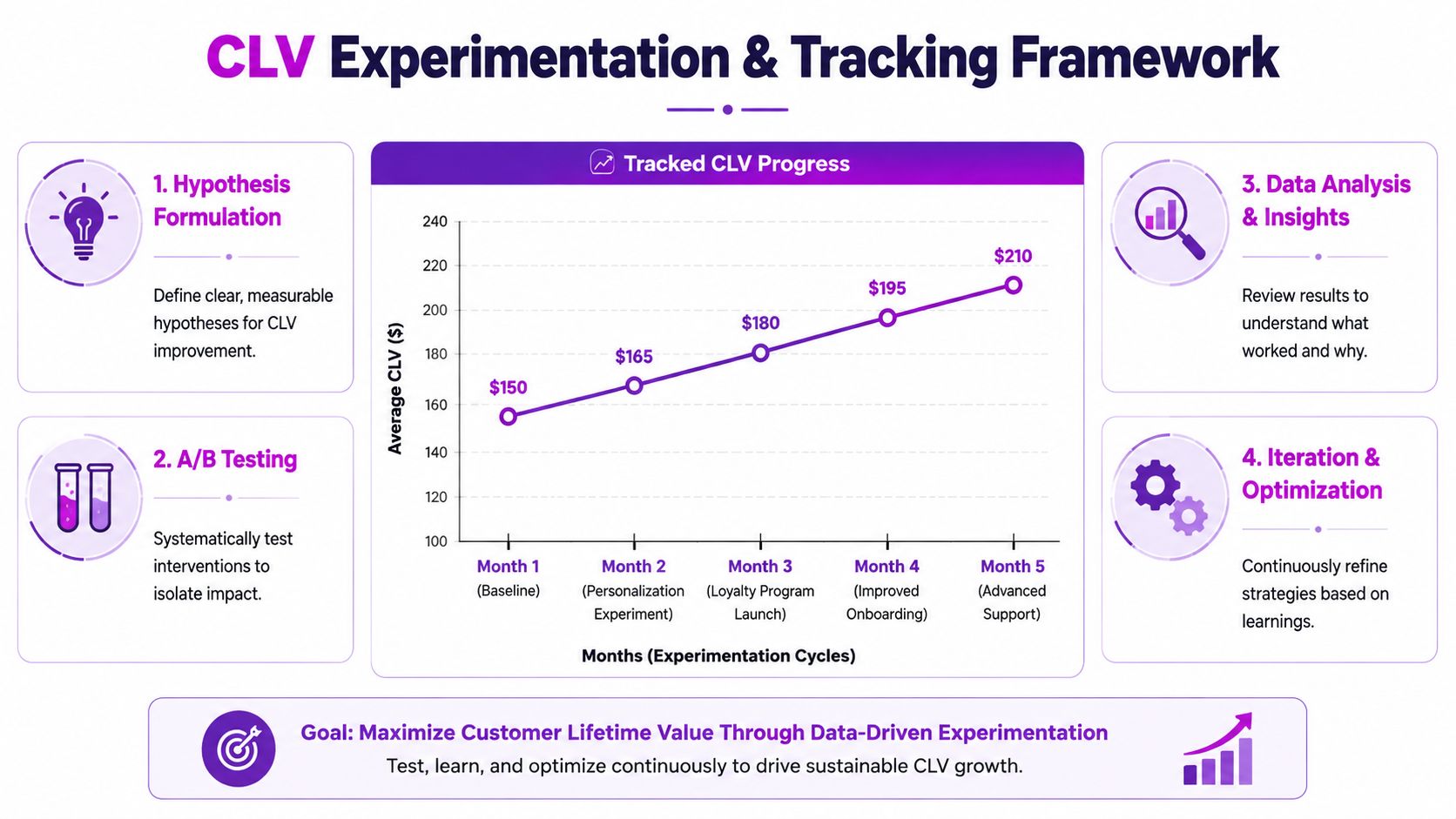
Most CLV programs fail for a simple reason. Teams launch tactics, report short-term revenue, and never isolate what changed customer value over time. That's why retention work needs an experimental framework, not a collection of ideas.
Use hypotheses, not hunches
Every CLV initiative should begin with a testable statement. Not “launch loyalty.” Not “improve onboarding.” A real operating hypothesis sounds more like this:
- Customers who buy refillable products will reorder sooner if we send replenishment messaging based on estimated usage timing.
- Customers entering through a starter bundle will show stronger repeat behavior than customers entering through a single-SKU discount.
- Customers who see a product education flow after purchase will have fewer support issues and stronger repeat purchase behavior.
The exact numbers in the hypothesis can vary by business, but the structure should stay the same. Name the audience, the intervention, and the expected CLV effect.
Read results through cohorts
Revenue reports answer “what sold.” Cohort analysis answers “what kind of customer did we create.”
Use monthly acquisition cohorts, then compare them over time by:
| Cohort view | What it tells you |
|---|---|
| Channel cohort | Which acquisition sources produce stronger long-term customers |
| First-product cohort | Which entry products attract repeat buyers |
| Offer cohort | Whether discount structure affects downstream value |
| Experience cohort | Whether customers exposed to a new journey perform better later |
Channel performance often gets misread. Brands routinely scale based on first-purchase economics alone, then discover later that those customers don't hold value well. A stronger approach is channel-level LTV:CAC alignment. Access Development's article on increasing customer LTV cites 2025 data showing that brands that reallocated budget based on cohort LTV, rather than first-purchase revenue, increased their 18-month CLV by 24% while reducing CAC by 18%.
That's the operational takeaway. Don't scale what looks good on day one if the cohort weakens by month twelve or month eighteen.
Working rule: Pause budget increases on channels that produce attractive first orders but weak downstream cohorts.
Keep the dashboard narrow
A useful CLV dashboard is smaller than is often believed. Include only the metrics that change decisions:
- Segmented CLV
- Time to second purchase
- Repeat purchase rate by cohort
- AOV by cohort
- Subscription retention or reorder cadence
- Channel-level LTV versus CAC
If the dashboard gets too broad, people revert to top-line revenue because it's easier to read. Keep CLV visible in weekly and monthly reviews so merchandising, lifecycle, media, and CX teams all operate from the same scorecard.
The goal isn't more reporting. It's cleaner decisions.
Your Practical CLV Rollout Checklist
If your team needs a starting plan, keep it simple and sequence the work. Don't try to rebuild lifecycle marketing, loyalty, merchandising, and analytics all at once. Get the foundation right, ship a few high-confidence tests, then scale what the cohorts validate.
Month 1 foundation and measurement
- Calculate baseline CLV. Pull a historical view from Shopify using average purchase value, purchase frequency, and customer lifespan.
- Segment the customer base. At minimum, break out acquisition channel, first product purchased, and discount versus full-price first order.
- Audit the post-purchase journey. Review confirmation, onboarding, account login, support flows, and reorder paths for friction.
- Build a simple dashboard. Put CLV, time to second purchase, and repeat behavior in one place your team checks regularly.
Month 2 quick wins and implementation
- Launch one AOV test. Start with a relevant bundle or a checkout upsell tied closely to the original product.
- Fix one major friction point. Choose the issue that most obviously slows repeat buying, such as confusing onboarding or a clumsy account experience.
- Improve lifecycle messaging. Replace broad post-purchase sends with segmented flows based on product type, expected reorder timing, or customer tier.
- Treat high-value customers differently. Give them better education, early access, or service priority instead of another generic discount.
Month 3 experimentation and scaling
- Create formal hypotheses. Tie each test to a specific customer segment and a defined retention outcome.
- Review cohorts monthly. Compare newer cohorts against earlier ones to see whether changes are producing stronger customer value over time.
- Reallocate channel spend. Shift budget toward sources that create durable customers, not just efficient first orders.
- Double down on frequency. The upside can be substantial because, as noted in Upside's retailer framework for increasing customer lifetime value, earning one additional visit per month from existing customers can dramatically increase annual revenue without new acquisition spend.
The sequence matters. Measure first. Remove friction second. Test focused retention and merchandising ideas third. Then scale only what improves the customer file, not just the next reporting window.
If your Shopify brand needs help turning CLV from a dashboard metric into an operating system, ECORN can help. Their team works across Shopify strategy, design, development, and CRO to build retention-focused experiences that increase repeat purchase behavior, strengthen conversion paths, and support sustainable growth.


10 Shopify App Ideas Worth Building in 2026
Conversion Rate Optimization for Landing Pages: The Playbook
Shopify Plus Automation: A Guide for 2026
10 Social Selling Platforms for Shopify Merchants

Shopify Website Design Examples: 7 Stores Worth Studying
7 Ecommerce Newsletter Examples for Shopify Brands
One Product Shopify Store: Build and Scale
Mobile Pop Up Strategy for Shopify Stores That Converts
Sitemap for Shopify: How to Find, Optimize, and Submit It
7 Single Product Websites Worth Emulating
Product Variants Shopify: The Complete 2026 Guide
Ecommerce Analytics Consulting for Growth
What Is AI Integration for eCommerce
How to Choose the Right eCommerce Website Development Firm
E Business Strategy Implementation
Conversion Tracking Setup for Shopify Stores
BigCommerce vs Shopify Plus Which Enterprise Wins in 2026
Shopify Theme Kit: Setup, Commands, and Migration Guide
Shopify Extension Development: A Practical 2026 Guide
Shopify Speed Score Explained and How to Improve It
Shopify Mobile Optimization: The 2026 Playbook
How to Add Subcategory in Shopify for Better UX
How to Implement Structured Data for Ecommerce in 2026
SEO App Mobile: Shopify Store Optimization Guide
Shopify Plus Support: What It Includes and How to Choose
Google Ads for Shopify: The Complete 2026 Playbook
Shopify New York: How to Find and Hire the Right Agency
Google Search Console for Shopify: The Complete Setup
First Party Data Collection for eCommerce Growth
FAQ Online Store Guide: Build and Measure It Right
Do FB Ads Work for eCommerce in 2026?
One Page Checkout for Shopify: Design and Implementation
Shopify GraphQL vs REST: The 2026 Developer Decision
Shopify Ecommerce Consulting: Strategy, Pricing &
Are Reddit Ads Worth It for eCommerce Brands
Shopify Title and Meta Description: A Practical 2026 Guide
Product Video Best Practices for Shopify Brands
Real-Time Inventory Management: A 2026 Guide
AI Chatbot Integration for Shopify Stores
Affiliate Program Management: A Shopify Guide
10 Best Performance Monitoring Tools for Shopify in 2026
Digital Asset Management for eCommerce Brands in 2026
Every Type of Facebook Ads Explained for eCommerce Growth
Product Information Management Explained for Shopify Brands
Support Ticket System: A Guide for Shopify Stores

10 Best Customer Service Tools for Shopify in 2026

Can I Start a Business with No Money? a 2026 Blueprint

What Sells Good on Etsy: Best Niches for 2026

Shopify Add to Cart Button: A Practical 2026 Guide

Customer Feedback Automation: A Practical eCommerce Guide
Critical Rendering Path: A Guide for Shopify Stores

How to Promote on TikTok for eCommerce in 2026

B2B eCommerce Consulting That Drives Real Revenue
10 Best Practices for Site Navigation in 2026
Return vs Refund for Shopify Stores: A Practical Guide
What Is Customer Lifetime Value and Why It Matters
What Is Voice of Customer Research for eCommerce

SMS Marketing for Ecommerce That Actually Converts

Master How to Improve Email Deliverability in 2026

Top 7 eCommerce Partners NYC for Shopify Brands in 2026
Machine Learning for Ecommerce: Boost Your Shopify Store

Beauty Market Research: Your 2026 Growth Guide

Shopify International Expansion: A 2026 Roadmap
What Does CRO Stand for in Business: Understanding CRO

Shopify Visual Merchandising: A Playbook for Higher Sales

Shopify Landing Page Design: Master Conversion in 2026
10 Best AI SEO Optimization Tools for Shopify in 2026

Agentic AI for Ecommerce: Boost Your Sales in 2026
Mastering Email Marketing Data for eCommerce Growth

Conversion Rate Optimisation Australia: Boost Your Sales
Conversion Rate Optimization AI: Your Shopify Store Guide

10 Product Bundling Strategies for Shopify in 2026
AI Customer Service Automation: Shopify Guide 2026
Clean Website Design: A Shopify Conversion Playbook

Omnichannel Retail Strategy: A Shopify Playbook
Product Data Enrichment: A Guide for Shopify Brands
Instagram Shopping Features a Guide for Shopify Stores
What Is Revenue Optimization: A Holistic RevOps Guide

Benefits of Conversion Rate Optimization: Boost Your
WordPress to Shopify Migration: Your 2026 Seamless Switch
Boost Sales: Ecommerce Payment Processing Guide 2026
Unified Commerce Platform: Benefits, KPIs & Shopify Guide
How to Reduce Bounce Rate eCommerce: Your 2026 Guide
Shopify API Integration: A Practical End-to-End Guide

How to Implement Data Governance: A 2026 Guide
Shopify Store Development Cost: A 2026 Breakdown
What Is Server Side Tracking: The Shopify Guide 2026
Marketing Automation Workflows: A Shopify Guide for 2026
Shopify: How to Reduce Technical Debt

Shopify UX Design Change: A Playbook for Growth
User Generated Content Strategy: Shopify Playbook
Shopify Pause and Build Plan Cost: A Complete 2026 Guide
Compare at Price on Shopify: A Complete Guide for 2026
Where Can I Sell My Prints? 10 Best Platforms for 2026
Shopify Order Management System: The Ultimate Guide 2026
What Is Marketing Attribution? an eCommerce Guide for 2026

10 Best Black Friday Sales Sheets for 2026

Discover the Top Social Media Marketing Agencies For
Consumer Confidence Definition for eCommerce in 2026
What Is Social Commerce? Your 2026 Guide to Boosting Sales


newsletter in your inbox