


A brand starts seeing orders trickle in from countries it never targeted. Then the questions stack up. Can you ship to Toronto? Why are prices still in USD? Will I get hit with duties at delivery? That is usually the moment Shopify international expansion stops feeling like a future idea and starts looking like a present operational decision.
The right move is not to rush into full localization. It is to prove where demand is real, protect margin while you learn, and expand only when the numbers support the extra complexity. I have seen brands waste months translating storefronts, setting up market-specific campaigns, and negotiating new 3PL terms for countries that never developed enough demand to pay back the effort. I have also seen brands grow internationally with far less risk by starting with a narrow test, clean reporting, and clear thresholds for what justifies the next layer of investment.
This represents the main opportunity with Shopify. It gives growing brands a practical starting point for selling across borders without forcing a multi-store rebuild on day one. The hard part is not turning features on. The hard part is deciding which market deserves attention first, how much localization it has earned, and when operational friction starts cutting too excessively into conversion and margin.
Good international expansion is capital allocation. Every decision affects cash flow, customer experience, and team workload. Brands that handle it well use early signals, disciplined testing, and AI agents for real-time insights to spot where international demand is forming before they commit to full-scale localization.
Your Global Opportunity Is Already in Your Analytics
A founder checks the morning dashboard and sees a familiar pattern. Orders are domestic, but a meaningful share of traffic is not. Visitors from the UK stay on site longer than average. Canadian shoppers reach checkout, then drop when shipping appears. A support rep has answered the same question three times before noon: “Do you ship to us?”
That is usually the first real signal. International expansion starts showing up in behavior before it shows up in a strategy deck.
The useful question is not whether people abroad can find your store. They can. The question is whether a specific country is producing enough high-intent activity to justify time, margin, and operational complexity. Raw traffic is weak evidence on its own. Traffic paired with repeat sessions, add-to-cart activity, checkout starts, support tickets, and a small number of cross-border orders is much more useful.
I tell Shopify teams to look for concentrated demand, not scattered curiosity. If one country keeps appearing across analytics, customer service, and checkout behavior, that market has earned a closer look. If interest is broad but shallow across dozens of countries, hold the line. Broad interest feels exciting, but it rarely gives you a clean first market.
What strong early signals look like
A promising market usually shows up in a few places at once:
- Traffic that behaves well: Lower bounce rates, longer sessions, stronger product page engagement
- Commercial intent: Add-to-cart activity, initiated checkouts, and recoverable abandoned carts from the same country
- Customer friction with a pattern: Repeated questions about shipping, duties, currency, or payment methods
- Order evidence: A small stream of completed orders, even if customers are tolerating a rough experience to place them
Each signal matters for a different reason. Traffic tells you where attention exists. Checkout behavior shows where intent is getting blocked. Support volume reveals what customers do not understand or do not trust yet. Orders prove that at least some buyers want the product enough to push through friction.
That last point matters. A market where customers buy despite a poor setup can be a strong candidate for a lean validation test. A market with plenty of visits but no commercial behavior usually needs less attention, not more.
What brands misread in the numbers
The common mistake is treating international traffic as a green light for full localization.
It is not.
It is an invitation to investigate whether demand is concentrated, whether margin can survive the extra cost to serve that market, and whether your team can support the customer experience without creating new problems. That is a capital allocation decision, not a feature activation exercise.
I have seen brands burn budget translating storefronts, enabling multiple currencies, and splitting paid media by region before they confirmed one simple thing: can this country produce profitable orders with a lightweight setup first? In many cases, the better move is smaller. Keep one primary storefront. Watch country-level conversion paths closely. Test shipping visibility, duties messaging, and local payment options where they matter most. Then decide what the market has earned.
If your reporting is spread across Shopify, GA4, ad platforms, and support tools, AI agents for real-time insights can help surface country-level patterns faster. That matters when the goal is to compare intent, friction, and conversion by market without waiting on manual reporting every week.
The real job of analytics at this stage
Analytics should help you rank opportunities by readiness.
The best first market is rarely the biggest country in your traffic report. It is usually the one where demand is visible, friction is understandable, and the path to serving customers looks manageable without a large upfront investment. That is how growing brands expand internationally without tying up cash in markets that have not earned it yet.
How to Validate Your Next Market Before Spending a Fortune
A founder sees a few orders from Germany, a retailer emails from Singapore, and a competitor starts shipping to the Gulf. That is usually when expensive mistakes begin. Interest from abroad is useful, but it is weak evidence on its own. The job at this stage is to prove that a market can produce repeatable, profitable demand without forcing the business into heavy localization, operational complexity, or a bloated launch budget.
The best validation process is small on purpose. It should answer one question clearly: does this market deserve more investment?
Start with countries already showing intent
Begin with behavior, not ambition. Countries that merit attention usually show up in a few places at once:
- Country-level traffic in Shopify and GA4
- Add-to-cart and checkout activity from international sessions
- Customer support volume about shipping, duties, currency, or stock availability
- Repeat purchases or workarounds such as freight forwarders and package forwarding addresses
One signal alone is not enough. A country with traffic but no checkout activity may just be curiosity. A country with modest traffic and frequent shipping questions is often more interesting because buyers are trying to close the gap themselves.
Teams often waste money. They chase the biggest traffic source instead of the cleanest path to first profitable orders.
Rank candidate markets by two filters. First, how much buying intent is already visible. Second, how hard the market will be to serve with your current team, catalog, and fulfillment setup. In practice, that usually pushes English-speaking or operationally simpler markets higher on the list because support, merchandising, and compliance are easier to control.
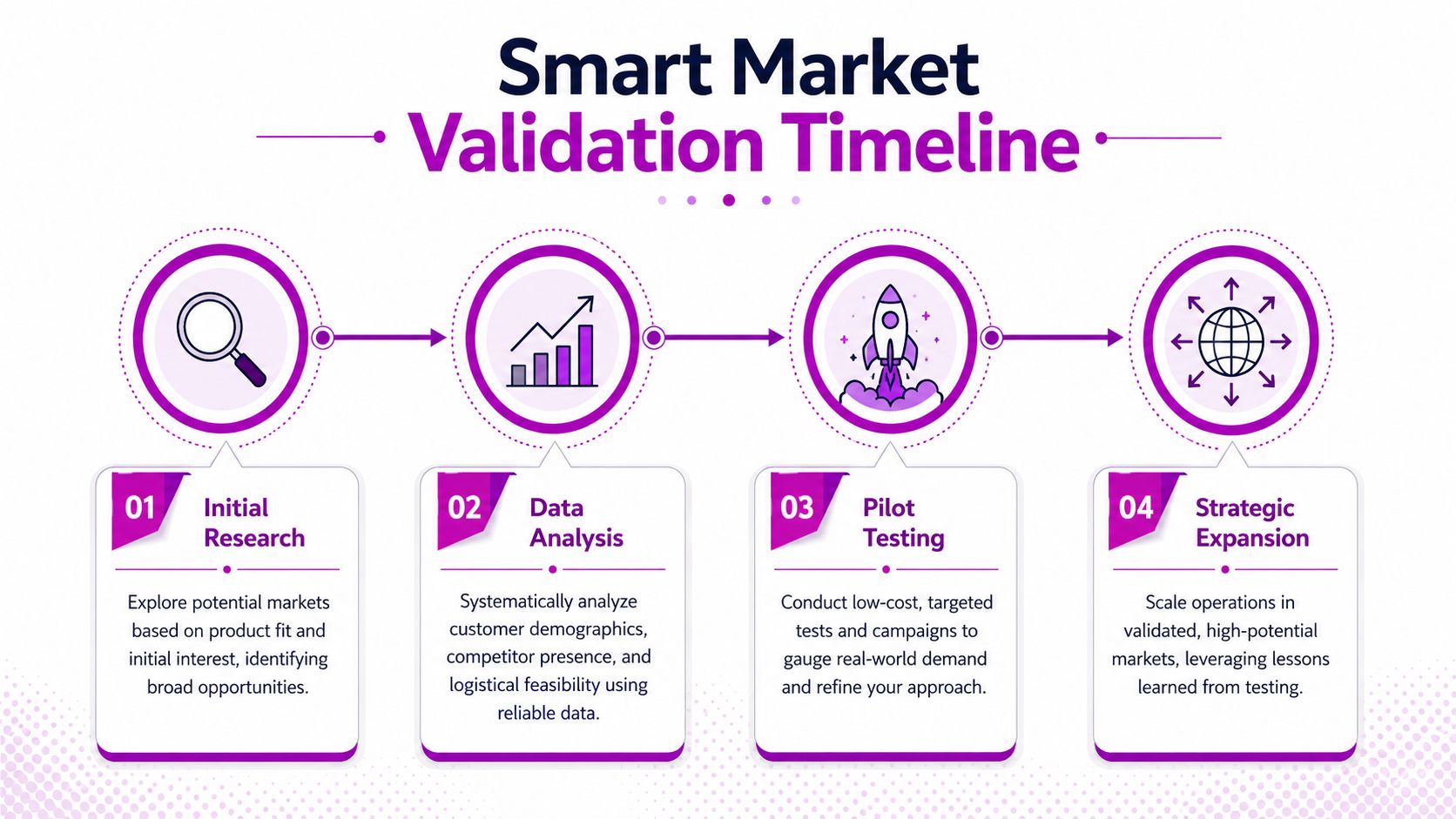
Run a low-cost demand test before you localize anything
A lightweight paid test can save weeks of work.
Use one or two proven products, a narrow offer, and ads targeted to a single country. Keep the budget tight. The point is not scale. The point is to compare click costs, landing page engagement, add-to-cart rate, and early checkout behavior against your home market or another known baseline.
If media costs are high and on-site behavior is weak, stop there. That market may still work later through partnerships, wholesale, marketplaces, or organic demand, but paid acquisition is probably not your first entry path. If traffic is reasonably priced and visitors behave like buyers despite a lightly adapted storefront, you have a much stronger case for the next investment.
I usually tell brands to resist the urge to translate the whole store before running this test. Translation does not fix poor economics. It can hide them.
Decide what kind of validation you need
Different brands need different proof before they commit. A repeat-purchase skincare brand can test more aggressively than a bulky furniture brand with expensive returns. A regulated product line needs a stricter operational check than a simple accessories catalog.
| Validation question | What to look for | Why it matters |
|---|---|---|
| Is there real demand? | Organic visits, support questions, add-to-cart activity, early orders | Confirms the market exists beyond top-line traffic |
| Can we buy attention at a sane cost? | Paid test results compared with your current benchmarks | Prevents costly launches in markets where CAC will be hard to control |
| Can we fulfill without creating support debt? | Delivery times, shipping cost, returns feasibility, duty visibility | Revenue falls apart fast when delivery and post-purchase experience break |
| Are there category-specific requirements? | Product rules, labeling, documentation, sustainability data needs | Some markets add compliance work long before volume justifies it |
Brands selling into regulated or compliance-heavy categories should test that last point early. If your products require traceability or documentation by market, operational readiness matters as much as demand. That includes adjacent work such as managing product passports on Shopify, which can become a real gating factor in parts of Europe.
Budget for the first layer, not the finished version
The first launch should look temporary because it is. You are buying information.
That usually means keeping one storefront, limiting the product range, tightening shipping rules, and making only the local changes that remove obvious friction. Currency display, clear duties messaging, realistic delivery promises, and the right payment options matter earlier than perfect translation or market-specific creative systems. If you need a practical reference point for how to configure that test phase, this Shopify Markets setup guide is a useful companion.
The trade-off is simple. A lighter launch gives you less market-specific polish, but it protects cash and shortens the feedback loop. That is the right exchange for most growing brands. Full localization should be earned by conversion data, repeat purchase behavior, and support load you can justify, not by optimism.
Building Your Technical Foundation with Shopify Markets
A common failure pattern looks like this. A brand proves demand in Canada, the UK, or parts of Europe, rushes into a second storefront, adds market-specific apps, patches taxes and shipping rules manually, and ends up with a setup the team can barely maintain by quarter end.
The better path is simpler. Once a market shows real promise, build the lightest technical setup that can support clean testing now and cleaner scaling later. For most growing brands, Shopify Markets is the right starting point because it lets one store handle country targeting, local currencies, domains, duties, and checkout behavior without forcing a full rebuild for each market.
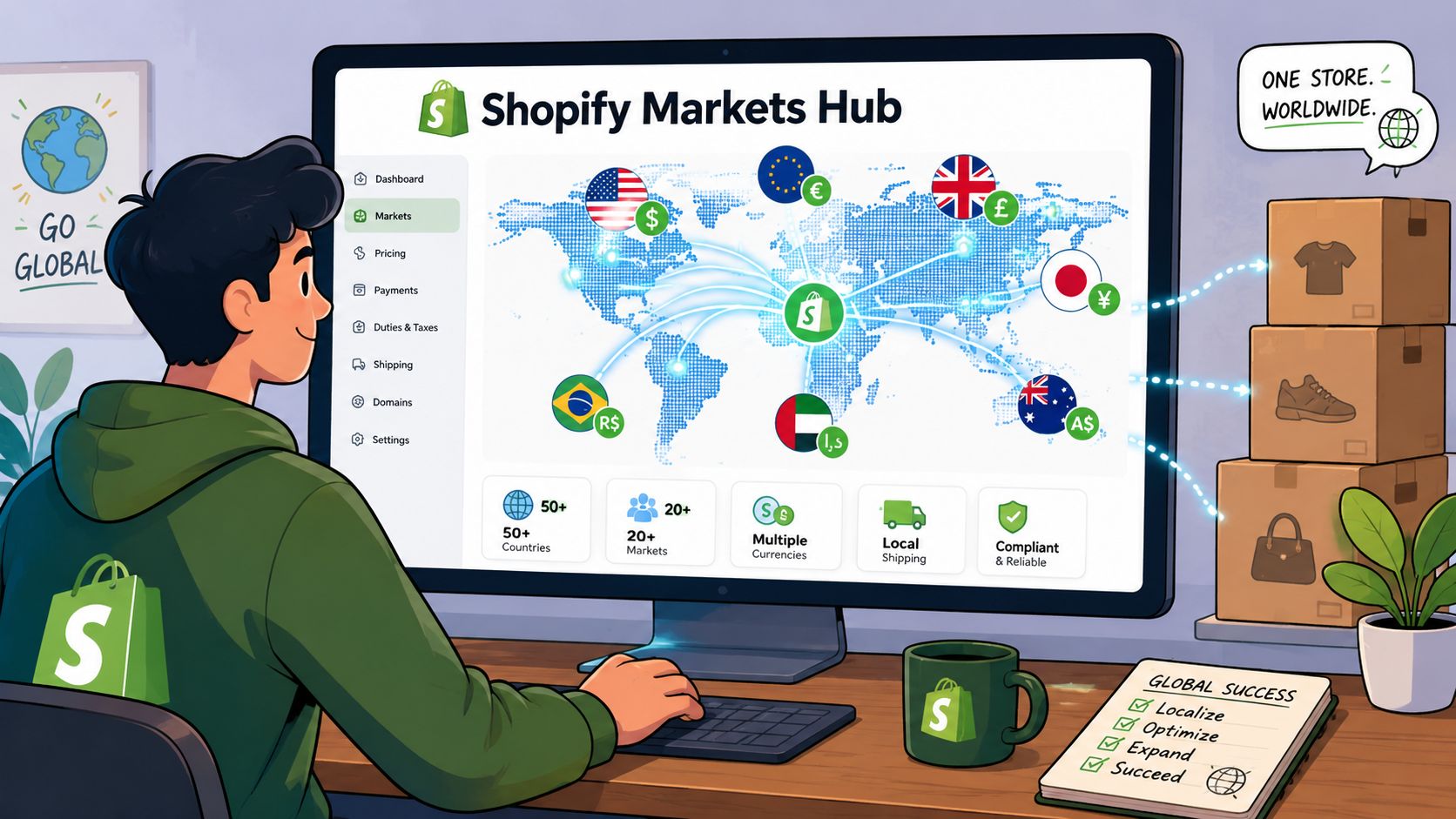
Pick the simplest architecture that preserves control
Separate storefronts sound attractive because they promise local control. They also create duplicated work across merchandising, theme changes, app management, analytics, and QA. That trade-off rarely makes sense early.
Start with a single-store Markets setup if the catalog, operations, and brand experience are still mostly shared across countries. It keeps the team focused on the variables that need testing, such as pricing logic, payment fit, shipping rules, and market-level conversion behavior.
Move to dedicated storefronts later if a country needs different inventory logic, different content systems, distinct promotions, separate teams, or market-specific compliance workflows. That is usually an operational decision first, not a branding one.
If you want a practical reference for those architecture choices, ECORN's guide to Shopify Markets implementation and architecture decisions is useful when you are weighing speed against future complexity.
Configure currencies and pricing with intent
Many teams stop at local currency display and assume the job is done. It is not.
Customers need prices that feel familiar, defensible, and internally consistent. If automated FX conversion creates awkward endings, your store starts to feel imported instead of built for that market. That hurts trust before anyone gets to shipping or returns.
A workable setup usually includes:
- Clean market assignment: Send shoppers to the right country experience the first time.
- Local currency display: Remove mental math from the buying decision.
- Rounded price rules: Protect margin without producing strange price points.
- Market-fit payment methods: Card acceptance alone is often not enough.
- Checkout testing by country: Payment success, fraud filters, and address formats can break in different ways by market.
Configuration is a critical factor in whether teams save time or create future cleanup. Good configuration reduces exceptions. Bad configuration pushes edge cases into support tickets, failed checkouts, and manual fixes.
Build the data layer before it becomes a problem
Technical foundation is not just what the shopper sees. It also includes the product data, tax logic, shipping rules, and compliance information that need to move correctly through the order.
That matters earlier than many founders expect. In regulated categories, or in markets with stronger traceability requirements, weak product data becomes a bigger blocker than weak design. Workflows around managing product passports on Shopify are a good example. Brands entering parts of Europe can run into these requirements long before they are ready for a larger localization program.
I have seen brands spend weeks refining market pages while their SKU data, customs fields, and documentation processes were still held together with spreadsheets. That is backwards. If operations cannot support the order cleanly, the storefront is not ready.
Here's a concise product walkthrough for teams that want to see Shopify Markets in action before configuring a live environment:
If your market setup works only because your team remembers a dozen exceptions manually, it isn't a setup. It's a temporary patch.
What not to overbuild yet
Keep the first technical layer boring. That is usually the right call.
Do not open separate stores just because a country is on the roadmap. Do not custom-code around problems Shopify Markets already solves. Do not choose domain structure on brand preference alone if the operational cost is higher than the upside.
The goal at this stage is a foundation that is easy to test, easy to maintain, and easy to change once the market earns more investment. That is how growing brands expand internationally without turning early traction into technical debt.
Achieving True Localization for Higher Conversions
A shopper in Germany lands on your product page from a paid ad. The page loads in German, but the product copy reads like a translation layer, the sizing still reflects your home market, the prices look mechanically converted, and the checkout options feel unfamiliar. Traffic showed up. Trust did not.
That is the difference between translation and localization, and it is where a lot of growing brands stall. The goal is not to make every market feel fully native on day one. The goal is to improve the parts of the buying journey that drive conversion, then earn the right to invest further.
Localized enough to buy from
Customers decide whether a store feels credible within seconds. They read tone, not just words. They look for signs that the brand understands their context, including how products are used, how sizes are explained, how returns work, and whether shipping expectations are clear.
A translated storefront can still feel imported.
That matters because early international growth is usually margin-sensitive. If a market is still being validated, full localization across every template and every support flow is often wasteful. Start with the pages that carry the most trust weight: top PDPs, returns policy, shipping policy, FAQs, cart messaging, and checkout reassurance copy. Those are the pages that answer the buyer's last objections.
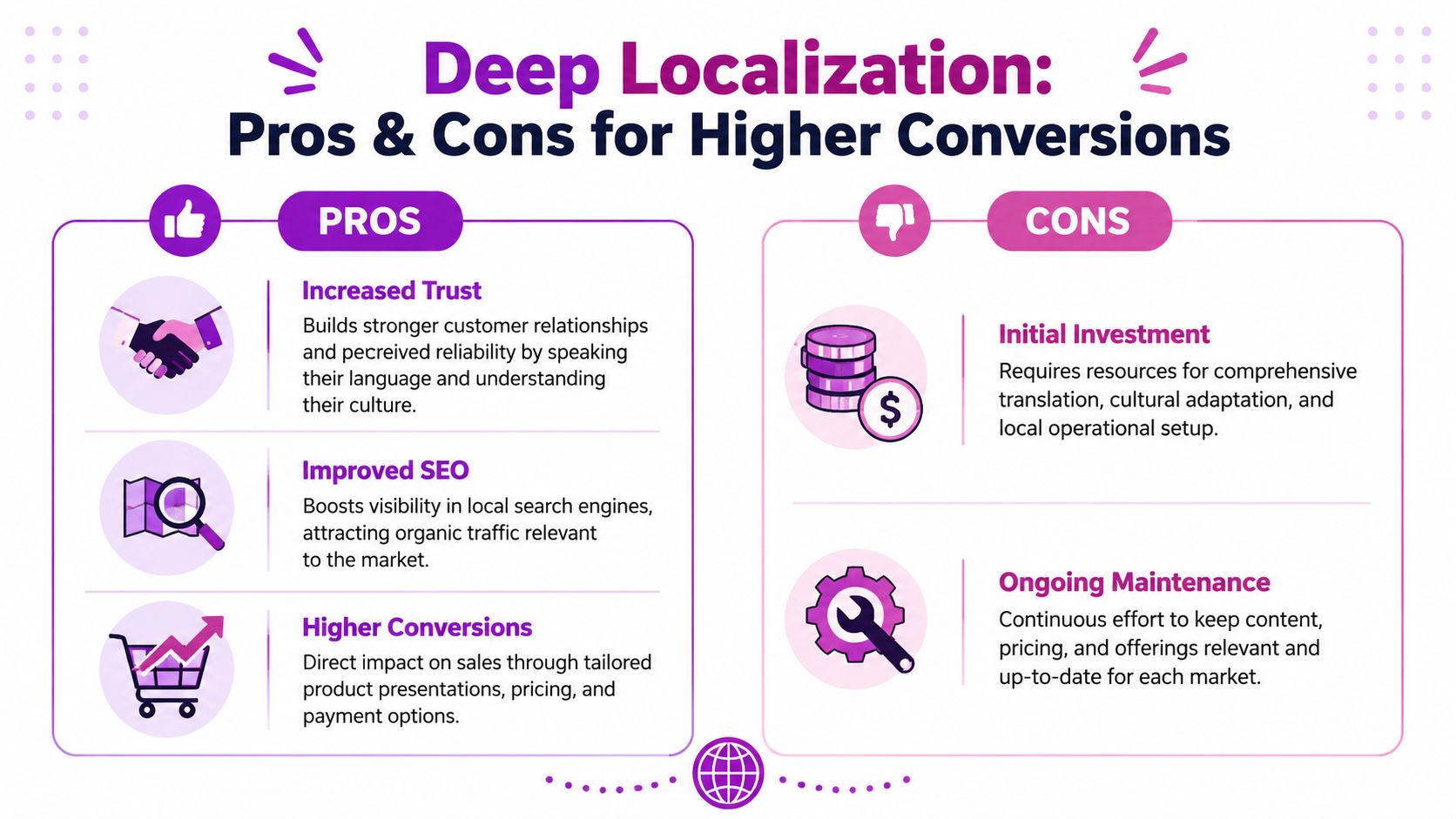
Pricing psychology changes how local your store feels
Currency conversion alone does not create pricing trust. Presentation matters just as much.
Torosachi's examination of localized pricing psychology explains the problem well. Prices like ¥1,037.43 can look careless or foreign in markets where rounded endings are the norm. Clean local pricing tells the customer the market was considered deliberately. Raw converted pricing tells them the store was exported.
Use a simple decision rule:
- Show prices in local currency.
- Round according to local buying conventions.
- Check whether your price position still makes sense in that market.
- Protect margin intentionally instead of letting exchange rates decide it for you.
For teams working through the operational side of this, ECORN's guide to Shopify multiple currencies and global sales strategy is a useful reference.
Payment methods are a conversion filter
Checkout tells the truth fast. If localized traffic adds to cart but fails to complete purchase, payment mix is one of the first places to look.
Regional payment behavior varies sharply. A checkout built around home-market preferences can suppress conversion even when product-market fit is real. That is why I usually treat payment localization as a validation tool, not just a later-stage optimization. If a market only converts once familiar payment methods are available, that is a strong signal the demand is real and the friction was operational, not commercial.
For some brands, local business setup also shapes what payment and compliance options are available in Europe. Teams exploring that path sometimes need outside help with assisting clients with EU entity registration, especially if they are trying to improve regional payment acceptance without building a full local operating structure too early.
Language should adapt the buying context
The copy that needs human review is usually obvious. Product detail pages. Shipping and returns. Size guidance. Subscription terms. Delivery promises. Any line of text that answers, "Can I trust this order to arrive the way I expect?"
Use Shopify's translation tools for scale. Then edit the commercial moments manually.
Localization check: If a local customer can understand your site but still feels hesitant to buy, the issue is usually context, not language.
The strongest international rollouts do not localize everything at once. They localize the trust-building moments first, measure the lift, and expand only after the market proves it deserves more investment.
Solving Global Logistics and Cross-Border Taxation
A market can look promising for weeks, then fail on the first delivered order.
The usual pattern is predictable. Ads convert. Checkout looks healthy. Then parcels arrive with duty requests, customs delays, or tracking updates the customer cannot make sense of. At that point, the issue is no longer marketing. It is whether the operating model matches the promise you made at checkout.
The shipping model changes conversion quality
Cross-border growth gets expensive fast when brands treat DDU and DDP as a back-office choice. Customers experience it as a trust choice.
If duties are collected on delivery, some buyers will accept that. Many will not, especially in consumer categories where the order value is modest and the fee feels arbitrary. A lower checkout price can help initial conversion, but surprise charges tend to show up later as refused deliveries, support tickets, chargebacks, and reviews that depress future acquisition efficiency.
DDP usually performs better once a market shows real potential because the customer sees the full cost before paying. The trade-off is operational. You need tighter carrier setup, cleaner product data, and enough margin to absorb mistakes.
| Model | What the customer sees | Commercial upside | Main risk |
|---|---|---|---|
| DDU | Lower upfront checkout cost | Faster to test in some markets | Fees due on delivery weaken trust and increase failed deliveries |
| DDP | Duties and taxes included upfront | Clearer buying decision and lower support volume | More setup work and less room for pricing errors |
For early validation, I usually tell brands to ask a harder question than "Which option is easier to launch?" Ask which option gives a clean signal. If poor conversion is caused by hidden import friction, the test tells you nothing useful about market demand.
Set the promise first, then build operations around it
Shipping policy should follow market economics, not habit from the home market.
Start with a small number of countries and define four things before scaling spend: delivery window, duty treatment, carrier choice, and return path. If any of those remain vague, the customer notices. So does your support team.
A workable setup usually includes:
- Country-level shipping rules: Delivery times, thresholds, and carrier options should reflect the destination market.
- Clear tax and duty messaging: Say whether charges are prepaid or collected on delivery in plain language.
- Customs-ready catalog data: HS codes, country of origin, and product values need to be accurate before volume increases.
- Return economics by market: Some markets can support local returns. Others need refund-without-return thresholds or stricter policies.
- Margin review after landed costs: Strong top-line sales can still hide weak contribution margin once duties, surcharges, and reshipments are included.
This is also the point where corporate structure can stop being an abstract legal topic and become an operating constraint. Payment acceptance, tax registration, importer-of-record requirements, and local partnerships can all get harder without the right entity setup. Brands preparing for a more serious European presence sometimes need outside help with assisting clients with EU entity registration.
Customers tolerate slower delivery more easily than unexpected charges.
Tax decisions show up in customer experience
Cross-border tax is not just a finance workflow. It affects conversion, cancellation rate, support burden, and whether repeat purchase ever happens.
The immediate goal is not perfect global coverage. It is controlled clarity. Know where you need tax registration, know how taxes appear at checkout, and know who is responsible when a shipment crosses the border. If those answers change by market, document them clearly and keep the storefront language aligned with the actual fulfillment setup.
That discipline matters even more for growing brands trying to stay capital efficient. Full localization can wait. Preventable friction at customs should not. A market is only worth scaling if you can deliver profitably and predictably after shipping, duties, tax treatment, and returns are accounted for.
Acquiring Your First International Customers
A common failure pattern looks like this. A brand turns on a new market, sends paid traffic to it, gets decent click-through rates, then watches conversion stall because the offer, landing page, and checkout were never adapted for local buying behavior. The fix is usually not a bigger budget. It is a tighter first test.
The first acquisition push should answer a practical question. Can this market produce customers at an acceptable cost before you invest in heavier localization, broader channel mix, or country-specific creative systems? That is the primary job of this stage.
Start with the offer that already wins
Use the products and positioning that already work in your home market. Early international acquisition is not the time to test a new collection, a new brand angle, and a new audience strategy all at once. If too many variables change together, you will not know what caused the result.
A strong first setup usually includes:
- Your highest-converting SKU set: Start with products that already have clear demand and strong contribution margin.
- Ad copy written for the market: Translation is not enough. Claims, tone, and buying triggers need to sound local.
- A landing page that matches the ad: Currency, delivery windows, returns language, and product promise should line up immediately.
- Tight audience selection: Start narrower than you would domestically so feedback is easier to interpret.
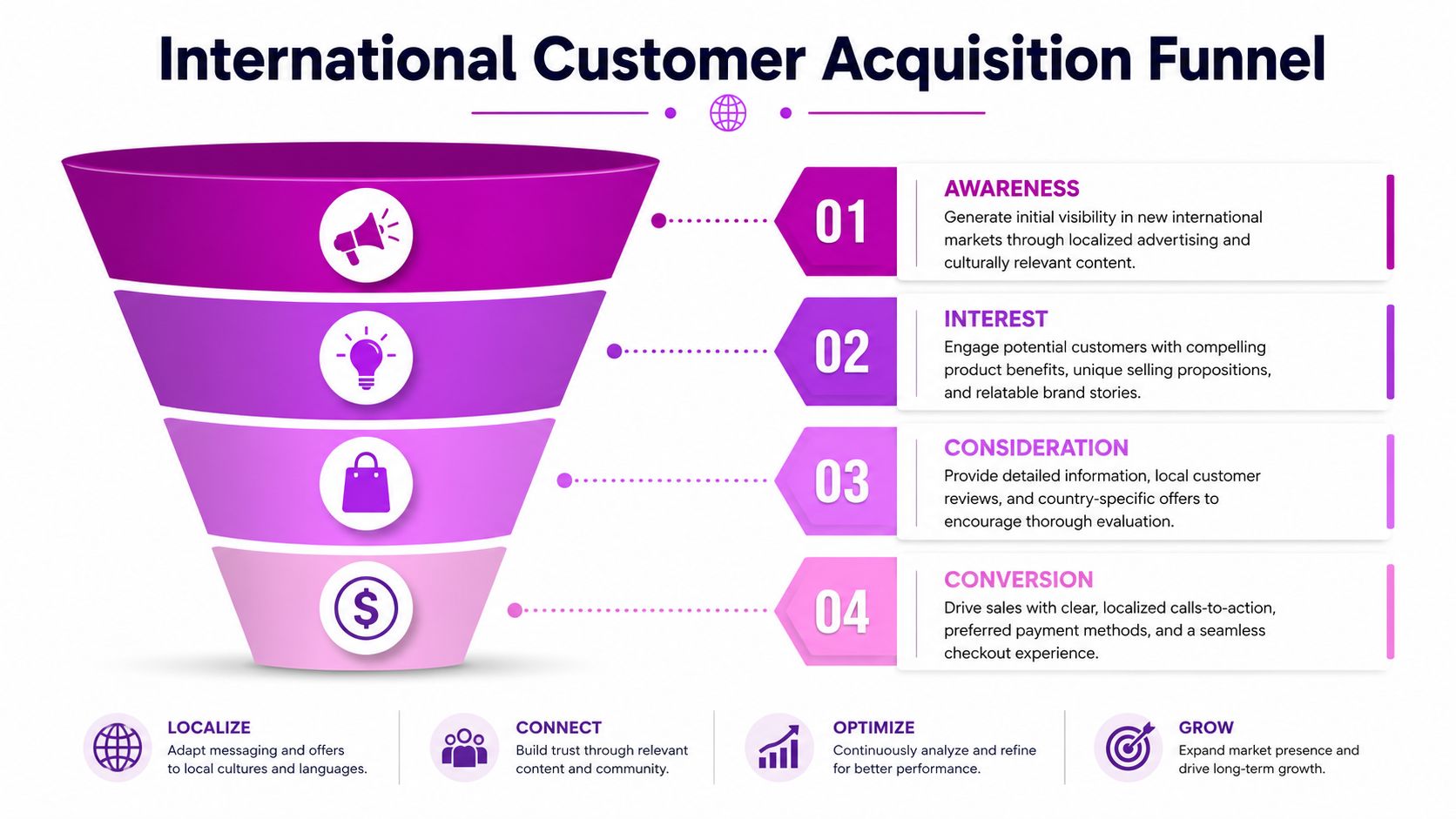
In practice, I usually want brands to prove one clean path first. One country, one core offer, one primary channel, one clear post-click experience. That keeps the learning cheap.
Paid traffic usually comes before organic traction
For most emerging brands, the first international customers come from Meta, Google Shopping, branded search, email to existing international subscribers, or creator whitelisting. SEO matters, but it rarely carries the first phase on its own. Paid acquisition gets you feedback faster, and speed matters when you are trying to validate demand without overbuilding the market.
Technical search errors still matter at this stage. If country targeting, localized URLs, or hreflang are misconfigured, shoppers can land on the wrong version of the site, see the wrong currency, or hit a page with the wrong shipping promise. That hurts conversion and makes paid traffic look worse than it is.
Local proof beats polished brand storytelling
New international shoppers ask a simple question first. Have people like me bought from this brand without problems?
Answer that question directly. Show reviews from buyers in that country as soon as you have them. Feature delivery estimates where shoppers can see them before checkout. Make returns and support response times easy to find. If you have local creator content, use it even if production quality is modest. Familiar context often outperforms highly produced assets from your home market.
Your first international customers are giving you two things at once: revenue and proof that the market can trust you.
Watch for friction by stage, not just by channel
Revenue is a lagging signal here. The better read is where people hesitate.
Look at:
- click quality by campaign and country,
- bounce rate on market-specific landing pages,
- add-to-cart rate by device,
- checkout starts versus completions,
- payment-method abandonment,
- repeated presale support questions,
- and discount sensitivity.
Those signals usually expose the core constraint quickly. Weak click quality points to targeting or message mismatch. Strong product engagement with poor checkout completion usually points to payment trust, shipping anxiety, or local pricing friction. Good checkout starts with repeated support questions often means the product resonates, but the market still does not trust the operational promise.
That is why this stage should stay controlled. The goal is not to scale spend fast. The goal is to find a customer acquisition motion that survives local scrutiny and still leaves room for profit. Once that works, increasing spend makes sense. Before that, broader expansion just makes the mistakes more expensive.
How to Measure Success and Plan Your Next Move
A lot of brands hit the same moment after the first few international wins. Orders are coming in, the new market looks promising, and the team wants to add three more countries before the quarter ends.
That is usually where expensive mistakes start.
The first market is not proof that global expansion is working. It is proof that the opportunity deserves a harder test. The core question is whether you have a model that can be repeated without adding margin drag, support strain, and operational workarounds every time you enter a new country.
Measure each market like its own business unit
Blended reporting hides bad decisions.
A market can post respectable revenue and still be a poor expansion candidate if checkout completion is weak, support volume is high, or margin collapses after shipping, duties, and returns. That is why performance needs to be reviewed country by country, with the same discipline used for a paid channel or product line.
Track the metrics that expose operating quality:
- sessions to checkout-start rate by market
- checkout completion rate, broken out by payment method
- support contacts per order
- return rate by reason code
- gross margin after shipping, duties, taxes, and return costs
- time-to-delivery and delivery exception rate
- percentage of orders requiring manual intervention
Those numbers show whether demand is real and whether the market is supportable at scale. If conversion is healthy but margin is thin, pricing or shipping structure needs work. If margin looks fine but support contacts are climbing, localization or post-purchase communication is probably weak. If manual fixes keep stacking up, the market may be growing faster than your operating model can handle.
Define the threshold for expansion before you add the next market
Do not wait until momentum takes over to decide what "good enough" looks like.
Set a clear threshold for expansion while the first market is still under review. That usually includes stable conversion, acceptable contribution margin, manageable support volume, and no recurring operational failures that depend on one person stepping in to fix them. Without that bar, teams expand on enthusiasm and then spend the next six months cleaning up avoidable issues.
I usually advise brands to document three things before entering the next market: what had to be localized to get conversion, what broke operationally in the first 90 days, and which fixes were one-time improvements versus permanent added complexity. That gives you a repeatable playbook instead of a vague sense that the launch "went pretty well."
Know when Shopify Markets is still the right structure
Shopify Markets covers a lot of ground for emerging and growing brands. It is often the right setup longer than teams expect, especially when the goal is capital-efficient validation rather than premature complexity.
The move to separate storefronts makes sense when shared infrastructure starts creating real business friction. Shopify points to common triggers in its enterprise guidance on global expansion, including cases where different regions need distinct catalogs, separate teams, or materially different customer experiences.
In practice, the signs tend to cluster:
- product assortment differs enough that shared merchandising becomes clumsy
- B2B and DTC flows need different pricing, content, or account structures
- fulfillment logic and service policies vary by market
- compliance or subscription requirements force custom experiences
- local teams need more control than a centralized setup can realistically give them
Stay in Markets while the differences are manageable inside one operating system. Move to multiple storefronts when the compromises start slowing growth, distorting reporting, or creating too much manual work.
Plan the next move based on readiness, not opportunity alone
There is almost always another market that looks attractive in analytics. That does not mean it is the next one to enter.
The better question is which market can be launched with the least new complexity while still teaching you something useful. Sometimes that is a large obvious country. Sometimes it is a smaller English-speaking market with easier logistics, fewer localization demands, and lower risk. For brands trying to grow without tying up too much capital, that second option is often smarter.
If the first market still needs constant exceptions, fix that first. Expansion works best when each new country adds learning, not chaos.
If your team is weighing Shopify Markets, localization depth, or the point where a single-store setup should evolve into a more customized architecture, ECORN works with Shopify brands on design, development, CRO, and international store optimization. They're a practical option for merchants that need implementation support, market-specific UX work, or a clearer path from first expansion to multi-store scale.


Shopify Git Integration: A Developer's Guide to 2026
Headless Ecommerce Development Services Explained

How to Build a Shopify Clothing Website That Converts

How to Launch a Box Subscription Business in 2026

Luxury Skincare Branding Playbook That Converters

10 Best Podcast Ecommerce Shows for Store Growth in 2026
Shopify Developer Hourly Rate: What to Pay in 2026

Critical Shopify Setup Errors That Are Secretly Sabotaging Your Store
Ecommerce Conversion Tracking: The Complete How-To Guide

Shopify Design Agency: How to Pick the Right Partner
Mastering Multi Store Management on Shopify
Scale Shopify Store

10 Shopify App Ideas Worth Building in 2026
Conversion Rate Optimization for Landing Pages: The Playbook
Shopify Plus Automation: A Guide for 2026
10 Social Selling Platforms for Shopify Merchants

Shopify Website Design Examples: 7 Stores Worth Studying

7 Ecommerce Newsletter Examples for Shopify Brands
One Product Shopify Store: Build and Scale

Mobile Pop Up Strategy for Shopify Stores That Converts
Sitemap for Shopify: How to Find, Optimize, and Submit It

7 Single Product Websites Worth Emulating

Product Variants Shopify: The Complete 2026 Guide

Ecommerce Analytics Consulting for Growth

What Is AI Integration for eCommerce

How to Choose the Right eCommerce Website Development Firm

E Business Strategy Implementation
Conversion Tracking Setup for Shopify Stores
BigCommerce vs Shopify Plus Which Enterprise Wins in 2026
Shopify Theme Kit: Setup, Commands, and Migration Guide

Shopify Extension Development: A Practical 2026 Guide

Shopify Speed Score Explained and How to Improve It

Shopify Mobile Optimization: The 2026 Playbook

How to Add Subcategory in Shopify for Better UX
How to Implement Structured Data for Ecommerce in 2026

SEO App Mobile: Shopify Store Optimization Guide

Shopify Plus Support: What It Includes and How to Choose

Google Ads for Shopify: The Complete 2026 Playbook

Shopify New York: How to Find and Hire the Right Agency

Google Search Console for Shopify: The Complete Setup

First Party Data Collection for eCommerce Growth
FAQ Online Store Guide: Build and Measure It Right

Do FB Ads Work for eCommerce in 2026?

One Page Checkout for Shopify: Design and Implementation
Shopify GraphQL vs REST: The 2026 Developer Decision
Shopify Ecommerce Consulting: Strategy, Pricing &

Are Reddit Ads Worth It for eCommerce Brands

Shopify Title and Meta Description: A Practical 2026 Guide

Product Video Best Practices for Shopify Brands

Real-Time Inventory Management: A 2026 Guide

AI Chatbot Integration for Shopify Stores

Affiliate Program Management: A Shopify Guide
10 Best Performance Monitoring Tools for Shopify in 2026

Digital Asset Management for eCommerce Brands in 2026

Every Type of Facebook Ads Explained for eCommerce Growth
Product Information Management Explained for Shopify Brands
Support Ticket System: A Guide for Shopify Stores

10 Best Customer Service Tools for Shopify in 2026

Can I Start a Business with No Money? a 2026 Blueprint

What Sells Good on Etsy: Best Niches for 2026

Shopify Add to Cart Button: A Practical 2026 Guide

Customer Feedback Automation: A Practical eCommerce Guide
Critical Rendering Path: A Guide for Shopify Stores

How to Promote on TikTok for eCommerce in 2026

B2B eCommerce Consulting That Drives Real Revenue
10 Best Practices for Site Navigation in 2026
Return vs Refund for Shopify Stores: A Practical Guide

What Is Customer Lifetime Value and Why It Matters

What Is Voice of Customer Research for eCommerce

SMS Marketing for Ecommerce That Actually Converts

Master How to Improve Email Deliverability in 2026

Top 8 eCommerce Partners NYC for Shopify Brands in 2026

Machine Learning for Ecommerce: Boost Your Shopify Store

Beauty Market Research: Your 2026 Growth Guide

What Does CRO Stand for in Business: Understanding CRO

Shopify Visual Merchandising: A Playbook for Higher Sales

Shopify Landing Page Design: Master Conversion in 2026

10 Best AI SEO Optimization Tools for Shopify in 2026

Agentic AI for Ecommerce: Boost Your Sales in 2026
Mastering Email Marketing Data for eCommerce Growth

Conversion Rate Optimisation Australia: Boost Your Sales
Conversion Rate Optimization AI: Your Shopify Store Guide

10 Product Bundling Strategies for Shopify in 2026

How to Increase Customer Lifetime Value: A Shopify Playbook

AI Customer Service Automation: Shopify Guide 2026

Clean Website Design: A Shopify Conversion Playbook

Omnichannel Retail Strategy: A Shopify Playbook

Product Data Enrichment: A Guide for Shopify Brands

Instagram Shopping Features a Guide for Shopify Stores

What Is Revenue Optimization: A Holistic RevOps Guide

Benefits of Conversion Rate Optimization: Boost Your
WordPress to Shopify Migration: Your 2026 Seamless Switch
Boost Sales: Ecommerce Payment Processing Guide 2026
Unified Commerce Platform: Benefits, KPIs & Shopify Guide

How to Reduce Bounce Rate eCommerce: Your 2026 Guide
Shopify API Integration: A Practical End-to-End Guide

How to Implement Data Governance: A 2026 Guide
Shopify Store Development Cost: A 2026 Breakdown
What Is Server Side Tracking: The Shopify Guide 2026
Marketing Automation Workflows: A Shopify Guide for 2026


newsletter in your inbox