

A lot of Shopify merchants are already doing more than one thing right. They sell through their online store, run paid social, answer DMs, maybe use Shopify POS in a showroom or retail location, and push email through Klaviyo. On paper, that looks advanced.
Then the cracks show up.
A customer clicks a product from Instagram, browses on mobile, comes back later on desktop, buys in-store, and asks support about loyalty points that never synced. The store team can't see the online order history. Marketing sends a welcome flow to someone who already bought in person. Inventory says one thing on the site and another thing at the counter. Nothing is fully broken, but nothing feels connected either.
That gap is where most questions about what is omnichannel ecommerce really come from. Merchants aren't asking for a definition. They're trying to solve operational friction that customers notice before the business does.
The Disconnected Journey of the Modern Shopper
One of the most common patterns in retail looks like this. A shopper finds your brand through an Instagram ad, taps through to your Shopify storefront, browses a few products, leaves, comes back later from a laptop, and then visits your store or pop-up because they want to see the product in person before buying.
From the shopper's point of view, that's one journey.
From the merchant's point of view, it often gets treated like four unrelated events. Paid social owns the first click. Ecommerce owns the site session. Retail staff own the in-store interaction. Support cleans up the confusion afterward.
That disconnect is the reason omnichannel matters. A 2025 retail shopper study found that 73% of consumers are omnichannel shoppers, using multiple channels during their buying journey. That means this behavior isn't edge-case behavior. It's the normal path.
Where the friction actually shows up
The biggest problems usually aren't dramatic. They're small failures that stack up:
- Customer identity breaks: The person who signed up to email online isn't recognized in-store.
- Inventory confidence drops: The website shows stock that the store team can't verify.
- Promotions conflict: An offer seen in one channel can't be honored in another.
- Service context disappears: Support has to ask questions the customer thinks you've already answered.
For a growing Shopify brand, this usually starts after success. You add channels because they work. Then each new channel adds another system, another team workflow, and another place where customer context gets lost.
If you're serious about optimizing retail customer experience, journey mapping becomes useful because it exposes exactly where these handoffs fail. Most brands don't have a channel problem. They have a continuity problem.
Omnichannel isn't about being present everywhere. It's about making the handoff between touchpoints feel invisible.
A customer shouldn't have to repeat themselves because your systems don't talk. They shouldn't wonder whether online pricing applies in-store, whether points carry over, or whether a store associate can access a recent order.
That's the practical answer to what omnichannel ecommerce is. It's the operating model that connects those moments into one coherent journey.
Omnichannel vs Multichannel The Critical Difference
Most Shopify brands start with multichannel. That's normal, and often smart. You sell on your site, maybe through retail, marketplaces, email, social, and paid acquisition. More channels can mean more demand capture.
The problem is that multichannel and omnichannel are not the same thing.
A simple way to think about it
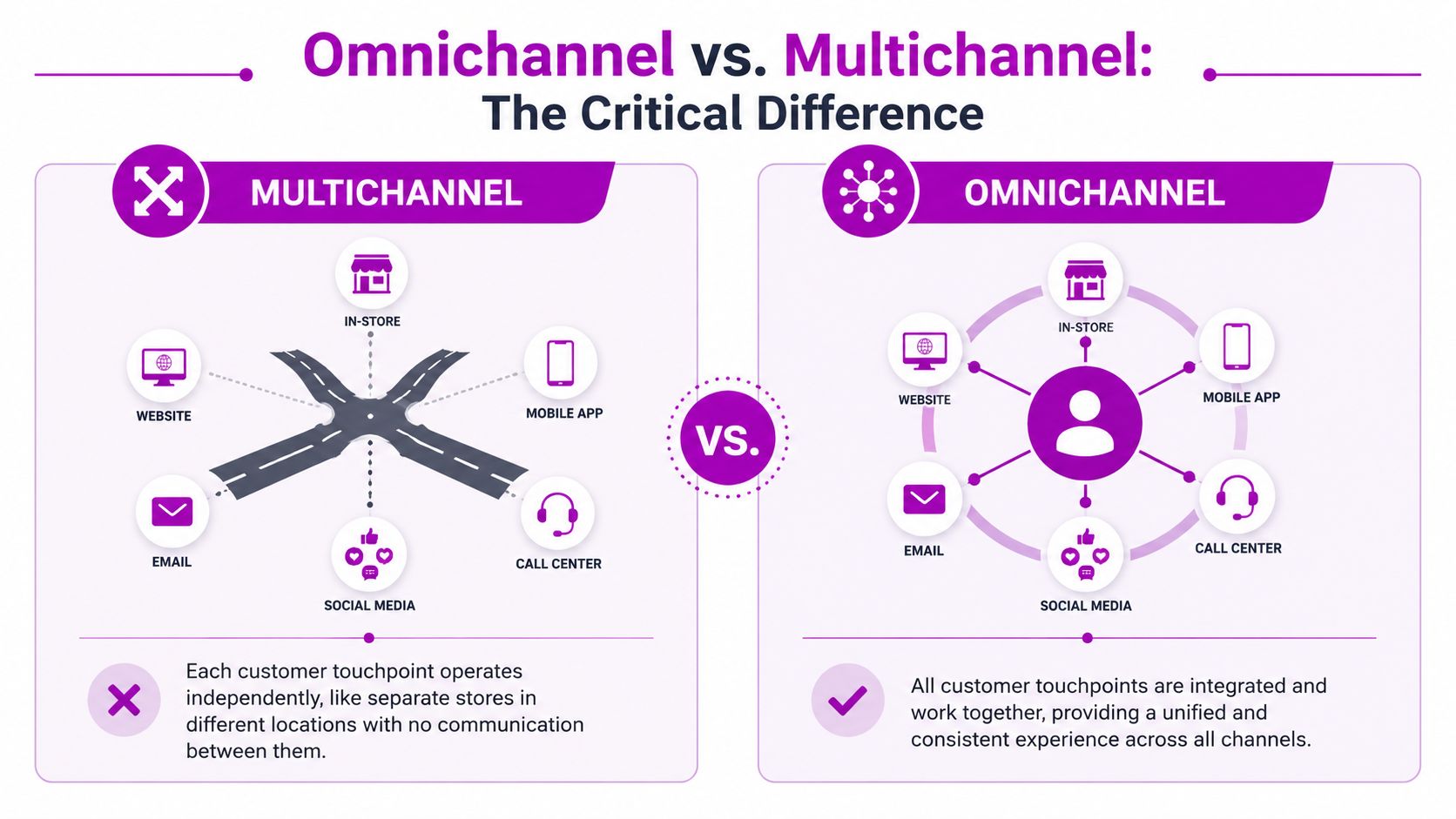
Multichannel is a set of solo musicians playing at the same venue. Omnichannel is an orchestra playing the same piece.
Both involve multiple players. Only one is coordinated.
In a multichannel setup, each touchpoint can perform well on its own. Your Shopify store may convert. Your retail team may sell well in person. Your email team may drive repeat purchases. But the channels operate in parallel, not as a shared system.
In an omnichannel setup, the customer sits at the center and every touchpoint responds to the same underlying data, rules, and context.
Here's a quick comparison:
| Model | What the business has | What the customer feels |
|---|---|---|
| Multichannel | Several active sales and marketing channels | Separate experiences depending on where they interact |
| Omnichannel | Connected channels sharing data and operational logic | One continuous relationship with the brand |
A lot of brands say they're omnichannel when they're really just broad-channel. That's not a criticism. It's a maturity issue.
For merchants working through that difference, this guide to a multichannel sales strategy is useful because multichannel is often the correct starting point before deeper integration makes sense.
Later in the decision process, this video gives a helpful visual breakdown of how the two models differ in practice.
Why the distinction matters for Shopify merchants
On Shopify, it's easy to add channels. That's one of the platform's strengths. You can launch new storefront experiences, plug in apps, turn on Shopify POS, connect social selling, and move fast.
Speed creates a trap. Brands often scale channel count faster than system coordination.
Practical rule: If a customer can move across channels but your data, pricing, inventory, and service logic can't move with them, you're multichannel, not omnichannel.
That distinction changes investment decisions. Multichannel asks, "Where else should we sell?" Omnichannel asks, "How should every customer touchpoint share context?"
One is distribution. The other is operating architecture.
The Three Pillars of a True Omnichannel Experience
A real omnichannel setup rests on three things. Not ten. Not an endless app stack. Three foundations that have to work together.

Unified customer data
This is the first pillar because every personalization promise depends on it.
If your Shopify customer record, email platform, loyalty tool, POS, and support system all hold different versions of the same person, your brand can't behave consistently. Marketing will segment one way. Retail staff will see another version of the customer. Support will work from partial history.
A useful test is simple: can your team understand the shopper's recent behavior without asking the shopper to reconstruct it?
For Shopify brands, this usually means connecting storefront behavior, purchase history, loyalty activity, and support interactions into a usable customer view. It doesn't have to be elegant on day one, but it does have to be shared.
Centralized inventory and order logic
This is the pillar that exposes weak setups fastest.
The moment you offer store pickup, in-store returns for online purchases, local delivery, or location-based fulfillment, fragmented inventory becomes expensive. Not just operationally, but in customer trust.
True omnichannel requires more than channel availability. It needs a unified commerce architecture where systems for inventory, customer identity, and transactions work from a coordinated backbone. According to this explanation of scalable omnichannel platform architecture, that backbone depends on an event-driven, API-first setup that enables real-time synchronization across channels.
That sounds technical because it is. But the business impact is easy to understand:
- Stock data stays aligned: Fewer channel conflicts around availability.
- Orders route with more control: Teams can choose the right fulfillment source.
- Promotions behave consistently: Pricing and rules come from a shared source.
- Returns become manageable: Staff aren't improvising around disconnected records.
The frontend experience only looks seamless when the backend stops behaving like separate businesses.
Consistent experience across touchpoints
Consistency isn't just branding. It's behavior.
Customers notice when product details differ by channel. They notice when store staff can't honor the same offer they saw online. They notice when tone shifts from premium on-site to transactional in support.
This third pillar is where many merchants oversimplify omnichannel. They treat it like a content problem. In practice, consistency comes from aligned operations just as much as aligned creative.
A strong omnichannel experience usually means these elements line up:
- Merchandising: The same product truths appear across site, store, and campaigns.
- Policy: Returns, exchanges, and service expectations don't change by channel unless clearly stated.
- Loyalty: Benefits travel with the customer instead of staying trapped in one system.
- Design and language: The brand feels familiar whether the interaction happens on mobile, POS, email, or live chat.
When these three pillars hold, omnichannel stops being a buzzword and starts becoming a real operating advantage.
Building Your Omnichannel Implementation Roadmap
Most omnichannel projects fail at the planning stage for one reason. The brand tries to transform everything at once.
That usually leads to expensive integration work, confused teams, and a launch that creates more exceptions than it removes. A better approach is phased, narrow, and operationally honest.
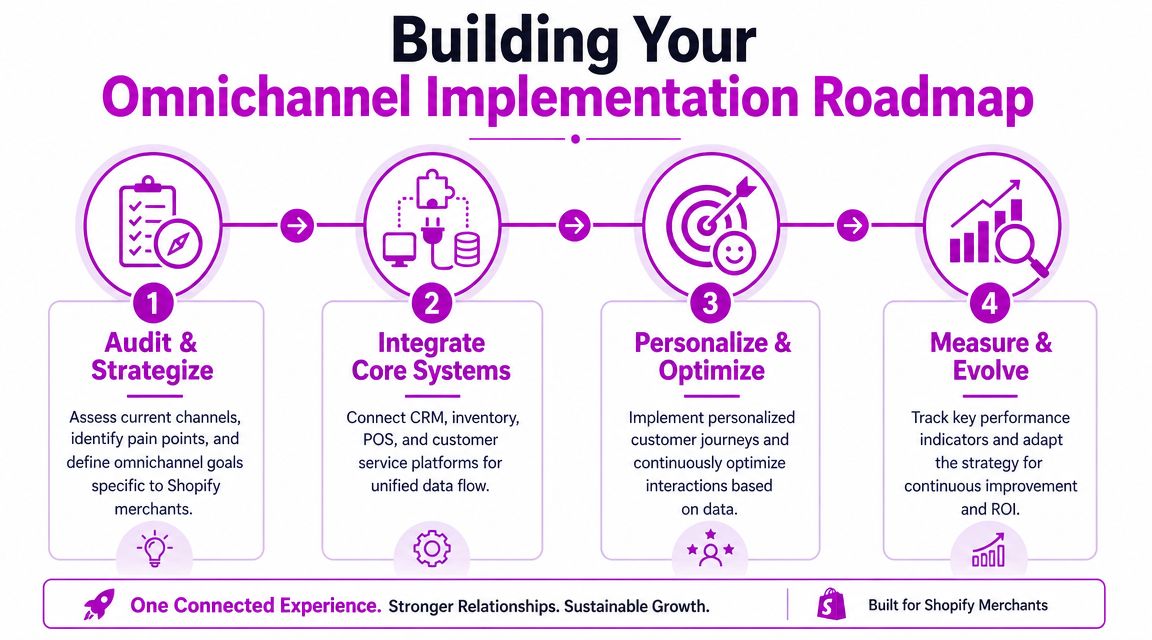
Phase one audit and strategy
Start with customer movement, not software demos.
Map the journeys that already matter to your business. For a Shopify brand, that might be paid social to site to email to purchase. Or online browse to store visit. Or first purchase online followed by support and repeat purchase through retail.
Look for friction that costs revenue or creates service overhead. Common examples include missing customer recognition in-store, inconsistent inventory visibility, non-transferable promotions, or clumsy returns.
This phase should answer a few direct questions:
- Which journeys are worth connecting first
- Which systems currently own customer, order, and inventory truth
- Which teams need to change process, not just tools
- What should stay multichannel for now
A good roadmap is selective. Not every channel needs full orchestration on day one.
Phase two integrate core systems
Once the use cases are clear, build the backbone around them.
For scalable omnichannel commerce, the stack often works best when frontend channels are decoupled from backend logic through APIs. This overview of modern ecommerce architecture describes a five-layer model that separates presentation, business logic, data, integration, and infrastructure. That's what gives brands room to add new touchpoints without rebuilding the core commerce engine.
In practical Shopify terms, this often means deciding which system owns each job:
| Function | Typical Shopify-centered owner |
|---|---|
| Commerce core | Shopify or Shopify Plus |
| In-store transactions | Shopify POS |
| Marketing automation | Klaviyo or similar |
| Customer support context | Gorgias or similar |
| Complex order orchestration | Dedicated OMS when needed |
This isn't a call to overbuild. Many brands can go a long way with Shopify, Shopify POS, a strong ESP, and disciplined integration choices.
Phase three align operations
In this scenario, many projects get underestimated.
You can connect systems and still fail if store teams, support agents, marketers, and ops managers follow old rules. Omnichannel changes how teams handle promotions, returns, customer recognition, fulfillment exceptions, and handoffs.
The practical work includes:
- Training store staff: They need confidence with online orders, pickup workflows, and customer lookup.
- Rewriting service policies: Returns and exchanges can't depend on channel silos.
- Defining exception handling: Teams need clear rules for stock mismatches, partial fulfillments, and loyalty disputes.
- Clarifying ownership: Someone must own the cross-channel journey, not just each isolated channel.
If your team has to ask, "Whose problem is this order?" the customer is already seeing the consequences.
Phase four launch narrow and optimize
Don't launch omnichannel as a grand reveal. Launch it as a controlled capability.
Pick a high-value use case. Common starting points include in-store pickup, unified returns handling, or customer recognition across online and POS. Roll it out in a limited environment, pressure-test the process, then expand.
Watch for where reality diverges from the project plan. That's where the actual work is. Not in the deck, but in the exceptions.
The brands that make omnichannel work treat it as a business transformation with technical dependencies. Not a software installation with a marketing label.
Essential Tech Stack for Shopify Omnichannel Merchants
The right stack depends on complexity. A two-location brand with a focused catalog doesn't need the same architecture as a Shopify Plus merchant running retail, multiple fulfillment nodes, and custom customer journeys.
What matters is choosing tools that create one operational system instead of stacking disconnected apps.
Start with the native Shopify foundation
For many merchants, the first omnichannel layer is already in the platform.
Shopify remains the commerce core. Shopify POS matters if you sell in-store because it gives retail teams a direct connection to the same commerce environment instead of forcing a separate store system into the mix. If you're trying to unify products, promotions, orders, and customer records, keeping POS close to the ecommerce core usually reduces friction.
For brands evaluating the broader architecture around that core, this breakdown of an ecommerce tech stack is a practical reference point.
Add systems based on the problem you're solving
Different tools solve different omnichannel gaps. The mistake is installing all of them before you need them.
- Customer data and lifecycle marketing: Tools like Klaviyo can help connect onsite behavior, purchase events, and retention flows. Some brands also use a CDP approach with platforms such as Segment when identity resolution gets more complex.
- Customer service context: Gorgias is a common choice for Shopify merchants who need support agents to see orders, profiles, and conversation history in one place.
- Loyalty and retention: Loyalty tools can work well when they integrate tightly with both ecommerce and POS interactions, not just online checkout.
- Order management: If fulfillment logic gets complicated across stores, warehouses, or pickup locations, a dedicated OMS becomes much more relevant.
- Search and merchandising: Omnichannel doesn't stop at transactions. Product discovery should stay coherent across web, mobile, and assisted selling environments.
When Shopify Plus and headless become relevant
Not every omnichannel project needs headless commerce. Many don't.
But Shopify Plus merchants should look at Hydrogen and Oxygen when they need custom frontend experiences across multiple touchpoints while keeping the commerce backend stable. This becomes more useful when a brand wants content-rich journeys, customized regional experiences, kiosk interfaces, or tightly controlled customer flows beyond a standard theme setup.
Headless is powerful when channel variety is the constraint. It's wasteful when the actual problem is poor process design or bad source-of-truth decisions.
A lean stack often wins. The best omnichannel setup isn't the one with the most tools. It's the one where product, customer, inventory, and order data move cleanly enough that the business can execute without constant manual reconciliation.
Measuring Omnichannel Success Key Metrics and ROI
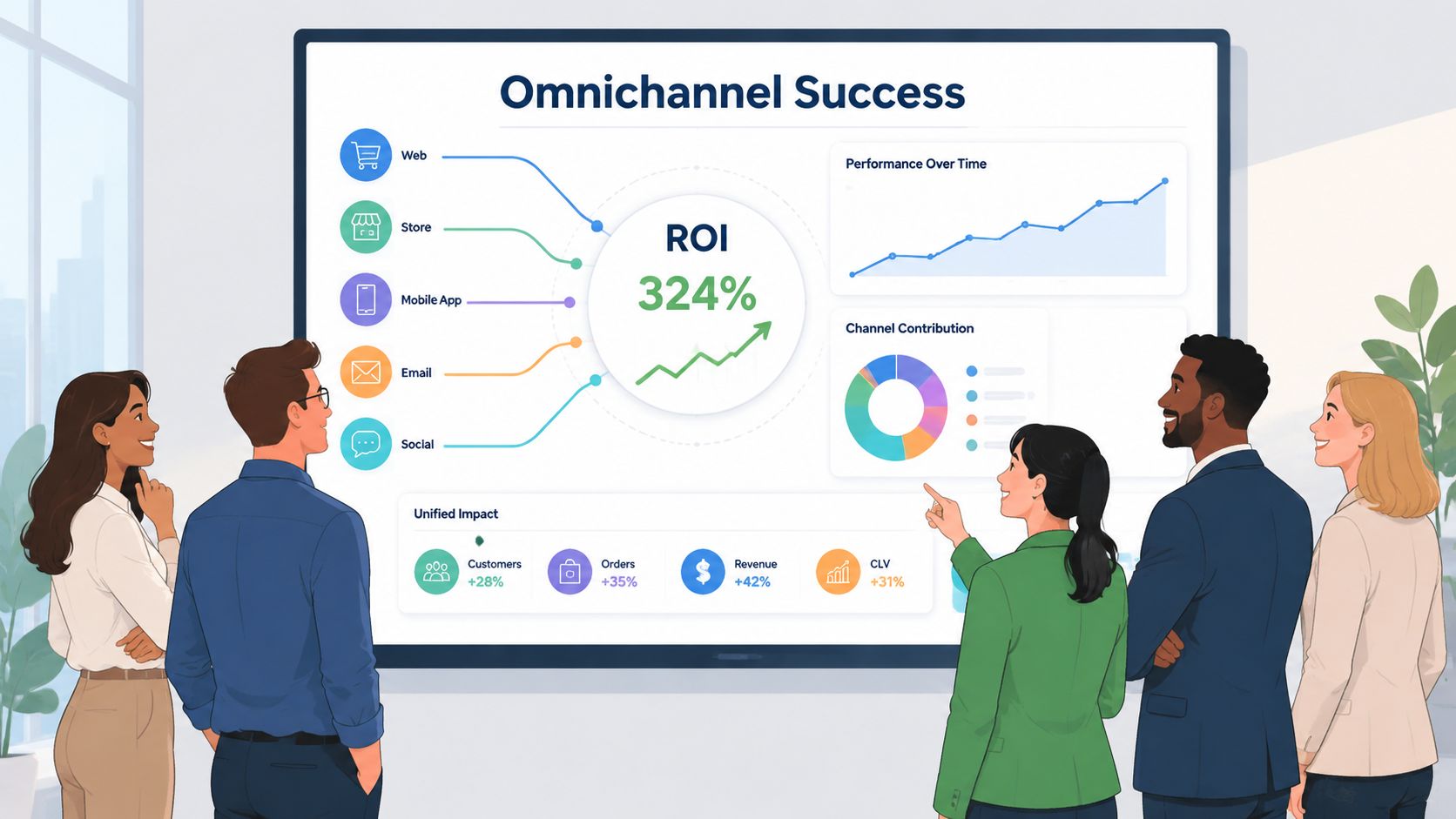
The wrong way to measure omnichannel is by asking whether one channel converted better than another.
That approach misses the whole point. Omnichannel changes how customers move, how teams fulfill, and how systems share context. Measurement has to reflect that broader reality.
Look past last-click reporting
A lot of Shopify reporting still gets interpreted through channel silos. Paid social drove this. Email closed that. Retail sold the final unit.
Useful, but incomplete.
Current guidance on omnichannel ecommerce strategy and measurement shows that success is shifting away from simple sales attribution and toward operational metrics like inventory accuracy and cross-channel loyalty program use. That's an important shift because a connected business wins through smoother execution, not just better attribution models.
Metrics that actually matter
If you want a practical measurement set, start with a mixed scorecard.
- Cross-channel customer value: Look at whether customers who interact across touchpoints become more valuable or more loyal over time.
- Inventory accuracy: If the business can't trust availability data, many omnichannel promises collapse.
- Order exception rate: Track where pickups, returns, substitutions, or routing decisions create manual work.
- Loyalty reuse across channels: A loyalty program only supports omnichannel if customers can use it wherever they interact.
- Time to resolution in support: Connected context should reduce repetitive customer service loops.
- Adoption of connected services: Measure how often shoppers choose capabilities like pickup, store-assisted purchase, or channel-flexible returns if you offer them.
A simple way to frame it is this:
| Category | Weak signal | Stronger omnichannel signal |
|---|---|---|
| Revenue | Single-channel conversion | Customer value across repeated touchpoints |
| Operations | Raw order count | Inventory trust and fulfillment reliability |
| Retention | Campaign response by channel | Loyalty behavior across the full relationship |
| Service | Ticket volume alone | How quickly teams resolve cross-channel issues |
Omnichannel ROI often shows up first in fewer conflicts, cleaner handoffs, and better retention behavior. Not just in a prettier dashboard.
Privacy constraints make measurement harder, not easier. Customers move through mobile, store, email, SMS, and paid media in ways that don't fit cleanly into old attribution models. That's why journey auditing and operational visibility matter so much now.
If the channels are connected but the measurement model isn't, teams still end up making channel-specific decisions that damage the overall customer experience.
Avoiding Pitfalls and Learning from Omnichannel Leaders
The biggest omnichannel mistake isn't choosing the wrong app. It's choosing the wrong ambition level.
Some merchants should absolutely invest in deeper integration. Others should stop at a disciplined multichannel model and run it well. That's not settling. It's good strategy. As noted in this perspective on whether omnichannel is right for every merchant, brands with low SKU complexity, limited offline demand, or weak systems maturity may get a better outcome from multichannel discipline than from forcing a costly omnichannel rollout.
The mistakes that slow brands down
A few patterns show up repeatedly:
- Buying architecture before defining the use case
- Treating omnichannel as a marketing initiative instead of an operating model
- Ignoring staff workflows while focusing on software
- Trying to connect every channel at once
- Assuming Shopify Plus alone solves process gaps
The best operators stay narrower. They connect the journeys that matter, prove operational control, and expand from there.
What good progression looks like
An emerging brand might stay mostly multichannel, but tighten product data, centralize promotions, and give store staff visibility into online orders through Shopify tools.
A growing merchant may add practical capabilities like in-store pickup, channel-consistent loyalty handling, and cleaner support context across Shopify, POS, and helpdesk systems.
A more advanced Shopify Plus brand may layer in a dedicated OMS, deeper data orchestration, and custom frontend experiences while keeping the backend rules centralized.
That's the actual maturity curve. Not multichannel bad, omnichannel good. The question is whether your current model matches customer behavior and your team's ability to execute.
If your Shopify brand is deciding whether to stay multichannel or move toward a true omnichannel setup, ECORN can help you evaluate the trade-offs, tighten the right systems, and build a roadmap that fits your stage instead of forcing enterprise complexity too early.


Shopify Git Integration: A Developer's Guide to 2026
Headless Ecommerce Development Services Explained

How to Build a Shopify Clothing Website That Converts

How to Launch a Box Subscription Business in 2026

Luxury Skincare Branding Playbook That Converters
10 Best Podcast Ecommerce Shows for Store Growth in 2026
Shopify Developer Hourly Rate: What to Pay in 2026

Critical Shopify Setup Errors That Are Secretly Sabotaging Your Store
Ecommerce Conversion Tracking: The Complete How-To Guide

Shopify Design Agency: How to Pick the Right Partner
Mastering Multi Store Management on Shopify

Scale Shopify Store

10 Shopify App Ideas Worth Building in 2026

Conversion Rate Optimization for Landing Pages: The Playbook
Shopify Plus Automation: A Guide for 2026
10 Social Selling Platforms for Shopify Merchants

Shopify Website Design Examples: 7 Stores Worth Studying

7 Ecommerce Newsletter Examples for Shopify Brands
One Product Shopify Store: Build and Scale

Mobile Pop Up Strategy for Shopify Stores That Converts

Sitemap for Shopify: How to Find, Optimize, and Submit It

7 Single Product Websites Worth Emulating
Product Variants Shopify: The Complete 2026 Guide
Ecommerce Analytics Consulting for Growth
What Is AI Integration for eCommerce

How to Choose the Right eCommerce Website Development Firm
E Business Strategy Implementation
Conversion Tracking Setup for Shopify Stores
BigCommerce vs Shopify Plus Which Enterprise Wins in 2026
Shopify Theme Kit: Setup, Commands, and Migration Guide
Shopify Extension Development: A Practical 2026 Guide
Shopify Speed Score Explained and How to Improve It

Shopify Mobile Optimization: The 2026 Playbook

How to Add Subcategory in Shopify for Better UX
How to Implement Structured Data for Ecommerce in 2026

SEO App Mobile: Shopify Store Optimization Guide
Shopify Plus Support: What It Includes and How to Choose

Google Ads for Shopify: The Complete 2026 Playbook

Shopify New York: How to Find and Hire the Right Agency
Google Search Console for Shopify: The Complete Setup
First Party Data Collection for eCommerce Growth
FAQ Online Store Guide: Build and Measure It Right
Do FB Ads Work for eCommerce in 2026?
One Page Checkout for Shopify: Design and Implementation
Shopify GraphQL vs REST: The 2026 Developer Decision
Shopify Ecommerce Consulting: Strategy, Pricing &

Are Reddit Ads Worth It for eCommerce Brands
Shopify Title and Meta Description: A Practical 2026 Guide

Product Video Best Practices for Shopify Brands
Real-Time Inventory Management: A 2026 Guide
AI Chatbot Integration for Shopify Stores
Affiliate Program Management: A Shopify Guide
10 Best Performance Monitoring Tools for Shopify in 2026
Digital Asset Management for eCommerce Brands in 2026

Every Type of Facebook Ads Explained for eCommerce Growth
Product Information Management Explained for Shopify Brands
Support Ticket System: A Guide for Shopify Stores

10 Best Customer Service Tools for Shopify in 2026

Can I Start a Business with No Money? a 2026 Blueprint

What Sells Good on Etsy: Best Niches for 2026

Shopify Add to Cart Button: A Practical 2026 Guide

Customer Feedback Automation: A Practical eCommerce Guide
Critical Rendering Path: A Guide for Shopify Stores

How to Promote on TikTok for eCommerce in 2026

B2B eCommerce Consulting That Drives Real Revenue

10 Best Practices for Site Navigation in 2026
Return vs Refund for Shopify Stores: A Practical Guide
What Is Customer Lifetime Value and Why It Matters
What Is Voice of Customer Research for eCommerce

SMS Marketing for Ecommerce That Actually Converts

Master How to Improve Email Deliverability in 2026

Top 8 eCommerce Partners NYC for Shopify Brands in 2026

Machine Learning for Ecommerce: Boost Your Shopify Store

Beauty Market Research: Your 2026 Growth Guide
Shopify International Expansion: A 2026 Roadmap
What Does CRO Stand for in Business: Understanding CRO

Shopify Visual Merchandising: A Playbook for Higher Sales

Shopify Landing Page Design: Master Conversion in 2026

10 Best AI SEO Optimization Tools for Shopify in 2026

Agentic AI for Ecommerce: Boost Your Sales in 2026
Mastering Email Marketing Data for eCommerce Growth

Conversion Rate Optimisation Australia: Boost Your Sales
Conversion Rate Optimization AI: Your Shopify Store Guide

10 Product Bundling Strategies for Shopify in 2026

How to Increase Customer Lifetime Value: A Shopify Playbook
AI Customer Service Automation: Shopify Guide 2026

Clean Website Design: A Shopify Conversion Playbook

Omnichannel Retail Strategy: A Shopify Playbook
Product Data Enrichment: A Guide for Shopify Brands
Instagram Shopping Features a Guide for Shopify Stores
What Is Revenue Optimization: A Holistic RevOps Guide

Benefits of Conversion Rate Optimization: Boost Your
WordPress to Shopify Migration: Your 2026 Seamless Switch
Boost Sales: Ecommerce Payment Processing Guide 2026
Unified Commerce Platform: Benefits, KPIs & Shopify Guide

How to Reduce Bounce Rate eCommerce: Your 2026 Guide
Shopify API Integration: A Practical End-to-End Guide

How to Implement Data Governance: A 2026 Guide
Shopify Store Development Cost: A 2026 Breakdown
What Is Server Side Tracking: The Shopify Guide 2026


newsletter in your inbox