

Average inventory accuracy sits at 83%, while world-class operators reach 95%, a 12-point gap that still leaves money on the table in stockouts and missed sales, with one industry source tying the broader problem to as much as $1 trillion in lost global sales annually Anchor Group's inventory statistics breakdown. That gap is the reason real-time inventory management matters, not because software sounds modern, but because lagged stock data causes overselling, backorders, and customer trust problems that compound fast across channels.
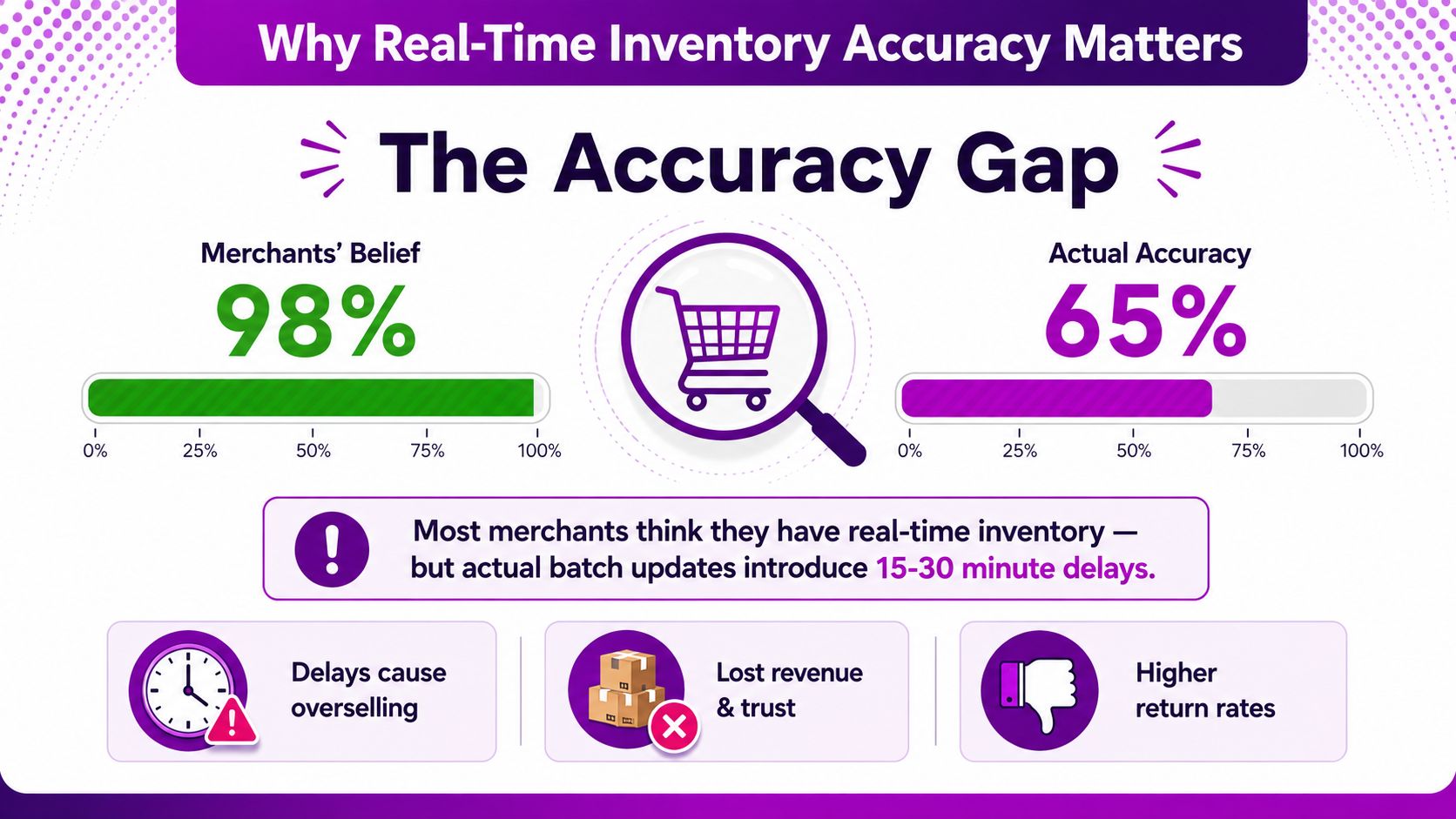
Most merchants think they're running live inventory when they're really running scheduled syncs. In Shopify-style stacks, that usually means the storefront, warehouse, and OMS each have their own version of the truth, and none of them agree for long.
Why Real-Time Inventory Accuracy Matters for eCommerce
A live dashboard can still be wrong. That is the part merchants miss. Inventory accuracy breaks down long before the interface shows it, and once the stored number drifts from physical stock, every channel starts making decisions on stale data. The issue is not visibility alone, it is whether the number is governed well enough to stay correct across sales, receiving, returns, and transfers.
The business impact shows up in the gap between what teams believe they can sell and what is really available. In many operations, that gap is created by unreviewed adjustments, delayed postings, and duplicate stock records across systems, not by the storefront itself. The result is overselling, canceled orders, and a growing buffer of safety stock that exists only because nobody trusts the system enough to reduce it.
For merchants selling through multiple channels, the cost of a bad count spreads fast. Sales teams quote inventory that was already allocated elsewhere. Operations teams spend time resolving exceptions after the order is placed. Finance teams keep more inventory on hand than needed because the live number cannot be trusted for replenishment or planning.
Practical rule: if a stock change only shows up after a scheduled sync, the process is not real-time, even if the screen refreshes often.
That is also why governance matters more than software selection. I have seen Shopify brands buy better tools and still fail because the source of truth was unclear, item masters were inconsistent, and warehouse adjustments were not handled the same way in every system. The software can move data quickly, but it cannot fix inconsistent rules about what should count as sellable stock.
That distinction matters in service-heavy operations too. A live inventory feed only changes outcomes when the underlying counts are trustworthy enough to drive action, which is the same basic logic behind improve break room vending service. If the machine says stock is available and it is not, the user experience fails in the same way a storefront order fails.
The practical takeaway is simple. Periodic counting can work in a single-location setup. Once a merchant is juggling marketplaces, retail stores, and multiple fulfillment nodes, continuous visibility only helps when the record behind it is clean.
The Architecture Behind Real-Time Inventory
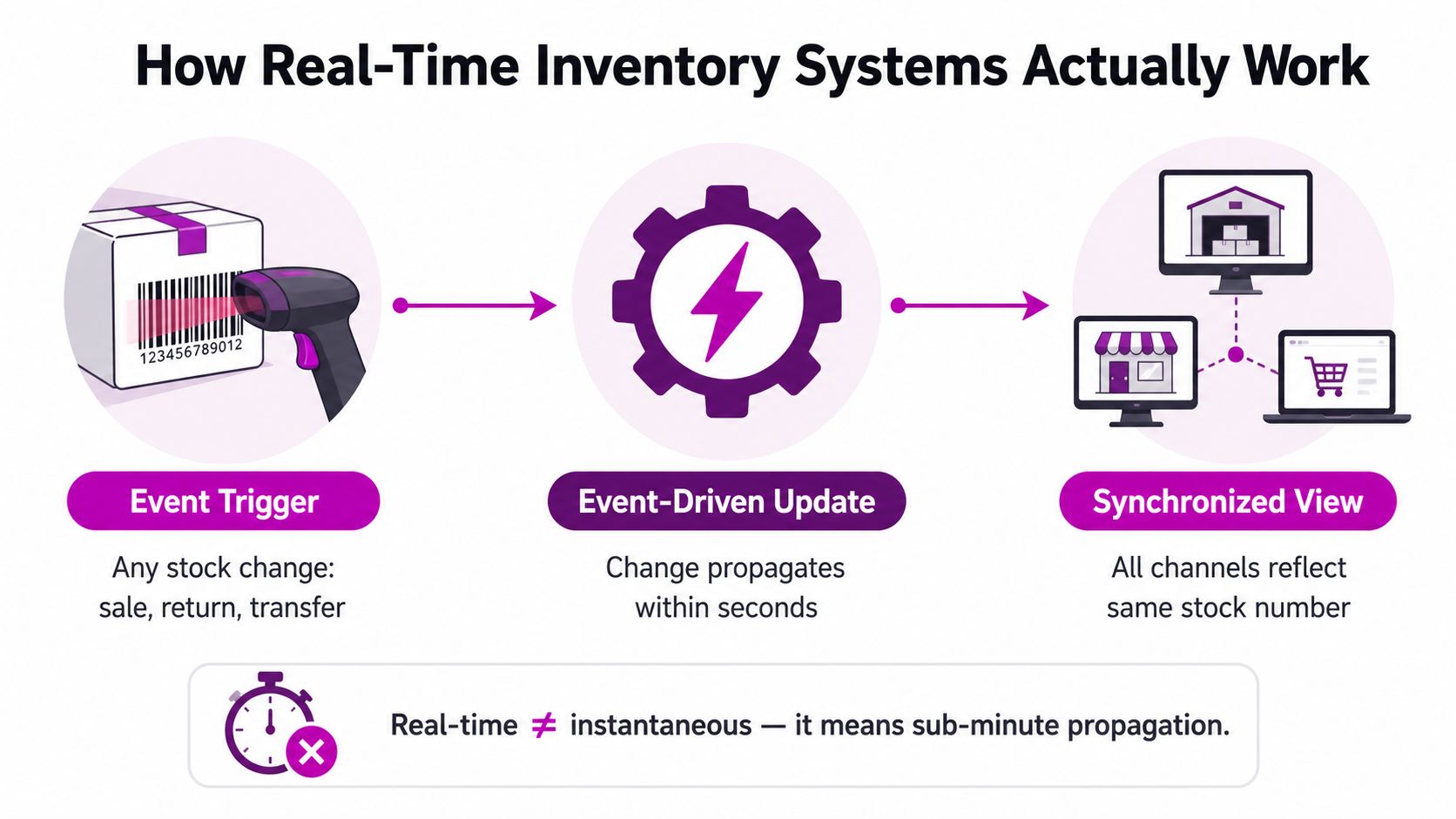
Real-time inventory does not mean instant in the human sense. It means a stock change becomes visible across connected systems quickly enough that the storefront, warehouse, and order management layers can still make the right call. In practice, the process starts with an event, a sale, return, transfer, or adjustment, then moves through the connected stack instead of waiting for a nightly job or a scheduled sync.
Event Trigger to Synchronized View
A clean setup usually has three layers. First, a scanner, POS, or order event writes the stock mutation into the source system. Second, an integration layer publishes that mutation outward. Third, every dependent system, such as Shopify Plus, the OMS, or a warehouse app, reads the same updated position.
The middle layer carries more weight than many merchants expect. Legacy POS and ERP setups often do not expose the real-time publishing APIs that modern eCommerce teams assume are there, so engineers use Change Data Capture (CDC) tools to pull database changes directly from transactional tables and stream them downstream IJNRD paper on real-time inventory visibility. That approach is better than polling because it pushes change instead of repeatedly asking whether anything changed yet.
Real-time visibility breaks when every system invents its own stock truth. One golden record, updated by events, is the only version that scales cleanly.
Why Data Quality Controls Matter
The architecture also needs guardrails. The same technical source calls out schema evolution and data quality controls as core requirements. If SKU attributes, store fields, or location codes change, a schema registry keeps old and new message formats compatible. Validation layers, or dead-letter queues, catch malformed inventory records before they distort downstream availability.
That is the part many implementations miss. Teams buy integration software and assume the hard work is finished. The hard work is making sure every update is valid, ordered correctly, and tied to the right SKU and location.
In Shopify Plus environments, the cleanest flow is usually easy to describe, even if it is hard to build. A warehouse scan updates the inventory source, the order system consumes that event, and the storefront reflects the new number without manual re-entry. The architecture only works when the stock event is treated as the authoritative signal, not as one of several competing inputs.
For teams already automating inventory workflows, ECORN's guide on automating inventory workflows is a useful companion because it frames inventory as a process problem, not just a software feature.
Batch Synchronization vs Event-Driven Architecture
Black Friday exposes the weakness in a batch-based stack fast. A flash sale can sell through inventory in minutes, while a 15-minute poll window still shows stock that is already committed to orders, pick lists, or marketplace holds. Most distributed eCommerce stacks run into that problem because they depend on scheduled batch synchronization or rate-limited APIs. If one system exports order data every 15 minutes and another exports inventory adjustments every 30 minutes, the storefront, warehouse, and order management layer are working from different stock counts Bizowie's technical breakdown.
Where Batch Sync Falls Short
Batch sync is acceptable when order volume is low and the business can tolerate stale data. It breaks down when you are managing many SKUs, multiple locations, or promotions that move inventory quickly. The same source notes that common API plans are often capped around 1,000 to 2,000 requests per hour, which makes brute-force polling a poor fit for large catalogs or multi-location operations Bizowie's technical breakdown.
The trade-off is blunt. Poll less often, and the storefront shows numbers that lag behind reality. Poll more often, and you hit limits without guaranteeing correctness. Either way, customers can place an order against stock that is already committed elsewhere.
Why Event-Driven Wins at Scale
Event-driven architecture handles the lag differently. Each stock change becomes a message that moves forward as soon as it happens, instead of waiting for the next reconciliation cycle. That is more complex to implement, but it fits omnichannel operations where one sale affects online availability, store pickup promises, and warehouse replenishment at the same time.
The choice comes down to tolerance for error. A merchant with one location and light order volume can often live with batch sync for a while. Once there are multiple sales channels, faster turnover, or 3PL handoffs, event-driven updates are the only way to keep false availability under control.
The failure point is usually governance, not software selection. Teams buy a new integration tool and expect the stock problem to disappear, but periodic reconciliation still leaves lag windows in place. The architecture changes the timing, and the data governance determines whether the numbers are trusted in the first place.
Implementation Roadmap for Multi-Store Merchants
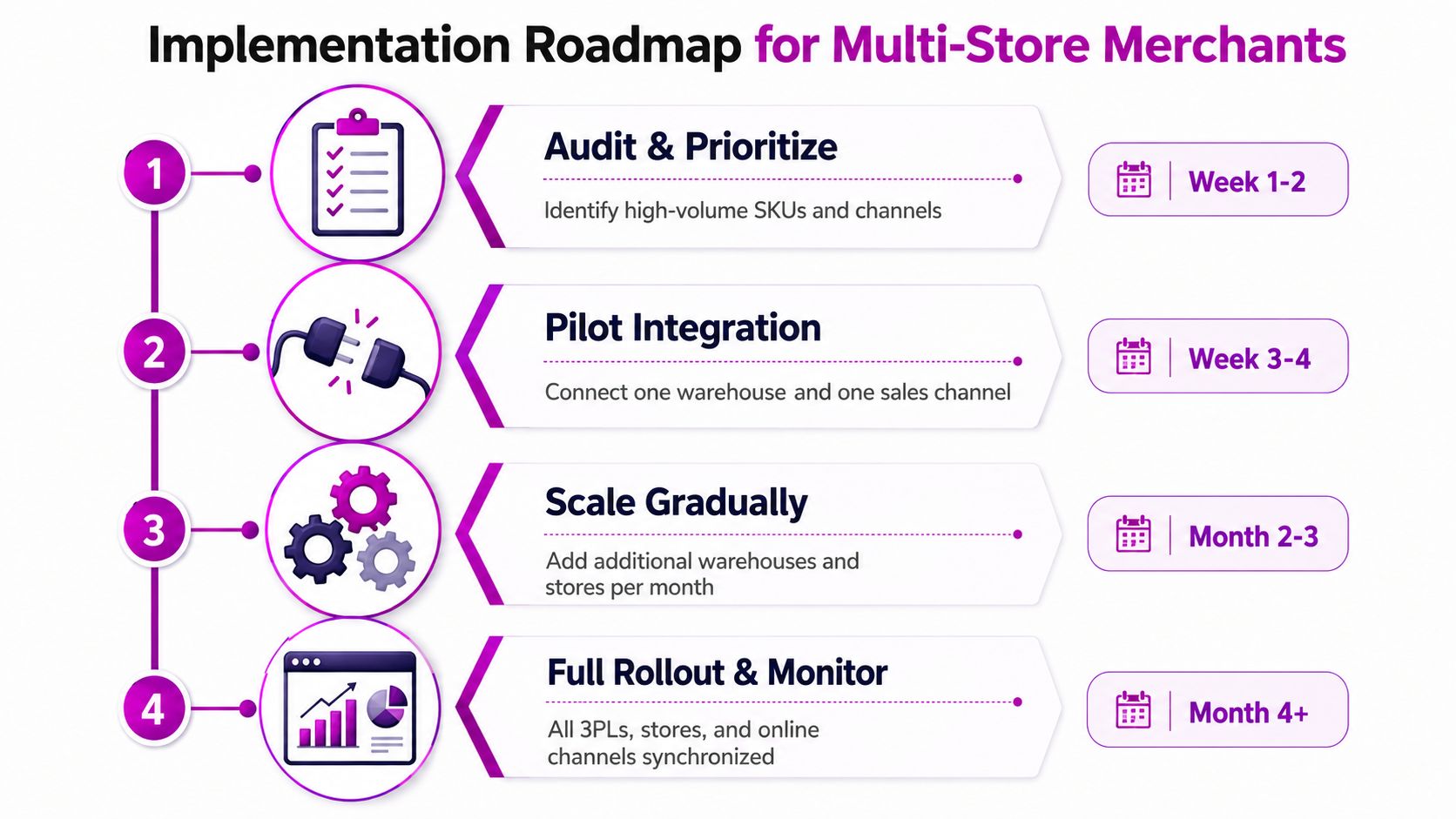
The fastest way to create false availability is to connect everything at once. When stores, 3PLs, warehouses, and marketplaces all start writing inventory at the same time, the merchant often ends up with conflicting stock states instead of clearer visibility. A phased rollout gives you a chance to prove the data model before it touches mission-critical channels.
Start with the Golden Record
The first job is governance, not integration. Decide which system owns the stock position for each SKU and location, then define how adjustments, returns, damaged goods, and transfers flow into that record. If your team can't name the owner of the inventory truth, automation will only move confusion faster.
Practical rule: do not automate until you can explain, in plain language, which system is authoritative for on-hand, committed, and available stock.
That baseline matters because a lot of teams skip straight to forecasting or routing logic. The stronger move is to measure current record accuracy first, then add automation on top of a clean reference point. Ventory's visibility guide recommends establishing baseline accuracy before layering forecasting or advanced control rules Ventory's visibility guide.
Pilot Before You Scale
Start with one warehouse and one channel, then review every exception closely. That setup is enough to surface duplicate SKUs, delayed returns posting, and inconsistent unit definitions before they spread across the business. Once the pilot behaves, expand to low-visibility sites before high-volume nodes.
Keep the rollout narrow enough to see where the data breaks. A small pilot also shows whether your item master, warehouse logic, and order routing rules agree with each other under real order flow, which is where many implementations drift. ECORN's multi-location inventory management resource frames this as a process design challenge, not just a connector setup problem.
Key Metrics and Performance Benchmarks
Inventory teams often track too many numbers and still miss the ones that matter. For real-time inventory management, the essential metrics are the ones that show whether physical stock, promised stock, and system stock are staying aligned. Start with stockout rate, backorder frequency, and the lag between a physical movement and a visible update.
A useful way to think about it is simple, if customers can buy stock you don't have, the system is lying. If staff can't trust the number, they'll compensate with manual checks, which defeats the point of automation.
| Metric | Small Store (<1K SKUs) | Mid-Market (1K-10K SKUs) | Enterprise (10K+ SKUs) |
|---|---|---|---|
| Stock record accuracy | Track by SKU and location daily | Track by channel and location daily | Track by node, channel, and committed stock continuously |
| Stockout rate | Review weekly by top sellers | Review daily by channel | Review in near real time across nodes |
| Backorder frequency | Flag every exception | Segment by location and carrier | Separate by source node and promise type |
| Inventory update lag | Check manually after each sale | Measure by system handoff | Monitor as an operational alert |
| Available-to-promise accuracy | Validate against physical counts | Validate against order commitments | Validate against all fulfillment nodes |
The benchmark isn't perfection, it's consistency. Small merchants can often get away with simpler reporting if one person still sees the whole operation. Larger teams need layered reporting because the failure might live in the warehouse, the 3PL feed, or the storefront promise layer.
The best metric is the one that forces a decision, not the one that looks good in a dashboard.
If you can only choose one operational test, measure how long it takes for a physical stock change to show up where customers or agents make a promise. That single lag number usually exposes whether the architecture is behaving in a real-time way or just appearing to.
Common Pitfalls That Create False Availability
False availability usually comes from process errors, not a bad platform choice. A merchant can buy solid inventory software and still oversell if committed stock, damaged units, and in-transit inventory are handled inconsistently. The software doesn't fix broken ownership rules by itself.
The Most Common Failure Modes
One common mistake is treating every system touchpoint as equally authoritative. That's how duplicate edits and race conditions creep in during flash sales, especially when the storefront and warehouse both try to adjust the same SKU at the same time. Another mistake is letting returns post late, which makes sellable stock look lower than it really is, then causes teams to overorder.
Timezone drift is another quiet problem in global operations. If warehouses in different regions post movements at different local times without a shared standard, reports can show contradictory states for the same item. That's especially painful when one location is already using the stock another site thinks is still available.
Diagnostic Questions That Expose Risk
Use these questions to pressure-test your setup.
- Who owns exceptions? If nobody owns damaged goods, returns, and adjustments, your data will drift.
- Can the OMS and ERP disagree? If yes, then promise logic is probably reading stale stock.
- What happens during a simultaneous sale and transfer? If the answer requires manual review every time, your automation is too fragile.
- Do 3PL updates arrive with enough context? If location and status fields are incomplete, downstream systems can't make a reliable promise.
The deeper technical guidance on visibility across stores, 3PLs, OMS, and ERP systems makes the same point, late or inconsistent updates still produce stockouts and overselling even when “real-time” tools are in place Netguru's visibility guidance.
The fix is usually process discipline first, software second. You need clear rules for which events can change sellable stock, which events only change internal counts, and which events require human review before the number is published. That's the difference between live data and believable data.
ROI Examples and Scaling Best Practices
The strongest ROI from real-time inventory management usually comes from a series of smaller gains, not one dramatic win. Fewer stockouts, less manual checking, less overbuying, and tighter promise accuracy across channels all add up. When teams trust the numbers, they stop padding inventory “just in case,” and that changes cash flow, purchasing decisions, and fulfillment behavior.
Where the Value Usually Shows Up
The first gain is operational. Teams spend less time reconciling mismatches between Shopify, the warehouse, and the 3PL. That time often goes into exception handling instead of chasing down which system is right, and that is a real cost even when it does not show up as a line item.
The second gain is customer-facing. Accurate stock status reduces broken promises, and it also cuts the support load that follows them. If a product is marked available in one channel after it was already committed elsewhere, the problem is not just a bad order. It becomes a refund, a replacement shipment, or a lost repeat buyer.
The third gain is strategic. Once stock truth is reliable, merchants can add locations and channels without turning every growth move into a data cleanup project. That matters because inventory errors do not stay small. Each new warehouse, marketplace, or fulfillment partner gives bad records more places to spread.
What to Prioritize First
A practical scaling order is straightforward.
- Fix SKU and location hygiene. Clean master data beats fancy automation on broken records.
- Stabilize one fulfillment path. Prove the flow with one warehouse and one sales channel.
- Expand promise logic carefully. Add pickup, transfer, and 3PL logic only after the core feed is stable.
- Train the operators. Warehouse and support teams need to know how exceptions are handled, or the system will drift again.
The key question is whether inventory is already crossing too many nodes for manual reconciliation. If the answer is yes, the software choice matters less than the operating model around it. A merchant can buy a stronger sync tool and still fail if damaged goods, returns, adjustments, and transfer rules are not governed the same way across every system.
One practical example is a brand that adds a second warehouse before its SKU map is clean. The result is usually duplicate items, mismatched location counts, and support tickets every time a channel oversells from the wrong node. Fixing the master data and exception rules first costs less than cleaning up the mess after the rollout.
The best ROI framework is to compare current error handling against the cost of getting it wrong. If every wrong promise creates extra support, replacement shipping, or lost repeat business, then real-time accuracy pays for itself through reduced friction, not just better dashboards.



Product Variants Shopify: The Complete 2026 Guide

Ecommerce Analytics Consulting for Growth

What Is AI Integration for eCommerce

How to Choose the Right eCommerce Website Development Firm
E Business Strategy Implementation
Conversion Tracking Setup for Shopify Stores
BigCommerce vs Shopify Plus Which Enterprise Wins in 2026
Shopify Theme Kit: Setup, Commands, and Migration Guide

Shopify Extension Development: A Practical 2026 Guide

Shopify Speed Score Explained and How to Improve It

Shopify Mobile Optimization: The 2026 Playbook

How to Add Subcategory in Shopify for Better UX
How to Implement Structured Data for Ecommerce in 2026

SEO App Mobile: Shopify Store Optimization Guide

Shopify Plus Support: What It Includes and How to Choose

Google Ads for Shopify: The Complete 2026 Playbook

Shopify New York: How to Find and Hire the Right Agency

Google Search Console for Shopify: The Complete Setup

First Party Data Collection for eCommerce Growth

FAQ Online Store Guide: Build and Measure It Right
Do FB Ads Work for eCommerce in 2026?

One Page Checkout for Shopify: Design and Implementation
Shopify GraphQL vs REST: The 2026 Developer Decision
Shopify Ecommerce Consulting: Strategy, Pricing &

Are Reddit Ads Worth It for eCommerce Brands

Shopify Title and Meta Description: A Practical 2026 Guide

Product Video Best Practices for Shopify Brands

AI Chatbot Integration for Shopify Stores
Affiliate Program Management: A Shopify Guide
10 Best Performance Monitoring Tools for Shopify in 2026

Digital Asset Management for eCommerce Brands in 2026

Every Type of Facebook Ads Explained for eCommerce Growth
Product Information Management Explained for Shopify Brands
Support Ticket System: A Guide for Shopify Stores

10 Best Customer Service Tools for Shopify in 2026

Can I Start a Business with No Money? a 2026 Blueprint

What Sells Good on Etsy: Best Niches for 2026

Shopify Add to Cart Button: A Practical 2026 Guide

Customer Feedback Automation: A Practical eCommerce Guide

Critical Rendering Path: A Guide for Shopify Stores

How to Promote on TikTok for eCommerce in 2026

B2B eCommerce Consulting That Drives Real Revenue

10 Best Practices for Site Navigation in 2026
Return vs Refund for Shopify Stores: A Practical Guide

What Is Customer Lifetime Value and Why It Matters

What Is Voice of Customer Research for eCommerce

SMS Marketing for Ecommerce That Actually Converts

Master How to Improve Email Deliverability in 2026

Top 7 eCommerce Partners NYC for Shopify Brands in 2026

Machine Learning for Ecommerce: Boost Your Shopify Store

Beauty Market Research: Your 2026 Growth Guide

Shopify International Expansion: A 2026 Roadmap

What Does CRO Stand for in Business: Understanding CRO

Shopify Visual Merchandising: A Playbook for Higher Sales

Shopify Landing Page Design: Master Conversion in 2026

10 Best AI SEO Optimization Tools for Shopify in 2026

Agentic AI for Ecommerce: Boost Your Sales in 2026
Mastering Email Marketing Data for eCommerce Growth

Conversion Rate Optimisation Australia: Boost Your Sales
Conversion Rate Optimization AI: Your Shopify Store Guide

10 Product Bundling Strategies for Shopify in 2026

How to Increase Customer Lifetime Value: A Shopify Playbook
AI Customer Service Automation: Shopify Guide 2026

Clean Website Design: A Shopify Conversion Playbook

Omnichannel Retail Strategy: A Shopify Playbook

Product Data Enrichment: A Guide for Shopify Brands

Instagram Shopping Features a Guide for Shopify Stores

What Is Revenue Optimization: A Holistic RevOps Guide

Benefits of Conversion Rate Optimization: Boost Your
WordPress to Shopify Migration: Your 2026 Seamless Switch
Boost Sales: Ecommerce Payment Processing Guide 2026

Unified Commerce Platform: Benefits, KPIs & Shopify Guide

How to Reduce Bounce Rate eCommerce: Your 2026 Guide
Shopify API Integration: A Practical End-to-End Guide

How to Implement Data Governance: A 2026 Guide

Shopify Store Development Cost: A 2026 Breakdown
What Is Server Side Tracking: The Shopify Guide 2026
Marketing Automation Workflows: A Shopify Guide for 2026

Shopify: How to Reduce Technical Debt

Shopify UX Design Change: A Playbook for Growth

User Generated Content Strategy: Shopify Playbook

Shopify Pause and Build Plan Cost: A Complete 2026 Guide

Compare at Price on Shopify: A Complete Guide for 2026

Where Can I Sell My Prints? 10 Best Platforms for 2026
Shopify Order Management System: The Ultimate Guide 2026

What Is Marketing Attribution? an eCommerce Guide for 2026

10 Best Black Friday Sales Sheets for 2026

Discover the Top Social Media Marketing Agencies For

Consumer Confidence Definition for eCommerce in 2026

What Is Social Commerce? Your 2026 Guide to Boosting Sales

A Social Ad Campaign Playbook for eCommerce Growth

7 Best FAQ Page Examples for SaaS & eCommerce

Market Research in Fashion Industry: A Guide for Shopify

Shopify Migration Services: Expert Guide for 2026

Mastering FB Retargeting Ads for Shopify in 2026
What Is Omnichannel Ecommerce

Master Your Shopify Plus Migration: The 2026 Guide
Shopify Integration Services: A Merchant's 2026 Guide

Shopify Collection Description: A Guide to SEO & Sales

Shopify Plus Contact: Reach Sales & Support Effectively


newsletter in your inbox