

A lot of growing brands are in the same spot right now. Shopify runs the storefront well, marketing has added strong apps, retail stores use a separate POS or legacy system, the warehouse relies on ERP logic that lives somewhere else, and support works from partial customer data. Nothing looks completely broken until a customer tries to do something simple across channels.
An online return hits the store, but inventory doesn't reflect it immediately. A repeat customer walks into a flagship location, yet the associate can't see order history or loyalty context. A promotion launches on the website, while store teams still ring up old pricing. Leaders call this an omnichannel problem. In practice, it's usually an architecture problem.
A unified commerce platform fixes that at the data layer. For Shopify and Shopify Plus brands, that doesn't always mean ripping out the storefront. More often, it means deciding where the core system of record should live, how data should move, and which integrations are worth owning versus eliminating. That's where most guides get vague. The expensive part isn't the pitch deck. It's the integration debt hiding behind 'effortless'.
The Hidden Costs of a Disconnected Business
Disconnected systems create friction in places teams tend to normalize. Returns get handled manually. Customer service checks three tools before answering a simple order question. Merchandising exports product data to one channel, then corrects mismatches in another. Finance closes the month with too many reconciliation exceptions.
Those aren't isolated operational annoyances. They usually point to the same root issue: each channel has its own version of product, customer, order, or inventory truth.
Where the leakage actually happens
The commercial damage shows up in familiar ways:
- Inventory confidence drops: ecommerce shows availability that store teams don't trust.
- Customer recognition breaks: loyalty, support history, and purchase history sit in different systems.
- Promotions become channel-specific by accident: one rule is configured in Shopify, another in POS, and a third in a middleware layer.
- Returns cost more than they should: staff spend time validating transactions instead of processing them cleanly.
A disconnected stack doesn't fail all at once. It fails in the handoff between teams, channels, and systems.
Multichannel setups make this worse because each channel operates independently. Omnichannel improves the customer-facing experience, but many brands still rely on stitched-together systems that sync after the fact. That's better than total fragmentation, but it still leaves delays, duplicate records, and operational workarounds.
Why growing brands hit the wall
Early on, apps and connectors can carry a lot of weight. Shopify can power a fast storefront, point solutions can cover subscriptions, loyalty, reviews, and search, and a small team can manually correct exceptions. Growth changes the equation. More locations, more SKUs, more order-routing complexity, and more customer touchpoints expose every fragile integration.
A unified commerce platform matters when the business can no longer tolerate delayed syncs and disconnected workflows. The goal isn't just convenience. It's one operational model for how the brand sells, fulfills, serves, and reports across channels.
Unified Commerce vs Omnichannel and Multichannel
Most confusion starts because these terms get used as if they describe the same maturity level. They don't. The difference is structural.
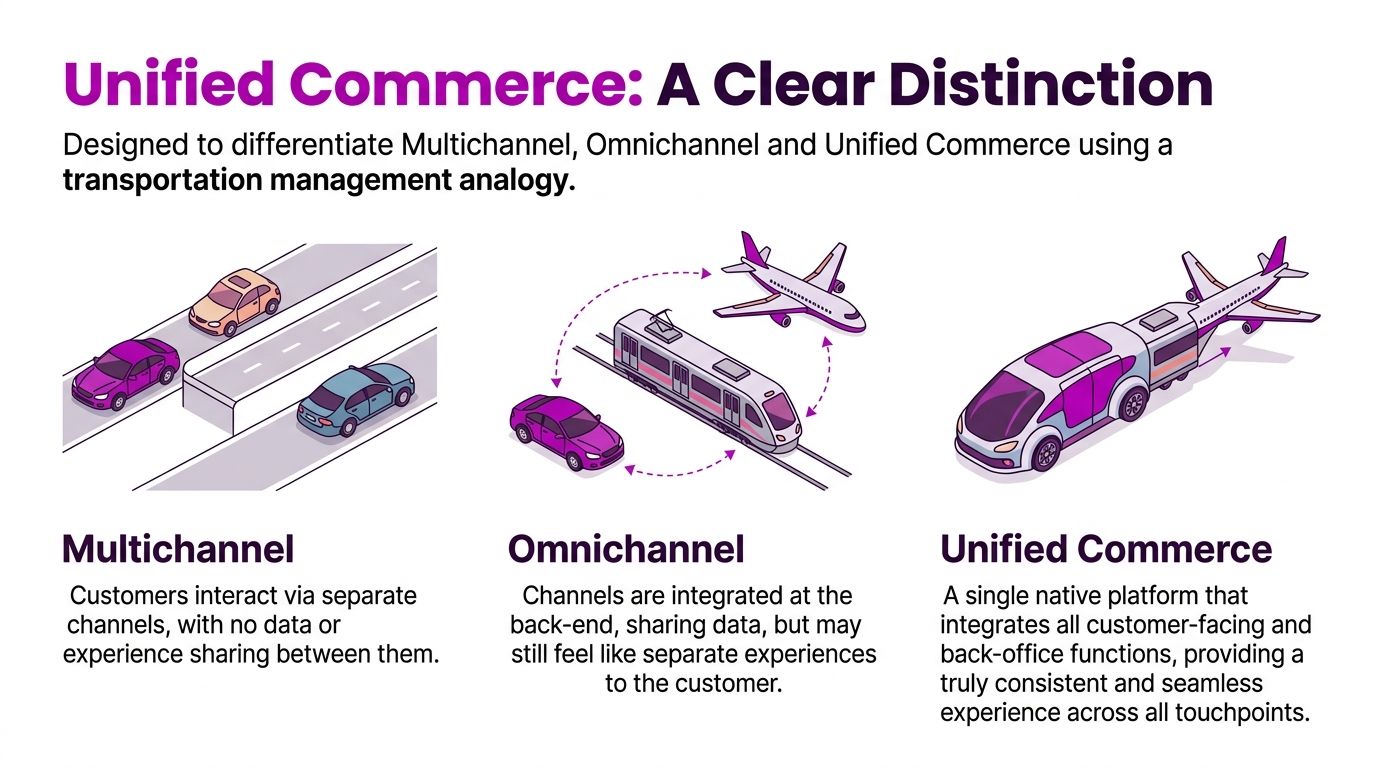
Three models, three very different realities
Think of it as transportation.
Multichannel is separate roads going to the same city. Your website, marketplace presence, social storefront, and physical store all exist, but they don't really coordinate. A customer may recognize the brand, yet the business behind each touchpoint behaves like separate operations.
Omnichannel adds bridges between those roads. Systems share some data. Customers can move between channels with fewer visible gaps. But under the hood, the business often still relies on separate vehicles, separate timetables, and separate operational logic. If you want a useful primer on that middle layer, this guide to omnichannel ecommerce is a good reference point.
Unified commerce is one transport system with a shared engine. The customer profile, order data, inventory state, pricing logic, and fulfillment rules all run from the same operational core. That's the difference that matters.
The practical comparison
| Model | Data flow | Customer experience | Operational reality |
|---|---|---|---|
| Multichannel | Separate by channel | Inconsistent | Teams reconcile manually |
| Omnichannel | Connected through integrations | More seamless, but not always consistent | Middleware and sync jobs do heavy lifting |
| Unified commerce | Real-time from one core | Consistent across touchpoints | Shared logic for orders, inventory, and customers |
The key mistake brands make is assuming omnichannel automatically means unified. It doesn't. A brand can offer click-and-collect, in-store returns, and shared promotions while still running on fragmented systems that create latency and data conflicts.
What leaders should look for
A vendor may market “unified commerce” when they really mean integrated commerce. Ask harder questions:
- Where does the master customer record live?
- Which system owns sellable inventory?
- Are price and promotion rules native, or pushed between systems?
- What happens when one integration fails for an hour?
- Can a store associate and support agent see the same customer context at the same moment?
If the answer depends on nightly syncs, middleware retries, or CSV fallbacks, you're not looking at a fully unified model.
That distinction matters because architecture determines whether growth adds efficiency or complexity.
Core Architecture of a Unified Platform
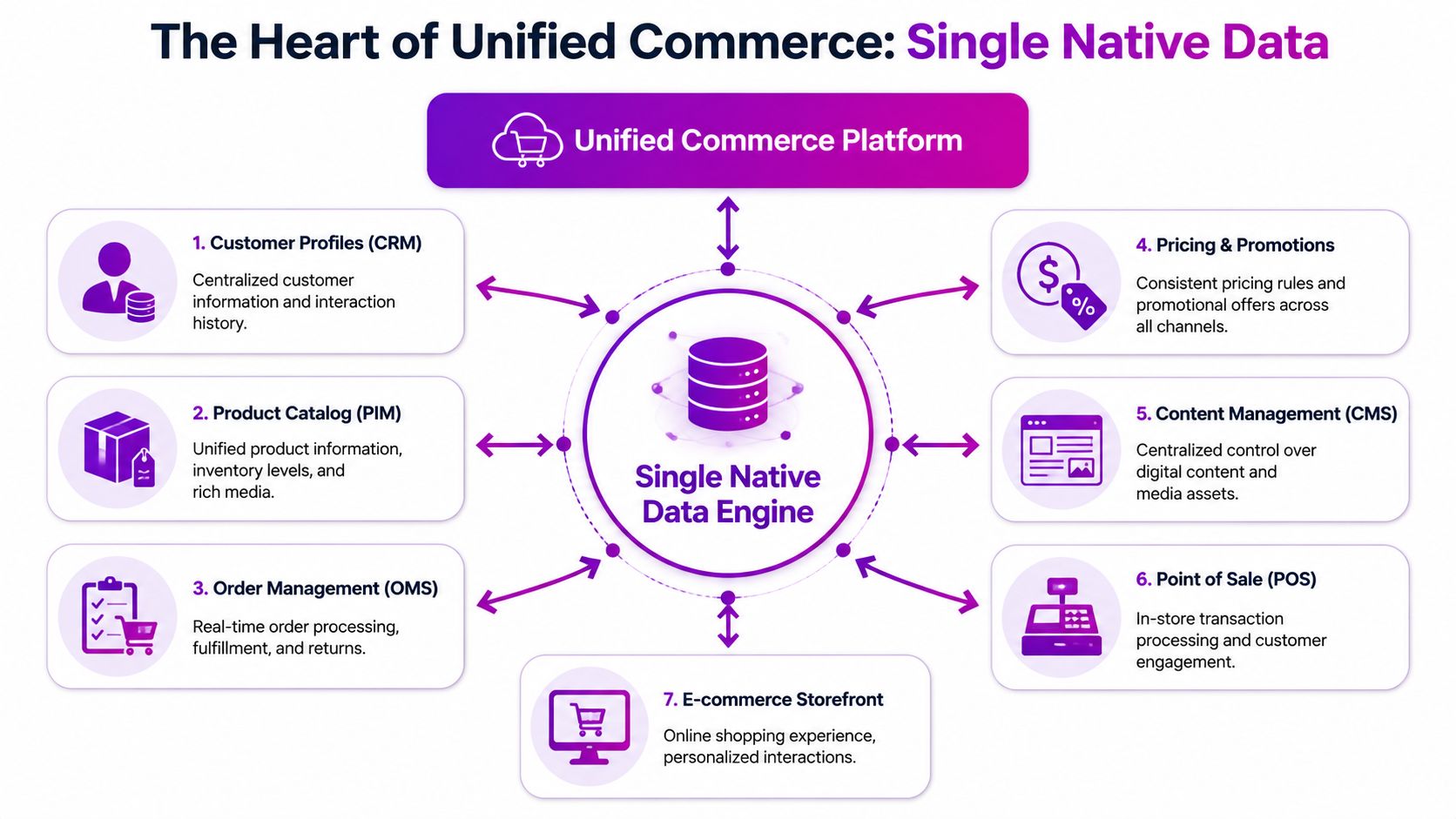
A real unified commerce platform starts with one principle: one native data core. Not a bundle of connected applications pretending to be one platform. Not a dashboard over multiple systems. One operational source of truth.
According to Manhattan's overview of unified commerce, the architecture centralizes all sales channels and back-end systems into a single native data core, eliminating fragmented third-party integrations that typically sync after the fact and ensuring product, customer, and transactional data stay synchronized in real time.
What sits in the core
A unified architecture usually connects these domains directly to the same data engine:
- Customer profiles: identity, history, preferences, service context
- Product catalog: titles, variants, availability, media, merchandising attributes
- Order management: capture, routing, fulfillment, returns, exchanges
- Pricing and promotions: channel-consistent rules
- Content and commerce touchpoints: storefront, mobile, support surfaces, POS
- Store operations: transactions, pickup, returns, assisted selling
That structure matters because each event updates the rest of the business immediately. An in-store sale affects online inventory. A support interaction informs marketing context. A return changes availability and order status without waiting on batch sync.
What this changes operationally
With a single core, teams stop asking which system is right. They work from the same answer.
That improves several day-to-day workflows:
| Function | Fragmented setup | Unified setup |
|---|---|---|
| Inventory | Channel-level snapshots | Real-time visibility |
| Customer service | Partial history across tools | Shared customer context |
| Returns | Manual validation and lag | Immediate status updates |
| Promotions | Rules duplicated by channel | Centralized execution |
A lot of brands underestimate how much time they waste on exception handling. The cost isn't only technical. Merchants delay campaign launches because they don't trust pricing parity. Retail teams work around inventory inconsistencies. Operations adds SOPs to compensate for software gaps.
What doesn't work
The weakest pattern is piling more middleware onto a stack that already lacks clear ownership. If Shopify owns products, ERP owns inventory, OMS owns orders, POS owns customers, and loyalty owns identity, every process depends on sync discipline. That can work for a while. It rarely stays elegant.
Practical rule: Before buying any platform, define one owner system for each critical domain. If two systems both claim to own inventory, customer identity, or order status, the project is already drifting toward conflict.
A unified commerce platform doesn't eliminate integrations. It reduces the number of critical ones and makes ownership clear.
The Business Impact and Key Performance Indicators
A unified commerce program earns budget only if it changes how the business performs. For Shopify and Shopify Plus brands, the payoff usually shows up in four places first: conversion, margin, operating speed, and data confidence.
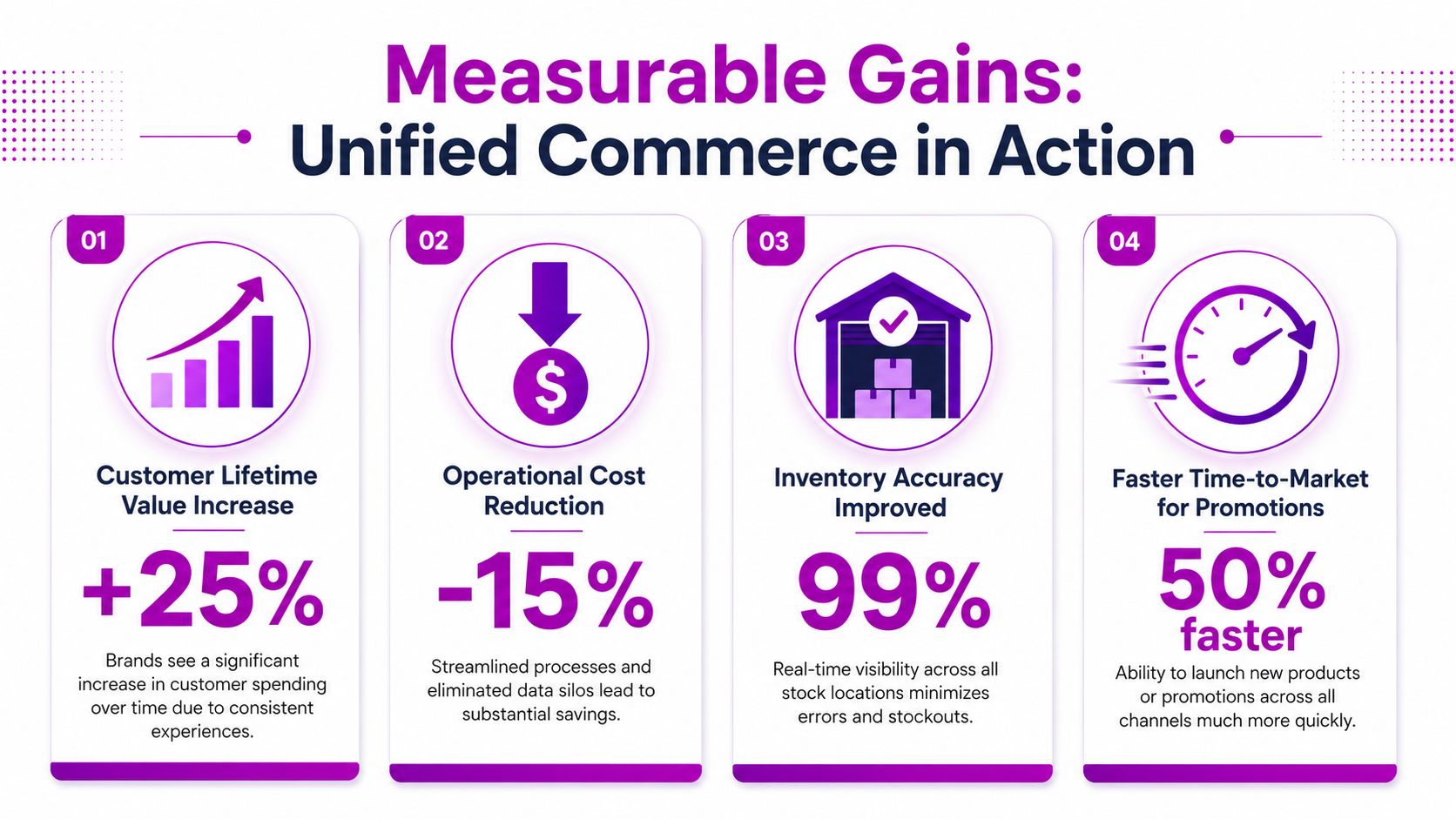
Research summarized in Maropost's unified commerce guide points to the scale of the opportunity. It cites stronger revenue growth, higher customer lifetime value, lower fulfillment costs, broad retailer adoption of unified models, and heavy cross-channel shopper behavior such as in-store customers using phones while they browse. Those figures are useful for framing the category. They are not a business case on their own.
A key test is whether the platform removes expensive friction inside your operation. In practice, that means fewer split orders, fewer oversell incidents, faster return handling, cleaner promotion execution, and less manual reconciliation between Shopify, ERP, OMS, WMS, POS, and finance tools.
That last point gets missed in a lot of board decks.
If reporting still depends on spreadsheet cleanup across entities, channels, and currencies, the architecture problem has not been solved. These insights on cross-border finance are a useful reminder that unified operational data also affects forecasting, cash visibility, and margin analysis.
For Shopify teams, KPI design should also reflect integration quality. If order edits break downstream routing, if customer records duplicate across systems, or if inventory updates lag by channel, the headline platform decision will look better than the daily operating reality. Brands planning custom connections should review common Shopify API integration patterns before they commit to targets.
A short explainer can help align stakeholders before platform decisions get too technical:
The KPIs worth tracking
Track outcomes that prove the operating model improved, not just that the project launched.
- Cross-channel conversion rate: Measure whether customers who move between retail, ecommerce, and support complete purchases more often.
- Customer lifetime value: Track repeat purchase rate, retention by cohort, and average time between orders after customer recognition improves.
- Fulfillment cost per order: Watch whether routing logic, split shipments, and exception handling reduce pick, pack, and shipping cost.
- Inventory accuracy: Compare system availability against real sellable stock by location. This is one of the clearest indicators of whether integrations are working.
- Return cycle time: Measure time from return initiation to refund, restock, and inventory reavailability.
- Promotion deployment speed: Track how long it takes to launch and update offers across Shopify, retail, and any adjacent channels.
- Order exception rate: Count holds, manual reviews, failed syncs, and rerouted orders. This is often the fastest way to expose hidden integration cost.
- Reporting latency: Measure how long it takes finance and operations to close the week or month with trusted numbers.
What leadership should expect
The strongest gains usually come from process compression across teams. Merchandising launches faster because pricing and promotion rules are consistent. Operations spends less time correcting orders. Support resolves more tickets on the first interaction because the order and customer history is usable.
Expect trade-offs too. A unified platform can improve control and visibility while increasing implementation discipline, data governance work, and integration testing requirements. That is normal. The right KPI set should show whether those costs are buying better margin, stronger service, and more reliable growth.
Integrating a Unified Platform with Shopify
For Shopify and Shopify Plus brands, the right question usually isn't “Should we replace Shopify?” It's “What role should Shopify play in the architecture?”
In many cases, Shopify remains the best storefront and commercial experience layer. The main decision is whether Shopify should also be the operational center, or whether another platform should become the central brain for inventory, orders, fulfillment, and customer data.
Pattern one with Shopify at the center
This model works well when the brand is still relatively straightforward operationally. Shopify powers the storefront, often powers POS if the retail footprint fits, and uses selected apps or native connections to support adjacent functions.
This setup is often a good fit when:
- Product complexity is manageable: catalog rules don't require extensive custom logic.
- Retail operations are limited: a smaller store estate reduces cross-location complexity.
- Fulfillment is simpler: one or a few fulfillment nodes, with fewer routing exceptions.
- Speed matters more than architectural purity: the team wants to benefit from Shopify's ecosystem quickly.
The upside is simplicity. The downside is that the business can outgrow app-led orchestration. Once multiple systems start competing for order, inventory, or customer ownership, the stack gets harder to govern.
Pattern two with Shopify as the storefront layer
A more scalable pattern uses Shopify as the customer-facing commerce experience while a dedicated OMS, ERP, or unified commerce layer owns the shared operational logic. Shopify remains critical, but it no longer tries to be the source of truth for everything.
That tends to suit brands dealing with:
| Scenario | Better fit |
|---|---|
| DTC-first, lighter operations | Shopify-centered model |
| Complex fulfillment and retail | Unified core with Shopify storefront |
| Heavy ERP dependencies | Unified core with strict ownership rules |
| Rapid international or channel expansion | Unified core if process variance is rising |
A lot of technical teams end up here after discovering that “connected” isn't the same as “governed.” If you're evaluating data flows, webhook dependencies, custom apps, and domain ownership, this guide to Shopify API integration is a useful companion.
What to decide before integrating
Don't start with middleware. Start with ownership.
Ask these questions first:
- Which system owns inventory availability?
- Where is order status finalized?
- Who owns returns state and restock logic?
- Where does the clean customer profile live?
- Which events must be real-time, and which can be asynchronous?
The best Shopify architectures are boring in one important way. Everyone on the team knows which system is authoritative for each business process.
When that isn't clear, integration projects stall in endless exception handling.
Implementation Roadmap and Vendor Selection
Teams often underestimate this project in the same place. They compare feature lists, negotiate licenses, and assume integration is a technical workstream the SI partner will sort out. That's how costs get missed.
According to commercetools on unified commerce, hidden legacy-system integration costs stall 60-70% of mid-market implementations. The same source notes 18–24 month timelines and 30–40% higher integration costs than projected due to legacy POS, ERP, and inventory silos.
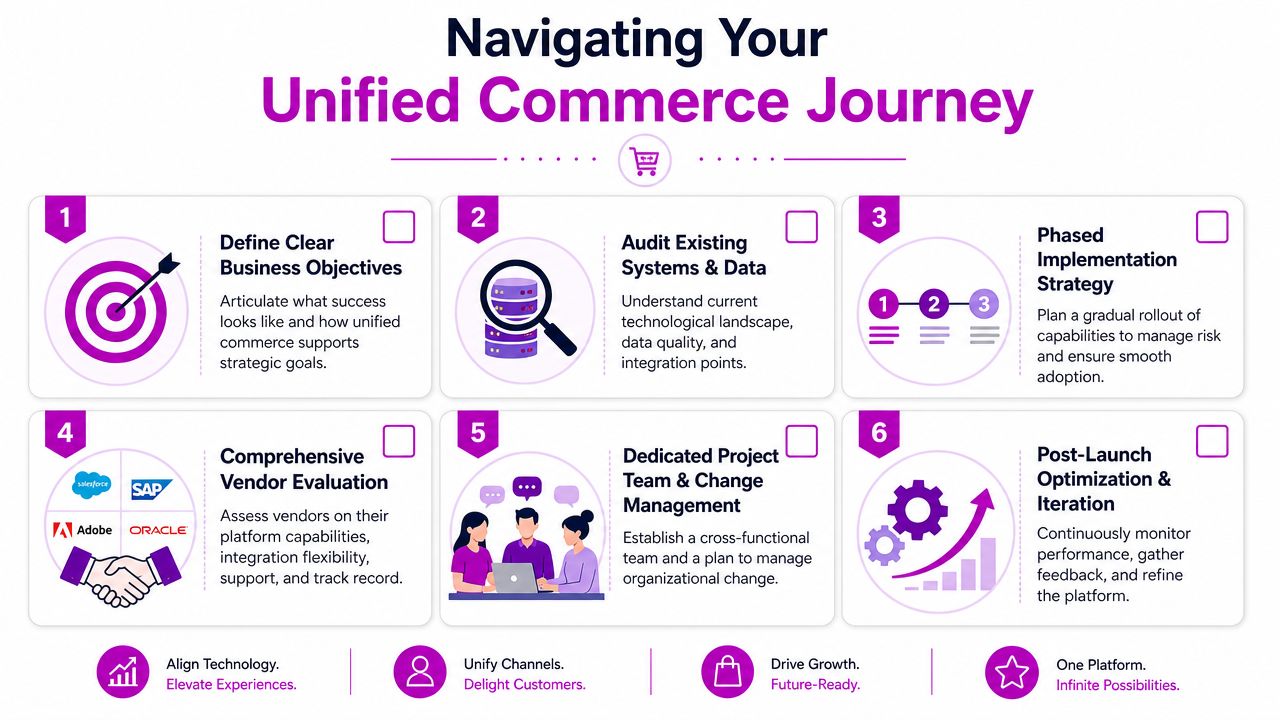
A roadmap that reflects reality
A disciplined implementation usually follows five phases.
Discovery and scoping
This phase is where teams either de-risk the program or plant future problems.
Map every system that touches product, customer, order, inventory, and reporting. Identify where manual overrides happen. Document which data needs real-time synchronization and which doesn't. If a process only works because one operator knows how to patch exceptions, put that in scope.
Data cleanup and migration
Bad data can sink a strong platform decision. Normalize product attributes, customer records, location logic, and historical order structures before migration starts. This work is tedious, but it's where a lot of future support burden gets avoided.
“If your source data is messy, the new platform won't simplify operations. It will expose the mess faster.”
Integration and testing
Brands often focus too narrowly on successful API calls. That's not enough. Test failure scenarios, partial syncs, duplicate events, delayed returns updates, and promotion conflicts. User acceptance testing should include store teams, support, operations, and finance, not only ecommerce and engineering.
Phased go-live and optimization
Avoid big-bang launches unless the operating model is unusually simple. Roll out by channel, region, store group, or capability set where possible. Early production learning is valuable. So are fallback procedures.
Vendor checklist for Shopify brands
Use this list during evaluation calls and solution design workshops.
- Architecture clarity: Can the vendor explain, in plain language, what data they own versus what Shopify owns?
- Real-time capabilities: Which workflows are natively real-time, and which rely on asynchronous sync?
- Legacy tolerance: How do they handle old POS, ERP, and inventory structures without custom sprawl?
- Operational fit: Can store teams, support agents, and fulfillment staff work in one coherent process?
- Total cost view: What costs sit outside software licensing, including migration, mapping, testing, and support?
- Exception handling: What happens when integrations fail, events duplicate, or order states conflict?
- Post-launch support: Who owns stabilization after launch, and how are change requests governed?
A good vendor doesn't just demo capabilities. They help quantify integration debt before contracts get signed.
How ECORN De-Risks Your Unified Commerce Journey
A unified commerce platform can create a cleaner, faster, more profitable operating model. It can also become an expensive detour if the team underestimates integration debt, unclear system ownership, or the gap between Shopify convenience and enterprise operational complexity.
That's why the best projects start with architecture decisions, not software enthusiasm. The priority is to define the future system of record, reduce unnecessary moving parts, and build an implementation path that matches the business you run today.
For Shopify and Shopify Plus brands, that usually means translating business goals into a practical stack decision. Keep Shopify as the center where it makes sense. Move core operational ownership elsewhere when scale, fulfillment complexity, or retail demands require it. What works is clarity. What fails is pretending every connector is strategic.
ECORN helps brands make those calls with a sharper view of Shopify architecture, integration design, CRO impact, and operational trade-offs. That matters when the project affects storefront performance, retail workflows, data governance, and future scalability all at once.
If you're evaluating a unified commerce platform and want a practical view of what should stay in Shopify, what should move, and where hidden integration cost is likely to appear, talk to ECORN. Their team works with growing and established Shopify brands to design scalable architectures, manage complex integrations, and turn platform investment into measurable ecommerce performance.



Product Variants Shopify: The Complete 2026 Guide

Ecommerce Analytics Consulting for Growth
What Is AI Integration for eCommerce

How to Choose the Right eCommerce Website Development Firm
E Business Strategy Implementation
Conversion Tracking Setup for Shopify Stores

BigCommerce vs Shopify Plus Which Enterprise Wins in 2026
Shopify Theme Kit: Setup, Commands, and Migration Guide

Shopify Extension Development: A Practical 2026 Guide

Shopify Speed Score Explained and How to Improve It

Shopify Mobile Optimization: The 2026 Playbook

How to Add Subcategory in Shopify for Better UX
How to Implement Structured Data for Ecommerce in 2026

SEO App Mobile: Shopify Store Optimization Guide

Shopify Plus Support: What It Includes and How to Choose

Google Ads for Shopify: The Complete 2026 Playbook

Shopify New York: How to Find and Hire the Right Agency

Google Search Console for Shopify: The Complete Setup

First Party Data Collection for eCommerce Growth

FAQ Online Store Guide: Build and Measure It Right

Do FB Ads Work for eCommerce in 2026?

One Page Checkout for Shopify: Design and Implementation
Shopify GraphQL vs REST: The 2026 Developer Decision
Shopify Ecommerce Consulting: Strategy, Pricing &

Are Reddit Ads Worth It for eCommerce Brands

Shopify Title and Meta Description: A Practical 2026 Guide

Product Video Best Practices for Shopify Brands
Real-Time Inventory Management: A 2026 Guide
AI Chatbot Integration for Shopify Stores

Affiliate Program Management: A Shopify Guide
10 Best Performance Monitoring Tools for Shopify in 2026

Digital Asset Management for eCommerce Brands in 2026

Every Type of Facebook Ads Explained for eCommerce Growth
Product Information Management Explained for Shopify Brands
Support Ticket System: A Guide for Shopify Stores

10 Best Customer Service Tools for Shopify in 2026

Can I Start a Business with No Money? a 2026 Blueprint

What Sells Good on Etsy: Best Niches for 2026

Shopify Add to Cart Button: A Practical 2026 Guide

Customer Feedback Automation: A Practical eCommerce Guide

Critical Rendering Path: A Guide for Shopify Stores

How to Promote on TikTok for eCommerce in 2026

B2B eCommerce Consulting That Drives Real Revenue

10 Best Practices for Site Navigation in 2026
Return vs Refund for Shopify Stores: A Practical Guide

What Is Customer Lifetime Value and Why It Matters

What Is Voice of Customer Research for eCommerce

SMS Marketing for Ecommerce That Actually Converts

Master How to Improve Email Deliverability in 2026

Top 7 eCommerce Partners NYC for Shopify Brands in 2026

Machine Learning for Ecommerce: Boost Your Shopify Store

Beauty Market Research: Your 2026 Growth Guide

Shopify International Expansion: A 2026 Roadmap

What Does CRO Stand for in Business: Understanding CRO

Shopify Visual Merchandising: A Playbook for Higher Sales

Shopify Landing Page Design: Master Conversion in 2026

10 Best AI SEO Optimization Tools for Shopify in 2026

Agentic AI for Ecommerce: Boost Your Sales in 2026
Mastering Email Marketing Data for eCommerce Growth

Conversion Rate Optimisation Australia: Boost Your Sales

Conversion Rate Optimization AI: Your Shopify Store Guide

10 Product Bundling Strategies for Shopify in 2026

How to Increase Customer Lifetime Value: A Shopify Playbook
AI Customer Service Automation: Shopify Guide 2026

Clean Website Design: A Shopify Conversion Playbook

Omnichannel Retail Strategy: A Shopify Playbook

Product Data Enrichment: A Guide for Shopify Brands

Instagram Shopping Features a Guide for Shopify Stores

What Is Revenue Optimization: A Holistic RevOps Guide

Benefits of Conversion Rate Optimization: Boost Your
WordPress to Shopify Migration: Your 2026 Seamless Switch

Boost Sales: Ecommerce Payment Processing Guide 2026

How to Reduce Bounce Rate eCommerce: Your 2026 Guide
Shopify API Integration: A Practical End-to-End Guide

How to Implement Data Governance: A 2026 Guide

Shopify Store Development Cost: A 2026 Breakdown
What Is Server Side Tracking: The Shopify Guide 2026
Marketing Automation Workflows: A Shopify Guide for 2026

Shopify: How to Reduce Technical Debt

Shopify UX Design Change: A Playbook for Growth

User Generated Content Strategy: Shopify Playbook

Shopify Pause and Build Plan Cost: A Complete 2026 Guide

Compare at Price on Shopify: A Complete Guide for 2026

Where Can I Sell My Prints? 10 Best Platforms for 2026
Shopify Order Management System: The Ultimate Guide 2026
What Is Marketing Attribution? an eCommerce Guide for 2026

10 Best Black Friday Sales Sheets for 2026

Discover the Top Social Media Marketing Agencies For

Consumer Confidence Definition for eCommerce in 2026

What Is Social Commerce? Your 2026 Guide to Boosting Sales

A Social Ad Campaign Playbook for eCommerce Growth

7 Best FAQ Page Examples for SaaS & eCommerce

Market Research in Fashion Industry: A Guide for Shopify
Shopify Migration Services: Expert Guide for 2026

Mastering FB Retargeting Ads for Shopify in 2026
What Is Omnichannel Ecommerce

Master Your Shopify Plus Migration: The 2026 Guide
Shopify Integration Services: A Merchant's 2026 Guide

Shopify Collection Description: A Guide to SEO & Sales

Shopify Plus Contact: Reach Sales & Support Effectively


newsletter in your inbox