

A lot of Shopify brands hit the same wall. Product pages get traffic, paid campaigns bring visitors in, and people still don't buy at the rate they should. Then returns start showing up for reasons that feel avoidable: “looked different than expected,” “not what I thought,” “missing details.”
That usually isn't a product problem. It's a product data problem.
Most catalogs start life as bare-bones records. Title, SKU, price, one image, maybe a supplier description copied into Shopify. That's enough to publish a page, but it's rarely enough to persuade a buyer. Product data enrichment is the work of turning that thin listing into a complete, accurate, persuasive product record that helps shoppers understand what they're buying and helps channels understand how to surface it.
A simple way to think about it is this. Basic product data is a résumé. Enriched product data is a full LinkedIn profile with skills, examples, context, proof, and a clear reason to care. One gets indexed. The other gets chosen.
This matters more now because the space is getting more competitive, not less. The global data enrichment solutions market was estimated at USD 2.37 billion in 2023 and is projected to grow at a 10.1% CAGR from 2024 to 2030, with SMEs showing the fastest growth in adoption, according to Grand View Research's data enrichment solutions market report. Smaller brands are investing here because richer catalogs help them compete with larger merchants without needing a massive content team.
Introduction Beyond the Barcode
A barcode, SKU, and supplier title can identify a product. They can't sell it.
On Shopify, that gap shows up fast. You see a product with decent sessions but weak add-to-cart rate. Or a product that sells well on one channel and underperforms everywhere else. Or a collection page where filters are messy because key attributes were never filled in consistently. In every case, the store isn't just missing content. It's missing usable structure.
What enriched product data actually looks like
In practice, product data enrichment means adding and improving information such as:
- Standardized attributes like size, material, compatibility, dimensions, and care instructions
- Better product copy that explains benefits, not just specs
- Stronger media context including video, multiple angles, and use-case imagery
- Trust signals like reviews and helpful Q&A
- Channel-ready formatting so the same product can work on Shopify, Google Shopping, Amazon, and Meta without manual rewriting every time
A raw supplier feed might say “Ceramic mug, 12 oz, blue.”
An enriched Shopify record says what shade of blue it is, whether it's dishwasher safe, whether it fits under a standard coffee machine, whether the glaze is matte or glossy, what kind of gifting occasion it suits, how the handle feels in hand, and which images belong to which color variant.
Practical rule: If a shopper has to guess, your product data is incomplete.
Why Shopify brands feel this pain first
Shopify makes publishing easy. That's one of its strengths. But easy publishing can hide weak data quality for a long time.
A merchant can launch dozens or hundreds of products with inconsistent descriptions, missing metafields, supplier naming issues, and uneven images. Then they try to scale. They add search and filter apps, launch Google Shopping, push into Meta catalogs, or move to Shopify Plus with multiple storefronts. Suddenly the weak foundation becomes expensive.
The brands that clean this up early usually move faster later. They can launch collections more cleanly, merchandise by attribute, and reuse structured content instead of rebuilding listings channel by channel.
The Business Case for Superior Product Data
Product data enrichment sounds operational. In reality, it affects revenue, conversion efficiency, and return risk.
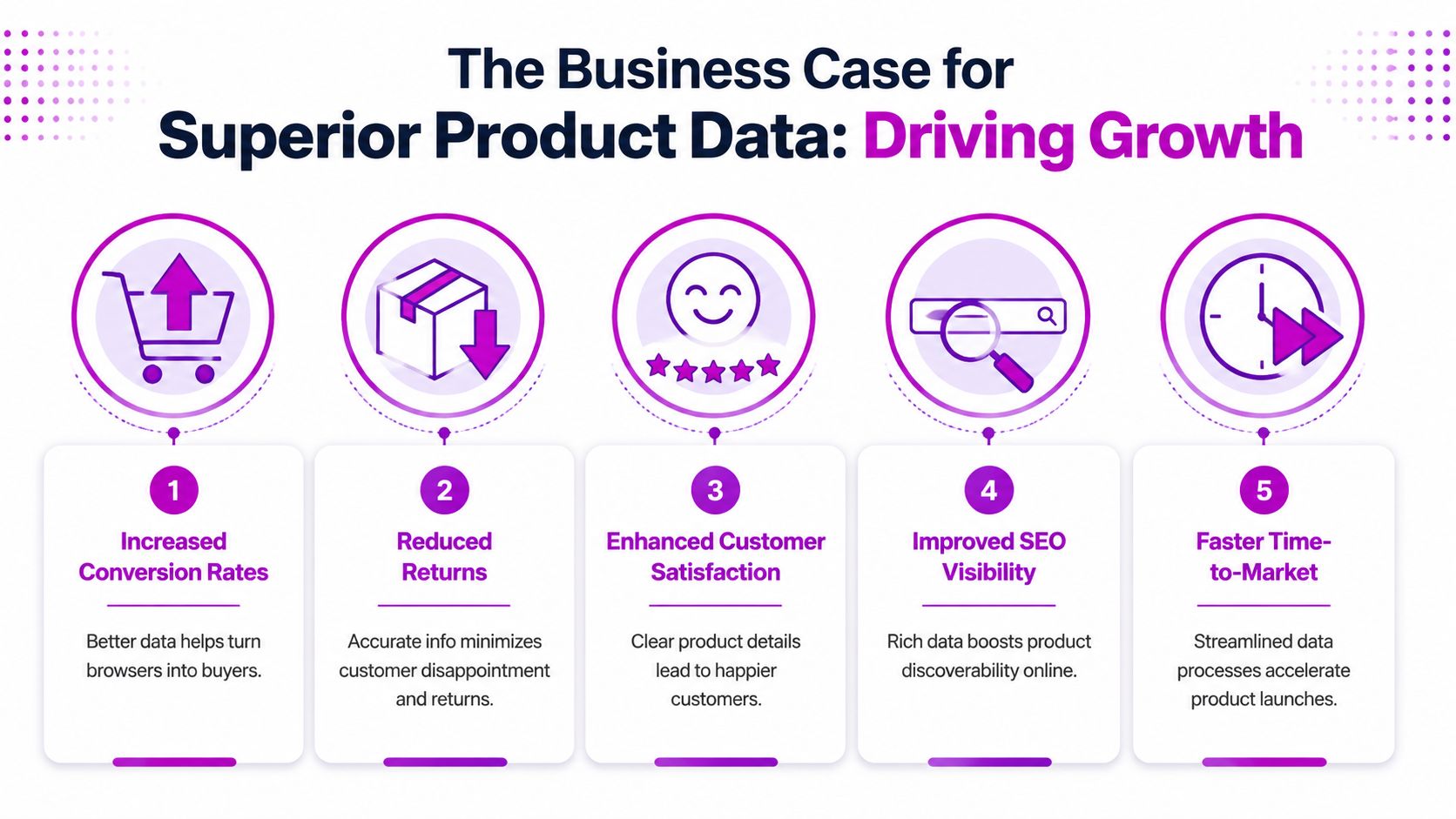
When a catalog is thin, marketing has to work harder to compensate. Paid traffic gets sent to pages that don't answer basic purchase questions. Merchandising teams can't build strong filters because fields are incomplete. Support gets repetitive pre-purchase questions. Returns rise because customers filled in the blanks incorrectly.
Revenue impact is the first reason to care
Companies using enriched product and contact data report a 25% increase in sales productivity, a 15% jump in marketing ROI, and a 20% increase in revenue, while 80% report a healthier sales pipeline, according to Salesmotion's overview of data enrichment outcomes.
Those numbers matter because they connect enrichment to outcomes leadership teams already track. Not content quality as an abstract goal. Better commercial performance.
For a Shopify brand, the path usually looks like this:
| Business issue | What weak data causes | What better data helps |
|---|---|---|
| Low conversion | Shoppers hesitate because details are vague | Cleaner decisions at product page level |
| High return volume | Buyers receive something different from what they expected | Better expectation setting before purchase |
| Poor paid traffic efficiency | Ads bring visits to pages that don't close | More value from traffic you already bought |
| Channel inconsistency | Product details vary by feed and storefront | More reliable merchandising and syndication |
Better data lowers friction at the point of sale
Shoppers don't buy when important details are buried, missing, or inconsistent. That friction doesn't always look dramatic. Often it's subtle.
A visitor lands on a product page and can't tell whether a garment is relaxed fit or slim fit. A customer wants to know whether a supplement contains a key ingredient and leaves to keep researching. A shopper sees one lifestyle image but no clear close-up of finish, texture, or packaging. Each small uncertainty reduces confidence.
That's why I treat product data enrichment as a conversion tool first and a catalog hygiene project second.
Your best-performing campaigns can't rescue a listing that leaves basic purchase questions unanswered.
It also protects margin
Returns are where weak data gets expensive. If the listing creates the wrong expectation, operations pays for it later. That's especially true in categories where material, dimensions, compatibility, finish, fit, or setup details affect satisfaction.
This is also where structured product information becomes a multiplier. Once attributes are clean, your team can reuse them in collection filters, comparison tables, bundles, recommendation logic, and feeds. One improvement supports multiple functions.
For brands selling across marketplaces as well as Shopify, a PIM often becomes the practical next step. If you're evaluating that route, this guide to PIM strategies for Amazon sellers is useful because it shows how better structure supports channel operations, not just copy quality.
What doesn't work
Three patterns usually waste time:
- Writing longer descriptions without fixing structure. More words don't help if size, material, or compatibility fields are still unreliable.
- Letting suppliers define the customer experience. Supplier content is often technically correct but commercially weak.
- Treating enrichment as a one-time cleanup. Catalogs drift. New SKUs, new channels, and new teams introduce inconsistency fast.
The business case is straightforward. Better product data helps buyers commit, helps channels index products correctly, and helps teams operate with less rework.
Core Techniques for Compelling Product Listings
Good enrichment isn't about stuffing more text into Shopify. It's about adding the right information in the right format.
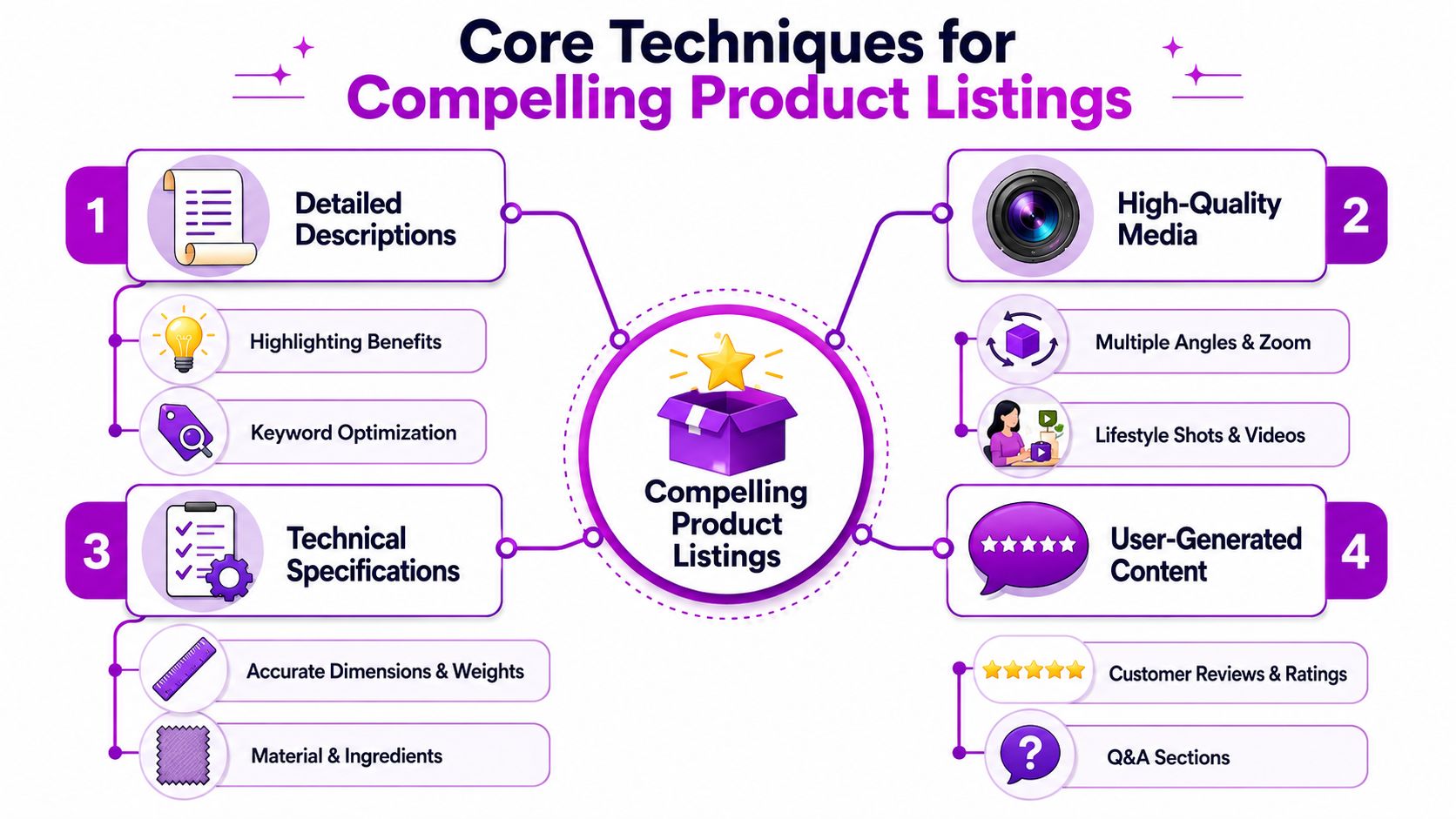
The easiest way to diagnose a listing is to ask four questions. Can a shopper understand the product? Can a channel classify the product? Can the buyer trust the page? Can your team reuse the information elsewhere?
Start with structured specifications
This is the least glamorous part, and it's often the most valuable.
Standardize units, normalize naming, and remove supplier inconsistencies. “2 c.m.” becomes “2 cm.” “Poly/cotton blend” becomes whatever standard format your catalog uses consistently. “Navy” and “Midnight Blue” might both be valid, but they shouldn't be mixed casually if one field is meant for filtering and another for merchandising copy.
A simple before-and-after example:
- Before: Material: mixed fabric
- After: Material: 80% cotton, 20% polyester. Care: machine wash cold. Fit: regular fit.
That second version helps shoppers, internal teams, and external channels.
Write benefit-led copy, not recycled supplier copy
A lot of Shopify product descriptions read like database exports. They list facts without explaining why they matter.
Here's a cleaner transformation:
- Before: “Features padded straps and zip compartments.”
- After: “Padded shoulder straps make it comfortable for day-long wear, while separate zip compartments keep your laptop, charger, and smaller essentials easy to reach.”
The facts stay. The meaning improves.
AI can help with first drafts, especially for large catalogs. For these efforts, teams also need strong prompts and human editing. If you're exploring broader automation in commerce operations, this overview of AI applications in eCommerce is a useful companion because enrichment works best when it fits into a bigger operating model.
Add media that answers buying questions
According to Plytix's guidance on product data enrichment, 92% of consumers hesitate to purchase without user-generated reviews, 82% are more likely to buy when video content is present, and AI tools can reduce missing fields by 40% to 60% when used for attribute extraction.
That lines up with what most Shopify teams see in practice. Some products need proof more than prose.
Use media to remove uncertainty:
- Close-up images for texture, finish, stitching, or materials
- Scale references so size is obvious
- Short videos for motion, setup, fit, or demonstration
- Variant-specific visuals so color and style choices don't feel ambiguous
For visual-first categories, rich product visualization can carry a lot of the enrichment workload. This article on how 3D content can transform mattress marketing is a good example of how richer visuals help buyers understand products that are otherwise hard to evaluate online.
A product page should answer the questions your support team keeps getting. If it doesn't, the listing is under-enriched.
Layer in social proof and real buyer language
Reviews matter for trust, but they're also a source of usable language.
Customers describe products in plain terms. They mention fit, feel, use cases, and comparison points that internal teams often overlook. Good enrichment uses that language to sharpen descriptions, FAQ content, and attribute choices.
A practical before-and-after:
- Before: “Suitable for travel.”
- After: “Compact enough for carry-on packing and easy to store in a gym or overnight bag.”
That second line often comes from listening to customers, not from a supplier spreadsheet.
The Shopify Enrichment Workflow From Manual to AI-Assisted
Most brands don't need a massive replatforming project to improve product data. They need a workflow that matches catalog size, team capacity, and channel complexity.
For a small catalog, you can do a surprising amount inside Shopify admin. For a larger one, you need bulk processes, metafields, and usually a PIM or feed layer. For almost everyone now, AI belongs in the workflow. Just not unsupervised.
Stage one uses Shopify admin for baseline cleanup
If your catalog is still manageable by hand, start there.
Fix the basics first. Product titles. Descriptions. Alt text. Media order. Variant naming. Core attributes. Collection assignments. This work is manual, but it quickly surfaces critical problems. You'll see where supplier data is inconsistent, where product types are too broad, and where fields are missing entirely.
Shopify's native product model becomes much more useful when you pair it with well-defined metafields. If you haven't structured those yet, this guide to Shopify metafields is worth reviewing because metafields are often the bridge between “content exists somewhere” and “content is usable across the storefront.”
Stage two uses bulk editing and imports
Once patterns are clear, stop editing one SKU at a time unless the product is high value or highly nuanced.
Bulk actions that usually belong in CSVs or apps include:
- Attribute normalization across size, color, material, and dimensions
- Template-driven descriptions for products within the same family
- Tag and collection cleanup so merchandising rules work properly
- Image-to-variant mapping where visual consistency affects conversion
This stage is where many teams discover they don't have a content problem only. They have a taxonomy problem.
Stage three adds AI for drafting, not final approval
Here's the balanced view. AI is excellent at drafting repetitive product content, extracting likely attributes from source material, and proposing variants of titles or bullets for different contexts. It's weak when source data is thin, contradictory, or category-specific in a way the model doesn't fully understand.
That distinction matters because pure AI-generated product descriptions can contain factual errors up to 15% to 20% of the time, while a hybrid workflow with human validation on important products reduces error rates to under 2% and keeps 80% of AI's efficiency gains, according to Enlink's analysis of AI-assisted product enrichment.
That's exactly the trade-off Shopify teams need to understand. Use AI to accelerate first drafts. Don't use it as a blind publishing engine.
Here's a practical split:
| Workflow task | Best owner |
|---|---|
| Drafting basic descriptions | AI with prompt guidance |
| Extracting attributes from supplier docs | AI first pass |
| Validating technical claims | Human reviewer |
| Final brand voice edit | Human reviewer |
| High-risk products like supplements, technical gear, or regulated items | Human-led with AI assistance |
A hybrid model works best on Shopify
Shopify's ecosystem makes this easier than it used to be. Merchants can combine native editing, Shopify Magic or similar AI drafting tools, feed apps, PIM systems, and custom metafield logic without rebuilding the whole stack.
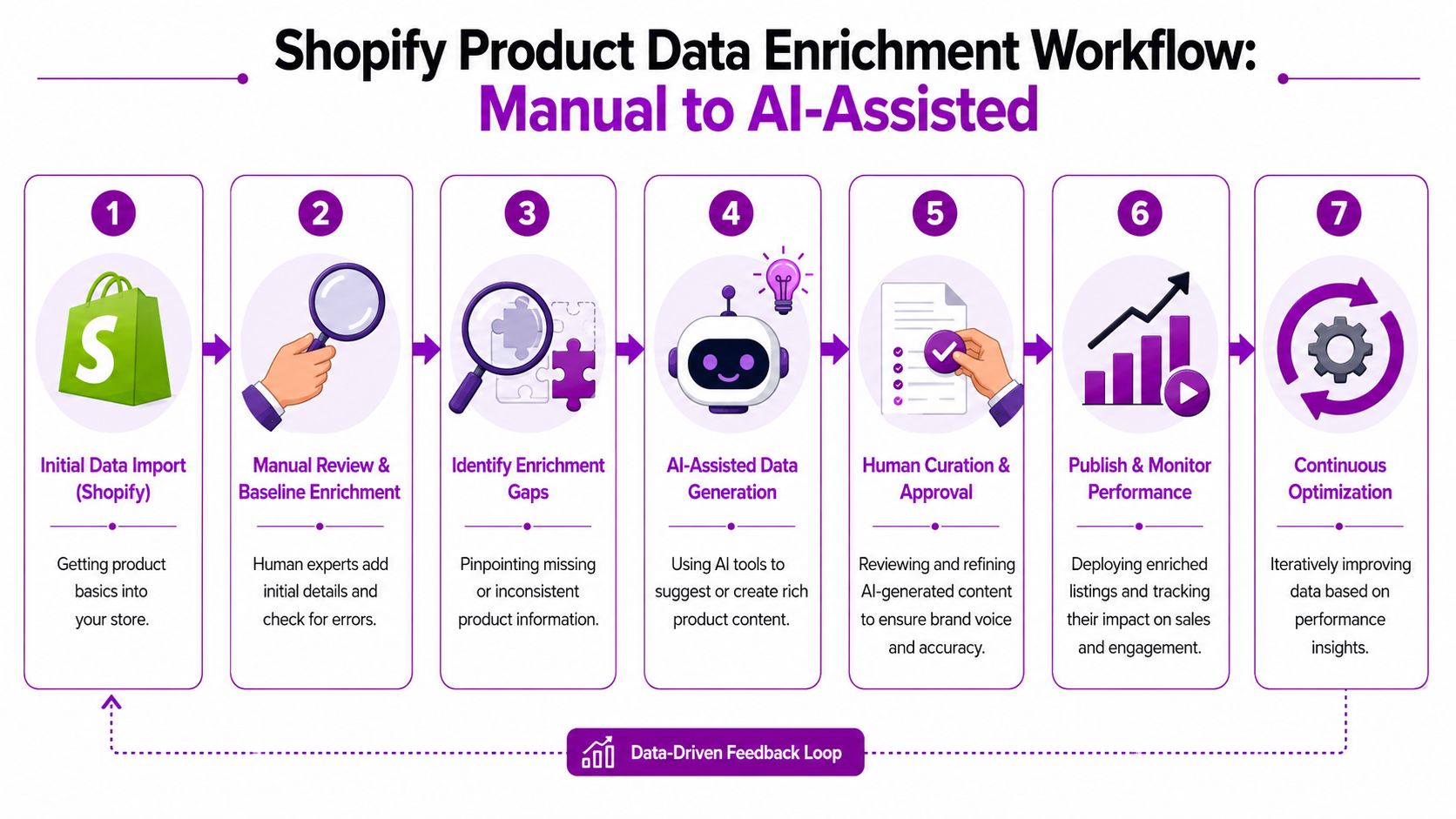
A sensible workflow usually looks like this:
- Import raw product data into Shopify or your source system.
- Define required fields by category.
- Let AI generate draft descriptions, bullets, and suggested attributes.
- Route priority products to a human validation step.
- Publish approved content.
- Monitor conversion, returns, search behavior, and support questions.
- Update weak records continuously.
To see the workflow in action, this short walkthrough is helpful:
What breaks these workflows
The common failure points are predictable:
- No field standards. AI can't produce consistent outputs if your schema is loose.
- No review gate. Teams publish drafts too quickly and create customer trust problems.
- No prioritization. High-volume, low-margin accessories get the same attention as flagship products.
- No measurement loop. Teams enrich content but never check whether returns, conversion, or support questions changed.
If you let AI write around bad source data, you don't get enrichment. You get polished misinformation.
For Shopify and Shopify Plus brands, the winning setup is rarely fully manual and never fully automated. It's a controlled system where AI speeds up repetitive work and humans protect accuracy, brand voice, and channel suitability.
Your Step-by-Step Implementation Roadmap
Many organizations delay enrichment because it feels too big. The fix is to make it a scoped operating project, not an endless cleanup exercise.
The most reliable framework is simple: audit, standardize, gather, automate, validate. According to Sales Captain's product data enrichment framework, standardized catalogs can reduce return rates by 25% and improve Google Shopping match rates by 35% when taxonomy and attributes are handled correctly.

Audit what you have
Start by finding where your catalog is weakest, not by trying to perfect everything.
Review products by category and source. Supplier-fed categories usually contain the biggest gaps. Look for missing dimensions, vague materials, inconsistent units, weak imagery, duplicate naming patterns, and absent review content.
Ask one question: Which missing data is most likely to block conversion or create returns?
Define standards before you add content
Projects often falter because teams start writing before they define what ‘complete' means.
Create category-level rules such as:
- Required attributes for every SKU in that category
- Accepted value formats for size, dimensions, materials, and compatibility
- Description rules for length, tone, and claim handling
- Media requirements like required image angles or variant imagery standards
A kitchenware product shouldn't follow the same schema as a skincare product. A universal checklist sounds efficient, but it usually creates mediocre records.
Gather source material from every useful place
Don't rely on one spreadsheet.
Useful inputs often include manufacturer documents, packaging, compliance documentation, customer service logs, review themes, and existing marketplace listings. If your team needs to pull structured data from multiple external sources, this comparison of objective web scraping API benchmarks for developers can help evaluate tooling options for collection workflows.
Clean enrichment starts with source discipline. If nobody knows which input is authoritative, quality slips fast.
Automate where repetition exists
Once standards and source hierarchy are clear, automate repetitive work. That includes draft copy generation, basic attribute filling, formatting normalization, and feed transformations.
But don't automate every category equally. Prioritize products that drive the most revenue, create the most support load, or suffer the highest return friction. That's where better enrichment pays back fastest.
Validate before publication
Validation should be an actual gate, not an assumption.
A useful pre-publish check includes:
| Validation point | What to catch |
|---|---|
| Completeness | Missing required fields |
| Format compliance | Unit inconsistency, messy values, broken naming |
| Accuracy | Claims that don't match source documents |
| Channel readiness | Attributes needed for feed eligibility |
| Media quality | Wrong variant imagery, weak sequencing, missing demonstrations |
If a product fails the standard, it shouldn't publish in final form.
That discipline is what turns enrichment from content production into a repeatable merchandising system.
Mastering Channel-Specific Enrichment and Avoiding Pitfalls
The biggest strategic mistake in product data enrichment is assuming one great product record can be copied everywhere unchanged.
It can't.
Your Shopify PDP, Google Shopping feed, Amazon listing, and Meta product catalog don't want the same thing from the same SKU. One channel needs structured attributes and clean taxonomy. Another rewards benefit-led bullets. Another needs short, visual-first framing that works in a feed. If you publish one universal version everywhere, some channels will underperform even if the product itself is strong.
According to Happiest Minds' analysis of channel-specific enrichment, 40% of eCommerce listings fail to meet channel-specific formatting requirements, leading to suppressed visibility and up to 30% lower conversion potential. Their core point is the right one: the target isn't a perfect universal listing. It's a context-perfect version for each channel.
The common pitfalls
The first pitfall is copying Shopify descriptions directly into every external feed. What reads well on a PDP often lacks the structure or formatting another channel expects.
The second is treating titles as branding space only. On owned storefronts, that can work. On channels with stricter data expectations, titles often need clearer product type, variant, or compatibility signals.
The third is storing all useful data inside body copy. If material, dimensions, ingredients, or fit only appear in paragraphs, you limit filtering, feed mapping, and merchandising automation.
The smarter operating model
Build a strong master record once. Then transform it.
That usually means:
- Keep a canonical source record with complete attributes, media, and approved messaging
- Map channel rules separately so title formats, bullets, and required fields adapt by destination
- Use rule-based logic in a PIM, feed platform, or app layer instead of manual rewriting
- Review exceptions manually for products with unusual variants, bundles, or regulated claims
Don't aim for one description that works everywhere. Aim for one source of truth that can be reshaped without losing accuracy.
For Shopify brands, this matters most when growth starts to come from multiple surfaces at once. The stronger your source data, the easier it becomes to create those channel-specific versions without rebuilding the listing every time.
If your Shopify catalog feels harder to manage every quarter, that's usually a data structure problem before it's a traffic problem. ECORN helps brands clean up product data, improve storefront conversion, and build scalable Shopify and Shopify Plus workflows that support better merchandising across every channel.



Shopify Website Design Examples: 7 Stores Worth Studying

7 Ecommerce Newsletter Examples for Shopify Brands

One Product Shopify Store: Build and Scale

Mobile Pop Up Strategy for Shopify Stores That Converts

Sitemap for Shopify: How to Find, Optimize, and Submit It

7 Single Product Websites Worth Emulating

Product Variants Shopify: The Complete 2026 Guide

Ecommerce Analytics Consulting for Growth

What Is AI Integration for eCommerce

How to Choose the Right eCommerce Website Development Firm

E Business Strategy Implementation
Conversion Tracking Setup for Shopify Stores
BigCommerce vs Shopify Plus Which Enterprise Wins in 2026
Shopify Theme Kit: Setup, Commands, and Migration Guide

Shopify Extension Development: A Practical 2026 Guide

Shopify Speed Score Explained and How to Improve It

Shopify Mobile Optimization: The 2026 Playbook

How to Add Subcategory in Shopify for Better UX
How to Implement Structured Data for Ecommerce in 2026

SEO App Mobile: Shopify Store Optimization Guide

Shopify Plus Support: What It Includes and How to Choose

Google Ads for Shopify: The Complete 2026 Playbook

Shopify New York: How to Find and Hire the Right Agency

Google Search Console for Shopify: The Complete Setup

First Party Data Collection for eCommerce Growth

FAQ Online Store Guide: Build and Measure It Right

Do FB Ads Work for eCommerce in 2026?

One Page Checkout for Shopify: Design and Implementation

Shopify GraphQL vs REST: The 2026 Developer Decision
Shopify Ecommerce Consulting: Strategy, Pricing &

Are Reddit Ads Worth It for eCommerce Brands
Shopify Title and Meta Description: A Practical 2026 Guide

Product Video Best Practices for Shopify Brands
Real-Time Inventory Management: A 2026 Guide

AI Chatbot Integration for Shopify Stores

Affiliate Program Management: A Shopify Guide
10 Best Performance Monitoring Tools for Shopify in 2026

Digital Asset Management for eCommerce Brands in 2026

Every Type of Facebook Ads Explained for eCommerce Growth
Product Information Management Explained for Shopify Brands

Support Ticket System: A Guide for Shopify Stores

10 Best Customer Service Tools for Shopify in 2026

Can I Start a Business with No Money? a 2026 Blueprint

What Sells Good on Etsy: Best Niches for 2026

Shopify Add to Cart Button: A Practical 2026 Guide

Customer Feedback Automation: A Practical eCommerce Guide

Critical Rendering Path: A Guide for Shopify Stores

How to Promote on TikTok for eCommerce in 2026

B2B eCommerce Consulting That Drives Real Revenue

10 Best Practices for Site Navigation in 2026
Return vs Refund for Shopify Stores: A Practical Guide
What Is Customer Lifetime Value and Why It Matters
What Is Voice of Customer Research for eCommerce

SMS Marketing for Ecommerce That Actually Converts

Master How to Improve Email Deliverability in 2026

Top 7 eCommerce Partners NYC for Shopify Brands in 2026

Machine Learning for Ecommerce: Boost Your Shopify Store

Beauty Market Research: Your 2026 Growth Guide

Shopify International Expansion: A 2026 Roadmap
What Does CRO Stand for in Business: Understanding CRO

Shopify Visual Merchandising: A Playbook for Higher Sales

Shopify Landing Page Design: Master Conversion in 2026

10 Best AI SEO Optimization Tools for Shopify in 2026

Agentic AI for Ecommerce: Boost Your Sales in 2026
Mastering Email Marketing Data for eCommerce Growth

Conversion Rate Optimisation Australia: Boost Your Sales
Conversion Rate Optimization AI: Your Shopify Store Guide

10 Product Bundling Strategies for Shopify in 2026

How to Increase Customer Lifetime Value: A Shopify Playbook

AI Customer Service Automation: Shopify Guide 2026

Clean Website Design: A Shopify Conversion Playbook

Omnichannel Retail Strategy: A Shopify Playbook

Instagram Shopping Features a Guide for Shopify Stores
What Is Revenue Optimization: A Holistic RevOps Guide

Benefits of Conversion Rate Optimization: Boost Your
WordPress to Shopify Migration: Your 2026 Seamless Switch
Boost Sales: Ecommerce Payment Processing Guide 2026

Unified Commerce Platform: Benefits, KPIs & Shopify Guide

How to Reduce Bounce Rate eCommerce: Your 2026 Guide
Shopify API Integration: A Practical End-to-End Guide

How to Implement Data Governance: A 2026 Guide

Shopify Store Development Cost: A 2026 Breakdown
What Is Server Side Tracking: The Shopify Guide 2026
Marketing Automation Workflows: A Shopify Guide for 2026

Shopify: How to Reduce Technical Debt

Shopify UX Design Change: A Playbook for Growth

User Generated Content Strategy: Shopify Playbook

Shopify Pause and Build Plan Cost: A Complete 2026 Guide

Compare at Price on Shopify: A Complete Guide for 2026
Where Can I Sell My Prints? 10 Best Platforms for 2026
Shopify Order Management System: The Ultimate Guide 2026
What Is Marketing Attribution? an eCommerce Guide for 2026

10 Best Black Friday Sales Sheets for 2026

Discover the Top Social Media Marketing Agencies For

Consumer Confidence Definition for eCommerce in 2026

What Is Social Commerce? Your 2026 Guide to Boosting Sales

A Social Ad Campaign Playbook for eCommerce Growth

7 Best FAQ Page Examples for SaaS & eCommerce

Market Research in Fashion Industry: A Guide for Shopify

Shopify Migration Services: Expert Guide for 2026


newsletter in your inbox