


Your Shopify store probably already runs on a patchwork of apps, alerts, dashboards, and manual checks. Marketing wants faster campaign launches. Support needs better answers. Operations is chasing inventory exceptions. Merchandising is reacting to what already happened instead of steering what should happen next.
That's the point where many teams add another automation tool and discover the same problem again. The tasks move faster, but the business still feels disconnected.
Agentic AI for ecommerce matters because it changes the unit of work. Instead of automating one action at a time, it can coordinate a full process across systems. For a growing brand, that means fewer handoffs, fewer dropped details, and less time spent babysitting workflows that should already be running on their own.
Beyond Automation Your New Autonomous Teammate
A familiar scene plays out in growing ecommerce teams every day.
A product starts selling faster than expected. Shopify shows the spike. Your inventory app throws a low stock warning. The email team is still promoting the item. Customer support starts answering “when will this be back?” questions. Someone from operations opens a spreadsheet, someone else checks the supplier thread, and the founder asks for an answer in Slack.
Nothing is broken. But nothing is connected well enough to respond like a business with one brain.
That's where agentic AI becomes useful. Not as a smarter chatbot. Not as another content generator. Think of it as a digital operator that can watch what's happening, decide what matters, and carry out the next steps across the tools you already use.
What makes it different
Traditional automation is like setting up dominoes. If one thing happens, another thing follows. That works for clean, predictable steps.
Agentic AI behaves more like a teammate with a brief. You give it an outcome, such as protect margin on low-stock bestsellers or recover carts without over-discounting, and it can choose among several actions based on context.
That difference matters on Shopify because real operations rarely fit a single rule.
- A simple automation can send a back-in-stock email.
- An agentic workflow can pause paid promotion for the product, update merchandising placement, alert purchasing, tag at-risk VIP customers, and draft a support macro for expected questions.
Practical rule: If a workflow needs judgment, context from multiple tools, and follow-up actions, it's a candidate for agentic AI.
The strongest use of agentic AI for ecommerce isn't replacing your team. It's handling the connective tissue your team usually carries in their heads. The “if this happens, then check that, then tell these people, then update those systems” work.
For Shopify brands, that's where the advantage is. Not novelty. Not demos. Actual business orchestration.
From Chatbot to Business Operator How Agentic AI Works
AI's introduction often begins with chat interactions. Ask a question, get an answer. Useful, but limited. A chatbot is often reactive. It waits for input and responds within a narrow frame.
An agentic system works more like a store manager. It doesn't just answer. It pursues a goal.
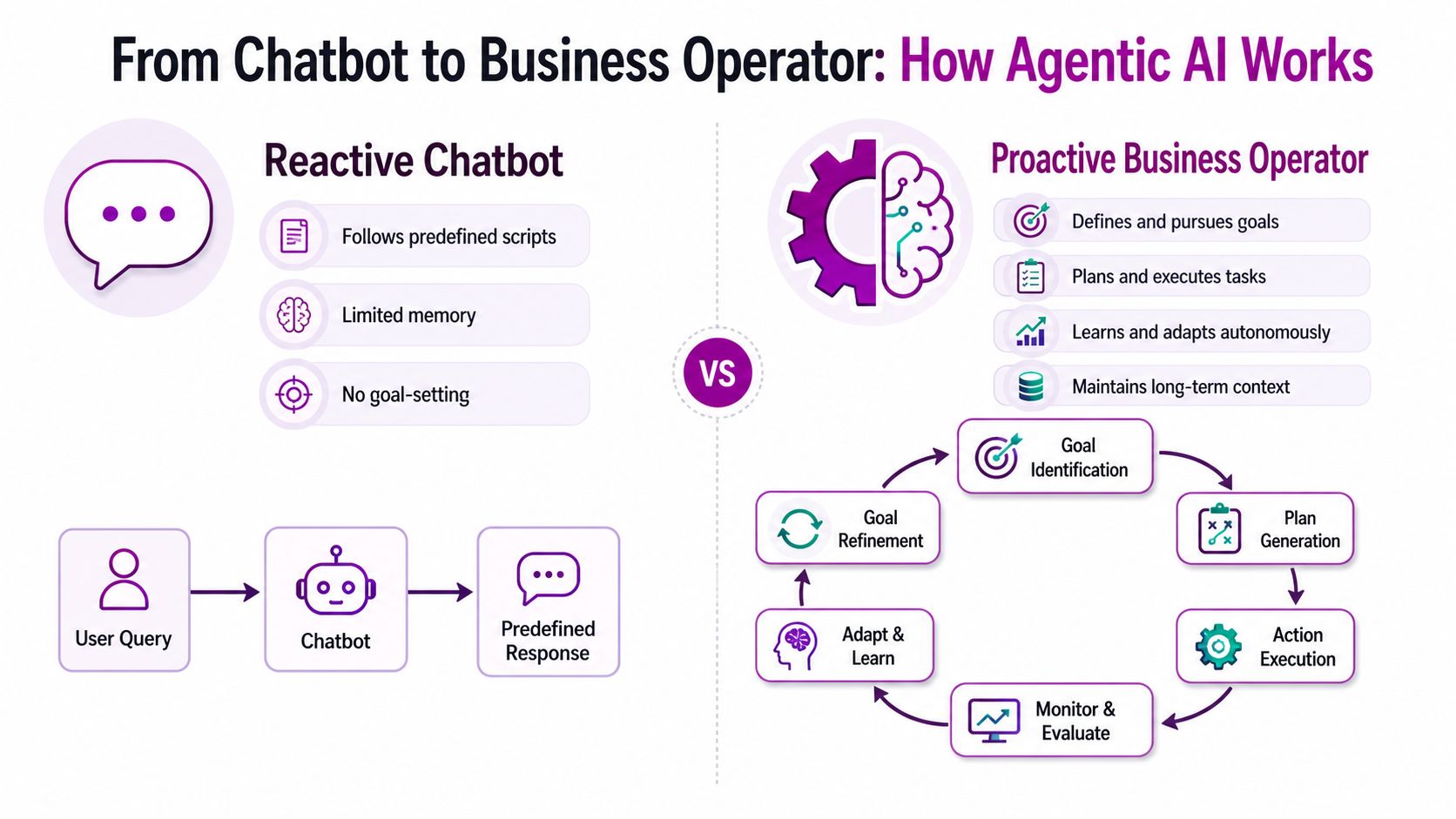
The cashier versus the manager
A script-following cashier can tell a customer where to find a product. A manager notices the product is low, checks whether a replacement is available, updates the display, asks staff to redirect demand, and flags the supplier issue before the weekend rush.
That's the leap.
A standard AI assistant might draft a response to a support ticket. An agentic AI can read the ticket, check order status in Shopify, look up shipment events, decide whether the delay qualifies for proactive outreach, send the right message, and log the case outcome in your CRM.
If you want a broader view of where AI already fits into online retail operations, this guide to AI applications in ecommerce is a useful companion.
The four parts that make an agent work
An agent usually needs four things to be effective:
| Component | What it does in practice | Shopify example |
|---|---|---|
| Goal | Gives the agent a business outcome to pursue | Reduce support friction around order status |
| Context | Supplies live and historical business data | Customer tags, product data, order history, inventory, campaign activity |
| Tools | Lets the agent take action through connected systems | Shopify Admin API, Klaviyo, Gorgias, Slack, Google Sheets |
| Plan | Breaks a goal into steps and adapts based on results | Detect issue, choose response, execute, monitor, escalate if needed |
The trap is thinking the model itself is the system. It isn't. The model is one part. The operating value comes from the combination of objective, data access, permissions, and feedback.
What works and what usually fails
Agentic AI works well when the business process has a clear outcome but many variable paths. That includes post-purchase support, merchandising exceptions, reorder decisions, and customer journey branching.
It usually fails when teams give it vague authority. “Improve retention” is not operational. “Identify customers at risk after a failed delivery experience and trigger the appropriate retention play” is.
The best agents don't act like geniuses. They act like disciplined operators with access to the right systems and rules.
That's also why governance matters. The agent should know what it may change, what needs approval, and when to stop. In ecommerce, autonomy without boundaries creates messes faster than it creates value.
Agentic AI Use Cases for Growing Shopify Stores
The most valuable agentic AI use cases aren't flashy. They sit in the middle of revenue, operations, and customer experience. They remove delays between noticing something and doing something about it.
For growing Shopify stores, four categories show up again and again.
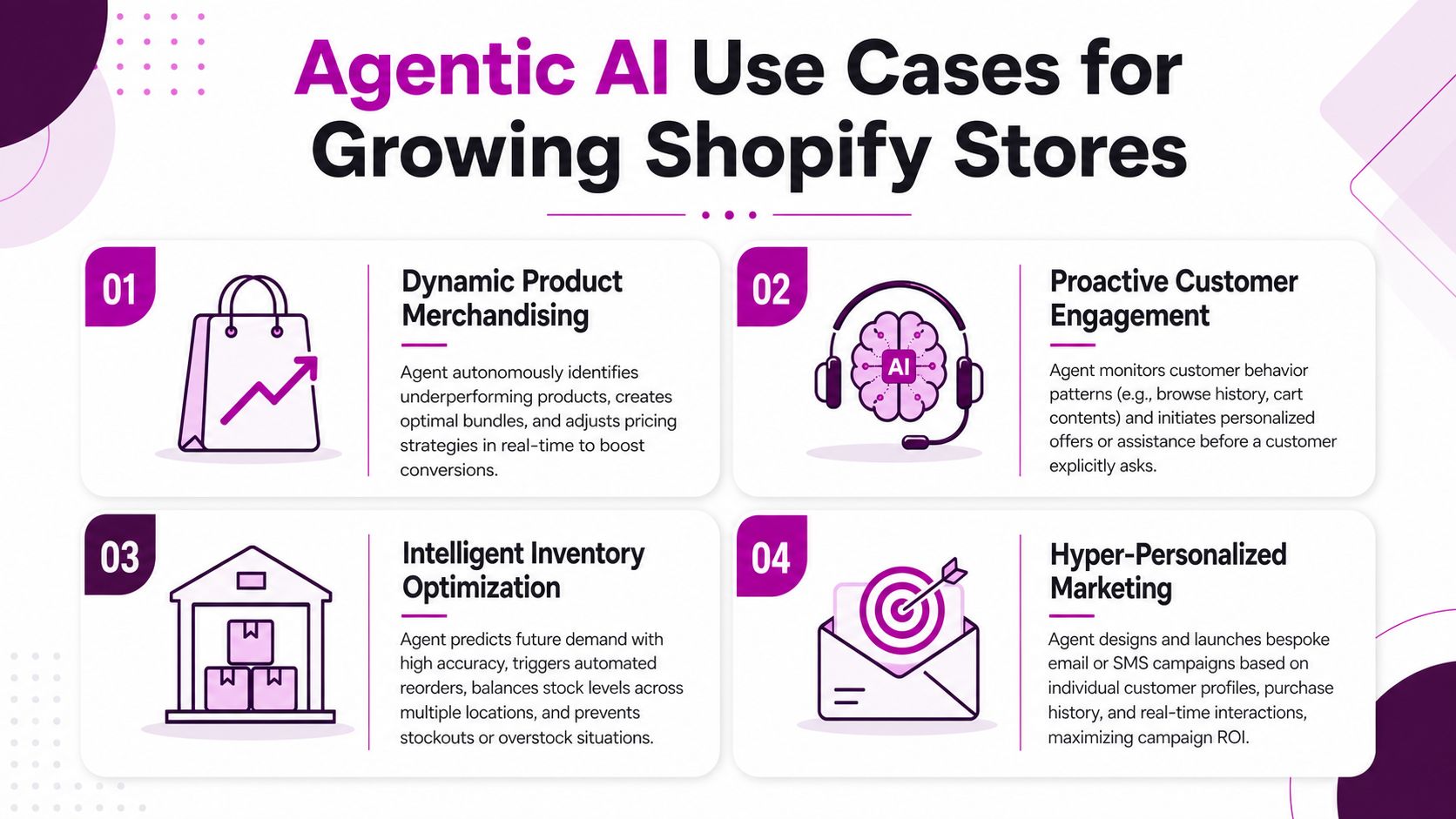
Inventory that acts before stock becomes a fire drill
Most brands don't struggle because they lack inventory data. They struggle because nobody converts the data into coordinated action fast enough.
An agent can watch product velocity, current stock, purchase order status, and channel demand at the same time. When a threshold is crossed, it doesn't just notify someone. It can draft a reorder recommendation, flag substitute products for merchandising, suppress promotion on constrained items, and push internal alerts to operations and lifecycle marketing.
This is especially useful on Shopify when one SKU appears in multiple collections, bundles, and campaign flows. A human sees low stock. An agent sees the downstream effects.
Customer journeys that adapt across channels
Personalization often stops at “show product recommendations” or “send a browse abandonment email.” That's still channel-level thinking.
Agentic AI can work at the customer-journey level. It can review browsing behavior, purchase history, support interactions, loyalty status, and current campaign exposure before deciding what should happen next.
That might look like:
- Holding back a discount for a customer who usually buys without one.
- Escalating to concierge-style outreach for a repeat customer showing hesitation on a high-consideration product.
- Switching from email to SMS when engagement patterns suggest that's the better next touch.
- Changing on-site merchandising for returning visitors based on collection affinity.
The key difference is orchestration. The agent isn't just sending messages. It's deciding how email, SMS, on-site content, and support should work together.
Merchandising that responds like a buyer, not a rule
Static collection sorting ages quickly. So do broad discounts.
An agent can monitor underperforming products, strong product pairings, margin sensitivity, seasonality signals, and inventory pressure. From there, it can adjust collection order, suggest bundles, rotate accessories into higher visibility positions, and trigger offer logic selectively.
Shopify brands often get practical value fast, because merchandising decisions sit at the intersection of conversion and margin. A strong agent can help you avoid two common mistakes:
- Blanket promotion: discounting too widely because the team needs speed.
- Static presentation: leaving collections unchanged while customer demand shifts.
Support operations that reduce preventable tickets
A lot of support volume comes from known issues. Shipment confusion, return eligibility, missing package anxiety, product compatibility questions.
An agent connected to Shopify, your helpdesk, and your shipping event feed can triage these before they become queue bloat. It can identify cases that are safe to resolve automatically, route edge cases to humans, and trigger proactive updates when a delay is likely to generate “where is my order?” contacts.
Don't start with the most magical use case. Start with the process your team repeats every day and resents every week.
That's usually where agentic AI for ecommerce proves itself first. Not in replacing strategy, but in running the business mechanics with more consistency.
An Agentic Workflow Example Recovering Abandoned Carts
Abandoned cart recovery is a good test because every Shopify brand understands the problem, and most already have some version of it running. The difference with an agentic workflow is that it doesn't treat every cart the same.
Here's the process view.

How the agent thinks through the job
The goal is straightforward: recover profitable carts without training customers to wait for discounts.
A basic flow would send the same email to everyone after a fixed delay. An agentic flow does more. It evaluates the cart, the customer, the likely friction point, and the best channel before it acts.
A practical sequence might run like this:
- The cart is detected as abandoned. The agent sees the event in Shopify and checks whether the session likely ended because of distraction, shipping friction, product uncertainty, or comparison shopping.
- The customer record is pulled in. It checks whether this is a first-time buyer, a repeat buyer, a subscription customer, or someone with a recent support issue.
- The outreach plan is selected. If the cart contains a replenishable product, the message might focus on convenience. If it contains a technical product, the message might answer compatibility questions first.
- The first message goes out. The content reflects the products left behind, not a generic reminder.
- Behavior is monitored. The agent watches for opens, clicks, return visits, cart edits, and support contact.
- The next move changes based on response. It may send an SMS, surface a live chat invitation, offer reassurance on shipping, or hold back entirely if the shopper looks likely to convert unaided.
For teams that want to sharpen the message side of this process, this article on Shopify abandoned cart email strategy pairs well with an agent-driven workflow approach.
Where the real lift comes from
The gain doesn't come from sending more reminders. It comes from sending better-timed, better-reasoned interventions.
A shopper who abandoned because delivery timing was unclear shouldn't get the same follow-up as a shopper who hesitated on product fit. A repeat customer with strong brand affinity doesn't need the same incentive logic as a first-time visitor from paid social.
This walkthrough shows the sequence visually before you translate it into tools and rules.
What not to do
Teams often overbuild this use case too early.
Avoid these mistakes:
- Overusing discounts: If every abandoned cart gets an offer, you teach shoppers to wait.
- Ignoring exclusions: VIP customers, wholesale buyers, and subscription users often need different logic.
- Skipping support signals: A customer who opened a ticket before abandoning may need reassurance, not urgency.
- Running it blind: If no one reviews outcomes by segment, the workflow drifts into busywork.
Abandoned cart recovery is where many brands first see how an agent can operate across Shopify, Klaviyo, SMS tools, support platforms, and analytics as one coordinated system.
Integrating Agentic AI into Your Ecommerce Stack
The hard part isn't generating decisions. The hard part is making those decisions trustworthy inside a live business.
Most agentic AI projects succeed or fail on architecture. Not in the model choice alone, but in whether the data is clean, the tools are connected, and the rules are specific enough to keep the system useful under pressure.
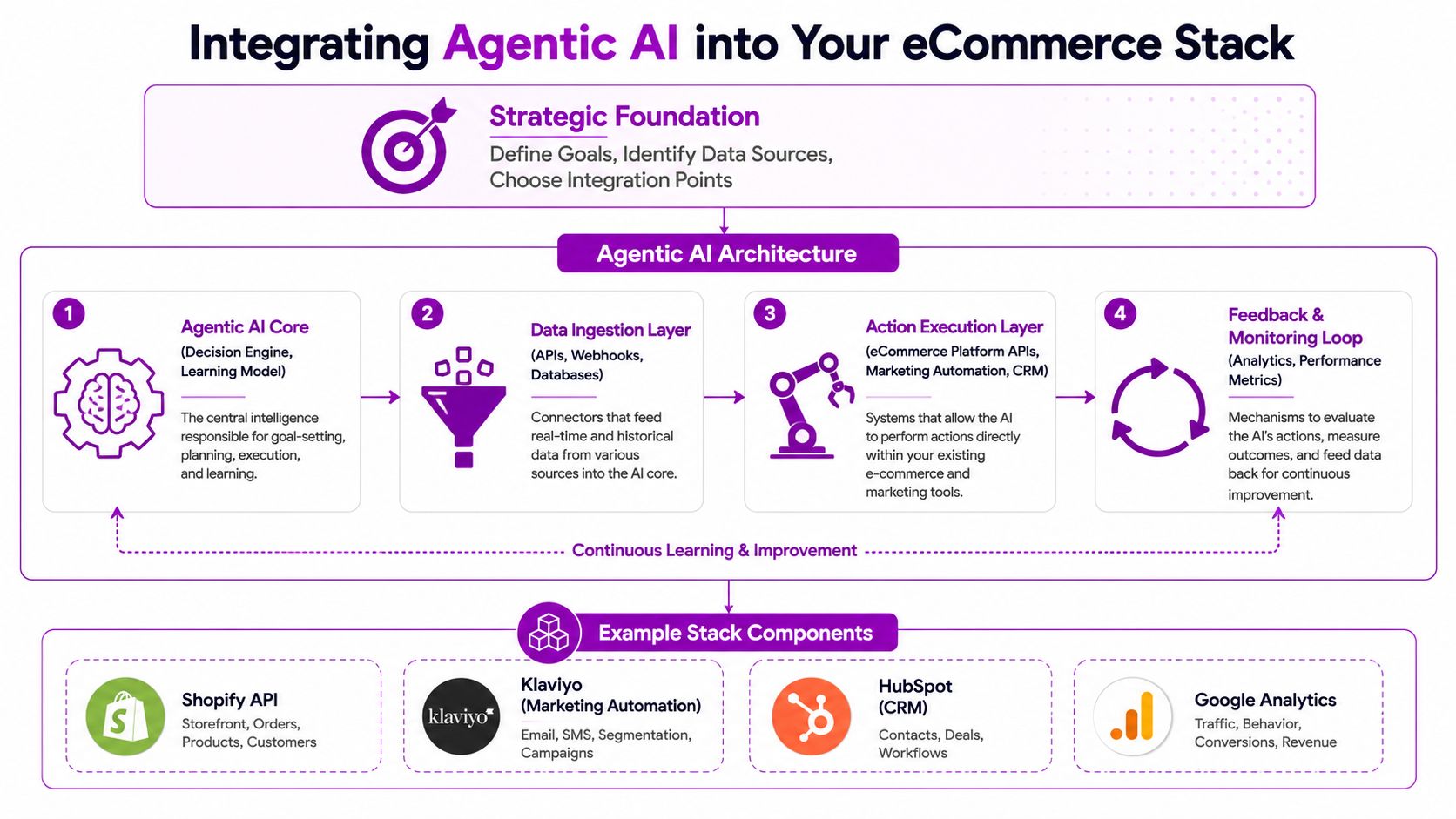
Start with data that agrees with itself
If Shopify says one thing, your CRM says another, and your lifecycle platform uses different tags, the agent won't know which truth to act on.
Before you automate actions, clean up:
- Customer identity rules: Make sure repeat customers, guest checkouts, and support contacts resolve correctly.
- Product data hygiene: Titles, variants, tags, bundles, and inventory states need consistent structure.
- Event definitions: “Abandoned cart,” “engaged customer,” and “high-risk order” should mean one thing across the stack.
This sounds unglamorous because it is. It's also the reason some AI pilots produce nonsense. The agent isn't confused. The business data is.
Give the agent tools, not vague access
An agent needs a controlled toolbox. In a Shopify stack, that usually means APIs, webhooks, and app actions tied to systems such as Shopify, Klaviyo, Gorgias, HubSpot, Google Analytics, Slack, and your fulfillment software.
A useful pattern is to separate permissions into layers:
| Layer | What the agent can do | Good first uses |
|---|---|---|
| Read only | Observe and analyze | Detect issues, generate recommendations |
| Draft mode | Prepare actions for approval | Build campaigns, write support replies, suggest merchandising changes |
| Guardrailed execute | Perform approved action types within rules | Tag customers, trigger flows, pause promotions, route tickets |
| Escalation required | Request human sign-off | Price changes, refunds, policy exceptions, supplier commitments |
Systems break when teams grant broad write access before they've defined business rules.
That's why governance belongs in the design, not in a cleanup phase later.
Build versus buy
You can assemble agentic capabilities with custom middleware and model orchestration, or you can adopt emerging platforms that already handle parts of memory, planning, and tool execution.
Buying is faster when your use case is common. Building makes sense when your workflows are unusual, your data model is complex, or control matters more than speed.
A good decision usually comes down to three questions:
- Does the workflow create advantage? If yes, custom logic may be worth it.
- Do you need deep Shopify-specific behavior? If yes, generic agent tools can feel shallow.
- Can your team support iteration? Agentic systems need tuning, not one-time setup.
For teams refining cart recovery or post-purchase orchestration, Adwave insights on abandoned cart recovery are useful because they ground the message strategy that an agent will eventually operationalize.
Your Implementation Roadmap and Measuring ROI
The fastest way to fail with agentic AI is to start with a giant ambition and no operating discipline. The better move is smaller and sharper.
Pick one process with clear friction
Good first projects usually share three traits. They happen often, touch multiple tools, and currently depend on people remembering what to do next.
Strong candidates include post-purchase support triage, cart recovery branching, low-stock response, and merchandising exceptions.
Use this checklist:
- Choose one workflow. Don't launch an “AI transformation” initiative. Launch one operator-level process.
- Define the business outcome. Focus on something the business cares about, such as fewer preventable support contacts, better recovery quality, cleaner campaign coordination, or faster issue handling.
- Map the decision points. Write down what data the agent needs, which systems it must read, and which actions it may take.
- Set approval boundaries. Decide what the agent can do alone, what it may draft, and what always requires a human.
- Run supervised first. Watch outputs, edge cases, and failure patterns before expanding autonomy.
Measure business impact, not activity
A lot of teams measure the wrong thing. They count tasks completed, messages sent, or recommendations produced.
That's not ROI. That's motion.
Measure whether the process improved the business:
- Operational relief: Did the team spend less time on repetitive coordination?
- Customer experience quality: Did shoppers get faster, clearer, more relevant responses?
- Commercial performance: Did the workflow influence conversion quality, repeat purchase behavior, or margin protection?
- Decision consistency: Did fewer cases fall through the cracks?
A useful outside analogy comes from operations-heavy industries. This guide to the Logivo platform for AI transport shows the same implementation lesson in another domain. AI creates value when it coordinates decisions across a system, not when it adds one more dashboard.
The same rule applies in ecommerce. Start where execution is fragmented. Then measure whether the business runs better.
Frequently Asked Questions About Agentic AI
Is it safe to let AI act inside my store?
It can be, if you set it up with boundaries. The safest approach is to start with low-risk actions, use approval gates for sensitive decisions, and log every action the agent takes.
Don't begin with refunds, pricing changes, or supplier commitments. Begin with observation, drafting, tagging, routing, and recommendations. Once the workflow proves reliable, you expand carefully.
Is this only for large enterprise brands?
No. Large brands may build deeper systems, but growing Shopify brands can still use agentic patterns effectively.
In practice, smaller teams often benefit faster because they have more operational strain and fewer people to carry the coordination load manually. The key is picking a workflow where the payoff is obvious and the scope is controlled.
Do I need developers to do this?
Sometimes yes, sometimes less than you think.
If you're connecting Shopify with tools like Klaviyo, Gorgias, HubSpot, Slack, or a lightweight orchestration layer, a lot can be done with existing APIs, webhooks, app actions, and low-code tools. For more advanced logic, custom middleware or agency support usually helps.
Will it replace my ecommerce team?
No. It changes what the team spends time on.
An agent is good at process execution, follow-up logic, and cross-system coordination. People still own strategy, brand judgment, exception handling, supplier relationships, and commercial trade-offs. The practical win is that your team stops spending so much time pushing information from one system to another.
What's the biggest mistake brands make?
They give the system a fuzzy objective and expect a sharp result.
“Improve retention” is too broad. “Watch for post-purchase friction signals and trigger the right recovery path” is operational. Agentic AI works when the goal, context, tools, and rules are all explicit.
If you're exploring how to apply agentic AI inside a real Shopify operation, ECORN can help you turn the idea into a practical roadmap. Their team works across Shopify development, CRO, and ecommerce operations, which makes them a strong fit for brands that want connected systems, not isolated experiments.


Shopify Developer Hourly Rate: What to Pay in 2026
Ecommerce Conversion Tracking: The Complete How-To Guide

Shopify Design Agency: How to Pick the Right Partner
Mastering Multi Store Management on Shopify

Scale Shopify Store
10 Shopify App Ideas Worth Building in 2026
Conversion Rate Optimization for Landing Pages: The Playbook
Shopify Plus Automation: A Guide for 2026
10 Social Selling Platforms for Shopify Merchants

Shopify Website Design Examples: 7 Stores Worth Studying
7 Ecommerce Newsletter Examples for Shopify Brands
One Product Shopify Store: Build and Scale

Mobile Pop Up Strategy for Shopify Stores That Converts
Sitemap for Shopify: How to Find, Optimize, and Submit It

7 Single Product Websites Worth Emulating
Product Variants Shopify: The Complete 2026 Guide
Ecommerce Analytics Consulting for Growth
What Is AI Integration for eCommerce
How to Choose the Right eCommerce Website Development Firm
E Business Strategy Implementation
Conversion Tracking Setup for Shopify Stores
BigCommerce vs Shopify Plus Which Enterprise Wins in 2026
Shopify Theme Kit: Setup, Commands, and Migration Guide
Shopify Extension Development: A Practical 2026 Guide
Shopify Speed Score Explained and How to Improve It
Shopify Mobile Optimization: The 2026 Playbook
How to Add Subcategory in Shopify for Better UX
How to Implement Structured Data for Ecommerce in 2026
SEO App Mobile: Shopify Store Optimization Guide

Shopify Plus Support: What It Includes and How to Choose

Google Ads for Shopify: The Complete 2026 Playbook

Shopify New York: How to Find and Hire the Right Agency
Google Search Console for Shopify: The Complete Setup
First Party Data Collection for eCommerce Growth
FAQ Online Store Guide: Build and Measure It Right
Do FB Ads Work for eCommerce in 2026?

One Page Checkout for Shopify: Design and Implementation
Shopify GraphQL vs REST: The 2026 Developer Decision
Shopify Ecommerce Consulting: Strategy, Pricing &

Are Reddit Ads Worth It for eCommerce Brands
Shopify Title and Meta Description: A Practical 2026 Guide

Product Video Best Practices for Shopify Brands
Real-Time Inventory Management: A 2026 Guide
AI Chatbot Integration for Shopify Stores
Affiliate Program Management: A Shopify Guide
10 Best Performance Monitoring Tools for Shopify in 2026
Digital Asset Management for eCommerce Brands in 2026
Every Type of Facebook Ads Explained for eCommerce Growth
Product Information Management Explained for Shopify Brands
Support Ticket System: A Guide for Shopify Stores

10 Best Customer Service Tools for Shopify in 2026

Can I Start a Business with No Money? a 2026 Blueprint

What Sells Good on Etsy: Best Niches for 2026

Shopify Add to Cart Button: A Practical 2026 Guide

Customer Feedback Automation: A Practical eCommerce Guide
Critical Rendering Path: A Guide for Shopify Stores

How to Promote on TikTok for eCommerce in 2026

B2B eCommerce Consulting That Drives Real Revenue
10 Best Practices for Site Navigation in 2026
Return vs Refund for Shopify Stores: A Practical Guide
What Is Customer Lifetime Value and Why It Matters
What Is Voice of Customer Research for eCommerce

SMS Marketing for Ecommerce That Actually Converts

Master How to Improve Email Deliverability in 2026

Top 8 eCommerce Partners NYC for Shopify Brands in 2026
Machine Learning for Ecommerce: Boost Your Shopify Store

Beauty Market Research: Your 2026 Growth Guide
Shopify International Expansion: A 2026 Roadmap
What Does CRO Stand for in Business: Understanding CRO

Shopify Visual Merchandising: A Playbook for Higher Sales

Shopify Landing Page Design: Master Conversion in 2026
10 Best AI SEO Optimization Tools for Shopify in 2026
Mastering Email Marketing Data for eCommerce Growth

Conversion Rate Optimisation Australia: Boost Your Sales
Conversion Rate Optimization AI: Your Shopify Store Guide

10 Product Bundling Strategies for Shopify in 2026
How to Increase Customer Lifetime Value: A Shopify Playbook
AI Customer Service Automation: Shopify Guide 2026

Clean Website Design: A Shopify Conversion Playbook

Omnichannel Retail Strategy: A Shopify Playbook
Product Data Enrichment: A Guide for Shopify Brands

Instagram Shopping Features a Guide for Shopify Stores
What Is Revenue Optimization: A Holistic RevOps Guide

Benefits of Conversion Rate Optimization: Boost Your
WordPress to Shopify Migration: Your 2026 Seamless Switch
Boost Sales: Ecommerce Payment Processing Guide 2026
Unified Commerce Platform: Benefits, KPIs & Shopify Guide

How to Reduce Bounce Rate eCommerce: Your 2026 Guide
Shopify API Integration: A Practical End-to-End Guide
How to Implement Data Governance: A 2026 Guide
Shopify Store Development Cost: A 2026 Breakdown
What Is Server Side Tracking: The Shopify Guide 2026
Marketing Automation Workflows: A Shopify Guide for 2026
Shopify: How to Reduce Technical Debt

Shopify UX Design Change: A Playbook for Growth
User Generated Content Strategy: Shopify Playbook

Shopify Pause and Build Plan Cost: A Complete 2026 Guide

Compare at Price on Shopify: A Complete Guide for 2026

Where Can I Sell My Prints? 10 Best Platforms for 2026
Shopify Order Management System: The Ultimate Guide 2026


newsletter in your inbox