

Conversion rate optimization is the discipline of turning a larger share of existing store traffic into completed purchases. In 2026, global eCommerce benchmarks place average conversion rates at roughly 1.89% to 2.3%, while another benchmark reports 2.4% for European stores and 2.8% for U.S. stores.
That range changes how a Shopify founder should think about growth. If most visitors leave without buying, increasing ad spend can raise traffic without solving the reason revenue stays flat. CRO gives you a structured way to find that reason, remove friction, and measure whether the store produces more value from the visitors it already attracts.
The work extends beyond changing a button or rewriting a headline. A visitor encounters a chain of signals across an ad, landing page, collection page, product detail page, cart, checkout, payment screen, and post-purchase experience. If those signals conflict, a strong page-level test may improve one step while the wider journey still leaks customers.
This guide explains what conversion rate optimization means, how the discipline developed, which levers influence performance, how to audit funnel integrity before testing, and how to build a practical 90-day operating rhythm for a small or midsize Shopify store.
What Conversion Rate Optimization Actually Means
Conversion rate optimization is the discipline of turning more of the traffic you already pay for into customers. The basic conversion rate formula is:
Conversion rate = completed purchases ÷ sessions × 100
The benchmark range gives that formula commercial weight. If a store operates near 2%, a small change in the percentage of visitors who buy can affect order volume without requiring a new acquisition channel. Category context matters too. The 2026 Blend Commerce benchmarks list category averages of 4.17% for pet care, 3.46% for beauty and personal care, 3.60% for electronics, 2.84% for fashion and apparel, and 1.40% for home and furniture.
A Shopify founder spending $50,000 per month on ads shouldn't treat conversion rate as a decorative dashboard metric. The same media budget can produce very different outcomes depending on traffic quality, average order value, checkout completion, and the percentage of visitors who purchase. You can't calculate the revenue gap from ad spend alone because the result depends on sessions, costs, and order value. You can, however, model those variables in a spreadsheet and see whether the bottleneck sits in acquisition or onsite conversion.
CRO is a program, not a checkout trick
A useful CRO program has four connected jobs:
- Define the outcome: Choose the primary conversion, usually a completed purchase, while tracking supporting actions such as product views, add-to-cart events, and checkout starts.
- Find the constraint: Identify where visitors hesitate, abandon, misunderstand the offer, or encounter a technical problem.
- Test a hypothesis: Change a specific experience element and compare it with a control.
- Institutionalize learning: Record the result, apply winning changes carefully, and use the insight to shape the next hypothesis.
The discipline emerged because traffic volume alone doesn't tell you whether the store serves visitors effectively. A better navigation path, clearer product proof, more consistent campaign messaging, or a simpler payment experience can all influence the same final outcome.
Practical rule: Treat every conversion as the end of a journey. If the ad promises one thing and the product page communicates another, optimizing only the product page addresses the symptom, not the system.
How CRO Became a Core eCommerce Discipline
A Shopify founder watches sessions climb while orders remain stubbornly flat. The first instinct is often to buy more traffic, but the data raises a more important question: are visitors arriving with the right expectation, and can they complete the purchase without confusion?
That question helped shape CRO during the early 2000s. After the dot-com bubble, companies paid closer attention to website analytics, usability, and measurable performance because online traffic had to produce more than attention. By 2004, marketers were already testing different layouts, copy, offers, and images. The history of the discipline is documented in the conversion rate optimization overview on Wikipedia.
From specialist technique to everyday practice
The launch of Google Website Optimizer in 2007 made A/B testing more accessible to mainstream marketers. Before that shift, experimentation often required specialist knowledge, technical support, or enterprise resources. A broader group of marketers could now compare a control page with a variant and evaluate the effect instead of relying solely on opinion.
That historical change still shapes modern eCommerce. Shopify themes, analytics integrations, low-code tools, and visual editors have put experimentation within reach of small and midsize brands. A founder doesn't need a large optimization department to form a hypothesis, create a variant, and inspect the result. The available tools have changed, but the operating principle remains stable: define an action, isolate a change, and measure the outcome against a baseline.
Why the history matters to Shopify operators
CRO became a core discipline because online stores need efficiency at every stage of growth. A brand can improve acquisition and still waste demand if product information is unclear, shipping costs appear too late, or payment options fail on mobile. Conversely, a store with disciplined funnel analysis can use existing traffic more effectively before expanding its media budget.
That's why CRO shouldn't be treated as a final polish applied after marketing. It belongs in the regular operating model, alongside merchandising, paid media, customer research, analytics, and development. The strongest programs use historical experimentation principles while applying them to the full journey, not just an isolated page.
The Numbers That Define a CRO Program
A CRO program starts with conversion rate, but a single percentage cannot describe the health of an online store. Conversion rate shows the share of sessions that produced orders. It does not reveal profit quality, basket economics, or whether a reported lift came from cleaner tracking. Those questions require a connected set of metrics.
Set a baseline from the same reporting period, then define how each metric is calculated before changing the Shopify store. Otherwise, the team may compare different populations and mistake a reporting difference for customer behavior.
Core CRO Metrics and Formulas
| Metric | Formula | Data Source | Healthy Benchmark |
|---|---|---|---|
| Conversion rate | Orders ÷ sessions × 100 | Shopify Analytics, GA4 | Compare with category and market context, not a universal target |
| Average order value | Revenue ÷ orders | Shopify Analytics, GA4 | Track against product mix and promotion strategy |
| Customer acquisition cost | Ad spend ÷ new customers | Ad platforms, Shopify, attribution platform | Compare with contribution margin and customer value |
| Revenue per visitor | Revenue ÷ visitors or sessions | Shopify Analytics, GA4 | Use as a primary efficiency trend |
| Revenue per ad dollar | Attributed revenue ÷ ad spend | Ad platform, Triple Whale | Compare by channel and attribution model |
Shopify Analytics provides the working view of orders, sales, sessions, and product behavior. GA4 adds event-level journey analysis, while Triple Whale helps operators compare marketing performance across channels. Use the definitions consistently. If Shopify counts sessions and another system counts users, their rates can differ even when both systems are configured correctly.
Metric gaps help identify where the journey needs attention. If a store's conversion rate stays at 1.9% while AOV climbs 12%, basket size is improving and order volume is the constraint. The founder might review qualified traffic, collection-page engagement, product-page progression, and checkout completion before changing bundles or adding promotions. That reading connects the number to a specific store action.
Where reported lifts go wrong
Attribution can change the apparent result because platforms use different windows, channel rules, identity resolution, and modeled conversions. A paid social platform may claim an order that another analytics system assigns to direct traffic. Consent settings, ad blockers, duplicate purchase events, refunds, and cross-device behavior can also distort the record.
Audit funnel integrity before spending budget on experiments. Confirm that control and variant traffic is comparable, purchase events fire once, and reported revenue reconciles with the Shopify backend. Check device, traffic source, new versus returning visitors, and checkout stage. A sitewide average can conceal a mobile product-page problem.
The commercial decision should use numbers the store can verify. A modeled move from 2.0% to 2.8% can be compared with a proposed 40% increase in ad budget, then tested against traffic quality, margin, and operational capacity. CRO may improve the return from existing demand, but the spreadsheet must show its assumptions clearly.
Core Levers That Move Conversion Rates
Four levers repeatedly appear in practical Shopify CRO work: UX clarity, persuasive copy, personalization, and structured experimentation. They don't have equal priority in every store. A broken mobile navigation path deserves attention before a recommendation engine.
UX clarity removes avoidable effort
Start with the path a customer must follow. Review mobile navigation, collection filters, product image behavior, variant selection, cart visibility, and checkout fields. Compress oversized hero images, remove distracting pop-ups, and make the primary action visible without forcing the shopper to hunt for it.
A store-level outcome might be simple: visitors reach the correct product faster, understand which variant they selected, and encounter fewer interruptions before checkout. You should measure the relevant step, such as product-page engagement, add-to-cart rate, or checkout completion, rather than assuming a visual improvement raised total purchases.
For brands that need a broader design review, Queen City Digital design services offer context on conversion-focused web design and how page structure can support clearer customer journeys.
Copy turns product information into a decision
Product copy should answer the questions that block purchase. Replace vague claims with specific benefits, explain who the product is for, show how it fits into a routine, and place reassurance near the decision point. A skincare brand might move ingredient proof, usage guidance, and reviews closer to the buy box instead of hiding them below several content blocks.
Small wording changes can matter, but you shouldn't treat copy as magic. Form a hypothesis about the objection, then test the headline, benefit statement, offer explanation, or add-to-cart microcopy against the existing version.
Personalization responds to context
A returning visitor may need a different prompt from a first-time visitor. A shopper arriving from a product-specific ad may need a landing page that echoes that product promise. Useful actions include surfacing recently viewed items, showing relevant recommendations, or tailoring banners by geography when shipping information differs.
Personalization can also create inconsistency if teams add rules without governance. Review whether the message matches the referral source, inventory position, margin, and customer status before deploying it.
Testing separates evidence from preference
A/B testing randomly exposes visitors to a control and a variant, then uses hypothesis testing to assess whether the observed difference is reliable rather than noise. The eCommerce A/B testing meta-analysis found that 20% of tests produced 81% of aggregate conversion uplift, which supports prioritizing high-impact problems over a long queue of cosmetic changes.
Use a clear hypothesis, one primary success metric, and guardrails such as revenue per visitor or refund behavior. For implementation details, consult these A/B testing best practices, then adapt the process to your store's traffic and buying cycle.
Tools and Platforms Shopify Brands Use
A CRO stack works best as four cooperating layers. No single app can tell you what visitors did, why they struggled, whether a change caused the result, and how to personalize the next visit.
The four-layer stack
Analytics establishes the measurement layer. Shopify Analytics gives merchants operational sales data, GA4 supports event and journey analysis, and Mixpanel can help teams analyze behavior when the store has a more complex product or account experience.
Testing validates proposed changes. Shopify's available experimentation features can suit straightforward needs, while VWO and Optimizely provide broader experimentation capabilities for teams with more mature processes.
Behavior tools help explain friction. Hotjar and Microsoft Clarity provide session replays, heatmaps, and interaction patterns that can reveal dead clicks, confusing layouts, or form hesitation. These tools generate hypotheses, not automatic answers.
Personalization changes the experience by context. Rebuy, Nosto, and Octane AI can support recommendations, audience-specific content, or conversational shopping flows. Their value depends on clean product data, clear rules, and a measurable business objective.
CRO Tool Stack for Shopify Brands
| Layer | What It Does | Example Tools | Best For Stage | Price Tier |
|---|---|---|---|---|
| Analytics | Measures traffic, revenue, events, and funnel movement | Shopify Analytics, GA4, Mixpanel | Every stage | Free to paid |
| Testing | Compares control and variant experiences | Shopify features, VWO, Optimizely | Growing to mature teams | Free to enterprise |
| Behavior | Shows interaction patterns and friction | Hotjar, Microsoft Clarity | Early diagnosis through growth | Free to paid |
| Personalization | Tailors content, recommendations, or offers | Rebuy, Nosto, Octane AI | Stores with enough segmentation need | Paid to enterprise |
A founder operating at moderate monthly revenue should avoid buying an enterprise stack before confirming tracking, funnel definitions, and a regular review habit. Start with the tools that answer the next business question. If you don't know where visitors abandon, behavior analytics matters more than personalization. If you can identify the problem but can't compare solutions, testing infrastructure becomes the next priority.
A larger Shopify Plus brand may justify more advanced tooling when multiple teams, storefronts, markets, or testing programs need shared governance. Before choosing, compare data ownership, implementation effort, privacy requirements, integration quality, and reporting consistency. This guide to conversion optimization tools provides another way to evaluate the category by use case rather than by app count.
Why Most CRO Programs Stall Before They Start
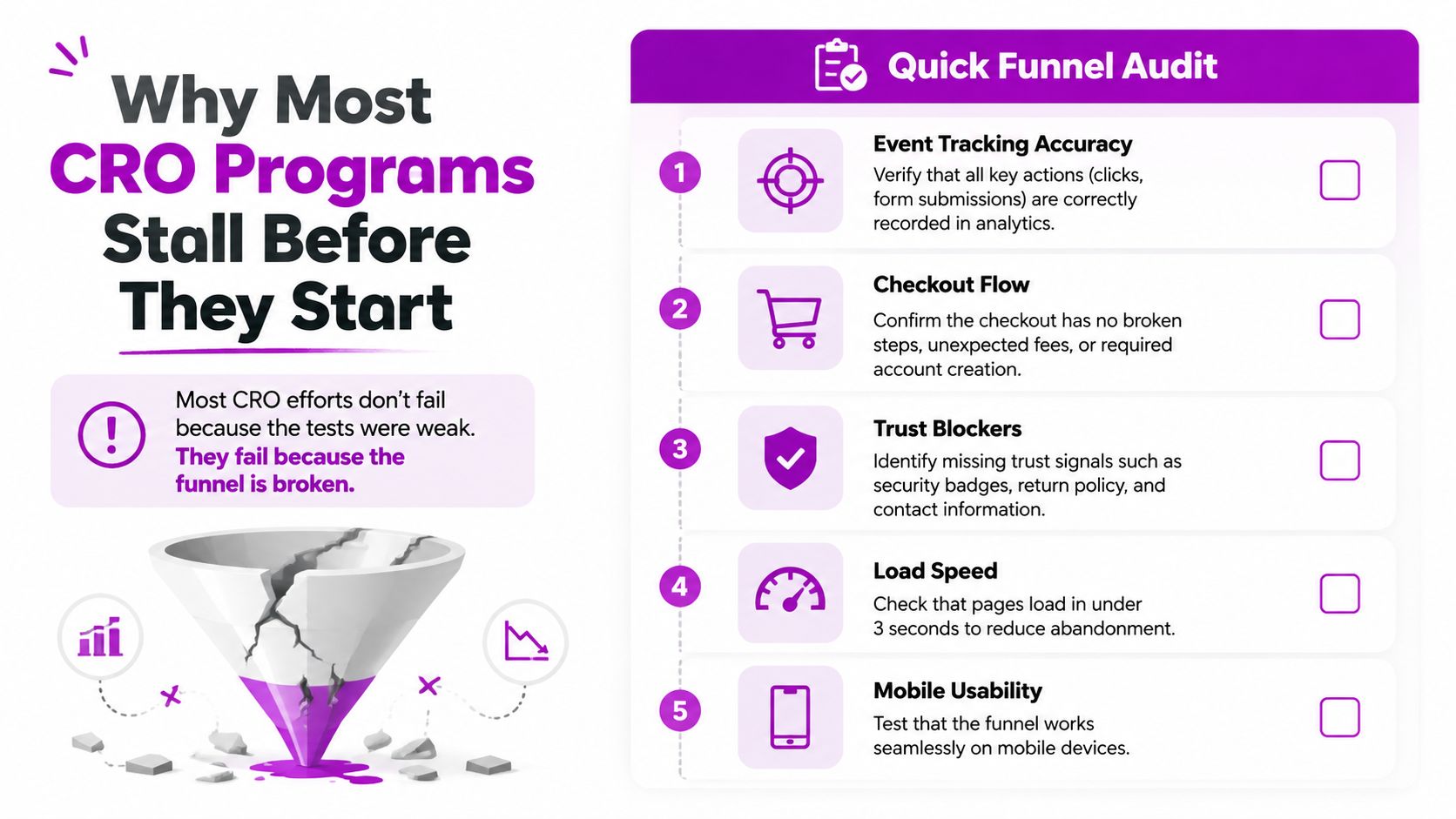
Many CRO programs fail before the first experiment because the funnel doesn't work reliably. A missing purchase event, a payment error, an unclear shipping charge, or an ad-to-landing-page mismatch can cap every later improvement.
Run the infrastructure check first
Start with a short audit:
- Event tracking accuracy: Verify that clicks, add-to-cart actions, checkout starts, purchases, and form submissions record correctly and only once.
- Checkout completion: Test the full path with real devices, payment methods, discount logic, shipping rules, and guest checkout.
- Trust signals: Place reviews, returns information, contact details, payment reassurance, and delivery expectations where shoppers make decisions.
- Mobile performance: Inspect product pages, cart, and checkout on actual mobile devices, not only a desktop preview.
- Message match: Compare the ad promise with the landing-page headline, product proof, offer terms, and call to action.
The 2026 conversion optimization statistics summary emphasizes why device and funnel-stage segmentation matters. Desktop conversion often outperforms mobile because device constraints can amplify load-time, form-friction, and trust-signal problems. The practical response is to inspect mobile product pages and checkout separately instead of hiding their performance inside a sitewide average.
Use a pre-test gate
Ask five questions before approving a new experiment:
- Is GA4 firing the intended events correctly?
- Does the checkout complete without a broken or confusing step?
- Do product detail pages meet the store's performance requirement on mobile?
- Can shoppers see credible reviews and key policies near the decision point?
- Does the page headline reflect the promise that brought the visitor there?
If the answer to any question is no, fix that issue before funding another test. A confusing shipping calculator can reduce checkout completion, while a missing tracking event can make a successful fix look ineffective. Measurement quality and funnel integrity determine whether your experimentation program produces knowledge or noise.
The Optimizely CRO glossary also frames CRO around data-driven improvement and testing. The systems view adds an operational requirement: the data must describe the journey accurately before you optimize it.
Real Examples of CRO in Shopify Stores
The most useful examples are patterns, not promises. A tactic that helps one catalog may fail for another because price, customer intent, device mix, offer structure, and trust requirements differ.
Scenario one, a skincare product page
A direct-to-consumer skincare brand notices that shoppers view product pages but hesitate near the purchase decision. The team reorganizes the page so reviews, ingredient evidence, routine guidance, and delivery reassurance appear closer to the buy box.
The test compares the existing hierarchy with the revised hierarchy while keeping price, promotion, traffic allocation, and product imagery stable. The primary measure is add-to-cart rate, with completed purchase and revenue per visitor as guardrails. The lesson isn't that reviews always belong in one fixed location. It's that evidence should appear where customers need it to resolve doubt.
Scenario two, an apparel basket
A mid-market apparel store promotes free shipping with a generic announcement bar. The team replaces it with a progress indicator that shows how much more value the shopper needs to qualify, then checks whether the change affects basket size and checkout completion.
The experiment needs clear eligibility rules. If the threshold is difficult to understand or appears only after the customer has committed to a purchase, the bar may create confusion instead of motivation. The useful insight is to connect the message to the customer's current basket, not merely display a louder promotion.
Scenario three, a home goods homepage
A home goods merchant uses a feature-led homepage headline that describes materials and construction. The team tests a benefit-led alternative focused on the result customers want from the room, while holding the layout and offer constant.
The primary measure is add-to-cart behavior from homepage visitors, supported by product-page progression and purchase data. A win would suggest that the audience responds better to an outcome than to a specification. It wouldn't prove that the same language belongs on every category or product page.
CRO Scenarios and Reported Lifts in Shopify Stores
| Scenario | Lever Used | Test Approach | Reported Lift |
|---|---|---|---|
| Skincare product page | Evidence hierarchy and trust content | Control versus revised product-page structure | Measure add-to-cart and purchase outcomes, no verified lift supplied |
| Apparel basket | Threshold-based shipping progress | Control announcement bar versus contextual progress bar | Measure average order value and checkout completion, no verified lift supplied |
| Home goods homepage | Benefit-led headline | Control feature copy versus benefit copy | Measure add-to-cart behavior, no verified lift supplied |
These scenarios illustrate why responsible CRO writing separates a test design from a claimed result. The conversion rate optimization guide from Lucky Orange describes the broader move toward personalization, journey-wide analysis, and omnichannel touchpoints, but it doesn't turn a generic tactic into a guaranteed lift for your store.
A Practical Roadmap and Habits That Last
A 90-day CRO plan should build an operating rhythm, not chase a dramatic headline number. The sequence matters because testing a redesigned page before validating checkout and event tracking creates ambiguity.
Phase one, audit the funnel
Begin by reviewing analytics events, Shopify orders, payment flows, shipping logic, discount behavior, mobile usability, reviews, policies, and referral-message consistency. Watch session replays where appropriate, inspect high-traffic pages, and compare the recorded funnel with actual store behavior.
Document each issue with the affected journey stage, evidence, owner, and business risk. Don't turn every observation into a test. Some problems belong with development, merchandising, customer service, or paid media.
Phase two, prioritize hypotheses
Create a living backlog. Each hypothesis should state:
- Observed problem: What visitors do or fail to do.
- Likely cause: Why the current experience may create friction.
- Proposed change: The smallest useful intervention.
- Primary metric: The outcome that determines success.
- Guardrails: Metrics that prevent a narrow win from damaging revenue quality.
- Effort and impact: The resources required and the potential business value.
Prioritize problems with meaningful traffic, clear evidence, and a realistic implementation path. A broken payment method usually outranks a minor visual preference.
Phase three, run controlled experiments
Use a control and a variant when the traffic and tooling support a reliable comparison. Pre-register the primary metric, audience, allocation, duration, and decision rule before launch. Avoid changing several unrelated elements at once unless the hypothesis concerns the complete experience.
Review results by device, source, intent, and new versus returning status. A variant can win overall while losing for a valuable segment, or appear successful because one channel's traffic changed during the test.
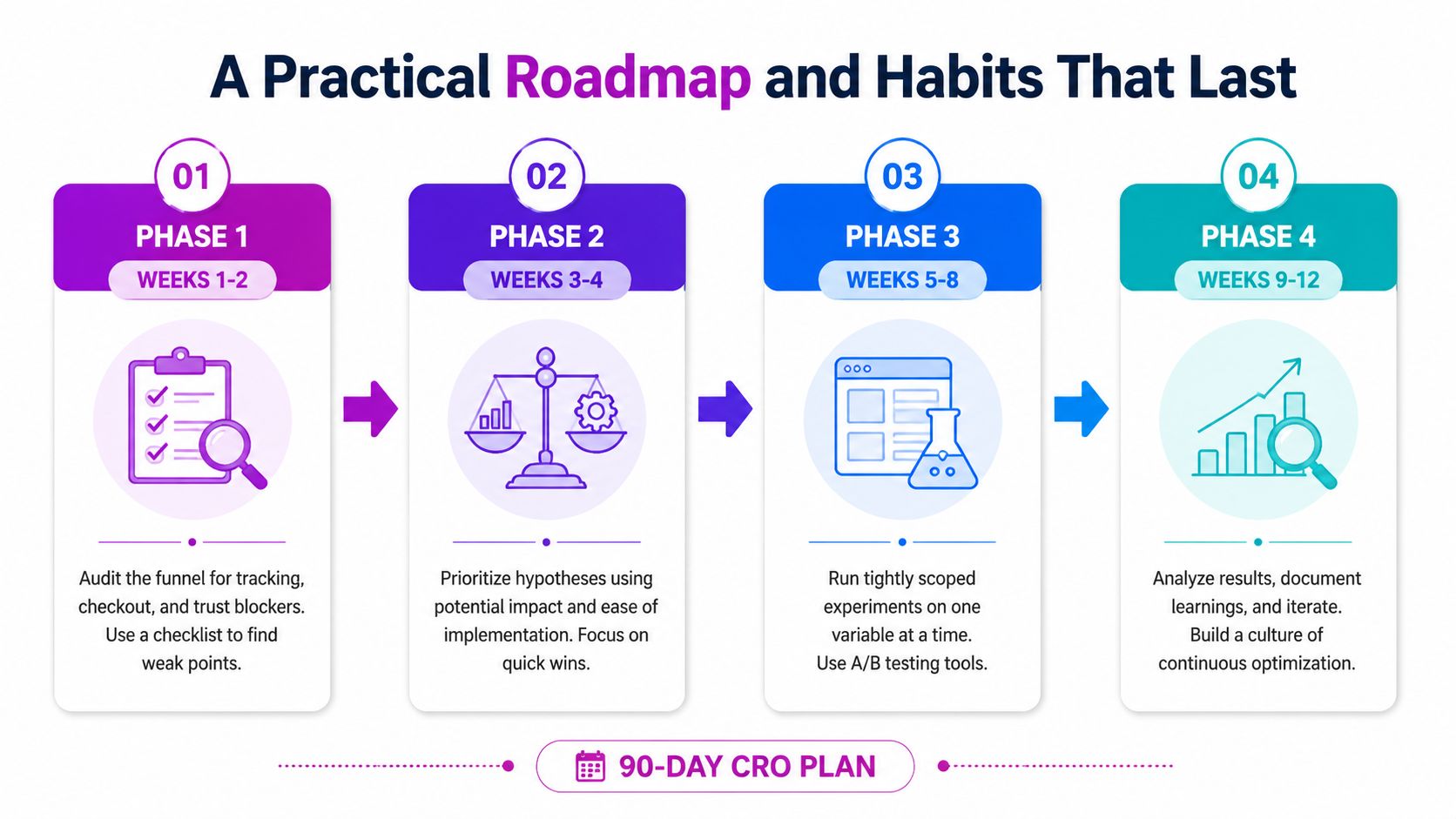
Phase four, roll out and preserve the learning
When a result supports the hypothesis, deploy the winning experience through the theme or approved component system. Record the change, audience, dates, metrics, caveats, and follow-up questions. Monitor the live implementation because an experiment can work in a controlled environment and still fail after theme changes, app conflicts, inventory shifts, or campaign changes.
Mature teams also maintain a small set of habits:
- Weekly experiment review: Inspect active tests, data quality, and implementation risks.
- Hypothesis backlog: Add evidence from analytics, support tickets, reviews, and session behavior.
- Post-test debrief: Record what happened, why it may have happened, and what the team will do next.
- Segment review: Check device, source, intent, and customer status before generalizing.
- Failed-test revisit: Reconsider an idea after adequate data or a meaningful change in audience, offer, or context.
CRO compounds through accumulated learning. The first 90 days should leave you with cleaner measurement, clearer ownership, better prioritization, and a repeatable way to improve the full customer journey.
ECORN offers Shopify conversion research, funnel audits, CRO strategy, Shopify development, and testing support for brands that need to turn diagnosis into implementation. Visit ECORN to explore flexible project and subscription options for improving product pages, checkout experiences, performance, and journey-wide conversion.



Shopify New York: How to Find and Hire the Right Agency
Google Search Console for Shopify: The Complete Setup
First Party Data Collection for eCommerce Growth
FAQ Online Store Guide: Build and Measure It Right
Do FB Ads Work for eCommerce in 2026?

One Page Checkout for Shopify: Design and Implementation
Shopify GraphQL vs REST: The 2026 Developer Decision
Shopify Ecommerce Consulting: Strategy, Pricing &

Are Reddit Ads Worth It for eCommerce Brands

Shopify Title and Meta Description: A Practical 2026 Guide

Product Video Best Practices for Shopify Brands
Real-Time Inventory Management: A 2026 Guide

AI Chatbot Integration for Shopify Stores
Affiliate Program Management: A Shopify Guide
10 Best Performance Monitoring Tools for Shopify in 2026
Digital Asset Management for eCommerce Brands in 2026
Every Type of Facebook Ads Explained for eCommerce Growth
Product Information Management Explained for Shopify Brands
Support Ticket System: A Guide for Shopify Stores

10 Best Customer Service Tools for Shopify in 2026

Can I Start a Business with No Money? a 2026 Blueprint

What Sells Good on Etsy: Best Niches for 2026

Shopify Add to Cart Button: A Practical 2026 Guide

Customer Feedback Automation: A Practical eCommerce Guide
Critical Rendering Path: A Guide for Shopify Stores

How to Promote on TikTok for eCommerce in 2026

B2B eCommerce Consulting That Drives Real Revenue

10 Best Practices for Site Navigation in 2026
Return vs Refund for Shopify Stores: A Practical Guide
What Is Customer Lifetime Value and Why It Matters
What Is Voice of Customer Research for eCommerce

SMS Marketing for Ecommerce That Actually Converts

Master How to Improve Email Deliverability in 2026

Top 7 eCommerce Partners NYC for Shopify Brands in 2026

Machine Learning for Ecommerce: Boost Your Shopify Store

Beauty Market Research: Your 2026 Growth Guide

Shopify International Expansion: A 2026 Roadmap
What Does CRO Stand for in Business: Understanding CRO

Shopify Visual Merchandising: A Playbook for Higher Sales

Shopify Landing Page Design: Master Conversion in 2026
10 Best AI SEO Optimization Tools for Shopify in 2026

Agentic AI for Ecommerce: Boost Your Sales in 2026
Mastering Email Marketing Data for eCommerce Growth

Conversion Rate Optimisation Australia: Boost Your Sales
Conversion Rate Optimization AI: Your Shopify Store Guide

10 Product Bundling Strategies for Shopify in 2026
How to Increase Customer Lifetime Value: A Shopify Playbook
AI Customer Service Automation: Shopify Guide 2026

Clean Website Design: A Shopify Conversion Playbook

Omnichannel Retail Strategy: A Shopify Playbook
Product Data Enrichment: A Guide for Shopify Brands
Instagram Shopping Features a Guide for Shopify Stores
What Is Revenue Optimization: A Holistic RevOps Guide

Benefits of Conversion Rate Optimization: Boost Your
WordPress to Shopify Migration: Your 2026 Seamless Switch
Boost Sales: Ecommerce Payment Processing Guide 2026
Unified Commerce Platform: Benefits, KPIs & Shopify Guide

How to Reduce Bounce Rate eCommerce: Your 2026 Guide
Shopify API Integration: A Practical End-to-End Guide

How to Implement Data Governance: A 2026 Guide
Shopify Store Development Cost: A 2026 Breakdown
What Is Server Side Tracking: The Shopify Guide 2026
Marketing Automation Workflows: A Shopify Guide for 2026

Shopify: How to Reduce Technical Debt

Shopify UX Design Change: A Playbook for Growth
User Generated Content Strategy: Shopify Playbook

Shopify Pause and Build Plan Cost: A Complete 2026 Guide
Compare at Price on Shopify: A Complete Guide for 2026

Where Can I Sell My Prints? 10 Best Platforms for 2026
Shopify Order Management System: The Ultimate Guide 2026
What Is Marketing Attribution? an eCommerce Guide for 2026

10 Best Black Friday Sales Sheets for 2026

Discover the Top Social Media Marketing Agencies For
Consumer Confidence Definition for eCommerce in 2026
What Is Social Commerce? Your 2026 Guide to Boosting Sales

A Social Ad Campaign Playbook for eCommerce Growth

7 Best FAQ Page Examples for SaaS & eCommerce

Market Research in Fashion Industry: A Guide for Shopify

Shopify Migration Services: Expert Guide for 2026
Mastering FB Retargeting Ads for Shopify in 2026
What Is Omnichannel Ecommerce

Master Your Shopify Plus Migration: The 2026 Guide
Shopify Integration Services: A Merchant's 2026 Guide
Shopify Collection Description: A Guide to SEO & Sales

Shopify Plus Contact: Reach Sales & Support Effectively

Top Luxury Shopify Stores: Design & UX Strategies
How to Improve Customer Experience: A Shopify Roadmap

Creative Facebook Ads: 10 Examples for Shopify Brands

Remarketing with Facebook Ads: A Shopify Guide for 2026

SEO Linking Strategies for Shopify Stores
Top 7 Statistics YouTube Channels for eCommerce in 2026

Hiring Shopify Plus Designers: A Founder's Guide

Shopify Product Variation: Master Your Variants for 2026

Leverage Ai Solutions Brands: Your 2026 Shopify Growth Guide
Filters in Shopify: A Guide for Growing Brands

Shopify Plus Developer: A Guide for Growing Brands

When Does Black Friday Online Start? A 2026 Guide
Black Friday Email Marketing: Shopify & Klaviyo Guide

Polaris Design System: The Complete Shopify Guide

How to Hire a Consultant Email Marketing Expert


newsletter in your inbox