

You're probably in one of two situations right now.
Your current platform still works, but your team is building workarounds every week. Merchants split products because variant limits get messy. Ops teams duplicate storefront tasks across regions. Sales wants B2B terms, custom pricing, and buyer roles. Marketing wants to launch faster without filing dev tickets for every campaign.
Or you're already at the point where the platform decision affects margin, not just convenience. That's when BigCommerce vs Shopify Plus stops being a feature-comparison exercise and becomes an operating-model decision.
Introduction Why This Comparison Matters Now
I've seen this decision play out most often when a brand hits a complexity wall, not a traffic wall.
A DTC brand starts selling wholesale and suddenly needs company accounts, payment terms, and account-specific pricing. A multi-region business realizes that adding another store also adds another layer of admin overhead. A brand with configurable products discovers that catalog structure, not homepage design, is what's slowing the business down.
That's why this comparison matters in 2026. Both platforms are viable. Both can support serious ecommerce operations. But they solve very different problems well, and teams waste time when they evaluate them like interchangeable software plans.
Here's the short version of my view:
- Choose Shopify Plus if your business wants speed, a governed ecosystem, cleaner launch velocity, and a platform that usually fits DTC-led growth best.
- Choose BigCommerce Enterprise if your business runs on catalog complexity, wholesale logic, multi-brand operations, or checkout and architecture flexibility.
Most articles stop at feature lists. That's not enough. Enterprise buyers don't just ask what a platform can do. They ask:
- What will this cost once payments, apps, and implementation are included?
- Will this reduce or increase admin overhead across stores, markets, and teams?
- Does the platform fit how we sell, or are we forcing our business into its constraints?
Those are the right questions.
To make this practical, here's the fast comparison before we go deeper:
| Criteria | Shopify Plus | BigCommerce Enterprise |
|---|---|---|
| Best for | DTC-led brands scaling into enterprise complexity | B2B-heavy, catalog-heavy, and multi-store operations |
| Checkout model | Controlled extension framework | Open, API-driven customization |
| Catalog flexibility | Strong, but more constrained on variants | Better fit for complex variant structures |
| Multi-store operations | Works, but often with separate-store complexity | Native multi-storefront is a major advantage |
| B2B model | Strong for brands adding B2B into DTC operations | Strong for businesses where B2B is core |
| Cost clarity | Published starting pricing exists | Usually custom-priced |
| Real decision lens | Ecosystem speed and operational simplicity | Architectural flexibility and control |
If you're deciding between these two, don't ask which one is better in the abstract. Ask which one creates less operational drag for the next stage of your business.
Platform Overview and Market Position
The market position of these platforms tells you something important before you even look at features: they win in different ways.
Shopify Plus is the scaled enterprise layer
Shopify Plus isn't just Shopify with a bigger invoice. It has become a meaningful enterprise layer inside a massive ecosystem. One 2026 industry summary estimates about 66,948 Shopify Plus stores globally, which is roughly 2.4% of all Shopify stores, yet those stores contribute an estimated 30% to 40% of Shopify's revenue. The same source estimates Shopify Plus at about 0.19% of total ecommerce market share. That's a small footprint with outsized commercial weight, which matters when evaluating enterprise platform maturity in this Shopify analytics and trends summary.
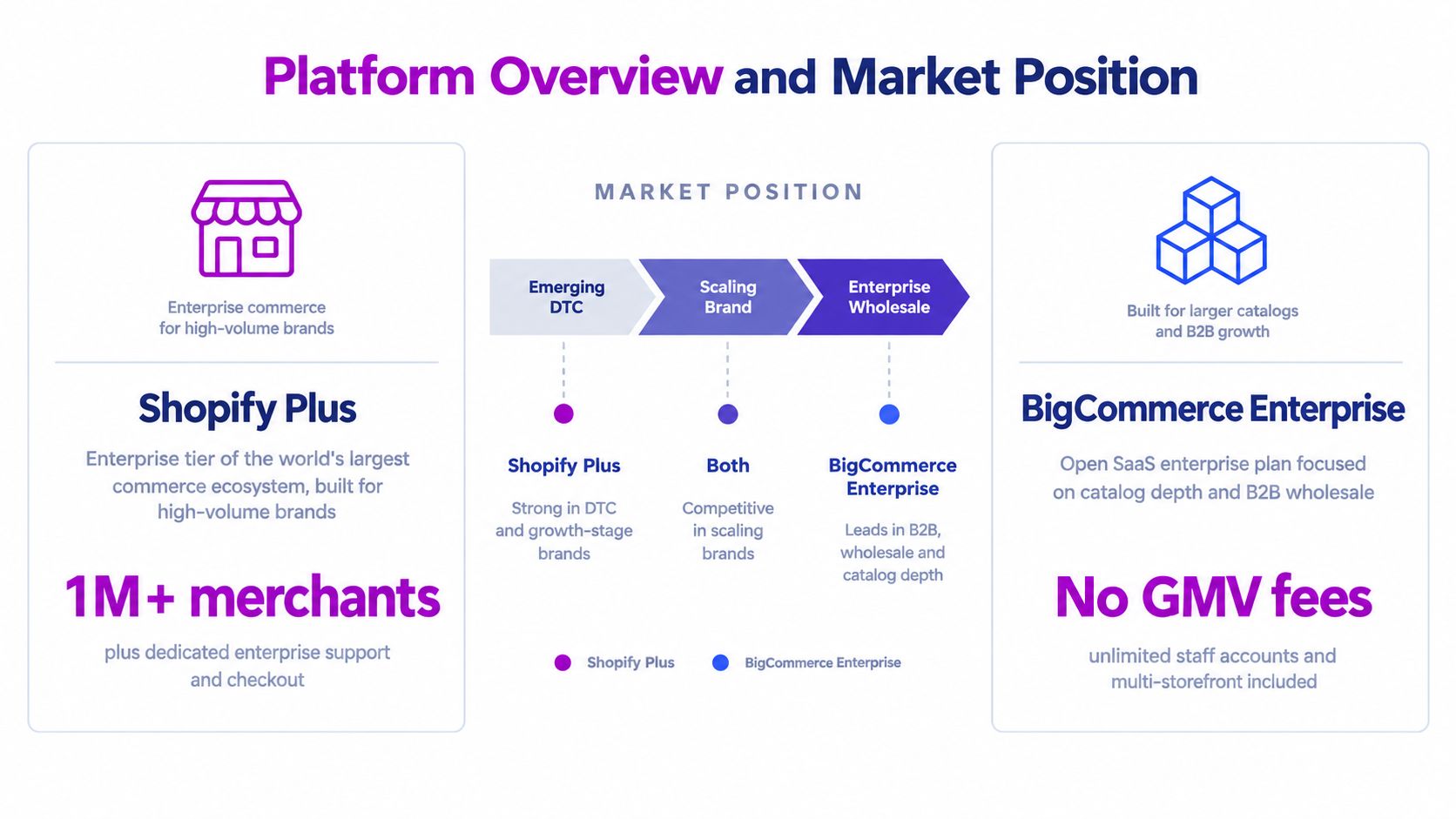
That concentration says a lot. Shopify Plus is built for brands that want enterprise capability inside a tightly managed commerce system. It usually appeals to operators who value speed, app availability, and a strong partner ecosystem.
If you want another perspective on how merchants frame this decision, ECORN has a useful BigCommerce vs Shopify comparison.
BigCommerce is smaller, but the positioning is sharper
BigCommerce doesn't match Shopify's ecosystem scale, but it remains relevant where operations get more complex.
Independent 2026 market analysis estimates BigCommerce's strongest position in the $10M to $50M GMV band at about 9% share, while Shopify Plus leads that band at roughly 41%. In the broader $50M to $200M band, Shopify Plus is estimated at 31% share, versus BigCommerce's 9% enterprise share, according to this enterprise ecommerce market share analysis by revenue band. The same source also notes that a separate BigCommerce earnings document says the company serves tens of thousands of merchants globally and facilitates nearly $32 billion in gross merchandise volume.
What the positioning means in practice
This isn't just market-share trivia. It affects hiring, implementation style, and the kinds of problems each platform is optimized to solve.
Shopify Plus behaves like the enterprise tier of a broad commerce ecosystem. BigCommerce behaves like a focused platform for merchants who need more structural freedom.
My opinion is simple. If your business model is mainstream enough that ecosystem depth matters more than architectural freedom, Shopify Plus is usually the safer bet. If your revenue depends on handling operational edge cases cleanly, BigCommerce deserves serious attention.
Core Features and Catalog Capabilities Compared
Most platform evaluations get this wrong. They obsess over long feature grids and ignore the features that create recurring operational pain.
The important questions are simpler. How complex is your catalog? How many storefronts do you need? Is B2B a side channel or a core operating model?
Variant and product structure
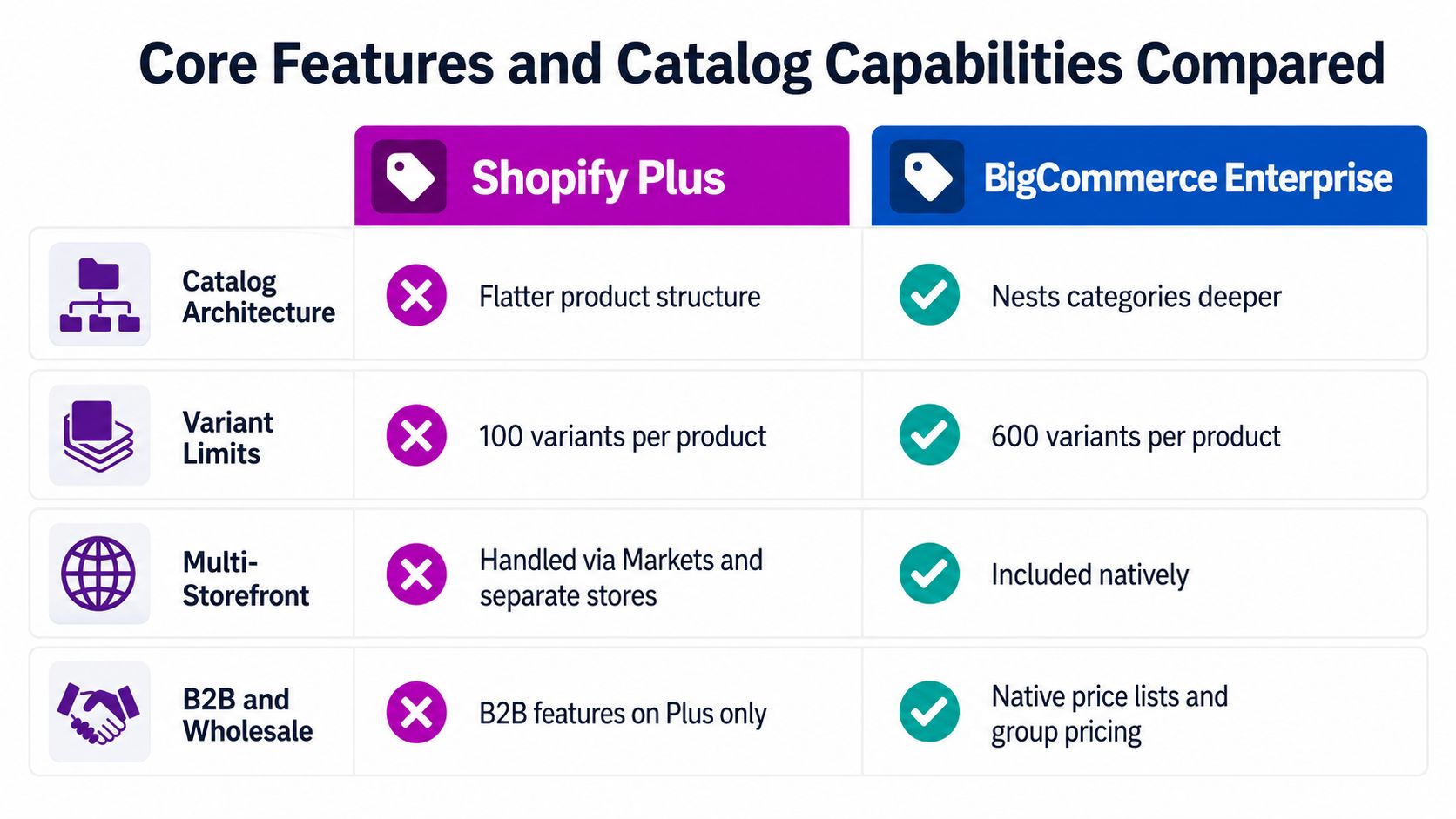
For large catalogs, BigCommerce publicly states support for up to 600 SKUs per product, versus Shopify's 100-SKU-per-product cap, as noted in this Shopify Plus vs BigCommerce comparison.
That's not a minor technical detail. It changes how your team manages products every day.
If you sell configurable items, wholesale assortments, or products with many option combinations, BigCommerce can reduce the need for product splitting, parent-child workarounds, and catalog gymnastics. Shopify can still handle complex merchandising, but it often does so through structure decisions and app or custom logic rather than native catalog breadth.
Key differentiator: If your merchandising team already complains about variant workarounds, don't ignore that signal. BigCommerce's higher variant ceiling can remove real admin friction.
Multi-storefront and regional operations
BigCommerce's native multi-storefront capability is one of its clearest advantages for multi-brand and multi-region businesses. The same comparison sources note that BigCommerce's multi-storefront and B2B-oriented controls are generally better suited to those operating models, while Shopify Plus often pairs its multi-store model with more app-driven or custom-development-heavy workflows in the source above.
That doesn't mean Shopify Plus can't support international expansion. It can. But the path is different. Shopify often works best when a brand wants strong central governance with separate stores, Shopify Markets, and carefully managed operating rules. BigCommerce tends to feel more natural when several storefronts need to coexist without multiplying backend complexity.
Here's the visual shorthand teams need:
| Capability | Shopify Plus | BigCommerce Enterprise |
|---|---|---|
| Variant-heavy products | More constrained | Better fit |
| Multi-brand setup | Possible, but often more operationally layered | More natural fit |
| Regional storefront control | Strong, but often store-based | Strong with native multi-storefront emphasis |
| Catalog admin simplicity | Better for simpler structures | Better for complex structures |
A useful platform walkthrough can help if your internal team is still split on what “complex catalog” really means in practice.
B2B functionality
The B2B conversation is more nuanced than most comparison posts admit.
Independent 2026 comparisons note that Shopify Plus includes B2B for All, while BigCommerce offers B2B Edition or BundleB2B plus independent multi-storefront architecture, according to this comparison of Shopify vs BigCommerce operating models. The question isn't who has the longer B2B checklist. It's which architecture fits your business.
- Shopify Plus fits better when DTC is still the main engine and B2B needs to live inside that world cleanly.
- BigCommerce fits better when wholesale isn't an add-on. It's the core logic of the business.
Pricing Structure and Total Cost of Ownership
If you compare these platforms on headline monthly price alone, you'll make the wrong decision.
The question is where total cost flips. That break-even point changes based on payment-gateway mix, revenue thresholds, and how much implementation complexity your business creates.
The published pricing only tells part of the story
Independent 2026 comparisons note that Shopify Plus starts at about $2,300 per month on a 3-year term or $2,500 per month on a 1-year term, while BigCommerce Enterprise is usually custom-priced and often positioned as cheaper on headline cost, according to this 2026 BigCommerce vs Shopify pricing comparison.
That's useful, but incomplete.
BigCommerce often looks cheaper in the first pass because custom pricing can be attractive at the contract stage. Shopify Plus looks easier to benchmark because there's at least a visible starting point. Neither number tells you what the platform will really cost your business to run.
Total Cost Drivers Beyond Monthly Fees
| Cost Factor | Shopify Plus | BigCommerce Enterprise |
|---|---|---|
| Base platform fee | Published starting point exists | Usually custom-quoted |
| Payment setup impact | Can change economics depending on processor mix | Can change economics depending on processor mix |
| Revenue-linked exposure | Important to model at higher GMV | Important to model in contract structure |
| Implementation scope | Depends on apps, integrations, checkout logic, B2B setup | Depends on integrations, catalog structure, B2B, storefront complexity |
| Ongoing operating cost | App stack and multi-store processes matter | Custom architecture and multi-store governance matter |
How to run the break-even analysis
This is the model I'd use with any leadership team.
Map your payment reality
Don't budget from list price. Budget from your actual processor mix and how that interacts with each platform's fee structure.Model current complexity, not idealized complexity
Include B2B logic, ERP sync, regional stores, catalog exceptions, and custom checkout requirements. The fake version of your business always looks cheaper.Price operational overhead
If one platform requires more duplicate admin work across stores or more recurring custom maintenance, that belongs in the model.Project one stage ahead
Don't choose the cheapest platform for today if your next stage makes that platform more expensive to operate.
Practical rule: The cheapest proposal at contract signature often loses once storefront complexity, payment setup, and internal admin overhead show up.
If your team needs a deeper framework for pricing assumptions on Shopify's side, this Shopify Plus pricing guide for enterprise ecommerce is a useful reference point.
My blunt advice: if your CFO or COO is asking “which one is cheaper,” push back. The right question is, “At our GMV, processor mix, and operating model, which one stays cheaper after implementation and twelve months of real use?”
Scalability Performance and Customization Models
The biggest architectural difference in BigCommerce vs Shopify Plus shows up at checkout and in how each platform handles customization.
Teams need to be honest about their appetite for control.
Shopify Plus favors governed extensibility
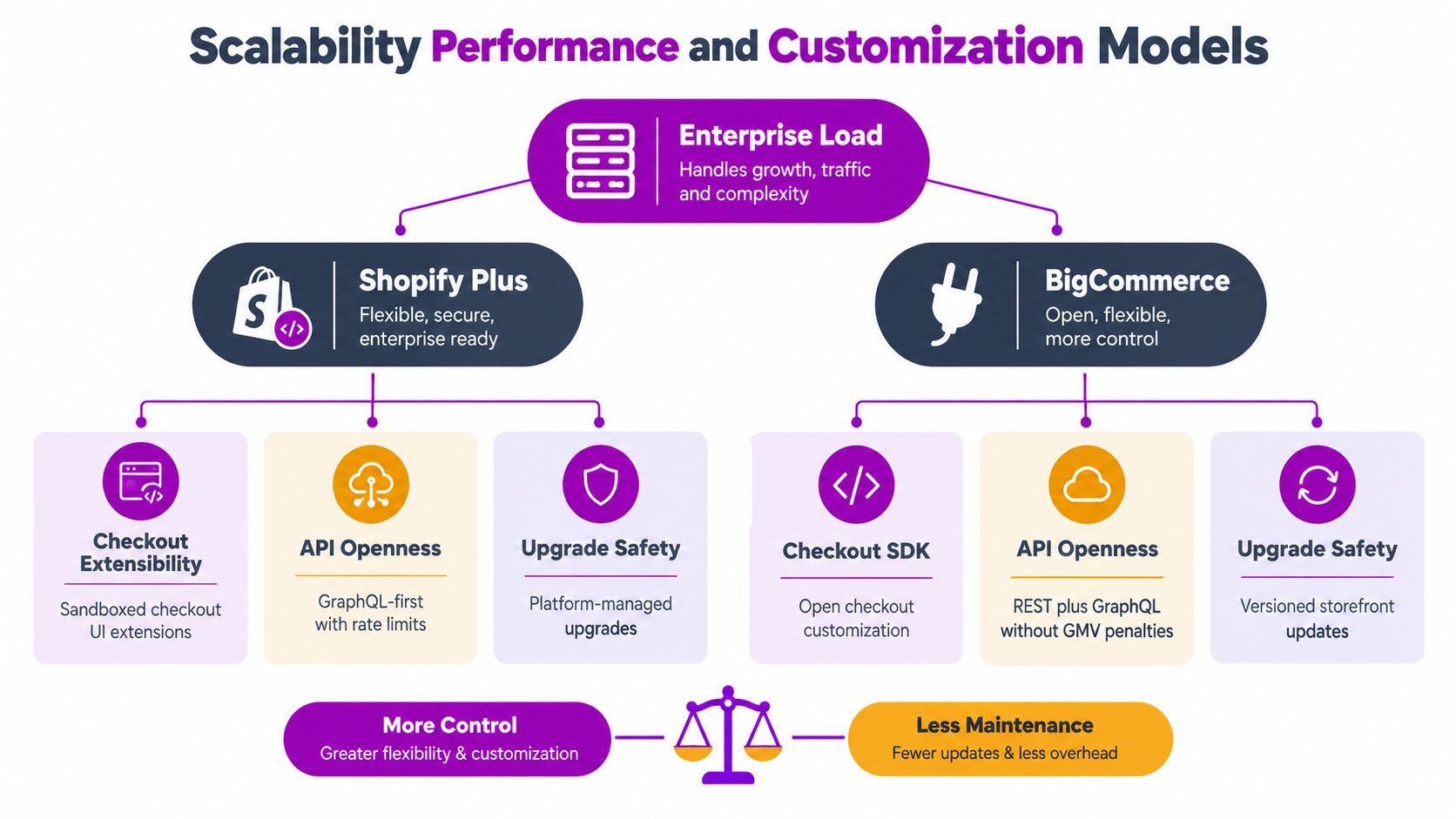
Shopify Plus exposes a faster, cleaner customization path at checkout through Checkout Extensibility and Shopify Functions, which let teams inject logic such as payment terms or credit checks without editing core checkout code, as described in this BigCommerce versus Shopify Plus architecture comparison.
That matters because governed extension points reduce upgrade risk. Your team can customize meaningful parts of the buying flow while staying inside Shopify's managed system.
That's usually the right trade-off for brands that want reliable release cycles, fewer platform surprises, and a checkout stack that doesn't become a long-term maintenance project.
BigCommerce favors architectural openness
BigCommerce Enterprise takes a more open approach. Its API-driven checkout is available in the base platform, which means teams can customize checkout behavior without waiting for a separate tier, based on the same source above.
That flexibility is valuable if your business needs unusual checkout logic, a more custom frontend approach, or fewer platform-imposed boundaries. But openness also shifts responsibility back to your team and implementation partner. More freedom can mean more things to own, test, and maintain.
The cleanest architecture isn't the one with the most freedom. It's the one your team can support without slowing the business down.
What I'd recommend by team type
If your internal team is lean and your commercial team wants to move quickly, Shopify Plus is usually the better fit. Its model reduces the chance that checkout customization turns into a custom-software problem.
If your business already operates like a systems integrator, with complex backend rules and tolerance for more technical ownership, BigCommerce can be a better platform to shape around the business.
Use this rule of thumb:
- Pick Shopify Plus when upgrade safety and governed extensibility matter more than total freedom.
- Pick BigCommerce when checkout control and architecture openness are central requirements, not preferences.
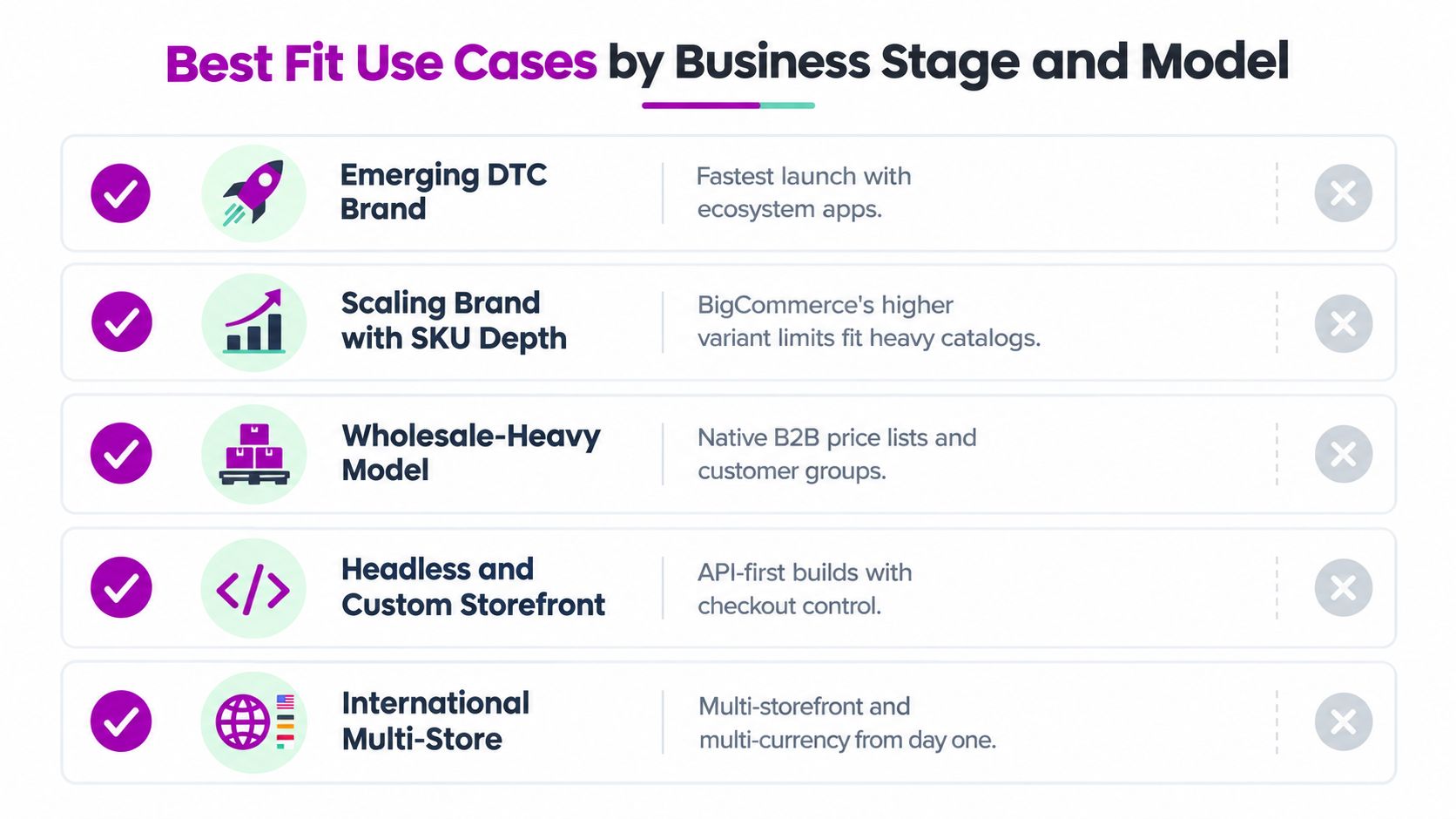
Best Fit Use Cases by Business Stage and Model
The right choice becomes obvious once you stop evaluating platforms as generic enterprise tools and start looking at the business model underneath them.
DTC-led brands moving upmarket
If the brand is DTC-first, marketing-led, and adding layers of complexity as it grows, I'd lean Shopify Plus.
That includes brands selling direct today but adding wholesale, company accounts, or regional expansion without wanting to rebuild their operating model from scratch. Shopify Plus usually reduces integration risk for these teams because the ecosystem, app depth, and operating conventions are easier to work with.
Wholesale-heavy and catalog-heavy businesses
If wholesale is the core of the business, the answer often changes fast.
BigCommerce is usually the stronger fit when the business depends on deep product configuration, account-specific pricing structures, and multi-store needs that would otherwise create admin duplication. The platform tends to align better with businesses that don't want to bend their catalog or storefront model around tighter constraints.
International and multi-brand operators
A lot of teams choose the wrong platform for the right reasons.
They see Shopify's brand momentum and assume it's automatically the best enterprise choice. But if the challenge is running multiple brands, regions, or storefronts without multiplying internal work, BigCommerce often deserves priority because of its multi-storefront posture and processor-agnostic setup, while Shopify Plus can be better for DTC-led brands that want native B2B capabilities and Shopify Markets in a more centralized ecosystem, as noted in the operating-model comparison cited earlier.
Fast recommendations
- Choose Shopify Plus if your business is DTC-led, your team wants speed, and B2B or international expansion needs to fit inside a cleaner managed system.
- Choose BigCommerce if your business is wholesale-led, variant-heavy, multi-brand, or structurally complex enough that native flexibility matters more than ecosystem convenience.
- Pause the decision if your requirements are still vague. A fuzzy RFP produces a bad platform choice every time.
Don't buy for the demo. Buy for the daily workload your merchandisers, operators, marketers, and developers will carry after launch.
Final Recommendation and How to Choose Confidently
Here's my direct recommendation.
Shopify Plus wins for most DTC-led brands. It's the better choice when you want faster execution, a more standardized operating model, cleaner checkout extensibility, and less architectural decision-making. If your business sells primarily direct to consumer and needs B2B, international, and retention capabilities layered in without blowing up team workflows, Shopify Plus is usually the right call.
BigCommerce wins when operational complexity is the business model. If your catalog is variant-heavy, your storefront structure is multi-brand or multi-region by design, or your wholesale logic is too central to force into a narrower system, BigCommerce can be the smarter long-term platform.
Use this decision checklist
Ask these five questions internally and answer them:
What drives revenue today?
If it's DTC with growing complexity, lean Shopify Plus. If it's wholesale or catalog depth, lean BigCommerce.How painful is product structure already?
If variant workarounds are common, treat that as a platform signal, not a merchandising annoyance.How many storefronts must operate cleanly together?
If the answer is several, and they aren't near-clones, BigCommerce gets stronger.Does your team want flexibility or guardrails?
Teams say they want freedom. Most want speed, predictability, and lower maintenance.What will your cost structure look like after implementation?
Don't sign until you've modeled payment mix, operating overhead, and one stage of growth beyond your current setup.
What to do next
If your answer is already clear, move into platform scoping and validate the ugly details early. Catalog rules. Checkout exceptions. ERP sync. B2B account structure. Regional store governance.
If the answer still feels close, run a short architecture and TCO workshop with a platform partner that can map your actual operating model instead of pushing a generic migration playbook. That's where implementation teams matter. Some agencies build only one side of this decision. Others, including Shopify-focused partners like ECORN, can help brands evaluate migration scope, Shopify Plus fit, design, development, and CRO in a more concrete way.
Don't overcomplicate it. Pick the platform that creates fewer recurring exceptions for your team. That's usually the platform that scales better.
If you're weighing a migration or trying to model the operational cost of BigCommerce vs Shopify Plus, ECORN helps brands scope platform fit, Shopify Plus builds, redesigns, and conversion-focused improvements without turning the project into theory. If you want a practical second opinion on architecture, cost trade-offs, or migration scope, visit ECORN.


Shopify Theme Kit: Setup, Commands, and Migration Guide
Shopify Extension Development: A Practical 2026 Guide
Shopify Speed Score Explained and How to Improve It
Shopify Mobile Optimization: The 2026 Playbook
How to Add Subcategory in Shopify for Better UX
How to Implement Structured Data for Ecommerce in 2026
SEO App Mobile: Shopify Store Optimization Guide
Shopify Plus Support: What It Includes and How to Choose

Google Ads for Shopify: The Complete 2026 Playbook

Shopify New York: How to Find and Hire the Right Agency
Google Search Console for Shopify: The Complete Setup
First Party Data Collection for eCommerce Growth
FAQ Online Store Guide: Build and Measure It Right
Do FB Ads Work for eCommerce in 2026?
One Page Checkout for Shopify: Design and Implementation
Shopify GraphQL vs REST: The 2026 Developer Decision
Shopify Ecommerce Consulting: Strategy, Pricing &

Are Reddit Ads Worth It for eCommerce Brands

Shopify Title and Meta Description: A Practical 2026 Guide

Product Video Best Practices for Shopify Brands
Real-Time Inventory Management: A 2026 Guide
AI Chatbot Integration for Shopify Stores
Affiliate Program Management: A Shopify Guide
10 Best Performance Monitoring Tools for Shopify in 2026
Digital Asset Management for eCommerce Brands in 2026
Every Type of Facebook Ads Explained for eCommerce Growth
Product Information Management Explained for Shopify Brands
Support Ticket System: A Guide for Shopify Stores

10 Best Customer Service Tools for Shopify in 2026

Can I Start a Business with No Money? a 2026 Blueprint

What Sells Good on Etsy: Best Niches for 2026

Shopify Add to Cart Button: A Practical 2026 Guide

Customer Feedback Automation: A Practical eCommerce Guide
Critical Rendering Path: A Guide for Shopify Stores

How to Promote on TikTok for eCommerce in 2026

B2B eCommerce Consulting That Drives Real Revenue

10 Best Practices for Site Navigation in 2026
Return vs Refund for Shopify Stores: A Practical Guide

What Is Customer Lifetime Value and Why It Matters
What Is Voice of Customer Research for eCommerce

SMS Marketing for Ecommerce That Actually Converts

Master How to Improve Email Deliverability in 2026

Top 7 eCommerce Partners NYC for Shopify Brands in 2026
Machine Learning for Ecommerce: Boost Your Shopify Store

Beauty Market Research: Your 2026 Growth Guide

Shopify International Expansion: A 2026 Roadmap
What Does CRO Stand for in Business: Understanding CRO

Shopify Visual Merchandising: A Playbook for Higher Sales

Shopify Landing Page Design: Master Conversion in 2026
10 Best AI SEO Optimization Tools for Shopify in 2026

Agentic AI for Ecommerce: Boost Your Sales in 2026
Mastering Email Marketing Data for eCommerce Growth

Conversion Rate Optimisation Australia: Boost Your Sales
Conversion Rate Optimization AI: Your Shopify Store Guide

10 Product Bundling Strategies for Shopify in 2026
How to Increase Customer Lifetime Value: A Shopify Playbook
AI Customer Service Automation: Shopify Guide 2026
Clean Website Design: A Shopify Conversion Playbook

Omnichannel Retail Strategy: A Shopify Playbook
Product Data Enrichment: A Guide for Shopify Brands
Instagram Shopping Features a Guide for Shopify Stores
What Is Revenue Optimization: A Holistic RevOps Guide
Benefits of Conversion Rate Optimization: Boost Your
WordPress to Shopify Migration: Your 2026 Seamless Switch
Boost Sales: Ecommerce Payment Processing Guide 2026
Unified Commerce Platform: Benefits, KPIs & Shopify Guide

How to Reduce Bounce Rate eCommerce: Your 2026 Guide
Shopify API Integration: A Practical End-to-End Guide

How to Implement Data Governance: A 2026 Guide
Shopify Store Development Cost: A 2026 Breakdown
What Is Server Side Tracking: The Shopify Guide 2026
Marketing Automation Workflows: A Shopify Guide for 2026

Shopify: How to Reduce Technical Debt

Shopify UX Design Change: A Playbook for Growth
User Generated Content Strategy: Shopify Playbook

Shopify Pause and Build Plan Cost: A Complete 2026 Guide
Compare at Price on Shopify: A Complete Guide for 2026

Where Can I Sell My Prints? 10 Best Platforms for 2026
Shopify Order Management System: The Ultimate Guide 2026
What Is Marketing Attribution? an eCommerce Guide for 2026

10 Best Black Friday Sales Sheets for 2026

Discover the Top Social Media Marketing Agencies For
Consumer Confidence Definition for eCommerce in 2026
What Is Social Commerce? Your 2026 Guide to Boosting Sales
A Social Ad Campaign Playbook for eCommerce Growth

7 Best FAQ Page Examples for SaaS & eCommerce

Market Research in Fashion Industry: A Guide for Shopify
Shopify Migration Services: Expert Guide for 2026

Mastering FB Retargeting Ads for Shopify in 2026
What Is Omnichannel Ecommerce

Master Your Shopify Plus Migration: The 2026 Guide
Shopify Integration Services: A Merchant's 2026 Guide
Shopify Collection Description: A Guide to SEO & Sales

Shopify Plus Contact: Reach Sales & Support Effectively

Top Luxury Shopify Stores: Design & UX Strategies
How to Improve Customer Experience: A Shopify Roadmap

Creative Facebook Ads: 10 Examples for Shopify Brands

Remarketing with Facebook Ads: A Shopify Guide for 2026

SEO Linking Strategies for Shopify Stores
Top 7 Statistics YouTube Channels for eCommerce in 2026


newsletter in your inbox