


You're halfway through a sales call with an ecommerce website development firm. The founder is asking whether the agency can “guarantee” a dramatic conversion lift, while the delivery team remains a vague collection of strategists, designers, and developers. The deck looks polished. The case studies look impressive. Nobody has explained who owns the code when checkout fails on a Saturday.
That's the decision most brands get wrong. You aren't buying a launch date or a redesigned homepage. You're choosing who will make technical decisions, protect your customer journey, manage your backlog, and answer for the store after go-live.
The Partnership Decision Behind the Build
A DTC founder once described agency selection as “trying to buy certainty from people who only showed me screenshots.” That captures the central risk. A portfolio demonstrates presentation skills and completed projects. It does not show whether the firm can manage product data, integrations, redirects, analytics, failed payments, emergency fixes, or the steady merchandising requests that begin after launch.
Choose an ecommerce website development firm as a 24-month operating partner, not a launch-day supplier. The build is only the first phase. Your team will need to update products, improve templates, test offers, review funnel performance, manage apps, and make decisions about platform constraints. If the firm treats that work as an awkward add-on, you may inherit a store that functions technically but stalls commercially.
The market makes ownership more important. One industry estimate values global ecommerce at $4,408.14 billion in 2025 and projects $7,927.94 billion by 2030, with a 12.6% CAGR (industry estimate on the Shopify agency ecosystem). Another estimate places worldwide ecommerce at $6.5 trillion, with a projected 9.8% CAGR from 2024 to 2028. More online commerce creates demand for launches, migrations, integrations, and ongoing optimization. It also gives agencies room to sell capacity without accepting responsibility for outcomes.
A poorly matched firm creates costs that rarely appear in the proposal:
- An abandoned backlog: Improvements accumulate because nobody has the time or authority to ship them.
- A content bottleneck: Merchandisers depend on developers for routine changes because the implementation was not built for internal ownership.
- A conversion plateau: The firm celebrates launch, then stops forming hypotheses and measuring customer behavior.
- Operational finger-pointing: The payment provider blames the app, the app vendor blames the theme, and the agency blames the brief.
Practical rule: Choose the firm you would trust with a production incident, not merely the firm whose homepage you would copy.
Score each candidate against five questions: Who owns the work after launch? How specialized is the team for your platform and business model? Does the commercial model support iteration? Can the firm prove its process under pressure? Are ownership, support, and measurement written into the contract?
Consolidating development, integrations, and support with one accountable partner can reduce handoffs. Review package consolidation for businesses only alongside contract terms that assign responsibility for code, incidents, optimization, and roadmap decisions. Fewer suppliers do not automatically create better accountability.
Select the firm that remains accountable when the work becomes repetitive, technical, and commercially important. That standard matters more than an impressive pitch or a low initial quote.
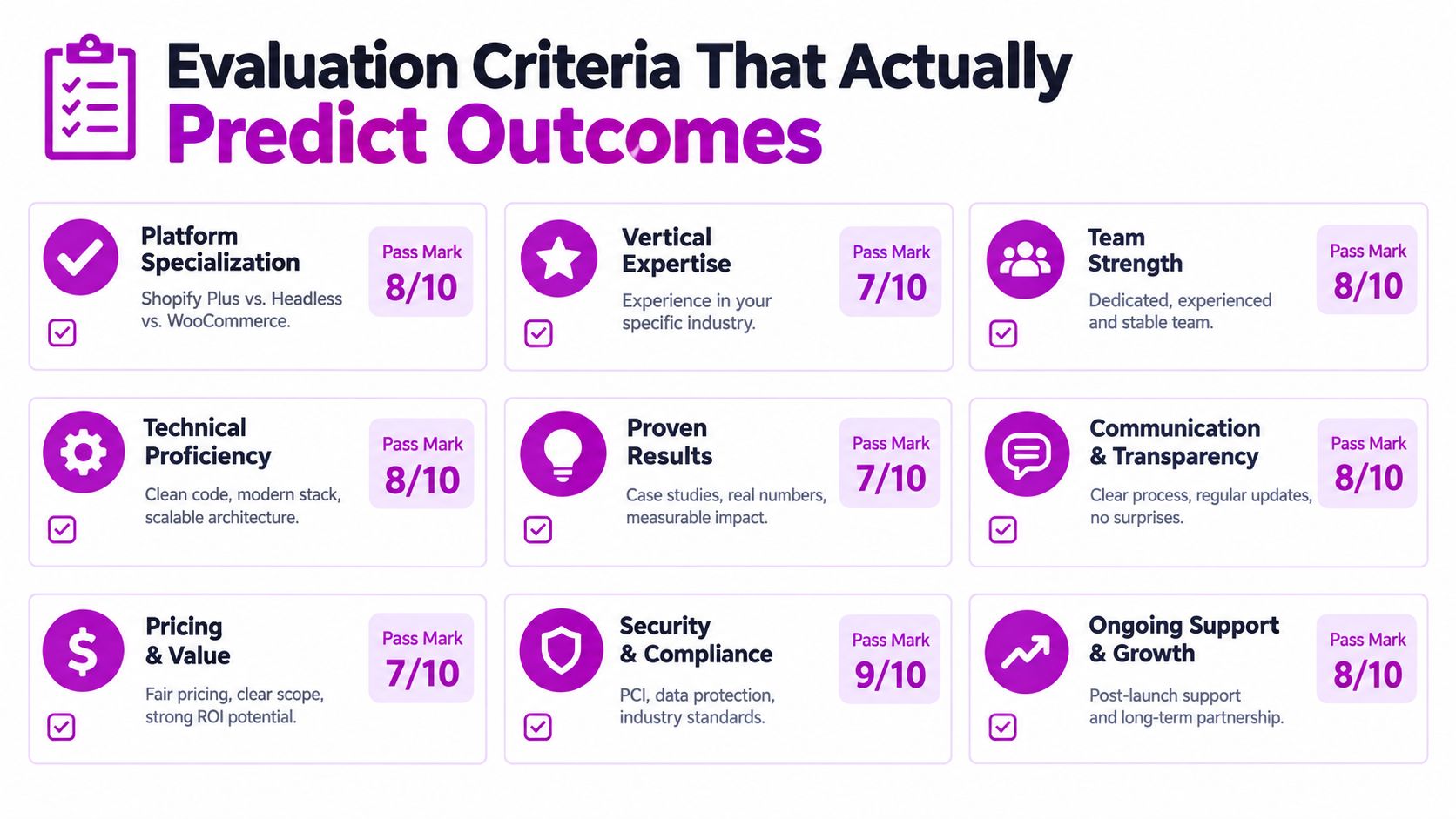
Evaluation Criteria That Predict Delivery Outcomes
A polished portfolio proves taste. It does not prove ownership after launch. Score each ecommerce website development firm on evidence that shows how its team will build, support, and improve your store once the launch project ends.
1. Platform specialization
A Shopify Plus build, headless storefront, and WooCommerce store demand different technical decisions. Ask the firm what it would avoid on your platform, how it structures themes, and which integrations it has maintained in production.
Pass mark: A named senior engineer, a platform-specific recommendation, and recent work involving your actual complexity. “We work across every platform” signals breadth, not specialization.
Shopify's scale makes platform knowledge commercially relevant. Shopify reportedly processed $378 billion in gross merchandise volume in full-year 2025 and generated $11.56 billion in annual revenue, both cited as record highs (Shopify development company market commentary). A firm in this ecosystem must maintain themes, apps, integrations, and customer journeys inside a major commerce platform, not just produce a presentation-ready storefront.
2. Relevant vertical experience
Category experience matters when your store includes subscriptions, wholesale pricing, regulated claims, complex variants, or repeat purchasing. Ask what the agency learned from comparable constraints and where those lessons changed its implementation choices.
Pass mark: The team identifies likely catalog risks and explains their effects on navigation, product detail pages, search, checkout, and administration. A list of familiar logos is weaker evidence than a clear explanation of trade-offs.
3. In-house delivery transparency
Find out who writes the code, manages releases, and handles defects. A distributed team can deliver well, while undisclosed white-label work creates unclear responsibility and slower decisions.
Pass mark: You receive the names, roles, locations, and expected allocation of the people doing the work. Ask who replaces a key contributor, how handover works, and whether your team retains access to documentation and repositories.
4. CRO and analytics maturity
Evaluate conversion capability before signing, using process artifacts rather than a promised benchmark. Request an example brief that shows the customer problem, evidence reviewed, hypothesis, proposed change, event tracking, and decision rule. That artifact reveals whether the firm forms testable ideas or labels design work “conversion-focused.”
Pass mark: The candidate can connect a user problem to an implementation plan and a commercial outcome, while explaining what it would measure first on your store. Do not use a general industry conversion range as a forecast for your business. Save post-launch benchmark tracking for the measurement plan.
5. Post-launch ownership
Make the firm define responsibility for source code, environments, credentials, integrations, defects, incidents, and the improvement roadmap. Current agency hiring guidance highlights code ownership, SLAs, support models, and responsibility for payment failures or outages (ecommerce web development company hiring guidance).
Pass mark: Written SLA terms, a named support owner, a clear handover process, and a recurring review cadence. If these items remain verbal, the commercial relationship will become harder to manage after go-live.
6. Team continuity
A “dedicated team” can still mean a rotating bench. Ask what happens when the project manager leaves, the senior developer is reassigned, or your account becomes less profitable. Require notice for material staffing changes and access to a current delivery record.
Pass mark: Named primary contacts, documented backup roles, notice requirements, and project documentation that another qualified person can use without restarting discovery.
Cut any firm that fails two or more pass marks before the RFP stage. Shortlisting fewer candidates improves the quality of commercial discussions and exposes weak ownership claims early.
Watch this short overview of practical ecommerce selection considerations before scoring your shortlist:
For a platform-specific comparison, use this guide to top Shopify development companies as an additional reference, then verify each claim directly with the candidate. Choose the firm whose delivery records, staffing plan, support terms, and improvement process remain visible after the pitch ends.
Comparing Pricing Models Without Getting Burned
Price becomes dangerous when it hides the way decisions get made. A fixed project can look safe while excluding migration work. A retainer can look flexible while allowing hours to disappear into vague activity. An hourly rate can look cheap while coordination, rework, and management consume the difference.
For a defined Shopify store with 50 SKUs, a project fee of $25,000 to $80,000 may be presented depending on design depth, integrations, migration requirements, and custom functionality. Ongoing retainers may be quoted at $4,000 to $12,000 per month. Those figures are scenario ranges, not universal market prices. Your proposal should explain the assumptions behind them.
| Pricing Model | Typical Range | Best For | Watch Out For |
|---|---|---|---|
| Fixed-scope project | $25,000 to $80,000 for the stated 50-SKU scenario | A defined launch or replatform | Change-order abuse, exclusions, weak post-launch support |
| Monthly retainer | $4,000 to $12,000 per month for the stated scenario | CRO, iteration, maintenance, and roadmap delivery | Scope creep, unused capacity, unclear priorities |
| Hourly | Varies by supplier and role | Audits, small fixes, and technical investigations | Coordination overhead and unpredictable totals |
| Performance-based | Contract-specific | Some paid media or tightly measurable campaigns | Misaligned incentives for development work |
A fixed-scope model fits a launch when the catalog, integrations, content responsibilities, and acceptance criteria are stable. It fails when the agency underestimates product data, redirects, app conflicts, or stakeholder review. Demand an itemized scope and a change-control process before you compare totals. The proposal should tell you what happens when a dependency changes, not merely what the happy path costs.
Retainers make more sense when the store needs continuous learning. The firm can move from audit to hypothesis, design, implementation, and measurement without reopening the commercial agreement for every improvement. The trap is paying for availability instead of output. Require a prioritized backlog, defined deliverables, time reporting, and a monthly review of shipped work.
Hourly billing works for contained technical questions. It's a poor primary model for a large build because you carry the risk of unclear estimates. Offshore rates can also create a false economy when communication gaps increase project management, rework, and approval time.
A sensible planning assumption is to reserve 15% to 25% of build cost annually for post-launch optimization, as a budgeting rule rather than a verified industry benchmark. Without ongoing ownership, the store can stagnate even when the original build was competent.
For a broader cost framework, review this ecommerce website development cost guide, then ask each agency to separate build fees, third-party costs, support, CRO, and future feature work. Never accept one blended number that makes ownership impossible to audit.
An RFP That Filters Out the Wrong Firms Fast
A useful RFP doesn't ask agencies to repeat your wish list. It forces them to reveal assumptions, people, dependencies, and post-launch obligations. Keep the document short enough to answer carefully and specific enough to expose weak thinking.
Use these eight sections
- Company snapshot: Ask how long the relevant ecommerce team has worked together, which services are delivered in-house, and who will be accountable for the engagement.
- Business goals and KPIs: State the commercial problem, the customer journey you want to improve, and the metrics you already trust. Ask how the firm would establish a baseline.
- Scope boundaries: Separate included work from optional work. Ask who supplies product data, copy, imagery, redirects, tracking requirements, and QA devices.
- Technology constraints: Specify your current platform, desired platform, theme approach, CMS needs, hosting assumptions, and headless considerations.
- Integration requirements: List payment, inventory, shipping, email, analytics, customer service, subscription, and ERP dependencies. Ask for integration risks and fallback plans.
- Timeline expectations: Request a milestone plan, client responsibilities, approval windows, and a written response plan for missed milestones.
- Budget band: Provide a realistic range and require a cost breakdown by phase, role, and assumption.
- Post-launch ownership model: Ask who owns source code, environments, credentials, defects, monitoring, incident response, CRO, and roadmap decisions.
Require three recent Shopify replatform references with contactable clients when replatforming is central to the project. Ask each reference what went wrong, how the firm handled it, and what the client still pays for today. A reference that only discusses visual quality is incomplete.
Score proposals before the sales call
| Category | Weight | Pass/Fail Criteria | Score (1-5) |
|---|---|---|---|
| Relevant experience | 30% | Comparable platform, catalog, integrations, and business model | |
| Process clarity | 25% | Discovery outputs, milestones, QA, approvals, and dependencies are explicit | |
| Ownership terms | 25% | Code, access, SLAs, support, and roadmap responsibilities are written | |
| Commercial fit | 20% | Pricing matches scope, assumptions, change control, and future needs |
Use the weights to prevent the lowest bid from winning by default. A firm with a beautiful deck but weak ownership terms should score poorly, even if its creative work is excellent.
Ask every bidder the same uncomfortable question: “What is most likely to go wrong on this project, and what will you do when it does?”
The answer reveals maturity faster than another portfolio walkthrough. Strong firms identify dependencies and decision points. Weak firms promise that nothing will go wrong.
Red Flags Most Founders Miss Until It's Too Late
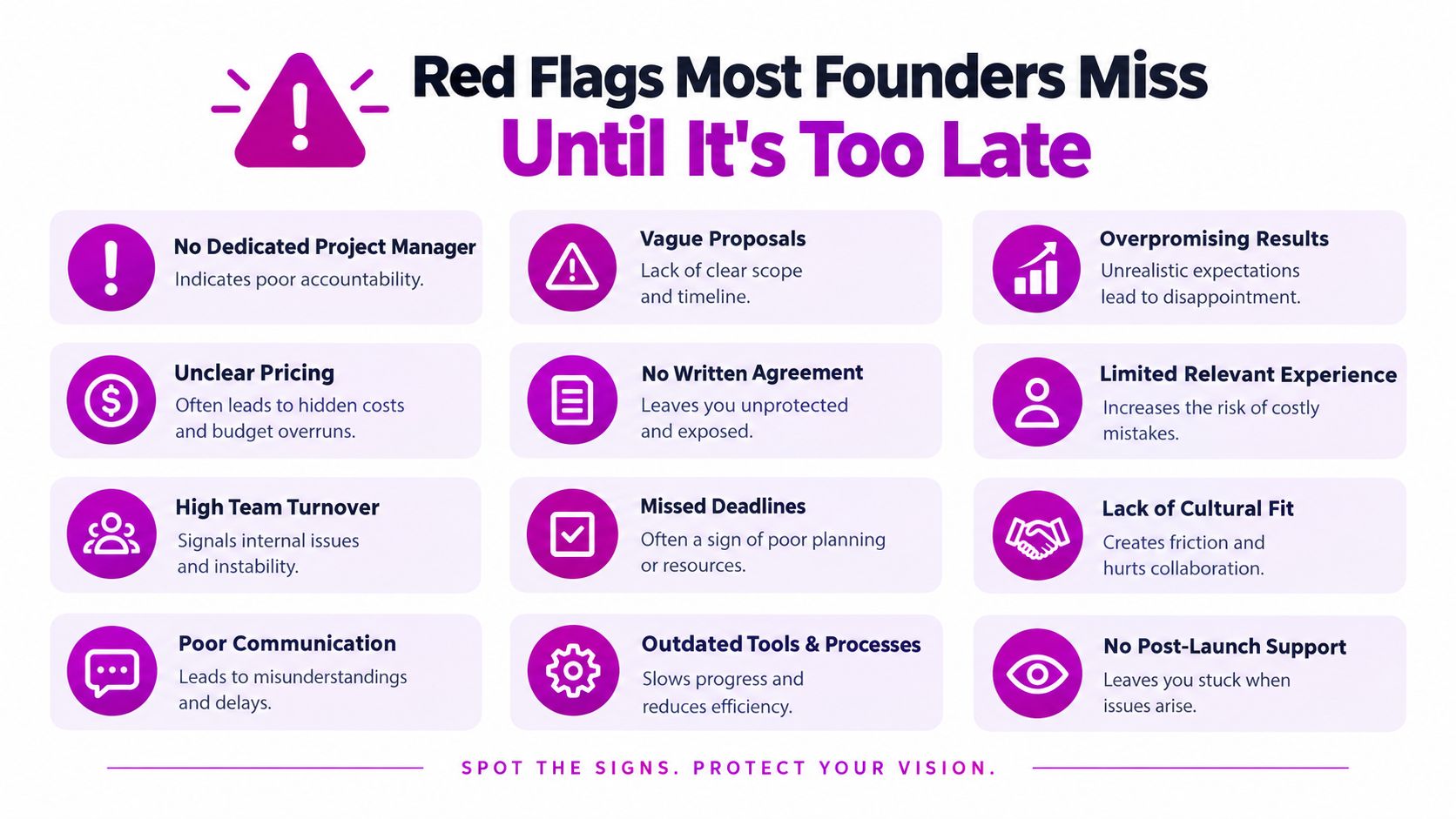
The most expensive warning signs appear before development begins. Founders often dismiss them as sales-process quirks, then discover that those quirks describe the operating model they just bought.
The accountability failures
No dedicated project manager: If nobody owns decisions, your team becomes the project manager. Expect scattered feedback, missed dependencies, and unresolved blockers.
No named senior engineer: A sales lead may understand your objectives, but they won't resolve a theme conflict or integration failure. Ask to meet the technical owner before signing.
A vague proposal: “Design and development” isn't scope. Without itemized effort, assumptions, and acceptance criteria, every ambiguity becomes a future negotiation.
A promise of guaranteed conversions: No firm controls traffic quality, offer strength, product-market fit, pricing, seasonality, or customer trust. A responsible agency can improve the funnel and define measurement. It can't guarantee a commercial outcome it doesn't control.
The commercial traps
A suspiciously low fixed bid: The agency may be excluding discovery, content migration, QA, analytics, or launch support. The initial price becomes an entry point for change orders.
A retainer bundled into the build quote: This can obscure what support includes. Separate launch work from recurring ownership so you can evaluate both.
A cheap hourly rate with no total estimate: The rate says little about the final cost when the agency needs extensive oversight or redoes work.
Post-launch support described as “available”: Availability isn't an SLA. Ask for response times, severity levels, escalation paths, and coverage windows.
The delivery risks
Glossy case studies with no contactable references: A polished story may omit the agency's actual role, setbacks, and ongoing obligations.
Undisclosed subcontracting: Outsourcing isn't automatically bad. Hidden outsourcing is. You need to know who accesses your systems and who carries responsibility for the result.
No access or ownership schedule: If the contract doesn't list source code, staging, design files, analytics properties, platform administration, and credentials, assume the handover will be contested.
No measurement plan: A launch without event tracking and baseline definitions leaves everyone arguing from opinions.
Each pattern predicts a downstream problem because it removes a control point. Vague staffing creates finger-pointing. Unitemized work creates scope disputes. Weak access terms create lock-in. Treat red flags as structural evidence, not personality differences.
Measuring Success After the Build Goes Live
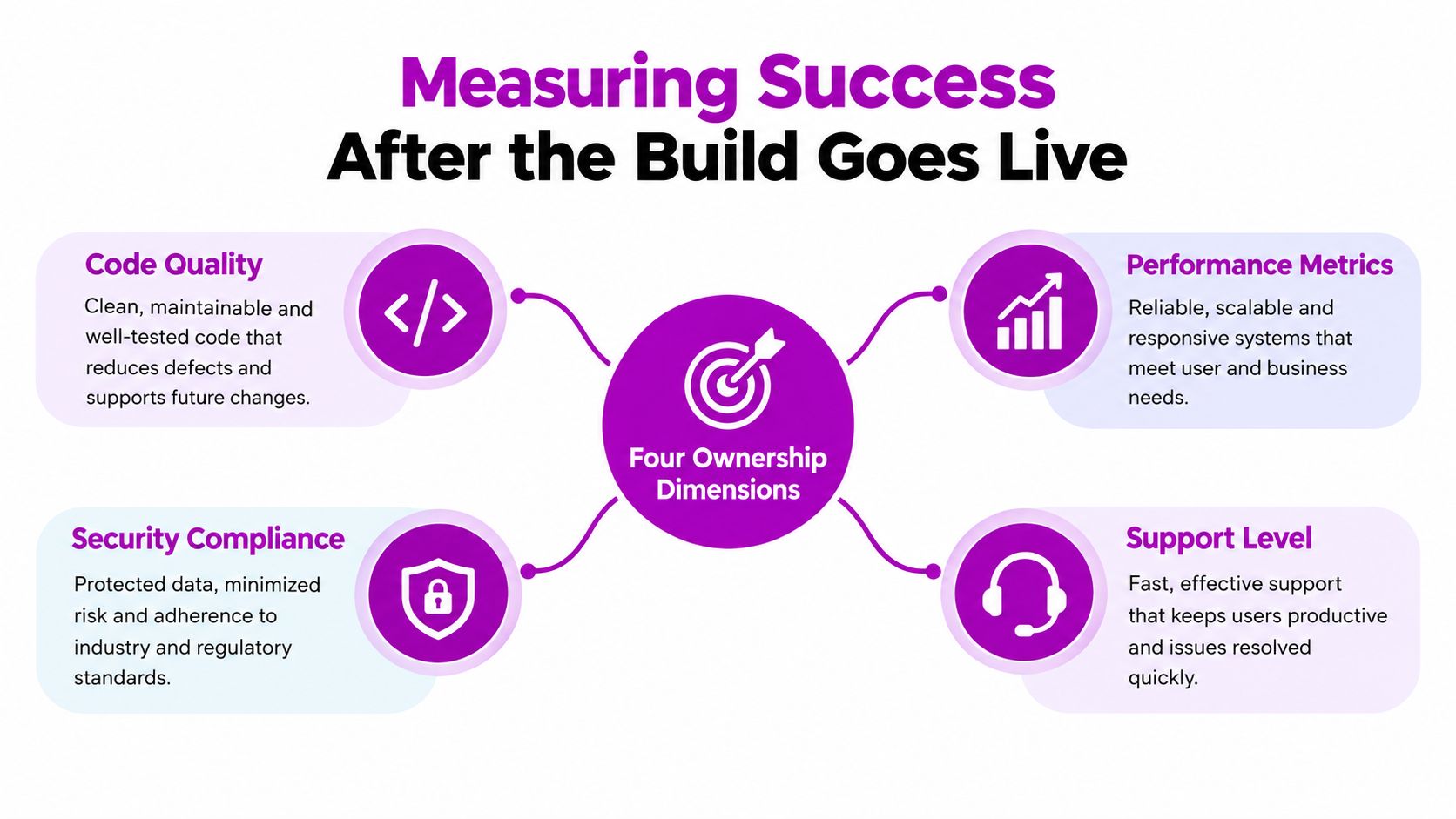
A store can launch on schedule and still fail commercially. Judge the ecommerce website development firm by what it owns after launch: system stability, measurable learning, performance control, and decisions that improve trading results after real customers expose weaknesses staging did not reveal.
Code and environment ownership
Put the handover in the contract. Your team should receive source code, theme and staging access, design files, deployment documentation, platform administration, analytics permissions, and a complete list of third-party accounts. Require the firm to document how changes move from development through staging into production.
Assign deployment approval and rollback authority before launch. If nobody can name the approver or explain the rollback process, the firm has not established real ownership.
Conversion optimization cadence
Start with segmented post-launch baselines by device, traffic source, and page template. Review product detail pages, collection pages, cart behavior, and checkout progression separately, then set targets against your own product mix, traffic quality, and historical performance.
Require every experiment to state its hypothesis, audience, success metric, implementation owner, test window, and decision rule before it ships. The decision rule should specify whether the team will keep, revise, or remove the change. A recurring partner should maintain a visible experiment backlog and report what changed, what was learned, and what happens next. A monthly report that repeats revenue and sessions is activity reporting, not optimization.
Performance QA
Treat performance testing as a release discipline. Use a separate development store, a standardized test catalog, a password-free preview link, and Lighthouse audits on the home page, a product page, and a collection page at least three times, using the median score to reduce noise (performance testing methodology).
Keep the page set and test data consistent across sprints. Track LCP, script weight, and template-specific load time, with device-level comparisons where mobile customers carry meaningful revenue. Set an escalation rule for regressions, and require the firm to identify which script, app, template change, or third-party dependency caused the decline.
Incident response and roadmap control
Define severity levels, response windows, escalation contacts, and communication duties in the agreement. You may choose a 99.9% uptime SLA with a four-hour response for serious incidents if that matches your commercial risk. State whether the clock starts when your team reports the issue or when monitoring detects it.
Assign roadmap ownership on your side. The agency can recommend priorities, but your team must approve them against margin, inventory, customer support load, and the trading calendar. A recurring partner should bring evidence, options, and trade-offs. If it keeps the backlog full without connecting work to customer or commercial outcomes, replace activity with accountability.
Onboarding Your New Firm the Right Way
A strong contract can still fail under weak onboarding. The first month should establish decision rights, documentation standards, communication habits, and proof that the team can deliver without constant chasing.
Days one through seven
Hold a kickoff with the commercial owner, project lead, technical lead, marketing owner, merchandising owner, and anyone responsible for fulfillment or customer support. Confirm the business goal, decision-maker, approval deadlines, communication windows, escalation path, and definition of a launch blocker.
Standardize the working environment immediately:
- Project board: Use Linear, Jira, ClickUp, or another shared system for tickets, owners, dependencies, and status.
- Communication channel: Create one shared Slack channel for decisions and escalation. Keep final approvals in the project record.
- Time and budget dashboard: Require visibility into hours burned, remaining allocation, and approved changes.
- Design repository: Store Figma files, content references, brand rules, and version history in one controlled location.
- Access register: Record who has access to Shopify, analytics, payment tools, apps, repositories, and staging.
The first-week deliverables should include a technical discovery document, sitemap draft, integration inventory, analytics event plan, and risk register. If the agency can't produce a useful view of the work after the first week, don't assume speed will improve later.
Weeks two through four
Use a predictable rhythm. Monday is for blockers and priorities. Wednesday is for a working demo, not a slide presentation. Friday is for a written status covering completed work, decisions needed, risks, budget, and next steps.
Set three gates:
- Week one alignment: Pause if goals, decision rights, access, or scope boundaries remain unclear.
- Week two architecture sign-off: Pause if the platform, theme approach, integrations, data model, or analytics plan still lacks an accountable approver.
- Week four design direction approval: Pause if the team is producing screens without validated customer journeys, content requirements, or technical feasibility.
Track engagement health, not just deliverables. Monitor meeting show-rate, ticket response time, scope-change requests logged, and hours burned versus budgeted. A firm that ships attractive work but misses meetings, hides effort, or ignores risks is not operating as a reliable partner.
| Week | Key Deliverable | Owner | Pass Criteria |
|---|---|---|---|
| Week 1 | Discovery document, access register, sitemap draft, risk register | Agency project and technical leads | Goals, owners, dependencies, and risks are documented |
| Week 2 | Architecture and integration plan | Senior engineer and client technical owner | Platform decisions, data flows, and fallback options are approved |
| Week 3 | Validated user journeys and design system direction | UX lead and client decision-maker | Core shopping paths and reusable components are agreed |
| Week 4 | Approved design direction and delivery backlog | Agency lead and client stakeholders | Designs are feasible, prioritized, and tied to acceptance criteria |
Schedule a 60-day fit checkpoint before the next retainer cycle renews. Review what shipped, what slipped, how quickly the firm responded, whether budget tracking was accurate, and whether the team is making better decisions with less supervision. If the answers are weak, change the operating model or replace the firm before dependency turns into lock-in.
ECORN provides Shopify design, development, CRO, migrations, theme customization, app integrations, and Shopify Plus support through project and monthly engagement options. If you're choosing an ecommerce website development firm, visit ECORN to discuss a store build or post-launch partnership with a team structured around ongoing ownership.



E Business Strategy Implementation

Conversion Tracking Setup for Shopify Stores
BigCommerce vs Shopify Plus Which Enterprise Wins in 2026
Shopify Theme Kit: Setup, Commands, and Migration Guide

Shopify Extension Development: A Practical 2026 Guide
Shopify Speed Score Explained and How to Improve It

Shopify Mobile Optimization: The 2026 Playbook

How to Add Subcategory in Shopify for Better UX
How to Implement Structured Data for Ecommerce in 2026

SEO App Mobile: Shopify Store Optimization Guide

Shopify Plus Support: What It Includes and How to Choose

Google Ads for Shopify: The Complete 2026 Playbook

Shopify New York: How to Find and Hire the Right Agency

Google Search Console for Shopify: The Complete Setup

First Party Data Collection for eCommerce Growth

FAQ Online Store Guide: Build and Measure It Right
Do FB Ads Work for eCommerce in 2026?

One Page Checkout for Shopify: Design and Implementation
Shopify GraphQL vs REST: The 2026 Developer Decision

Shopify Ecommerce Consulting: Strategy, Pricing &

Are Reddit Ads Worth It for eCommerce Brands

Shopify Title and Meta Description: A Practical 2026 Guide

Product Video Best Practices for Shopify Brands
Real-Time Inventory Management: A 2026 Guide

AI Chatbot Integration for Shopify Stores
Affiliate Program Management: A Shopify Guide
10 Best Performance Monitoring Tools for Shopify in 2026

Digital Asset Management for eCommerce Brands in 2026

Every Type of Facebook Ads Explained for eCommerce Growth

Product Information Management Explained for Shopify Brands

Support Ticket System: A Guide for Shopify Stores

10 Best Customer Service Tools for Shopify in 2026

Can I Start a Business with No Money? a 2026 Blueprint

What Sells Good on Etsy: Best Niches for 2026

Shopify Add to Cart Button: A Practical 2026 Guide

Customer Feedback Automation: A Practical eCommerce Guide

Critical Rendering Path: A Guide for Shopify Stores

How to Promote on TikTok for eCommerce in 2026

B2B eCommerce Consulting That Drives Real Revenue

10 Best Practices for Site Navigation in 2026

Return vs Refund for Shopify Stores: A Practical Guide

What Is Customer Lifetime Value and Why It Matters

What Is Voice of Customer Research for eCommerce

SMS Marketing for Ecommerce That Actually Converts

Master How to Improve Email Deliverability in 2026

Top 7 eCommerce Partners NYC for Shopify Brands in 2026

Machine Learning for Ecommerce: Boost Your Shopify Store

Beauty Market Research: Your 2026 Growth Guide

Shopify International Expansion: A 2026 Roadmap

What Does CRO Stand for in Business: Understanding CRO

Shopify Visual Merchandising: A Playbook for Higher Sales

Shopify Landing Page Design: Master Conversion in 2026

10 Best AI SEO Optimization Tools for Shopify in 2026

Agentic AI for Ecommerce: Boost Your Sales in 2026
Mastering Email Marketing Data for eCommerce Growth

Conversion Rate Optimisation Australia: Boost Your Sales

Conversion Rate Optimization AI: Your Shopify Store Guide

10 Product Bundling Strategies for Shopify in 2026

How to Increase Customer Lifetime Value: A Shopify Playbook
AI Customer Service Automation: Shopify Guide 2026

Clean Website Design: A Shopify Conversion Playbook

Omnichannel Retail Strategy: A Shopify Playbook

Product Data Enrichment: A Guide for Shopify Brands

Instagram Shopping Features a Guide for Shopify Stores

What Is Revenue Optimization: A Holistic RevOps Guide

Benefits of Conversion Rate Optimization: Boost Your
WordPress to Shopify Migration: Your 2026 Seamless Switch

Boost Sales: Ecommerce Payment Processing Guide 2026

Unified Commerce Platform: Benefits, KPIs & Shopify Guide

How to Reduce Bounce Rate eCommerce: Your 2026 Guide
Shopify API Integration: A Practical End-to-End Guide

How to Implement Data Governance: A 2026 Guide

Shopify Store Development Cost: A 2026 Breakdown
What Is Server Side Tracking: The Shopify Guide 2026
Marketing Automation Workflows: A Shopify Guide for 2026

Shopify: How to Reduce Technical Debt

Shopify UX Design Change: A Playbook for Growth

User Generated Content Strategy: Shopify Playbook

Shopify Pause and Build Plan Cost: A Complete 2026 Guide

Compare at Price on Shopify: A Complete Guide for 2026

Where Can I Sell My Prints? 10 Best Platforms for 2026
Shopify Order Management System: The Ultimate Guide 2026

What Is Marketing Attribution? an eCommerce Guide for 2026

10 Best Black Friday Sales Sheets for 2026

Discover the Top Social Media Marketing Agencies For

Consumer Confidence Definition for eCommerce in 2026

What Is Social Commerce? Your 2026 Guide to Boosting Sales

A Social Ad Campaign Playbook for eCommerce Growth

7 Best FAQ Page Examples for SaaS & eCommerce

Market Research in Fashion Industry: A Guide for Shopify

Shopify Migration Services: Expert Guide for 2026

Mastering FB Retargeting Ads for Shopify in 2026

What Is Omnichannel Ecommerce

Master Your Shopify Plus Migration: The 2026 Guide
Shopify Integration Services: A Merchant's 2026 Guide

Shopify Collection Description: A Guide to SEO & Sales

Shopify Plus Contact: Reach Sales & Support Effectively

Top Luxury Shopify Stores: Design & UX Strategies

How to Improve Customer Experience: A Shopify Roadmap

Creative Facebook Ads: 10 Examples for Shopify Brands


newsletter in your inbox