

Fewer than one-third of digital transformations succeed, and only 16% both improve performance and sustain those gains over time. The missing link is usually organizational alignment, not technology.
The popular advice says to choose the right platform, launch quickly, and let the software solve the operational problem. That advice is incomplete. A platform can process orders, connect payment providers, and support multiple storefronts, but it can't decide who owns the product data, which team approves a promotion, or whether finance trusts the revenue dashboard.
E-business strategy implementation is the work of turning an approved commercial plan into coordinated decisions, measurable outcomes, and repeatable operating routines. It includes technology, but it also includes governance, process redesign, data migration, training, and the discipline to improve the customer journey after launch.
At global scale, those details have immediate commercial consequences. One industry summary projects worldwide e-commerce sales at $6.42 trillion in 2025 and estimates that e-commerce will represent 20.5% of global retail sales in the same year, while average conversion rates remain around 2.0% to 2.3% (e-commerce statistics and benchmarks). A small improvement in a checkout flow or landing page can therefore matter far more than a polished launch presentation.
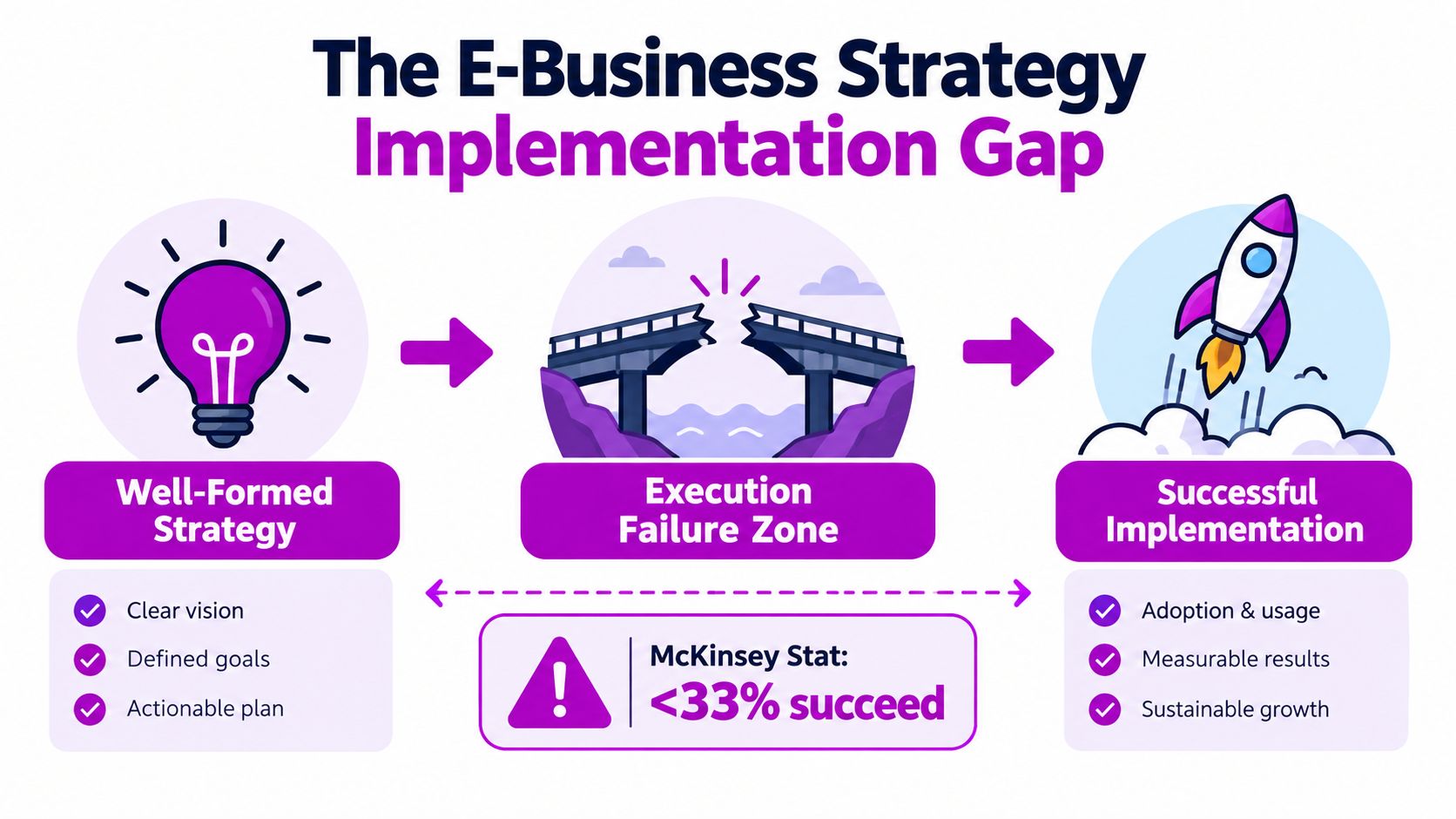
The E-Business Strategy Implementation Gap
The biggest mistake is treating implementation as a deployment project. Teams approve a roadmap, configure Shopify, migrate products, connect an ERP, and announce launch completion. Then customer service keeps using old workflows, merchandising can't publish quickly, finance questions the numbers, and nobody has clear authority to fix the friction.
That is the strategy-execution gap. The strategy may be sound, yet the organization lacks the ownership, capability, or operating rhythm required to deliver it. McKinsey reports that fewer than one-third of organizational transformations succeed, and only 16% of respondents said their digital transformations both improved performance and sustained those gains long term (McKinsey's digital transformation research).
Why approved roadmaps stall
A roadmap often describes what the business wants to build, but not how people will work differently afterward. That missing layer creates predictable problems:
- Unclear ownership: Several teams influence a decision, but nobody has final accountability.
- Unmeasured outcomes: The project team reports completed tickets instead of changes in conversion, margin, fulfilment reliability, or retention.
- Weak adoption: Staff receive access to a new system but not enough training, documentation, or time to change their routines.
- No post-launch cadence: The organization assumes launch equals success, so testing and issue resolution lose budget and attention.
A stronger method treats implementation as a transformation rollout with governance, integration, and change-management gates. Define the business outcomes first. Then map process changes, data migration, system dependencies, and decision rights before technical work begins. A practical e-commerce strategy framework can help connect commercial priorities to that delivery model.
Practical rule: A launch plan isn't complete until it explains who owns the result after the development team leaves.
The post-launch period deserves explicit space in the roadmap. Assign owners for conversion research, merchandising changes, SEO maintenance, analytics quality, and customer-service feedback. Set review meetings around decisions, not status updates. If a landing page underperforms, the team should know who can change the offer, who approves the copy, and which metric determines whether the test continues.
Phased Implementation Roadmap
A dependable implementation roadmap moves from business intent to operational readiness. The phases can overlap, but the decision gates shouldn't disappear.
Phase one, discovery and goals
Start with a short list of measurable business outcomes. Examples include improving checkout completion, reducing manual order handling, supporting international merchandising, or making inventory visibility more reliable. Don't begin with app requirements or theme preferences. Interview finance, operations, marketing, customer service, and leadership to identify where the current model breaks.
The output should include a prioritized requirements document, a process map, baseline performance data, and a decision log. Each requirement needs an owner and a reason. “We need an integration” isn't sufficient. State which process it supports, what data it exchanges, and what happens if it fails.
Phase two, platform and governance
Choose the platform against the operating model, not a feature checklist. Confirm who controls product information, pricing, promotions, customer data, fulfilment rules, and release approvals. Create a governance group with decision-makers from commercial, technical, finance, and operations teams.
This is also where CRM planning belongs. A CRM should support defined customer processes, segmentation, ownership, and measurement, not just collect contacts. Teams assessing why a CRM needs a strategy will find the same principle applies to e-commerce implementation: the system follows the operating model.
Phase three, integrations and migration
Map every system dependency before build work reaches its final stage. Product information management, ERP, warehouse tools, payment services, tax logic, CRM, analytics, and marketing automation each need an accountable owner and a failure-handling process.
Run data-migration rehearsals using realistic records. Check product variants, redirects, customer permissions, order history, inventory states, discount rules, and reporting fields. A successful import isn't proof of a successful migration if the new data produces incorrect fulfilment or misleading reports.
Phase four, launch and optimization
Use a staged launch when operational risk is high. Test speed, checkout, payments, search, analytics, fulfilment, customer notifications, and SEO before exposing the full experience. Define go or no-go criteria in advance.
After launch, review performance in a fixed rhythm. Keep a prioritized backlog for defects, conversion opportunities, content improvements, and process changes. The roadmap should fund this work rather than treating it as optional support.
Shopify vs Shopify Plus, Choosing the Right Platform
Shopify and Shopify Plus can both support serious commerce operations. The harder decision is matching platform capacity to the operating model your roadmap requires. Assess markets, storefronts, workflows, integrations, approval paths, and the teams responsible for running them, rather than using revenue as the only threshold.
Shopify often fits an emerging brand that needs fast deployment, straightforward administration, and a focused storefront. It can also serve a growing business whose complexity remains within one market and one operating model. Adopting Plus before those needs exist adds subscription cost, governance work, and change-management demands without solving a real constraint.
Shopify Plus becomes more suitable when the business requires advanced automation, multiple storefronts, international structures, higher-touch support, or greater control over enterprise workflows. Shopify's scale illustrates how the platform can function as commerce infrastructure rather than a standalone store. Shopify reported $11.6 billion in fiscal 2025 revenue, $378 billion in gross merchandise volume, and fiscal Q2 2026 GMV of $115.6 billion (Shopify's reported results).
| Feature | Shopify | Shopify Plus |
|---|---|---|
| Storefront setup | Fast deployment for focused operations | Fast deployment with broader enterprise coordination |
| Market structure | Suitable for simpler market setups | Better suited to multi-storefront and international complexity |
| Automation | Standard workflow options and apps | More advanced automation and enterprise workflows |
| Customization | Strong theme and app ecosystem | Greater control where complex processes justify it |
| Governance | Leaner day-to-day administration | More formal ownership, support, and release management |
| Commercial fit | Emerging and growing brands | Established brands with significant operational complexity |
The subscription is only part of the cost. Budget for migration work, app replacement, integration testing, training, and the internal capacity required to govern a more complex setup. The Shopify versus Shopify Plus comparison is most useful when read alongside a process, ownership, and capability assessment.
Make the decision with finance, operations, technology, and leadership in the same room. Finance should model total operating cost, operations should confirm workflow fit, and leadership should approve the ownership required after launch. Choose the platform teams can run well now, with a credible route to the next stage. A capable platform cannot compensate for weak requirements or unclear accountability.
Key Performance Indicators and Technical Benchmarks
A dashboard can show a successful launch while customers struggle to buy. The implementation strategy needs measures that connect technical delivery with commercial and operational results. Conversion rate without page speed hides a likely cause. Acquisition cost without contribution margin can reward unprofitable growth. Launch tasks without customer behavior measures activity, not performance.
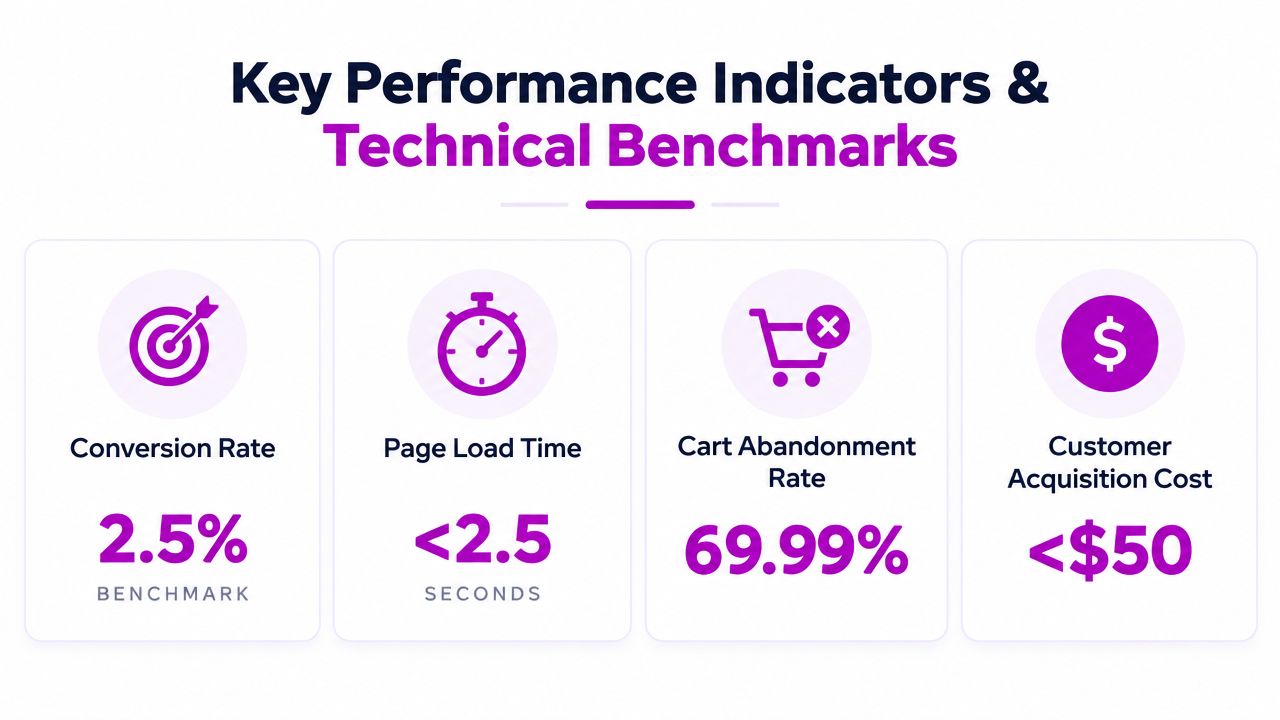
Average e-commerce conversion rates sit around 2.0% to 2.3% (e-commerce conversion benchmarks). Use that range as context rather than a target. A credible baseline reflects product category, traffic intent, price, market, device mix, brand trust, and offer quality.
Build a linked measurement model
Keep the model small enough for teams to use, while connecting each measure to an owner and a decision:
- Conversion rate: Segment by device, market, landing page, channel, and new versus returning customer.
- Page performance: Monitor templates and key journeys, not only the homepage score.
- Checkout behavior: Locate drop-off points and connect them to payment, delivery, form, or trust problems.
- Acquisition cost: Compare spend with contribution margin and customer quality, rather than revenue alone.
- Operational reliability: Track inventory accuracy, fulfilment exceptions, refunds, and customer-service contacts.
Performance belongs in the launch checklist. A widely cited implementation benchmark reports that a 1-second page-load delay can reduce conversions by 7% (e-commerce platform implementation guidance). The exact impact varies by audience and site. Set a performance budget before launch, test image weight and third-party scripts, and assign ownership for regressions.
Checkout also requires controlled testing. The one-page checkout claim should not be treated as a universal answer. Test field count, guest checkout, payment options, delivery clarity, error handling, and reassurance against the store's own baseline. A shorter flow can improve completion, but it can also remove information customers need before committing.
A dashboard becomes useful when a metric triggers a decision, not when it merely fills a report.
Review SEO, analytics, and performance throughout rollout. A fast site with broken tracking produces poor decisions, while accurate tagging cannot recover sales lost to slow templates. Finance, operations, and leadership should review the same definitions so the approved roadmap is measured consistently after launch.
Change Management and Organizational Alignment
A new commerce system changes daily work. Merchandisers publish differently, customer-service agents see new order states, finance reconciles new reports, and operations handles exceptions through different tools. If leaders communicate only the launch date, teams may understand what is changing without understanding how to succeed in the new model.

Give each team a role in the outcome
Begin with a clear change statement. Name the business problem, the desired outcome, the affected teams, and the decisions that will move the result. Then translate that statement into role-specific actions.
- Leadership: Resolve trade-offs, protect resources, and reinforce the new priorities.
- Finance: Validate definitions for revenue, refunds, margin, tax, and forecasting.
- Operations: Own fulfilment rules, inventory processes, and exception handling.
- Marketing and merchandising: Manage content, offers, testing, SEO, and customer segments.
- Customer service: Report recurring friction and verify that new workflows help agents resolve issues.
- Technology: Maintain integrations, access controls, quality assurance, and release procedures.
Training should use real tasks rather than generic demonstrations. Ask a merchandiser to create a product with variants, a service agent to handle a failed payment, and a finance user to reconcile an order. Record the decisions and questions that arise. Those observations often reveal gaps in requirements before customers find them.
Leaders also need a post-launch communication rhythm. Share what changed, what the data says, which experiments are running, and what teams should do next. Invite frontline feedback through structured sessions, then show which suggestions changed the backlog.
Use this video as a practical prompt for discussing how leaders communicate organizational change with the people responsible for execution.
Adoption improves when incentives and ownership match the strategy. If leaders ask teams to prioritize customer experience but reward only campaign volume, the old behavior will persist. Assign one accountable owner to each outcome, while giving specialists authority to change tactics within agreed boundaries.
Common Implementation Pitfalls and How to Avoid Them
Platform selection rarely causes an implementation to fail. The larger risk is an approved strategy that never becomes coordinated delivery. Deadlines expose gaps in requirements, ownership, data quality, testing, and operational readiness.
Common failure points include unclear scope, weak resource planning, migration errors, integration complexity, neglected SEO, poor site performance, and missing post-launch optimization. Treat each as a control problem. Assign an owner, define evidence of completion, and make unresolved exceptions visible to finance, operations, and leadership.
Control the failure points early
Unclear requirements create rework when teams discover operational rules late. Write acceptance criteria for each major workflow, including failed payments, unavailable inventory, address changes, and conflicting promotions. Have the relevant business owner approve those criteria before development is considered complete.
Data migration errors often survive tests that cover successful records only. Rehearse imports, compare source and destination records, validate edge cases, and obtain business approval for the results. Keep a rollback or correction process available for launch week.
Integration complexity becomes costly when systems exchange data without clear ownership. Document the source of truth for product, inventory, price, customer, and order fields. Define how staff handle delayed or failed synchronisation, then test that procedure rather than relying on an alert alone.
Resource underestimation removes time for review. Schedule internal reviewers, decision-makers, content owners, finance, and support staff. Developers can deliver a feature, but they cannot approve operational readiness for every department.
Post-launch neglect leaves small defects in customer and staff workflows. Reserve capacity for monitoring, conversion testing, SEO checks, analytics validation, and refinement from the start.
Run a launch rehearsal across the full commercial journey: place an order, process payment, send fulfilment, issue a refund, update inventory, reconcile the transaction, and inspect the analytics event. Record owners, deadlines, and unresolved decisions. A rehearsal is useful only when it produces accountable follow-up, not just a pass or fail result.
Scaling Your E-Commerce Operations
Scaling means increasing commercial reach without letting catalogue governance, fulfilment, customer data, or reporting fragment. The strategy must translate into operating rules that finance, operations, marketing, customer service, and leadership can apply consistently.
Shopify's development from a single-store solution founded in 2006 into infrastructure for larger, multi-market commerce shows why the operating model must evolve with the storefront. Centralize standards where consistency protects the brand, and assign local decisions to teams with market knowledge. Leadership should define who owns each decision, which system records it, and how performance is reviewed.
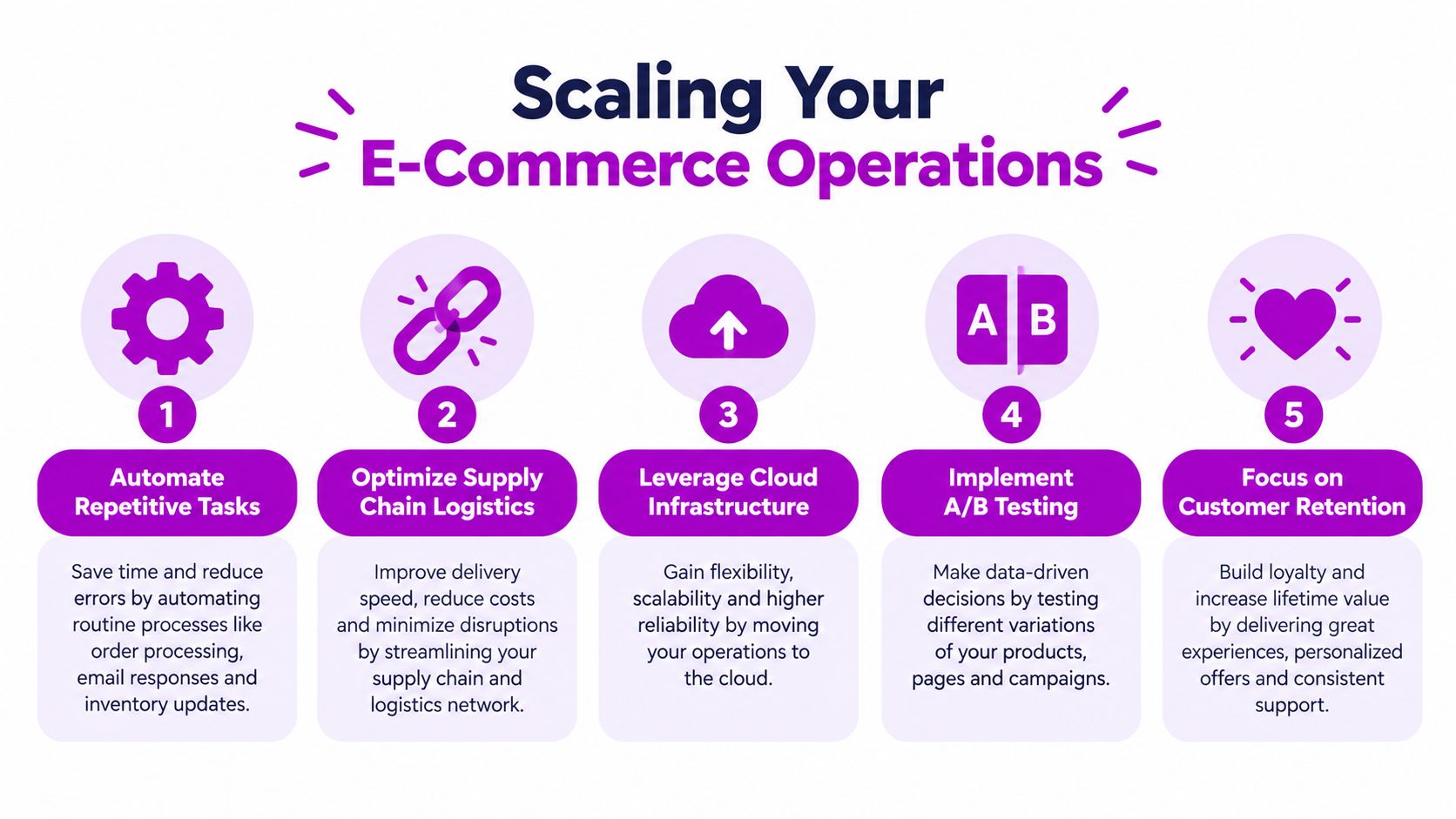
Use this operating checklist:
- Automate repetitive tasks: Begin with order routing, tagging, merchandising rules, and reports that require predictable manual effort.
- Protect catalogue quality: Assign ownership for titles, attributes, translations, imagery, and market-specific content.
- Design for market variation: Keep tax, delivery, payment, pricing, and legal requirements separate from shared brand standards.
- Test before scaling spend: Run controlled experiments on landing pages, offers, navigation, and checkout before expanding traffic or budgets.
- Retain customer context: Connect service, purchase, consent, and behavioural data so automation supports relevant experiences.
AI can assist with classification, content, search, customer-service triage, and merchandising analysis. Introduce it only after data ownership, approval controls, and exception handling are defined. The 2025 digital commerce landscape report identifies technology limitations, legacy systems, and third-party integration as barriers affecting digital commerce operations. Staged implementation therefore reduces the risk of adding disconnected tools.
For apparel teams, fashion brand AI tool strategies offers a useful way to frame use cases around merchandising and customer experience. Before enabling automation, record the data source, human approval point, expected business outcome, and rollback process.
ECORN provides Shopify development, e-commerce consulting, conversion research, CRO, and Shopify Plus support. Visit ECORN to discuss an implementation roadmap, migration requirements, or post-launch optimization priorities with a Shopify-focused team.


Conversion Tracking Setup for Shopify Stores
BigCommerce vs Shopify Plus Which Enterprise Wins in 2026
Shopify Theme Kit: Setup, Commands, and Migration Guide

Shopify Extension Development: A Practical 2026 Guide
Shopify Speed Score Explained and How to Improve It

Shopify Mobile Optimization: The 2026 Playbook

How to Add Subcategory in Shopify for Better UX
How to Implement Structured Data for Ecommerce in 2026

SEO App Mobile: Shopify Store Optimization Guide

Shopify Plus Support: What It Includes and How to Choose

Google Ads for Shopify: The Complete 2026 Playbook

Shopify New York: How to Find and Hire the Right Agency

Google Search Console for Shopify: The Complete Setup

First Party Data Collection for eCommerce Growth

FAQ Online Store Guide: Build and Measure It Right
Do FB Ads Work for eCommerce in 2026?

One Page Checkout for Shopify: Design and Implementation

Shopify GraphQL vs REST: The 2026 Developer Decision
Shopify Ecommerce Consulting: Strategy, Pricing &

Are Reddit Ads Worth It for eCommerce Brands

Shopify Title and Meta Description: A Practical 2026 Guide

Product Video Best Practices for Shopify Brands
Real-Time Inventory Management: A 2026 Guide

AI Chatbot Integration for Shopify Stores
Affiliate Program Management: A Shopify Guide
10 Best Performance Monitoring Tools for Shopify in 2026

Digital Asset Management for eCommerce Brands in 2026

Every Type of Facebook Ads Explained for eCommerce Growth
Product Information Management Explained for Shopify Brands
Support Ticket System: A Guide for Shopify Stores

10 Best Customer Service Tools for Shopify in 2026

Can I Start a Business with No Money? a 2026 Blueprint

What Sells Good on Etsy: Best Niches for 2026

Shopify Add to Cart Button: A Practical 2026 Guide

Customer Feedback Automation: A Practical eCommerce Guide

Critical Rendering Path: A Guide for Shopify Stores

How to Promote on TikTok for eCommerce in 2026

B2B eCommerce Consulting That Drives Real Revenue
10 Best Practices for Site Navigation in 2026

Return vs Refund for Shopify Stores: A Practical Guide

What Is Customer Lifetime Value and Why It Matters
What Is Voice of Customer Research for eCommerce

SMS Marketing for Ecommerce That Actually Converts

Master How to Improve Email Deliverability in 2026

Top 7 eCommerce Partners NYC for Shopify Brands in 2026

Machine Learning for Ecommerce: Boost Your Shopify Store

Beauty Market Research: Your 2026 Growth Guide

Shopify International Expansion: A 2026 Roadmap

What Does CRO Stand for in Business: Understanding CRO

Shopify Visual Merchandising: A Playbook for Higher Sales

Shopify Landing Page Design: Master Conversion in 2026

10 Best AI SEO Optimization Tools for Shopify in 2026

Agentic AI for Ecommerce: Boost Your Sales in 2026
Mastering Email Marketing Data for eCommerce Growth

Conversion Rate Optimisation Australia: Boost Your Sales

Conversion Rate Optimization AI: Your Shopify Store Guide

10 Product Bundling Strategies for Shopify in 2026

How to Increase Customer Lifetime Value: A Shopify Playbook
AI Customer Service Automation: Shopify Guide 2026

Clean Website Design: A Shopify Conversion Playbook

Omnichannel Retail Strategy: A Shopify Playbook

Product Data Enrichment: A Guide for Shopify Brands

Instagram Shopping Features a Guide for Shopify Stores
What Is Revenue Optimization: A Holistic RevOps Guide

Benefits of Conversion Rate Optimization: Boost Your
WordPress to Shopify Migration: Your 2026 Seamless Switch
Boost Sales: Ecommerce Payment Processing Guide 2026
Unified Commerce Platform: Benefits, KPIs & Shopify Guide

How to Reduce Bounce Rate eCommerce: Your 2026 Guide
Shopify API Integration: A Practical End-to-End Guide

How to Implement Data Governance: A 2026 Guide

Shopify Store Development Cost: A 2026 Breakdown
What Is Server Side Tracking: The Shopify Guide 2026
Marketing Automation Workflows: A Shopify Guide for 2026

Shopify: How to Reduce Technical Debt

Shopify UX Design Change: A Playbook for Growth

User Generated Content Strategy: Shopify Playbook

Shopify Pause and Build Plan Cost: A Complete 2026 Guide

Compare at Price on Shopify: A Complete Guide for 2026

Where Can I Sell My Prints? 10 Best Platforms for 2026
Shopify Order Management System: The Ultimate Guide 2026
What Is Marketing Attribution? an eCommerce Guide for 2026

10 Best Black Friday Sales Sheets for 2026

Discover the Top Social Media Marketing Agencies For
Consumer Confidence Definition for eCommerce in 2026

What Is Social Commerce? Your 2026 Guide to Boosting Sales

A Social Ad Campaign Playbook for eCommerce Growth

7 Best FAQ Page Examples for SaaS & eCommerce

Market Research in Fashion Industry: A Guide for Shopify
Shopify Migration Services: Expert Guide for 2026

Mastering FB Retargeting Ads for Shopify in 2026
What Is Omnichannel Ecommerce

Master Your Shopify Plus Migration: The 2026 Guide
Shopify Integration Services: A Merchant's 2026 Guide

Shopify Collection Description: A Guide to SEO & Sales

Shopify Plus Contact: Reach Sales & Support Effectively

Top Luxury Shopify Stores: Design & UX Strategies
How to Improve Customer Experience: A Shopify Roadmap

Creative Facebook Ads: 10 Examples for Shopify Brands

Remarketing with Facebook Ads: A Shopify Guide for 2026


newsletter in your inbox