

Your Shopify store already has more data than your team can use manually. Orders sit in Shopify, customer history lives in Klaviyo or a CRM, support conversations run through Gorgias, and inventory decisions depend on spreadsheets. You may even have a chatbot answering questions, yet your staff still copies information between systems and makes important decisions without a connected view of the business.
That's the gap between using an AI tool and integrating AI into commerce operations. A chatbot produces an answer in isolation. An integrated AI system can read approved Shopify data, interpret customer or operational context, and return a controlled action to the system where work actually happens.
For eCommerce founders, the useful question isn't just, “What is AI integration?” It's, “Which business decision should AI improve, which systems must it access, and how will we measure the result?”
Defining AI Integration Beyond the Hype
Many merchants encounter AI through a product recommendation app, an automated copywriting tool, or a customer-service chatbot. These products can be useful, but installing one doesn't automatically create AI integration. The distinction is whether the capability operates inside a live workflow or remains a separate destination that employees and customers must visit.
A practical definition comes from the integration layer itself. AI integration is the engineering work of connecting AI capabilities into existing applications, data sources, user interfaces, and operational tooling. The model is only one component. The surrounding system handles authentication, data piping, request shaping, response handling, error recovery, permissions, and monitoring.
Access is not the same as integration
Suppose a Shopify merchant gives a marketing manager access to an AI writing assistant. The manager can paste product information into the tool, generate an email, and manually transfer the result to Klaviyo. That's AI access. It may save time, but the workflow still depends on manual movement and individual judgment.
An integrated version could retrieve approved product attributes, customer segments, and campaign rules from connected systems. It could generate a draft within a defined workflow, send it for review, and record the outcome without allowing the model to change customer data or publish content independently.
Practical rule: If your team must repeatedly copy data into an AI tool and copy the answer back into Shopify, you probably have a useful assistant, not an integrated system.
The model doesn't create the operating value
AI models can classify text, summarize conversations, predict likely outcomes, and generate recommendations. They don't know which Shopify products are in stock, which customer segment is eligible for an offer, or whether a refund falls within your policy unless the integration supplies that context.
That's why founders looking to integrate AI systems for non-technical founders should begin with workflows rather than model selection. Define the event, the data the system may read, the decision AI can support, the action it may propose or execute, and the human approval required.
For a Shopify operation, the integration stack might connect the Shopify Admin API with a CRM, Klaviyo, Gorgias, an inventory platform, and internal reporting. AI then becomes a controlled reasoning layer over those systems. It can help staff act faster, but the business still owns the rules, permissions, and final accountability.
The Architecture of Connected Commerce Systems
A connected commerce system needs more than a model and a webhook. Shopify contains deterministic business logic, such as product records, orders, inventory states, discounts, and customer permissions. AI introduces probabilistic interpretation, which means the architecture must control how uncertain outputs interact with systems that expect precise inputs.
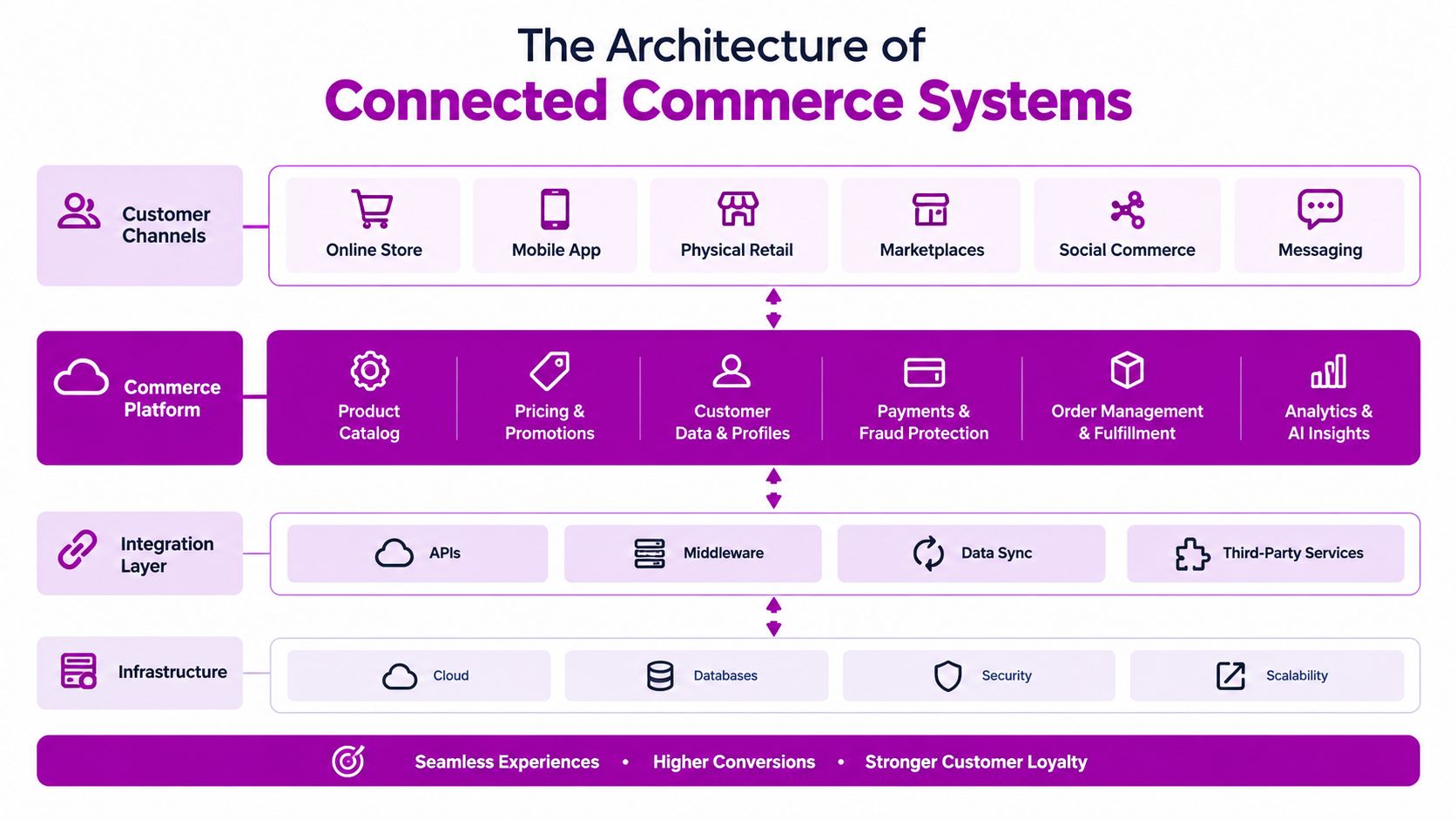
At the center sits an orchestration layer. It receives an event, gathers relevant context, calls the model or agent, validates the response, and routes an approved action to the appropriate business system. This layer can use APIs, microservices, queues, and event-driven patterns rather than creating a separate direct connection for every tool.
Why point-to-point connections become fragile
A direct connection between a chatbot and Shopify may work for a narrow question. Add a CRM, support platform, warehouse system, and email provider, and the number of dependencies grows quickly. A change in one system can break another, while nobody has a complete view of which workflow owns a particular action.
Enterprise-scale deployments require a full orchestration layer between AI agents and business systems, because standard middleware wasn't designed to manage semantic context, dynamic decisions, and workflow execution together. The architecture should therefore separate responsibilities:
- Context retrieval gathers only the customer, product, order, or inventory information required for the task.
- Decision logic determines what AI may recommend, classify, or execute.
- Validation checks that outputs match Shopify's data types, business rules, and permission boundaries.
- Execution sends an approved action through the correct API or service.
- Observability records inputs, outputs, failures, approvals, and downstream results.
A Shopify partner evaluating Shopify integration services should be able to explain these boundaries clearly. Ask where credentials live, how retries work, how failed actions are handled, and whether the AI layer can be updated without changing core commerce logic.
The architecture also needs a distinction between recommendation and execution. AI can suggest a replenishment order, draft a support response, or identify a suspicious refund. Shopify and your operational systems should enforce the rules that determine whether that suggestion can become a real action.
A short technical overview can help teams visualize how these pieces fit together:
Strong orchestration gives you reusable capabilities. A customer-context service can support recommendations, support triage, and retention workflows without each team rebuilding the same connection. Weak architecture creates brittle automation that looks impressive in a demo and becomes expensive to maintain in production.
High Impact Use Cases for Shopify Merchants
The most valuable AI integrations sit close to a decision that already affects revenue, margin, or operating capacity. A merchant doesn't need an autonomous system everywhere. It needs a reliable connection between a business event, relevant context, and a measurable next action.

Product recommendations that use real context
A basic recommendation widget may show related products based on catalog relationships. An integrated system can combine product attributes with browsing behavior, previous orders, inventory availability, and customer status. That allows the storefront to avoid recommending an unavailable item, suppress a product the customer already purchased, or prioritize a complementary item that makes sense for the current basket.
The value comes from the decision path, not from displaying an AI label. The system should retrieve context, produce a recommendation, apply merchandising constraints, and return a result quickly enough for the storefront experience. Track the recommendation's contribution through assisted revenue, add-to-cart behavior, and margin quality rather than clicks alone.
Storefront personalization with boundaries
Personalization can influence collection ordering, onsite messaging, bundles, and post-purchase content. A returning customer might see products aligned with their previous category interest, while a first-time visitor receives broader discovery paths.
The operational risk is over-personalization. If a model makes decisions from incomplete or stale data, it can hide profitable products or create inconsistent experiences across channels. Keep a fallback experience, define which attributes may influence presentation, and let merchandising teams override the system when stock, seasonality, or commercial priorities change.
Founders comparing creative automation tools may also benefit from understanding who AdCreative.ai is built for. That type of tool addresses a different layer of the stack, namely creative production. It can complement an integrated commerce system, but it doesn't replace the APIs, permissions, and workflow controls needed to act on Shopify data.
Backend automation that removes repetitive work
The strongest early opportunities often sit away from the storefront:
- Support triage: Classify incoming Gorgias tickets by intent, order status, urgency, and policy category, then route them to the right queue.
- Catalog operations: Suggest product tags, identify missing attributes, and flag inconsistent descriptions for a human reviewer.
- Inventory planning: Combine order history and current stock signals to surface products that need attention, while leaving purchasing approval with the operator.
- Refund review: Identify cases that match established policies and route exceptions for manual handling.
Each workflow needs a clear owner and a defined failure path. If AI cannot determine an answer confidently, it should request review or return the task to a queue. A system that handles uncertainty safely is more useful than one that claims to automate every exception.
Navigating Adoption Barriers and Security Risks
“Plug and play” is usually an accurate description of installing an app, not integrating AI across a fragmented commerce business. Existing systems may use different identifiers, data structures, permission models, and update schedules. Your team may also lack the skills to maintain API connections, evaluate model behavior, and monitor failures after launch.
The barriers are practical: technical infrastructure, employee resistance, compliance requirements, limited internal expertise, and the difficulty of connecting legacy tools. Training and change management matter because an automation that staff don't trust will be bypassed, even if the underlying technology works.
Security follows the connections
An AI model becomes more consequential when it can access customer records, order details, internal documents, or operational tools. The main security question isn't only whether a model can produce an unsafe response. It's what that response could influence through its connected permissions.
An EY survey on AI governance and technology risk found that 13% of organizations had experienced AI model or application breaches. Among compromised organizations, 97% lacked proper AI access controls, and 60% of AI-related incidents involved compromised data. Those figures make access design a first-order implementation task, not a later compliance exercise.
Use narrow service accounts, separate read and write permissions, and require approval for irreversible actions such as refunds, price changes, customer exports, or bulk catalog updates. Log the request context, the model output, the rule evaluation, and the final action so an operator can reconstruct what happened.
Security question: Don't ask only what the AI can generate. Ask what it can reach, what it can change, and how quickly you'd detect misuse.
Data governance should cover retention, consent, vendor access, data minimization, and human review. Teams building this foundation can use guidance on how to implement data governance, then adapt the controls to their Shopify apps and operational workflows.
A Phased Implementation Strategy for Growing Brands
A growing Shopify brand rarely needs a large autonomous platform on day one. It needs a controlled starting point that proves the data is usable, gives staff confidence, and creates reusable integration patterns.
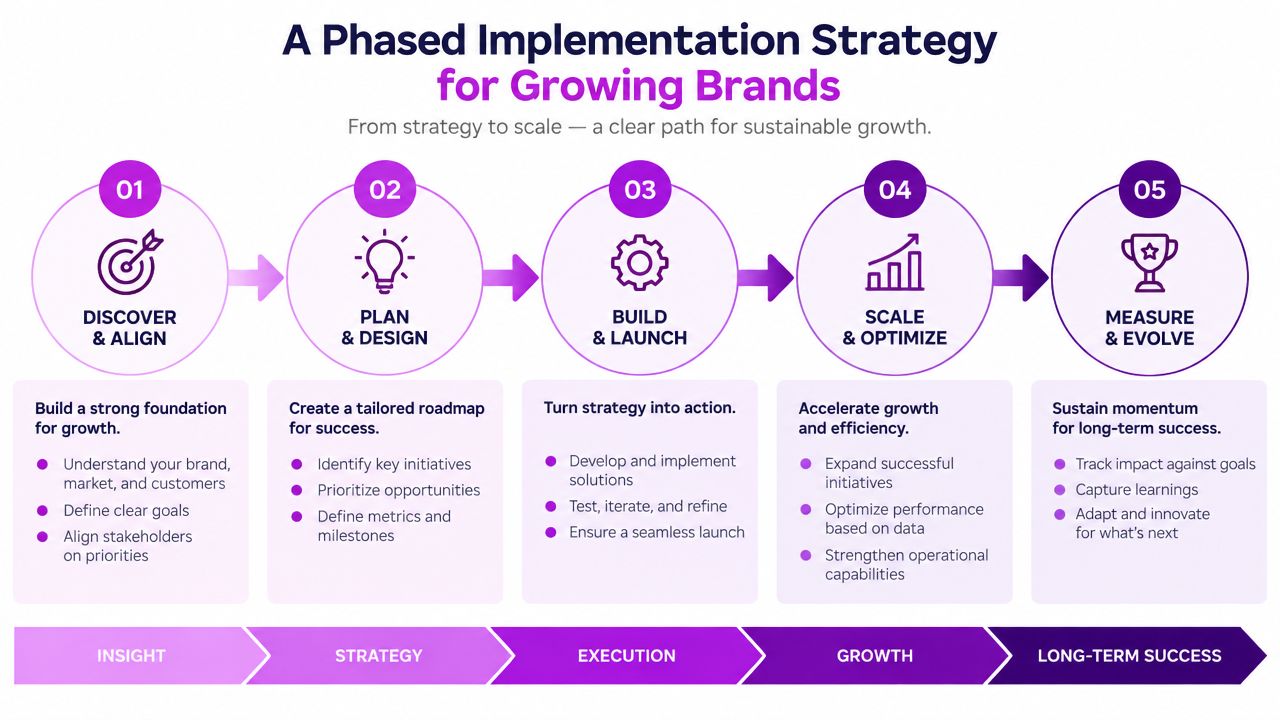
Start with discovery and constraints
Map the systems involved in one business process. Document where product, order, customer, support, and inventory data originates, who owns it, and which actions require approval. Choose a workflow with clear inputs and a visible operational cost, such as product tagging or support categorization.
Avoid starting with a broad instruction like “add AI to the store.” Start with a defined problem, such as reducing the manual work required to route post-purchase questions.
Prove a low-risk workflow
The first release should usually recommend, classify, summarize, or draft rather than make irreversible changes. Product tagging, internal support summaries, FAQ retrieval, and draft replies are useful because a staff member can review the output before it affects a customer or the catalog.
Create a baseline before launch. Record handling time, review effort, error types, and the volume of tasks entering the workflow. Without that baseline, stakeholders will debate impressions instead of evaluating operational evidence.
Connect systems through reusable services
Once the first workflow is stable, centralize authentication, logging, validation, and error handling. Add connections to systems such as Shopify, Klaviyo, Gorgias, Slack, or inventory platforms through documented interfaces rather than embedding credentials and logic inside a single app.
A small experiment becomes an integration capability here. The next use case should reuse context retrieval and governance components instead of starting from scratch.
Expand into decisions with controlled execution
Predictive inventory review, cross-channel personalization, and pricing recommendations require stronger validation because they can affect margin, customer experience, and cash flow. Let AI identify opportunities, but keep deterministic rules and human approvals around high-impact actions.
Operate, review, and improve
Assign an owner for model behavior, data quality, permissions, and business outcomes. Review false positives, missed cases, latency, and staff overrides. Retire workflows that don't create value, and improve the ones that reliably reduce friction.
The phased approach protects the business from a common failure mode: launching an impressive demo before establishing dependable data, permissions, and ownership.
Measuring ROI and Operational Efficiency Gains
AI integration deserves a business case that looks beyond the cost of an app or API call. The comparison is between two operating models. One relies on disconnected SaaS tools, manual exports, duplicated customer records, and staff context-switching. The other creates a shared data and action layer that reduces repeated work and makes decisions easier to execute.
Deloitte reported that two-thirds of organizations saw productivity and efficiency gains from AI adoption. For a Shopify merchant, that doesn't guarantee a result. It does support treating integration as an operational investment whose value must be tested against a specific workflow.
Measure the workflow, not the novelty
A recommendation engine should be evaluated differently from support triage. Choose one primary KPI, supporting measures, and a guardrail metric that protects the business from an apparently positive but harmful outcome.
| Metric Category | Specific KPI | Expected Impact |
|---|---|---|
| Labor efficiency | Manual handling time per task | Less repetitive work and more staff capacity |
| Customer experience | First-response time and escalation rate | Faster routing with controlled human intervention |
| Merchandising | Add-to-cart behavior from recommendation placements | More relevant product discovery |
| Commercial quality | Margin mix and return patterns | Growth without encouraging low-quality orders |
| Data operations | Product records requiring correction | Cleaner catalog information and fewer manual edits |
| System reliability | Failed workflows and approval overrides | Visibility into automation quality and risk |
Track the cost of maintaining the integration as well. Include implementation effort, monitoring, vendor fees, support time, and the cost of correcting bad outputs. A workflow that saves staff time but creates frequent exceptions may not be economically attractive.
Use guardrails to avoid false wins
A lower support handling time isn't a success if unresolved issues increase. Higher conversion isn't enough if returns rise or discounts erode margin. More automated catalog edits aren't useful if merchandising teams spend their time undoing them.
Review results by segment where possible, compare assisted actions with unassisted workflows, and monitor human overrides. Keep an audit trail so the team can connect an outcome to the input data, AI recommendation, approval decision, and final system action.
The financial case becomes clearer when leadership can see which manual tasks disappeared, which decisions improved, and which risks remain controlled. That's more credible than claiming that AI will transform the store without showing how the store operates differently.
Building a Scalable Foundation for Future Growth
AI integration should become a permanent operating capability, not a one-off feature launch. Your Shopify ecosystem will continue to change as you add markets, channels, fulfillment partners, customer tools, and new commercial processes. A well-designed orchestration layer lets those changes happen without rebuilding every AI workflow from the beginning.
The business foundation matters more than the novelty of the model. Keep product and customer identifiers consistent, document APIs, separate business rules from model prompts, and make permissions explicit. Store teams should know which decisions AI can support, which actions require approval, and who owns the workflow when it fails.
Build for reuse
A scalable foundation typically includes:
- A reliable data layer that supplies current, permissioned context.
- Reusable connectors for Shopify and adjacent systems.
- Validation rules that protect deterministic commerce operations.
- Monitoring and logs that expose failures and unexpected behavior.
- Human review paths for uncertainty and high-impact decisions.
- An improvement process that turns overrides and errors into better rules.
McKinsey's 2026 Global Survey on the state of AI found that 44% of respondents said AI was scaling across their enterprise, up from 38% a year earlier, while 56% said their organizations used AI in three or more functions. The direction is clear: companies are moving from isolated experiments toward connected operational use. For eCommerce founders, that makes architecture and governance strategic capabilities rather than back-office concerns.
The right target isn't an AI-first storefront that replaces every existing process. It's a Shopify business where useful intelligence can move safely between customer channels, commerce systems, and operational teams. Start with one workflow, prove its value, and build the integration patterns that future workflows can reuse.
ECORN offers Shopify design, development, CRO, consulting, Shopify Plus support, and AI workflow implementation for brands that need connected commerce operations. Visit ECORN to discuss a focused AI integration project, from a controlled first workflow to a scalable Shopify architecture.



How to Choose the Right eCommerce Website Development Firm
E Business Strategy Implementation
Conversion Tracking Setup for Shopify Stores
BigCommerce vs Shopify Plus Which Enterprise Wins in 2026
Shopify Theme Kit: Setup, Commands, and Migration Guide

Shopify Extension Development: A Practical 2026 Guide
Shopify Speed Score Explained and How to Improve It
Shopify Mobile Optimization: The 2026 Playbook

How to Add Subcategory in Shopify for Better UX
How to Implement Structured Data for Ecommerce in 2026

SEO App Mobile: Shopify Store Optimization Guide

Shopify Plus Support: What It Includes and How to Choose

Google Ads for Shopify: The Complete 2026 Playbook

Shopify New York: How to Find and Hire the Right Agency

Google Search Console for Shopify: The Complete Setup

First Party Data Collection for eCommerce Growth

FAQ Online Store Guide: Build and Measure It Right
Do FB Ads Work for eCommerce in 2026?

One Page Checkout for Shopify: Design and Implementation
Shopify GraphQL vs REST: The 2026 Developer Decision
Shopify Ecommerce Consulting: Strategy, Pricing &

Are Reddit Ads Worth It for eCommerce Brands

Shopify Title and Meta Description: A Practical 2026 Guide

Product Video Best Practices for Shopify Brands

Real-Time Inventory Management: A 2026 Guide
AI Chatbot Integration for Shopify Stores
Affiliate Program Management: A Shopify Guide
10 Best Performance Monitoring Tools for Shopify in 2026
Digital Asset Management for eCommerce Brands in 2026

Every Type of Facebook Ads Explained for eCommerce Growth
Product Information Management Explained for Shopify Brands
Support Ticket System: A Guide for Shopify Stores

10 Best Customer Service Tools for Shopify in 2026

Can I Start a Business with No Money? a 2026 Blueprint

What Sells Good on Etsy: Best Niches for 2026

Shopify Add to Cart Button: A Practical 2026 Guide

Customer Feedback Automation: A Practical eCommerce Guide

Critical Rendering Path: A Guide for Shopify Stores

How to Promote on TikTok for eCommerce in 2026

B2B eCommerce Consulting That Drives Real Revenue
10 Best Practices for Site Navigation in 2026

Return vs Refund for Shopify Stores: A Practical Guide

What Is Customer Lifetime Value and Why It Matters
What Is Voice of Customer Research for eCommerce

SMS Marketing for Ecommerce That Actually Converts

Master How to Improve Email Deliverability in 2026

Top 7 eCommerce Partners NYC for Shopify Brands in 2026

Machine Learning for Ecommerce: Boost Your Shopify Store

Beauty Market Research: Your 2026 Growth Guide

Shopify International Expansion: A 2026 Roadmap

What Does CRO Stand for in Business: Understanding CRO

Shopify Visual Merchandising: A Playbook for Higher Sales

Shopify Landing Page Design: Master Conversion in 2026
10 Best AI SEO Optimization Tools for Shopify in 2026

Agentic AI for Ecommerce: Boost Your Sales in 2026
Mastering Email Marketing Data for eCommerce Growth

Conversion Rate Optimisation Australia: Boost Your Sales
Conversion Rate Optimization AI: Your Shopify Store Guide

10 Product Bundling Strategies for Shopify in 2026

How to Increase Customer Lifetime Value: A Shopify Playbook
AI Customer Service Automation: Shopify Guide 2026

Clean Website Design: A Shopify Conversion Playbook

Omnichannel Retail Strategy: A Shopify Playbook

Product Data Enrichment: A Guide for Shopify Brands

Instagram Shopping Features a Guide for Shopify Stores
What Is Revenue Optimization: A Holistic RevOps Guide

Benefits of Conversion Rate Optimization: Boost Your
WordPress to Shopify Migration: Your 2026 Seamless Switch
Boost Sales: Ecommerce Payment Processing Guide 2026
Unified Commerce Platform: Benefits, KPIs & Shopify Guide

How to Reduce Bounce Rate eCommerce: Your 2026 Guide
Shopify API Integration: A Practical End-to-End Guide

How to Implement Data Governance: A 2026 Guide

Shopify Store Development Cost: A 2026 Breakdown
What Is Server Side Tracking: The Shopify Guide 2026
Marketing Automation Workflows: A Shopify Guide for 2026

Shopify: How to Reduce Technical Debt

Shopify UX Design Change: A Playbook for Growth

User Generated Content Strategy: Shopify Playbook

Shopify Pause and Build Plan Cost: A Complete 2026 Guide

Compare at Price on Shopify: A Complete Guide for 2026

Where Can I Sell My Prints? 10 Best Platforms for 2026
Shopify Order Management System: The Ultimate Guide 2026
What Is Marketing Attribution? an eCommerce Guide for 2026

10 Best Black Friday Sales Sheets for 2026

Discover the Top Social Media Marketing Agencies For

Consumer Confidence Definition for eCommerce in 2026

What Is Social Commerce? Your 2026 Guide to Boosting Sales

A Social Ad Campaign Playbook for eCommerce Growth

7 Best FAQ Page Examples for SaaS & eCommerce

Market Research in Fashion Industry: A Guide for Shopify
Shopify Migration Services: Expert Guide for 2026

Mastering FB Retargeting Ads for Shopify in 2026
What Is Omnichannel Ecommerce

Master Your Shopify Plus Migration: The 2026 Guide
Shopify Integration Services: A Merchant's 2026 Guide

Shopify Collection Description: A Guide to SEO & Sales

Shopify Plus Contact: Reach Sales & Support Effectively

Top Luxury Shopify Stores: Design & UX Strategies
How to Improve Customer Experience: A Shopify Roadmap


newsletter in your inbox