


More dashboards won't fix ecommerce measurement. If your Shopify store sends incomplete purchase events to GA4, duplicates transactions, loses consented sessions, or defines revenue differently from Meta and finance, a polished dashboard only makes unreliable numbers easier to consume.
That problem is more common than most consulting advice admits. Recent coverage reports that only 48% of GA4 ecommerce implementations track purchase events, while 39% track begin_checkout and 31% track product list views. Those figures come from recent ecommerce tracking coverage, and they point to a practical conclusion: measurement repair must come before dashboard design, attribution analysis, or conversion rate optimization.
Ecommerce analytics consulting should therefore start with a less glamorous question: can the business trust the data it uses to make decisions? If the answer is no, the consultant's first job isn't to recommend a new report. It's to establish what happened, what was recorded, what was lost, and which commercial decisions the available evidence can support.
Understanding Ecommerce Analytics Consulting
Ecommerce analytics consulting is not dashboard production. A dashboard displays a model of the business. Consulting determines whether that model reflects reality, which metrics belong in it, and how the team should act when the numbers conflict.
A reporting specialist may connect Shopify, GA4, Google Ads, and Meta to Looker Studio. That can be useful, but the connection itself doesn't make the data comparable. Shopify may record an order that GA4 misses. Meta may attribute a conversion using a different time window. Finance may exclude refunds while the storefront reports gross sales. Without agreed definitions and validated event flows, the dashboard places competing versions of truth in one screen.
The scale of the consulting market reflects how central this work has become. The broader e-commerce consulting services market reached USD 14.50 billion in 2025 and is projected to reach USD 32.97 billion by 2032, implying a 12.5% CAGR. Digital marketing and analytics represented an estimated 21.0% share, or about USD 3.045 billion, according to market coverage of e-commerce consulting services. The commercial demand isn't for more charts. It's for better performance measurement, optimization, and data-led decisions.
The measurement layer comes first
A credible engagement begins by mapping the journey from product impression to profit. The consultant checks event names, parameters, consent behavior, transaction IDs, currency handling, refunds, cross-domain behavior, and the relationship between browser-side and server-side tracking. On Shopify, that review also needs to account for checkout behavior, apps that inject scripts, subscription flows, post-purchase offers, and changes made by developers or agencies.
The output should be a documented measurement plan, not a list of disconnected fixes. It should state which events matter, what each event means, where it originates, how it is validated, and which business question it answers.
Reporting versus decision support
Basic reporting answers, “What happened?” True analytics consulting also asks, “Why did it happen, what should we do next, and how will we know whether the decision worked?”
That distinction affects CRO and media buying. A consultant shouldn't recommend a checkout test because the average conversion rate looks low, or scale a campaign because platform ROAS looks attractive. The team needs segment-level context, a trustworthy denominator, and a commercial outcome that survives reconciliation with orders, refunds, costs, and margin.
For a practical overview of the platforms and customer-behavior tools involved, see ECORN's ecommerce data analytics guide. The useful principle is simple: repair the evidence before interpreting it.
The Core Value Proposition of Data Strategy
Once the tracking layer is dependable, data strategy turns disconnected activity into a decision system. The value comes from linking four components: what the business measures, how it assigns credit, how it evaluates customers, and how quickly teams can act.
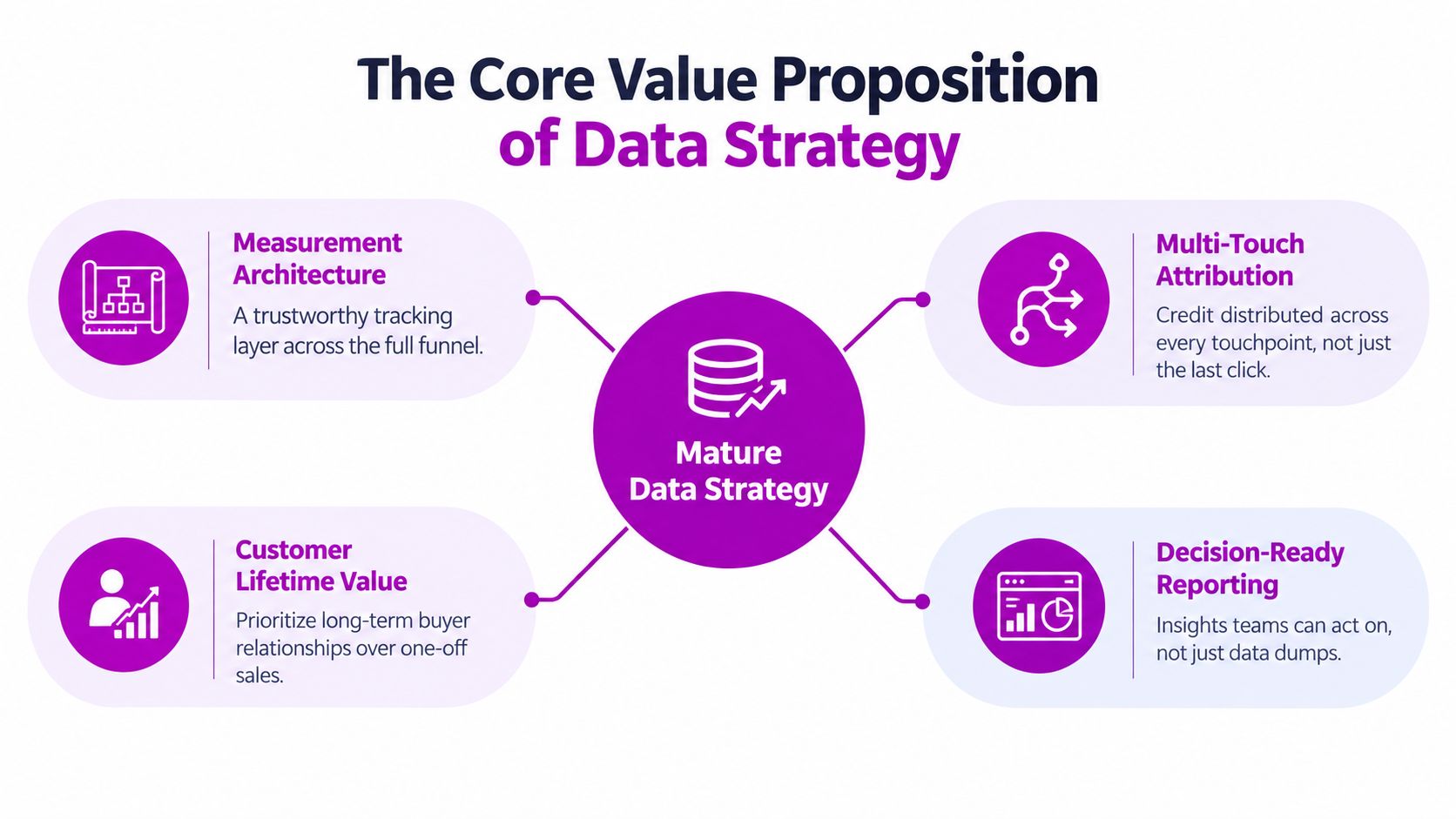
Measurement architecture
A measurement architecture defines the rules behind the numbers. It connects storefront events, advertising interactions, CRM activity, order data, refunds, and finance inputs without pretending that every source measures the same thing.
The consultant should establish:
- KPI definitions: Specify whether revenue means gross sales, net sales, collected revenue, or contribution after variable costs.
- Event ownership: Record which system creates each event and which system is responsible for validating it.
- Identity rules: Document how the business treats logged-in customers, anonymous visitors, returning buyers, and consent-denied sessions.
- Reconciliation rules: Explain how the team investigates differences between Shopify, GA4, advertising platforms, and finance.
This work prevents a common failure mode: teams debate whose number is correct without first agreeing what each number represents.
Attribution with fewer illusions
Last-click attribution is easy to read and often too narrow for budget decisions. It gives disproportionate credit to the interaction closest to purchase, while prospecting, content, email, organic search, and other earlier influences can disappear from the report.
A more useful approach combines several views rather than treating one model as objective truth. Use channel reporting for operational decisions, customer and cohort analysis for retention, and controlled tests or incrementality work when the team needs to estimate causal impact. The consultant's role is to show the limits of each method, not to replace one oversimplification with another.
Practical rule: Never let an attribution model answer a causal question that only an experiment or incrementality method can answer.
Customer value and actionable reporting
A customer view changes the question from “Which campaign produced this order?” to “Which acquisition and retention paths produce valuable customers?” That requires cohort logic, repeat-purchase behavior, returns, discounts, fulfilment costs, and contribution margin. It also requires restraint. Customer lifetime value isn't useful if the underlying order, refund, or identity data is unstable.
Decision-ready dashboards should make priorities visible. A growth team might need a daily view of spend, orders, conversion, and stock pressure. Finance may need net revenue and contribution. Merchandising may need product demand, returns, and margin. One universal dashboard usually satisfies none of those users well.
The best data strategy creates a shared commercial language, then gives each team the minimum view needed to make a sound decision. More metrics don't create more certainty. Clear definitions and suitable analysis do.
How Agencies Structure Analytics Engagements
A mature engagement should feel less like a dashboard project and more like a controlled repair and optimization program. The sequence matters because implementation work can hide analytical flaws if nobody validates the output before publishing it.
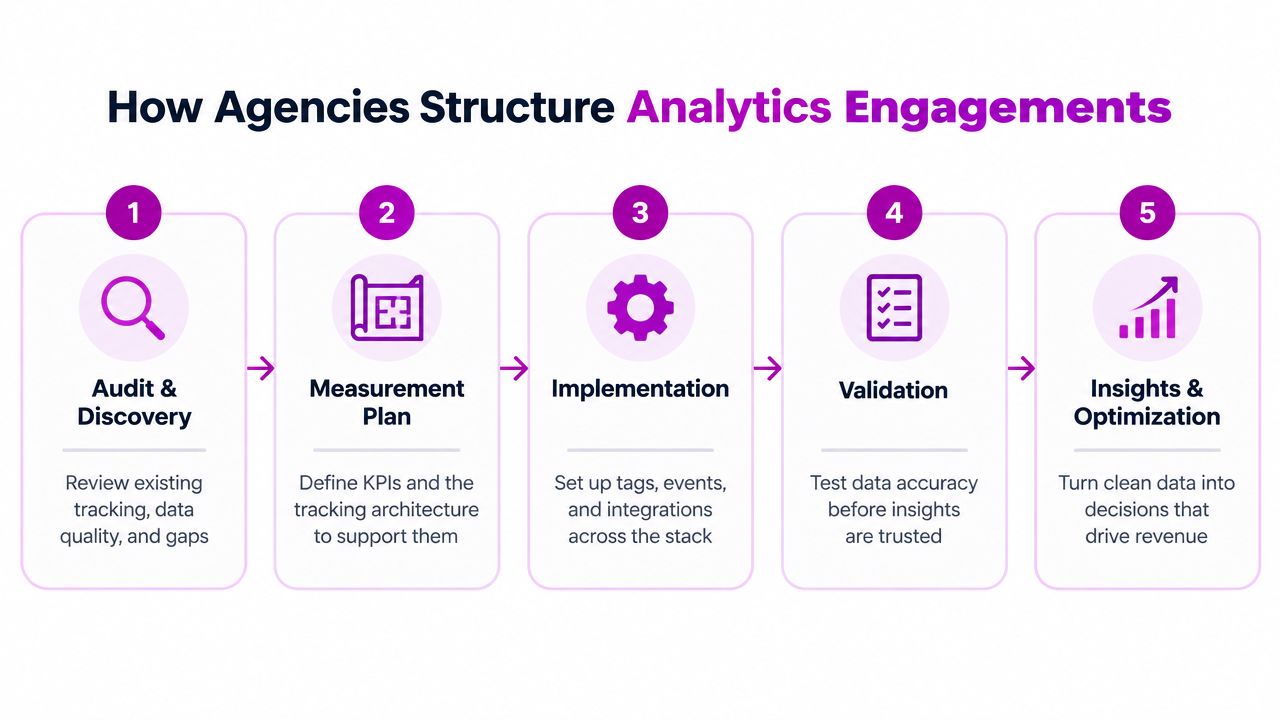
Start with audit and discovery
The first phase maps the Shopify environment and the operating questions behind it. The consultant reviews GA4, Google Tag Manager, Shopify analytics, ad platforms, CRM and email tools, consent management, checkout behavior, data warehouses, and existing reports.
The audit should identify:
- Missing events, such as product views, checkout starts, purchases, refunds, or subscription actions.
- Duplicate events, especially repeated purchases caused by reloads, redirects, or inconsistent transaction handling.
- Conflicting definitions, including different revenue, order, currency, and customer rules.
- Unvalidated integrations, where data appears in a platform but hasn't been compared with a trusted source.
- Operational gaps, such as no owner for event changes or no process for checking tracking after a theme update.
The consultant should connect each issue to a business risk. “Purchase event missing” is a technical observation. “Paid media is being evaluated on incomplete conversion data” is the decision risk.
Define and implement the measurement plan
The next phase translates commercial questions into a tracking specification. It should define event names, required parameters, identity behavior, consent conditions, destination systems, and acceptance criteria.
Implementation may involve GA4 and Google Tag Manager changes, Shopify data connections, server-side event handling, ad-platform integrations, CRM enrichment, or warehouse modeling. The right method depends on the stack and privacy requirements. Server-side tracking can improve control and data governance, but it won't rescue a poorly defined event model or make unconsented data available.
Validate before insight
Validation deserves its own phase. The team should test realistic journeys, compare recorded transactions against Shopify, inspect order IDs, check currency and item values, verify refunds, and examine behavior across devices and consent states.
A consultant who publishes a dashboard before this work is complete is asking the client to trust an untested pipeline. That creates false confidence and makes later corrections harder because stakeholders have already built routines around the wrong numbers.
The final phase turns clean data into analysis and action. A specialist may build dashboards, define recurring reviews, identify friction, and develop a CRO roadmap. The client should also know what happens after handover, including who approves tracking changes, who monitors anomalies, and who owns the backlog.
The engagement can include a technical walkthrough for developers and a commercial workshop for marketing, finance, and operations. That collaboration matters because tracking changes affect all three groups.
A short visual explanation can help internal stakeholders understand the relationship between implementation and decision-making:
Key Deliverables You Should Expect
A serious analytics engagement leaves behind working systems and documented decisions. If the only deliverable is a dashboard link, the brand has purchased presentation rather than capability.
A usable measurement specification
The specification should cover the complete funnel and post-purchase journey. It should name events, parameters, expected values, source systems, consent behavior, and validation methods. It should also explain how the team handles refunds, cancellations, returns, subscriptions, exchanges, and duplicate transaction IDs.
This document protects the business when an app changes, a developer updates the theme, or a new agency takes over. Without it, every future tracking change becomes a reverse-engineering exercise.
Validated implementation
The implementation may include browser-side GA4, Google Tag Manager, server-side event flows, Meta Conversions API, CRM integrations, and warehouse transformations. The technology isn't the deliverable by itself. The deliverable is a tested path from customer action to trustworthy business record.
A good handover includes test evidence, known limitations, access ownership, and a monitoring process. It distinguishes data that is missing because of consent from data that is missing because the implementation failed.
For teams that need broader marketing visibility, an SEO reporting tool can sit alongside ecommerce reporting, provided its definitions are kept separate from revenue and order logic. SEO visibility is useful, but it shouldn't be presented as a substitute for validated commercial measurement.
Dashboards tied to decisions
A dashboard should answer a defined set of operating questions. For example, marketing may need channel spend and net revenue, merchandising may need product demand and stock context, and finance may need contribution after discounts, returns, and variable costs.
The reporting layer should therefore include:
- Metric dictionary: A shared definition for every executive KPI.
- Source-of-truth rules: Clear precedence when Shopify, GA4, platforms, and finance disagree.
- Profitability views: Revenue linked to discounts, returns, fulfilment, payment fees, and product economics where the data exists.
- Customer analysis: Cohorts, repeat behavior, acquisition source, and post-purchase outcomes.
- Experiment backlog: Hypotheses ranked by expected commercial value, evidence, confidence, and effort.
- Governance guide: Owners, change controls, QA checks, and escalation paths.
The relationship between tracking and CRO is especially important. The conversion tracking setup guidance from ECORN is relevant because experiment results are only as credible as the conversion events and denominators behind them.
A complete engagement gives the team something it can maintain, not just something it can admire.
Shifting Focus From Vanity Metrics to Profitability
Traffic can rise while the business becomes less profitable. ROAS can look healthy while returns, discounts, fulfilment costs, and low repeat purchase erode the contribution from each order.
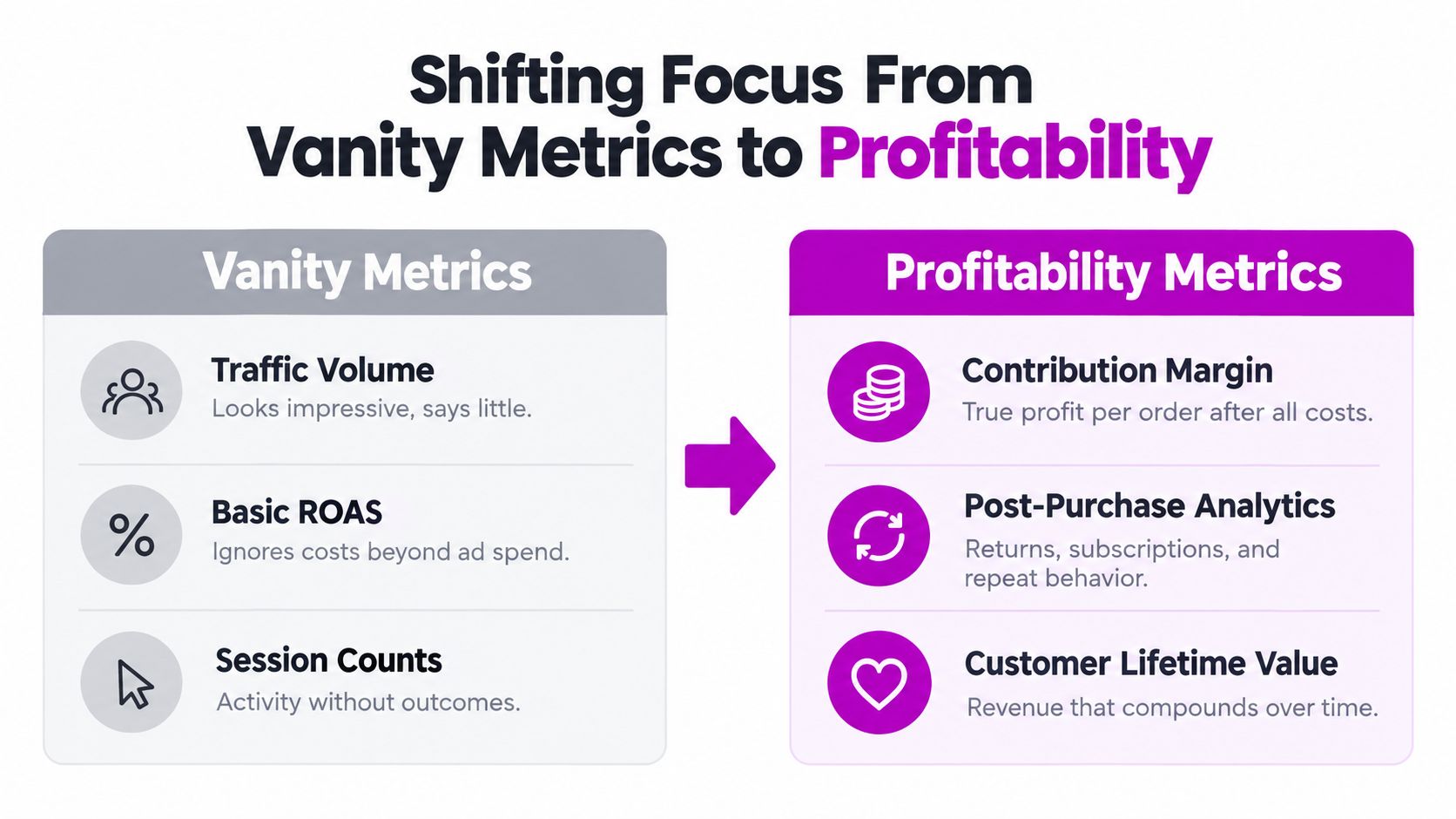
The pressure on channel economics makes this shift urgent. One industry analysis reports that customer acquisition costs rose 15% to 25% on Google Ads and Meta in 2025 to 2026, as covered in ecommerce analytics trend analysis. That claim should be treated as directional industry coverage, not a universal benchmark for every account. The operational implication is still clear: raw ROAS isn't enough to govern investment when acquisition becomes more expensive.
The metric that looks good but misleads
A campaign can produce a purchase at an acceptable platform ROAS while attracting customers who return products, use deep discounts, or never buy again. A landing page test can increase conversion by promoting a lower-margin bundle. A promotion can lift revenue and damage contribution.
Analytics consulting should connect acquisition to post-purchase outcomes. That means examining net revenue, contribution margin, return behavior, repeat purchase, subscription retention where relevant, discount dependence, and product-level economics.
The goal isn't to discard traffic, sessions, or ROAS. Those metrics still help teams diagnose activity and manage channels. The mistake is treating them as the final measure of business health.
Build a commercial decision system
Profitability reporting works best when it reflects how the business operates. An inventory-constrained retailer may prioritize contribution per unit of scarce stock. A subscription brand may focus on retention and payback. A high-return category may need channel reporting joined to product and fulfilment outcomes before budget is moved.
That model also changes how teams judge CRO. A test should be evaluated against incremental revenue, contribution, or revenue per visitor, not only a statistically significant change in conversion. An independent 2026 report covering 168 audited A/B tests across 23 clients found a median site-level control conversion rate of 3.5%, with a normal range of 1.8% to 5.5%. It also identifies session-based conversion rate as the standard denominator for benchmarking. The benchmark and methodology are detailed in Conversion Team's ecommerce conversion research.
A separate 2026 meta-analysis found that 20% of tests generated 81% of total conversion uplift, while another source reported statistically significant wins in 36.3% of tests across more than 90 European ecommerce brands. Winning tests produced median lifts of 1.88% in conversion rate and 2.77% in revenue per visitor, according to the 2026 ecommerce A/B testing analysis. These figures support a practical discipline: prioritize strong hypotheses, plan sufficient traffic, and validate commercial value after the test.
How to Choose the Right Analytics Consultant
The right provider depends on the gap you're trying to close. A freelance data engineer may solve an integration problem efficiently, while a specialist ecommerce consultancy may be better equipped to connect tracking, merchandising, CRO, and profitability. A generalist agency may offer broad marketing support but lack the technical depth to diagnose transaction duplication or consent-related gaps.
Start discovery by asking for evidence of method, not a list of tools. The consultant should explain how they test purchase events, reconcile platform differences, treat consent-denied traffic, investigate transaction ID discrepancies, and separate statistical significance from commercial significance.
Consultant Evaluation Matrix
| Provider Type | Technical Depth | Strategic Value | Shopify Expertise |
|---|---|---|---|
| Freelance data engineer | Strong for implementation, integrations, and debugging | Often limited unless they also understand commercial analytics | Varies, verify Shopify and checkout experience |
| Generalist marketing agency | Usually moderate, depending on the team | Broad channel strategy and campaign support | Often adequate for standard reporting, less reliable for complex stacks |
| Analytics consultancy | Strong across measurement, modeling, reporting, and validation | High when the team links data to budget, customer value, and operations | Depends on its ecommerce specialization |
| Shopify-focused partner | Strong in storefront, theme, app, and platform context | Useful for CRO and ecommerce operations, depth in advanced analytics varies | Typically strong, especially for Shopify Plus environments |
| In-house hire | Can become deeply aligned with the business | Potentially high, but depends on seniority and cross-functional access | Depends on prior platform experience |
Questions that expose weak proposals
Ask the consultant to show a sample measurement plan with sensitive details removed. Look for event definitions, ownership, QA steps, data limitations, and business questions. A proposal that jumps directly to dashboards is incomplete.
Also ask:
- What happens when numbers disagree? You should hear a reconciliation process, not a promise that one platform is always right.
- How do you validate implementation changes? Look for test cases, transaction checks, and post-release monitoring.
- How do you handle consent behavior? The answer should distinguish lawful data loss from technical failure.
- How do you connect analytics to profit? The consultant should ask about returns, discounts, costs, inventory, and customer value.
- Who owns the system after launch? A sustainable handover matters as much as the initial build.
Price and speed involve trade-offs. A short implementation may suit a narrow tracking fix, but it won't necessarily solve fragmented definitions or profitability reporting. A large consultancy may bring breadth but introduce heavier process. Choose the smallest partner model capable of solving the actual problem, then define success through deliverables and decisions rather than dashboard count.
Building a Sustainable Measurement Culture
A brand doesn't become data-led when a consultant delivers a report. It becomes data-led when people use shared definitions, challenge unreliable evidence, and maintain the measurement layer as the business changes.
The transition usually starts with a simple operating rhythm. Marketing reviews acquisition and conversion. Finance checks net revenue and contribution. Operations examines fulfilment, returns, and inventory. Product and development review tracking changes and experiment results. These teams don't need identical dashboards, but they do need compatible definitions.
Make ownership explicit
Assign owners to the measurement plan, metric dictionary, implementation, QA, and decision backlog. Add tracking review to release processes so a new Shopify app, theme update, checkout change, or promotion doesn't silently alter the data.
A weekly review should focus on decisions, not a tour of every chart. Each discussion can ask:
- What changed?
- Which change is supported by reliable data?
- What decision follows?
- What remains uncertain?
- What will we validate next?
That cadence helps the team distinguish a genuine commercial signal from instrumentation noise.
Move from repair to learning
Once the data is trustworthy, the brand can build a prioritized experimentation roadmap. The roadmap should connect customer friction to a business hypothesis, identify the primary outcome, specify guardrails, and define what happens after the result. A conversion uplift that reduces margin or increases returns isn't a clean win.
Teams should also document known limitations. Some journeys will remain difficult to measure because of consent choices, cross-device behavior, platform modeling, or incomplete historical data. Recording those limitations is more credible than presenting false precision.
The practical journey is straightforward. A brand begins with broken or incomplete events, establishes definitions, repairs and validates the pipeline, builds reports around decisions, then creates a routine for testing and governance. The consultant's value declines as internal capability grows, but the framework remains.
ECORN combines Shopify design, development, CRO, and ecommerce consulting, with flexible project and subscription options for brands that need help improving store performance and measurement practices. If your reports don't yet support confident decisions, visit ECORN to discuss an audit, tracking remediation, or optimization engagement built around the data layer first.



What Is AI Integration for eCommerce

How to Choose the Right eCommerce Website Development Firm
E Business Strategy Implementation
Conversion Tracking Setup for Shopify Stores
BigCommerce vs Shopify Plus Which Enterprise Wins in 2026
Shopify Theme Kit: Setup, Commands, and Migration Guide

Shopify Extension Development: A Practical 2026 Guide
Shopify Speed Score Explained and How to Improve It
Shopify Mobile Optimization: The 2026 Playbook

How to Add Subcategory in Shopify for Better UX
How to Implement Structured Data for Ecommerce in 2026

SEO App Mobile: Shopify Store Optimization Guide

Shopify Plus Support: What It Includes and How to Choose

Google Ads for Shopify: The Complete 2026 Playbook

Shopify New York: How to Find and Hire the Right Agency

Google Search Console for Shopify: The Complete Setup

First Party Data Collection for eCommerce Growth
FAQ Online Store Guide: Build and Measure It Right
Do FB Ads Work for eCommerce in 2026?

One Page Checkout for Shopify: Design and Implementation
Shopify GraphQL vs REST: The 2026 Developer Decision
Shopify Ecommerce Consulting: Strategy, Pricing &

Are Reddit Ads Worth It for eCommerce Brands

Shopify Title and Meta Description: A Practical 2026 Guide

Product Video Best Practices for Shopify Brands
Real-Time Inventory Management: A 2026 Guide

AI Chatbot Integration for Shopify Stores
Affiliate Program Management: A Shopify Guide
10 Best Performance Monitoring Tools for Shopify in 2026

Digital Asset Management for eCommerce Brands in 2026

Every Type of Facebook Ads Explained for eCommerce Growth
Product Information Management Explained for Shopify Brands
Support Ticket System: A Guide for Shopify Stores

10 Best Customer Service Tools for Shopify in 2026

Can I Start a Business with No Money? a 2026 Blueprint

What Sells Good on Etsy: Best Niches for 2026

Shopify Add to Cart Button: A Practical 2026 Guide

Customer Feedback Automation: A Practical eCommerce Guide
Critical Rendering Path: A Guide for Shopify Stores

How to Promote on TikTok for eCommerce in 2026

B2B eCommerce Consulting That Drives Real Revenue
10 Best Practices for Site Navigation in 2026
Return vs Refund for Shopify Stores: A Practical Guide

What Is Customer Lifetime Value and Why It Matters

What Is Voice of Customer Research for eCommerce

SMS Marketing for Ecommerce That Actually Converts

Master How to Improve Email Deliverability in 2026

Top 7 eCommerce Partners NYC for Shopify Brands in 2026

Machine Learning for Ecommerce: Boost Your Shopify Store

Beauty Market Research: Your 2026 Growth Guide

Shopify International Expansion: A 2026 Roadmap

What Does CRO Stand for in Business: Understanding CRO

Shopify Visual Merchandising: A Playbook for Higher Sales

Shopify Landing Page Design: Master Conversion in 2026

10 Best AI SEO Optimization Tools for Shopify in 2026

Agentic AI for Ecommerce: Boost Your Sales in 2026
Mastering Email Marketing Data for eCommerce Growth

Conversion Rate Optimisation Australia: Boost Your Sales
Conversion Rate Optimization AI: Your Shopify Store Guide

10 Product Bundling Strategies for Shopify in 2026

How to Increase Customer Lifetime Value: A Shopify Playbook
AI Customer Service Automation: Shopify Guide 2026

Clean Website Design: A Shopify Conversion Playbook

Omnichannel Retail Strategy: A Shopify Playbook
Product Data Enrichment: A Guide for Shopify Brands

Instagram Shopping Features a Guide for Shopify Stores
What Is Revenue Optimization: A Holistic RevOps Guide

Benefits of Conversion Rate Optimization: Boost Your
WordPress to Shopify Migration: Your 2026 Seamless Switch
Boost Sales: Ecommerce Payment Processing Guide 2026
Unified Commerce Platform: Benefits, KPIs & Shopify Guide

How to Reduce Bounce Rate eCommerce: Your 2026 Guide
Shopify API Integration: A Practical End-to-End Guide
How to Implement Data Governance: A 2026 Guide

Shopify Store Development Cost: A 2026 Breakdown
What Is Server Side Tracking: The Shopify Guide 2026
Marketing Automation Workflows: A Shopify Guide for 2026

Shopify: How to Reduce Technical Debt

Shopify UX Design Change: A Playbook for Growth
User Generated Content Strategy: Shopify Playbook

Shopify Pause and Build Plan Cost: A Complete 2026 Guide

Compare at Price on Shopify: A Complete Guide for 2026

Where Can I Sell My Prints? 10 Best Platforms for 2026
Shopify Order Management System: The Ultimate Guide 2026
What Is Marketing Attribution? an eCommerce Guide for 2026

10 Best Black Friday Sales Sheets for 2026

Discover the Top Social Media Marketing Agencies For

Consumer Confidence Definition for eCommerce in 2026

What Is Social Commerce? Your 2026 Guide to Boosting Sales

A Social Ad Campaign Playbook for eCommerce Growth

7 Best FAQ Page Examples for SaaS & eCommerce

Market Research in Fashion Industry: A Guide for Shopify

Shopify Migration Services: Expert Guide for 2026

Mastering FB Retargeting Ads for Shopify in 2026
What Is Omnichannel Ecommerce

Master Your Shopify Plus Migration: The 2026 Guide
Shopify Integration Services: A Merchant's 2026 Guide

Shopify Collection Description: A Guide to SEO & Sales

Shopify Plus Contact: Reach Sales & Support Effectively

Top Luxury Shopify Stores: Design & UX Strategies


newsletter in your inbox