

Your Shopify Plus store launched on time. The design looks right, but every bulk order still needs a spreadsheet check before the warehouse can ship it. Your operations manager is chasing stock discrepancies, and nobody seems sure whether the agency or your software vendor should fix them.
That's the hiring problem to solve. A polished portfolio can help you judge an agency's design taste, but it won't tell you who answers when orders stop reaching the warehouse. Choose your partner around what happens after launch, not just what the launch looks like.
What a Shopify Plus Agency Actually Does
A Shopify Plus ecommerce agency is a specialist partner for brands using Shopify's enterprise offering. Its role can include designing the storefront, developing custom functionality, connecting business systems, and maintaining the store after release.
Think of Shopify as supplying the building. The agency fits out the kitchen, plumbing, and wiring so your team can keep serving customers during the lunch rush. Beautiful interiors matter, but they don't compensate for a kitchen that can't process orders.
The scale behind these decisions is substantial. Shopify reported $11.6 billion in revenue and $378.4 billion in gross merchandise volume, meaning the total value of merchant sales, for fiscal-year 2025, according to its annual filing. Those platform-wide figures provide context, not proof that your brand needs an enterprise agency.
The services you're actually buying
Agency proposals can bundle very different responsibilities under “Shopify development.” Use this service map to separate them.
| Service area | What the agency handles | Sign you need it |
|---|---|---|
| Storefront design and theme development | Custom themes, components, and mobile layouts using Liquid, Shopify's template language | Your brand experience doesn't fit stock themes |
| Custom apps and checkout extensions | Shopify Functions for custom commerce logic, checkout interface extensions, and business-to-business pricing rules | Existing apps can't express your wholesale or discount rules |
| Systems integration | Connections between business systems through application programming interfaces, or APIs, and event notifications called webhooks | Staff re-enter orders or stock levels manually |
| Multi-store and international | Market-specific storefronts, currencies, languages, tax requirements, and domain planning | You manage several markets or brands |
| Conversion rate optimization | Funnel analysis, checkout testing, and experiment design | Traffic grows but revenue per visitor stays flat |
| Managed support and optimization | Release management, monitoring, fixes, and ongoing development | Nobody internally owns Shopify maintenance |
Conversion rate optimization, usually shortened to CRO, means systematically improving the proportion of visitors who complete a desired action. That might involve changing checkout instructions rather than redesigning the entire store.
Practical rule: Buy responsibility for a business outcome, not an impressive list of development tools.
An agency shouldn't function merely as a template reseller, a launch-only production team, or an advertising buyer. Those narrower services can be useful, but they don't replace ownership of the store's ongoing technical health.
Ask which services the agency delivers directly, which it subcontracts, and which remain your responsibility. The gaps matter as much as the capabilities.
Why Growing Brands Hire a Specialist Partner
An agency pays off when the cost of staying in-house, or staying stuck, exceeds its fee. That calculation should include your team's time and operational disruption, not just potential sales.
Access to specialist skills is one reason to hire. Instead of recruiting separately for checkout development, analytics, and integration work, you can contract for the combination your project needs. The trade-off is that you must check who will do the work, rather than assuming the sales team represents the delivery team.
The specialist-partner decision combines capability, commercial opportunity, and cost.
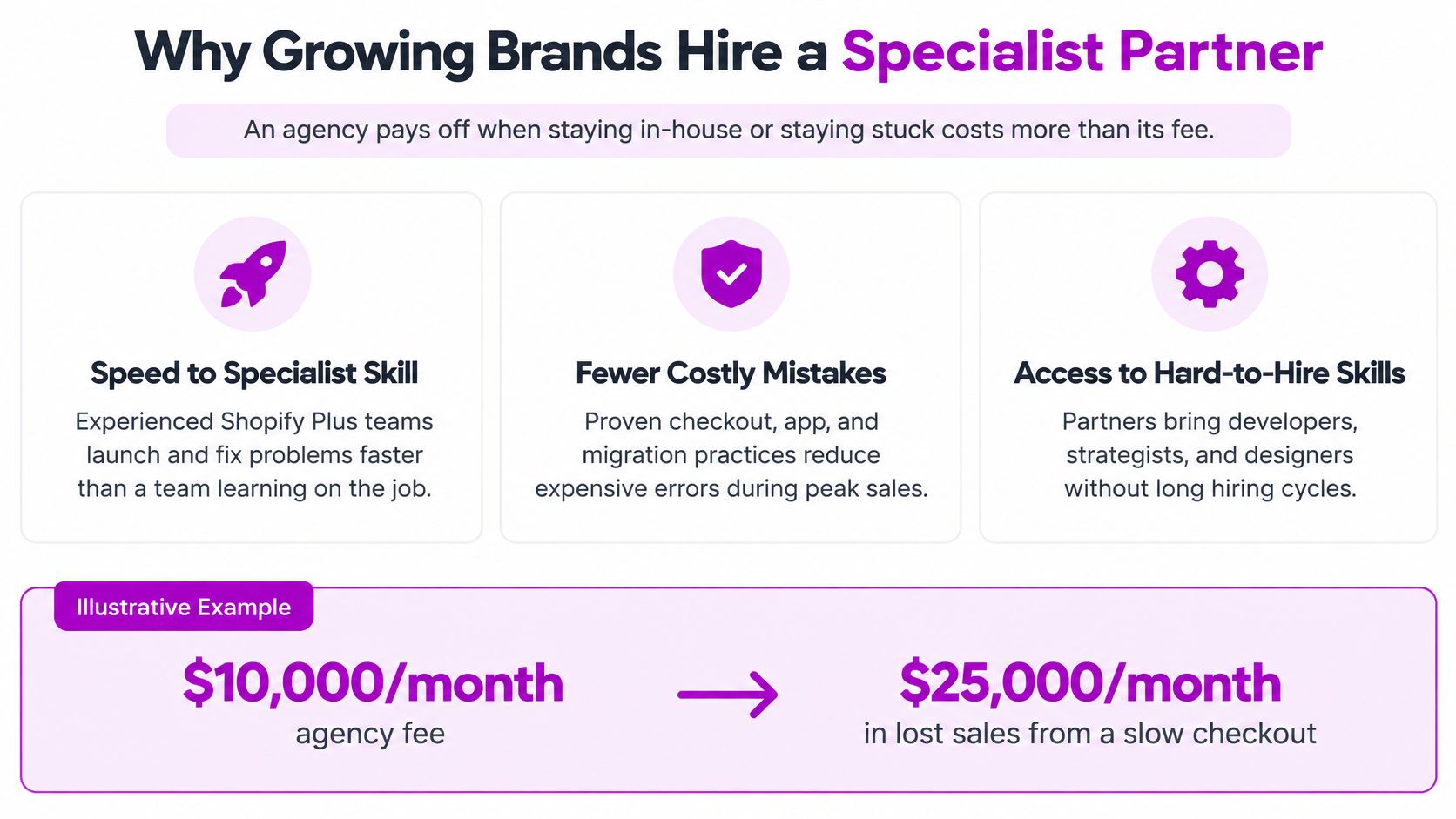
Treat the monetary comparison in the illustration as hypothetical, not an agency pricing benchmark or a forecast for your store.
Checkout opportunity needs careful interpretation
Baymard's checkout usability research provides these benchmarks: 70.19% average cart abandonment, an estimated 35% potential conversion increase through better checkout usability for an average large-scale site, and about 32 checkout improvements available on the average site.
| Metric | Figure | How to read it |
|---|---|---|
| Average cart-abandonment rate | 70.19% | Baymard's average across ecommerce sites |
| Potential conversion lift from better checkout user experience | 35% | An estimate for large-scale sites, not a guaranteed result |
| Checkout improvements available per average site | About 32 | A starting point for an audit, not your store's confirmed backlog |
A credible agency won't turn those benchmarks into a revenue promise. It should identify friction in your checkout, test a proposed fix, and watch for unwanted effects on order value, refunds, and payment failures.
Reliability is another reason to hire. Ask whether the proposed team can reduce the manual checking and emergency fixes that consume your employees' attention.
But don't buy enterprise complexity unnecessarily. A straightforward, single-product business without integrations may be better served by a freelancer or a standard Shopify setup. Separate the benefits of Shopify Plus from the question of who should implement it.
A race team needs dependable pit stops, not just an attractive car. Your agency should help your team keep trading, not merely deliver something worth photographing.
How Agencies Price Their Engagements
| Engagement model | How it is billed | Best fit | Pricing driver to check |
|---|---|---|---|
| Fixed-scope build | An agreed project fee | New store or replatform with a written specification | Change-order rules after kickoff |
| Time and materials | Hourly or daily rate | Discovery or uncertain requirements | Spending cap and weekly reporting |
| Monthly retainer | Flat monthly package of hours or sprints | Ongoing releases, CRO, and optimization | Unused-hour rollover and notice period |
| Single test project | A defined deliverable, such as a checkout audit | Testing an agency before a longer commitment | Whether implementation is included |
A fixed-scope build suits a project whose requirements are already understood. A replatform, meaning a move from another commerce platform, can fit this model if the data, integrations, and acceptance criteria are documented.
Time and materials offers flexibility when the team still needs to investigate the problem. Without a spending cap and frequent reporting, however, you carry the uncertainty.
Read the quote in delivery order
Start with discovery, the investigation that turns business requirements into an implementation plan. Ask what it produces: a system map, technical specification, migration assessment, prioritized backlog, or some combination. Paying for discovery should leave you with usable decisions and documentation.
Next, check the people assigned to delivery. A proposal should distinguish design, development, testing, project management, and technical leadership rather than hiding everything inside a blended allowance.
Then separate agency fees from operating costs:
- Platform charges: Confirm that your business pays Shopify's subscription directly and understands the applicable payment charges.
- App subscriptions: Identify required apps, account ownership, and who approves recurring costs.
- Testing environments: Ask how the team will test safely away from live customers and whether extra software charges apply.
- Quality assurance: Confirm responsibility for checking devices, payment journeys, market variations, and integrations.
- Post-launch support: Separate included defect fixes from paid enhancements and ongoing maintenance.
A low hourly rate isn't necessarily a low project price. Compare the estimated effort, senior oversight, and exclusions alongside the rate.
Likewise, a fixed fee doesn't protect you if the scope says little more than “integrate the warehouse.” Define the data exchanged, exception handling, testing, and handover before signing.
Make ongoing commitments explicit
A retainer reserves ongoing capacity. Ask whether unused time expires, rolls over, or can be reassigned, and whether meetings and project management consume the same allowance.
Cancellation terms deserve equal attention. Confirm the notice period, treatment of unfinished work, and access to code, documentation, credentials, and open tickets when the relationship ends.
A predictable invoice isn't the same as a predictable outcome. The contract needs to define both capacity and responsibility.
A small test project can reveal working habits without committing you to a full build. Make sure its deliverable is useful independently, even if you don't continue.
There's no verified typical agency rate range to use as a benchmark here. Send the same written brief to your shortlisted agencies and compare quotes line by line, including assumptions and exclusions.
Checking the Tech Stack and Integration Depth
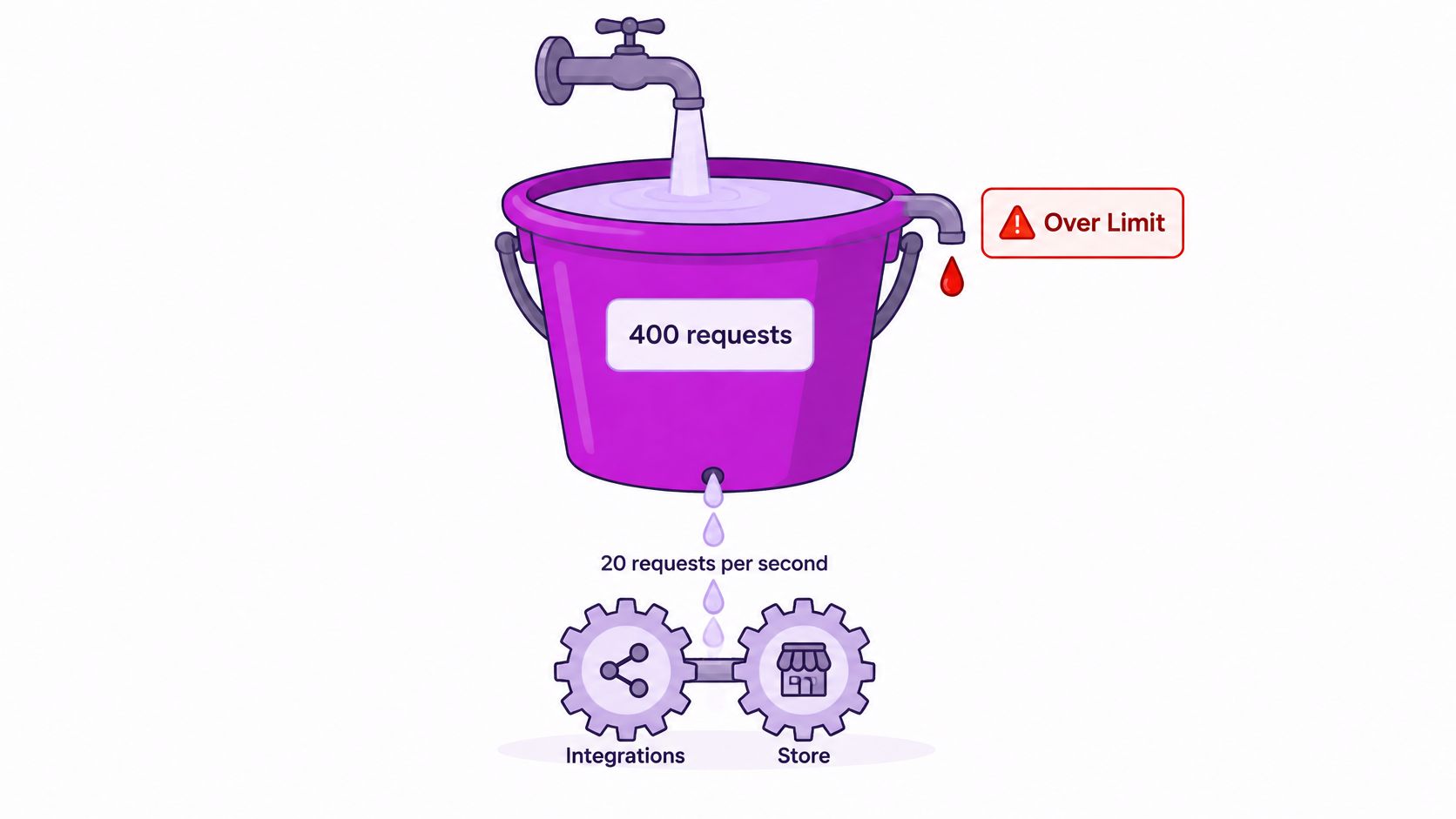
Shopify integrations must work within defined limits. For the Plus REST Admin API, Shopify documents a 400-request bucket per app per store, draining at 20 requests per second; requests beyond available capacity receive HTTP 429, a rate-limit response, in its REST Admin API rate-limit documentation.
Think of requests as water entering a bucket. Your agency must control the incoming flow rather than assume Shopify will accept every request immediately. These figures describe that specific API, not every Shopify interface.
The diagram illustrates the capacity constraint behind that conversation.
Ask how the integration behaves under pressure
You don't need to inspect code to ask useful questions. Request a walkthrough of a catalog import, a delayed inventory update, and a failed order export.
- How do you handle throttling? Look for queued jobs, meaning work waiting in an orderly processing line, and exponential backoff, meaning progressively longer waits between retries.
- Can retries create duplicates? Ask about idempotent writes, operations designed so repeating the same request doesn't create another order or record.
- How do changes reach connected systems? Prefer event-driven webhooks over constant polling, which repeatedly asks whether anything changed. Ask how periodic reconciliation catches missed updates.
- What can support staff see? Request monitoring of queue age, failures, retries, and the
X-Shopify-Shop-Api-Call-Limitresponse header. - Who maintains the connection? Require a named owner for the code, credentials, alerts, and recovery procedure.
Reconciliation means comparing records across systems and resolving differences. For example, a warehouse might acknowledge an order while the storefront still shows it awaiting export. Your team needs a way to detect and investigate that mismatch.
This video provides an additional reference point for your technical discussion.
Check maintainability, not just connectivity
Ask for a staging environment, a safe place to test changes, and version control, a recorded history of code changes. The agency should explain how it approves releases and restores a previous version when necessary.
For custom commerce rules, ask why Shopify Functions or checkout extensions fit the requirement. For a headless storefront, where the customer-facing site is built separately from the commerce backend, require a business case before considering tools such as Hydrogen.
Use your Shopify integration services requirements to test those explanations against actual workflows.
Warning signs include routine polling without justification, no staging setup, and no recovery procedure. A no-code connector isn't automatically a problem, but putting every workflow through one without a responsible owner is.
Reading Case Studies and References Critically
A flattering case study can show genuine work while offering weak evidence. Client logos establish association, screenshots show appearance, and a revenue chart may reflect advertising changes rather than the agency's contribution.
A credible account should explain the baseline, meaning the starting position, the delivery timeline, the scope, and the measurement method. It should also distinguish what the agency did from what the client's employees and other partners did.
Ask questions the portfolio doesn't answer
Request a conversation about the project's difficult parts, not another presentation of the finished homepage.
- Starting conditions: What was the baseline conversion rate, and how reliable was the tracking?
- Testing method: Which experiments ran, for how long, and what else changed during that period?
- Division of work: Who owned the enterprise resource planning system, or ERP, which coordinates core business records such as inventory and finance?
- Delivery problems: What broke after launch, and how did the team diagnose and resolve it?
- Client judgment: Would the client hire the same team again for a similar scope?
Ask for a reference from a business with comparable revenue, store count, and operational complexity. Industry familiarity helps, but a similar operating model can be more relevant than a recognizable brand name.
Ask the reference what their employees still had to fix manually after the agency finished.
Listen for how the agency handled disagreement, unexpected work, and handover. Those answers help you assess the working relationship rather than just the final deliverable.
Apply the same skepticism to AI claims
Artificial intelligence, or AI, deserves the same scrutiny as any other implementation. DHL's global business ecommerce research found that 61% of business-to-business e-tailers used AI in 2025, particularly for personalization, content generation, and customer service, according to its business-edition research announcement.
Adoption doesn't prove commercial value. Ask for a baseline and a control group, a comparable group that doesn't receive the change, alongside safeguards for accuracy, consent, and data handling.
Choose measurements that match the workflow. These might include content production time, incorrect-answer frequency, assisted purchases, or contribution margin, the revenue left after relevant variable costs.
Also name the person who approves outputs and decides when a customer needs human support. A controlled internal workflow may be more useful than a customer-facing chatbot, especially when the team can clearly measure the time saved and errors introduced.
Matching the Agency to Your Brand Stage
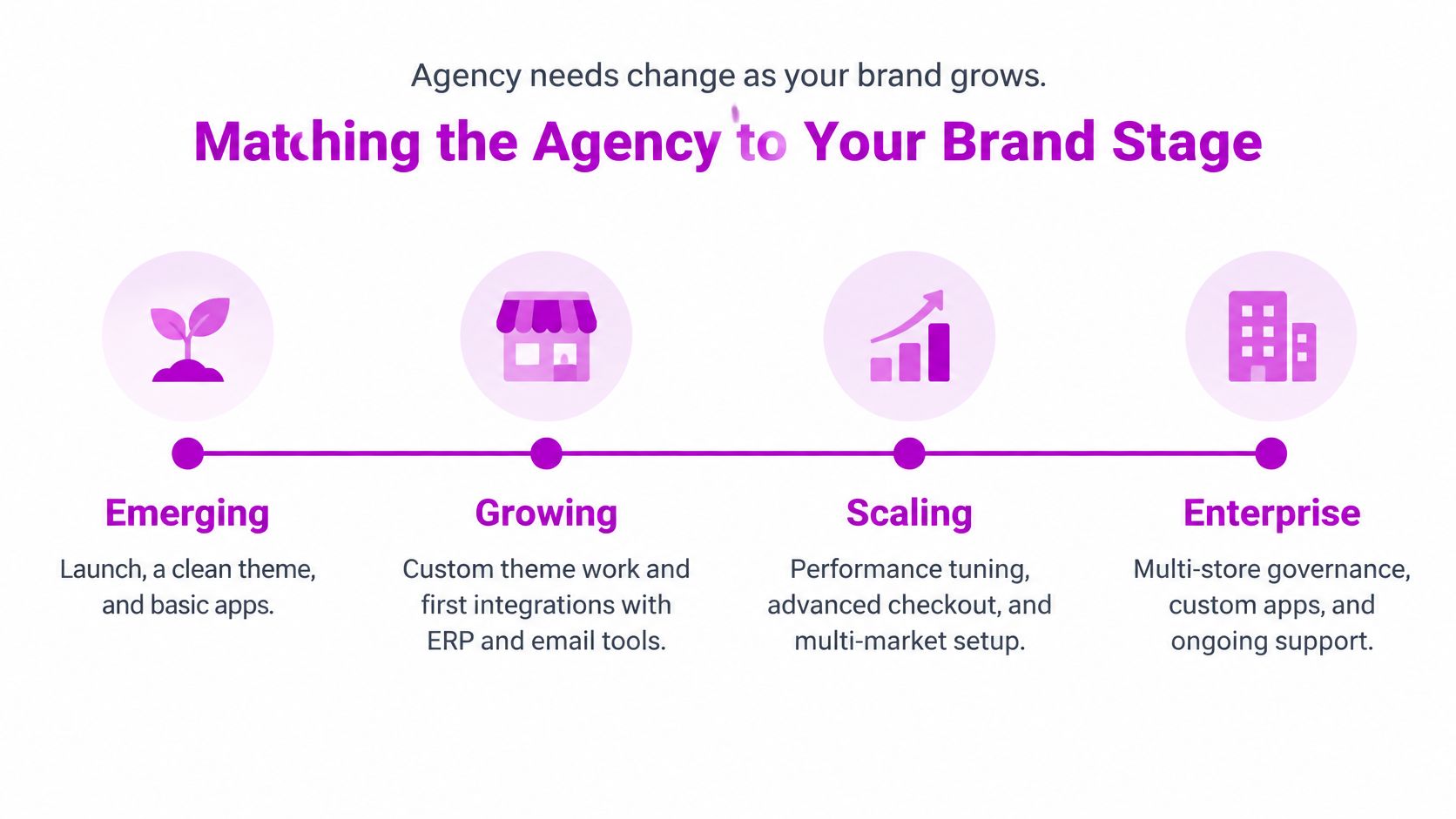
Your agency needs should follow operational complexity, not ambition alone. A brand preparing its first storefront has different risks from an established merchant replacing software used by finance and warehouse teams.
The timeline shows how the required support can change as a business develops.
| Brand stage | Typical signal | What the agency must solve | Engagement to start with |
|---|---|---|---|
| Emerging brand | Launching or early trading | Store build, clean theme, and basic apps | Fixed-scope build or single test project |
| Growing brand | Steady monthly revenue on a storefront | Checkout fixes, CRO, and first logistics or accounting connections | Monthly retainer |
| Scaling multi-market brand | Several storefronts, currencies, and languages | Multi-store architecture, international tax requirements, and order or warehouse systems integration | Retainer with a named team |
| Established Plus brand | High volume, complex systems, and migration risk | Phased migration with an ownership matrix and intensive post-launch support | Phased project contract with a post-launch period |
For an emerging brand, prioritize a maintainable store your employees can operate. Paying for elaborate custom architecture before you have a clear requirement can restrict the budget available for merchandising and customer acquisition.
A growing brand should organize ongoing work around observed problems. A third-party logistics provider, or 3PL, handles outsourced fulfillment; connecting one introduces operational responsibilities beyond theme maintenance.
Multi-market growth changes the hiring criteria
A scaling brand needs decisions about what stays shared and what varies locally. Ask how the team will manage market-specific content, releases, permissions, and reporting without creating avoidable duplication.
At this stage, an order management system, or OMS, coordinates order processing, while a warehouse management system, or WMS, manages warehouse activities. Confirm who understands the business processes behind those connections, not just their technical interfaces.
For an established merchant migrating to Plus, speed is only part of the decision. Enterprise migration guidance discusses Shopify-reported averages of 20% faster implementation and 23% lower budgets, but those aggregate comparisons don't establish the risk or cost of your project.
Require an operational migration risk map
Before approving launch, ask for a responsibility matrix covering each connected system. It should identify the business owner, technical maintainer, escalation contact, and acceptance criteria.
Define rollback criteria, the conditions that trigger a return to a previous working state, while recognizing that reversing code and reversing already-processed business transactions are different problems.
Require hypercare, an intensive post-launch support period, with a dashboard tracking order export failures, inventory mismatches, payment exceptions, unresolved incidents, and manual workarounds. Set reconciliation thresholds and escalation rules with the people who run those processes.
A technically fast migration can still leave customer service and finance doing more work. The decisive question is: What is the post-launch failure plan for our store and connected systems?
Shortlist Agencies and Book a Scoped Test
Turn your shortlist into a comparable hiring exercise. Give every candidate the same business problem, system inventory, and required outcome so you're assessing delivery proposals rather than presentation styles.
- Score the evidence. Assess service fit, pricing transparency, technical depth, verifiable results, and named post-launch ownership. Record unanswered questions rather than filling gaps with assumptions.
- Compare written scopes. Check deliverables, exclusions, responsibilities, acceptance criteria, and support terms side by side. Ask candidates to explain material differences.
- Commission a paid test. Choose a bounded checkout audit or isolated integration task before signing a long contract. Agree on the deliverable, access requirements, and decision criteria in advance.
Make the test useful even if you stop
An audit should leave your team with prioritized findings and enough evidence to act. An implementation test should include documentation, testing results, and a handover, not just a demonstration that something worked once.
Judge communication alongside technical output. Did the team surface uncertainty early, explain trade-offs plainly, and give your staff clear next steps?
Reject a candidate that can't identify its support owner or explain the rate-limit controls discussed earlier. For a large ERP or WMS migration, confirm dedicated integration capacity and the post-launch plan in writing.
Your first commitment should buy useful evidence about the working relationship, not force you to trust a polished pitch.
ECORN offers Shopify design, development, and CRO through monthly packages and single-project engagements. Visit ECORN to request a written quote against your brief or discuss a scoped test, with deliverables, integration responsibilities, and post-launch support agreed before work begins.



Shopify Themes Retina: How to Serve 2x Images

How to Cross Sell on Shopify Without Friction

Best Shopify Theme for Custom Products Compared
Multi Store Inventory Management: A Practical Guide

SEO Consulting for Ecommerce: A Practical Guide
Shopify Theme Updater App: A Safe Update Playbook
Shopify Git Integration: A Developer's Guide to 2026
Headless Ecommerce Development Services Explained

How to Build a Shopify Clothing Website That Converts

How to Launch a Box Subscription Business in 2026

Luxury Skincare Branding Playbook That Converters

10 Best Podcast Ecommerce Shows for Store Growth in 2026
Shopify Developer Hourly Rate: What to Pay in 2026
Critical Shopify Setup Errors That Are Secretly Sabotaging Your Store
Ecommerce Conversion Tracking: The Complete How-To Guide

Shopify Design Agency: How to Pick the Right Partner
Mastering Multi Store Management on Shopify

Scale Shopify Store

10 Shopify App Ideas Worth Building in 2026
Conversion Rate Optimization for Landing Pages: The Playbook
Shopify Plus Automation: A Guide for 2026
10 Social Selling Platforms for Shopify Merchants

Shopify Website Design Examples: 7 Stores Worth Studying
7 Ecommerce Newsletter Examples for Shopify Brands
One Product Shopify Store: Build and Scale

Mobile Pop Up Strategy for Shopify Stores That Converts
Sitemap for Shopify: How to Find, Optimize, and Submit It

7 Single Product Websites Worth Emulating
Product Variants Shopify: The Complete 2026 Guide
Ecommerce Analytics Consulting for Growth
What Is AI Integration for eCommerce
How to Choose the Right eCommerce Website Development Firm
E Business Strategy Implementation
Conversion Tracking Setup for Shopify Stores
BigCommerce vs Shopify Plus Which Enterprise Wins in 2026
Shopify Theme Kit: Setup, Commands, and Migration Guide
Shopify Extension Development: A Practical 2026 Guide
Shopify Speed Score Explained and How to Improve It
Shopify Mobile Optimization: The 2026 Playbook
How to Add Subcategory in Shopify for Better UX
How to Implement Structured Data for Ecommerce in 2026
SEO App Mobile: Shopify Store Optimization Guide

Shopify Plus Support: What It Includes and How to Choose

Google Ads for Shopify: The Complete 2026 Playbook

Shopify New York: How to Find and Hire the Right Agency
Google Search Console for Shopify: The Complete Setup
First Party Data Collection for eCommerce Growth
FAQ Online Store Guide: Build and Measure It Right
Do FB Ads Work for eCommerce in 2026?
One Page Checkout for Shopify: Design and Implementation
Shopify GraphQL vs REST: The 2026 Developer Decision
Shopify Ecommerce Consulting: Strategy, Pricing &

Are Reddit Ads Worth It for eCommerce Brands

Shopify Title and Meta Description: A Practical 2026 Guide

Product Video Best Practices for Shopify Brands
Real-Time Inventory Management: A 2026 Guide
AI Chatbot Integration for Shopify Stores
Affiliate Program Management: A Shopify Guide
10 Best Performance Monitoring Tools for Shopify in 2026
Digital Asset Management for eCommerce Brands in 2026

Every Type of Facebook Ads Explained for eCommerce Growth
Product Information Management Explained for Shopify Brands
Support Ticket System: A Guide for Shopify Stores

10 Best Customer Service Tools for Shopify in 2026

Can I Start a Business with No Money? a 2026 Blueprint

What Sells Good on Etsy: Best Niches for 2026

Shopify Add to Cart Button: A Practical 2026 Guide

Customer Feedback Automation: A Practical eCommerce Guide
Critical Rendering Path: A Guide for Shopify Stores

How to Promote on TikTok for eCommerce in 2026

B2B eCommerce Consulting That Drives Real Revenue
10 Best Practices for Site Navigation in 2026
Return vs Refund for Shopify Stores: A Practical Guide

What Is Customer Lifetime Value and Why It Matters

What Is Voice of Customer Research for eCommerce

SMS Marketing for Ecommerce That Actually Converts

Master How to Improve Email Deliverability in 2026

Top 8 eCommerce Partners NYC for Shopify Brands in 2026

Machine Learning for Ecommerce: Boost Your Shopify Store

Beauty Market Research: Your 2026 Growth Guide

Shopify International Expansion: A 2026 Roadmap

What Does CRO Stand for in Business: Understanding CRO

Shopify Visual Merchandising: A Playbook for Higher Sales

Shopify Landing Page Design: Master Conversion in 2026
10 Best AI SEO Optimization Tools for Shopify in 2026

Agentic AI for Ecommerce: Boost Your Sales in 2026
Mastering Email Marketing Data for eCommerce Growth

Conversion Rate Optimisation Australia: Boost Your Sales
Conversion Rate Optimization AI: Your Shopify Store Guide

10 Product Bundling Strategies for Shopify in 2026

How to Increase Customer Lifetime Value: A Shopify Playbook
AI Customer Service Automation: Shopify Guide 2026

Clean Website Design: A Shopify Conversion Playbook

Omnichannel Retail Strategy: A Shopify Playbook
Product Data Enrichment: A Guide for Shopify Brands

Instagram Shopping Features a Guide for Shopify Stores
What Is Revenue Optimization: A Holistic RevOps Guide

Benefits of Conversion Rate Optimization: Boost Your
WordPress to Shopify Migration: Your 2026 Seamless Switch
Boost Sales: Ecommerce Payment Processing Guide 2026


newsletter in your inbox