

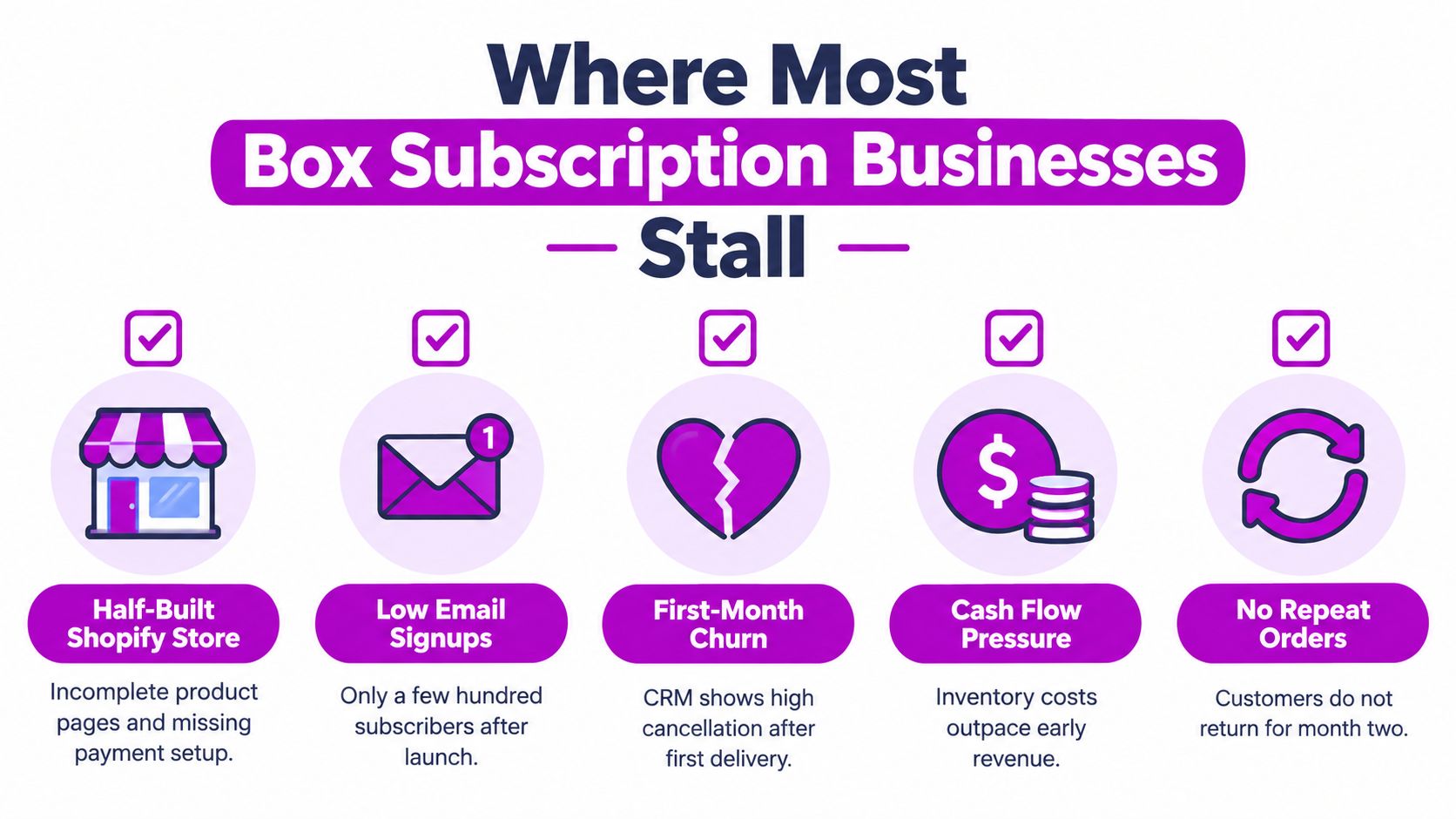
You've got a half-built Shopify store, a waitlist that looks promising, and enough first-month cancellations to make the dashboard uncomfortable. The box itself may be attractive, but attraction doesn't pay for packaging, failed payments, replacement shipments, or inventory sitting on a shelf.
A profitable box subscription business is built around contribution margin by cohort, not subscriber count. The operators who last treat cadence, sourcing, fulfillment, onboarding, and churn as one commercial system. The decisions below are deliberately ordered: validate demand, prove willingness to pay, protect cash, then scale acquisition only after the second-order economics make sense.
Where Most Box Subscription Businesses Stall
Most founders don't fail because nobody likes the concept. They fail after the first launch, when the business has enough customers to create operational complexity but not enough margin to absorb mistakes. A discount attracts the first order, a generous box inflates product cost, and a failed payment removes a customer who may never return.
The category has grown far beyond a niche experiment. McKinsey reported that 15% of online shoppers had joined at least one recurring product subscription by 2018, while subscription e-commerce had grown by more than 100% annually during the preceding five years. A longer market series places the industry at approximately $57 million in 2011, $2.6 billion in 2016, and $22.7 billion in 2021, although the source cautions that these estimates use different market definitions and shouldn't be treated as one perfectly comparable series. (McKinsey research)
Validate the customer before the catalog
Start with three questions.
- Does demand already exist? Search category trends, inspect Etsy and Amazon reviews, study competitor waitlists, and identify the language customers use when describing the problem. You're looking for repeated demand, not compliments about the idea.
- Will people pay your intended price? A landing page with a real checkout, a refundable deposit, or a tightly scoped pre-order tells you more than a survey. Keep the offer specific enough that the buyer understands what will arrive, when it will arrive, and what happens if they don't like it.
- Does the category support recurring value? Replenishment works when customers regularly consume the product. Curation works when variety matters. Discovery works when the surprise itself is valuable. If your products are neither consumed nor refreshed, the subscription has no natural reason to continue.
Competitor traffic is only a directional signal. Review velocity, repeated complaints, waitlist language, and the number of customers discussing what they received can reveal more about product-market fit than a large social following. Look especially for complaints about repetition, weak value, late delivery, and unwanted payment commitment. Those are design inputs for your offer.
Practical rule: Don't order inventory because people say they'd buy. Order when a defined audience commits money under conditions close to the real offer.
Model the first cohort before you launch
Build a simple contribution model for one box:
Selling price minus product cost, packaging, fulfillment labor, shipping, payment fees, discounts, refunds, replacement shipments, and allocated acquisition cost equals contribution margin.
Then calculate the same figure for the second and third renewal. The first order may carry a discount or sampling cost. That's acceptable only if the later orders recover the acquisition expense and remain profitable.
Set a minimum order quantity that keeps the cohort positive after expected cancellations and payment failures. If the supplier requires more units than your launch cohort can support, negotiate a smaller run, split delivery, or choose a product with a lower commitment. The correct launch size is not the number that makes the brand look established. It's the largest cohort you can serve accurately without putting the next purchasing cycle at risk.
Use established examples to sharpen the offer architecture. If your product is a spirits discovery service, reviewing how customers compare whiskey club plans can help you examine cadence, assortment, and commitment without copying the offer.
Run this pre-launch checklist in the first week:
- Identify the customer community and the recurring problem.
- Record competitor prices, delivery promises, complaints, and review patterns.
- Publish a landing page with a real price and delivery window.
- Collect deposits or pre-orders before placing a substantial purchase order.
- Build contribution margin for the first three boxes.
- Define the cohort size that keeps cash and service levels under control.
Sourcing Products and Packaging Without Locking Up Cash
Sourcing determines whether your box has room for support costs, retention work, and acquisition. A supplier that offers a low unit price but demands an oversized minimum order can be more expensive than a slightly higher-priced vendor with flexible terms.
Ask every supplier for the same scorecard: unit cost at each volume tier, minimum order quantity, lead time, payment schedule, defect policy, replacement process, customization options, and shipping terms. Request samples from more than one vendor, but test them in the same shipment or prototype run so you can compare consistency rather than relying on polished samples.
Wholesale curation is usually faster and more flexible. Private label can improve differentiation and control, but it often increases minimum orders, approvals, and lead times. A hybrid model can work well when one branded or exclusive item anchors the box and complementary wholesale products provide variety.
Packaging should protect the contents before it performs on social media. Test the actual packed box for movement, crushed corners, leaks, temperature exposure, and label failure. Printed inserts can start with short production runs or print-on-demand, while outer packaging deserves more scrutiny because freight volume, storage, and damage risk follow every design choice. For practical ideas on protecting presentation while controlling materials, review these 2026 packaging tips for takeaways.

Before signing, document the cash required for deposits, balance payments, packaging, freight, storage, and replacements. A basic inventory management process should connect component-level stock to paid subscriptions, not just finished boxes. That distinction matters when one missing item can hold up an entire shipment.
Pricing, Billing, and Cadence That Protect Margin
Price the box from the cost structure outward, not from a competitor's retail comparison. Customers don't experience your wholesale discount, packing labor, payment recovery, or replacement policy. You do.
Create one contribution-margin sheet with separate lines for:
| Cost area | What to include |
|---|---|
| Product | Wholesale, private-label, samples, and spoilage |
| Delivery | Packaging, pick-and-pack, postage, and surcharges |
| Commerce | Payment processing, subscription software, and support |
| Revenue leakage | Discounts, refunds, failed payments, and replacements |
| Growth | Allocated acquisition cost by channel |
Then compare monthly, prepaid, and annual offers using the same cohort assumptions. Monthly billing lowers commitment and may improve initial conversion, but it exposes you to repeated payment events and earlier cancellation. Annual billing collects cash sooner and can improve retention, but it requires stronger trust and a clearer value proposition.
The trade-off is visible in current market reporting. One estimate places annual subscribers at 51% lower churn than monthly subscribers, while 42% of subscribers report feeling overwhelmed by recurring payments. The same source reports that budget-friendly boxes represented 62.1% of the market in 2025, and replenishment boxes held a 48.2% share, signals that affordability and practical utility are shaping demand. (Global Market Research reporting)
Don't hide the commitment. Show the renewal date, renewal price, skip rules, cancellation path, and delivery timing before checkout. Use dunning sequences for failed cards, with clear emails and a self-service update path. A customer who intended to stay shouldn't become involuntarily churned because the payment flow gave up after one decline.
A second-box incentive can help, but avoid training buyers to cancel and rejoin. Test a benefit that reinforces continuity, such as a subscriber-only item, early choice, or shipping advantage. For a useful comparison of how a themed apparel offer explains recurring value, see this mystery shirt box subscription guide.
Fulfillment and Logistics for Month Two Onward
Fulfillment becomes a margin problem before it becomes a warehouse problem. Every extra touch, address correction, late component, damaged parcel, and replacement order belongs in the contribution model.
Start in-house when the process is still changing and hands-on control helps you learn. Create a repeatable pick list, a component check, a pack-out inspection, and a final carrier scan. Separate inventory for the next cycle from sellable one-time stock so a flash sale can't consume the item reserved for subscribers.
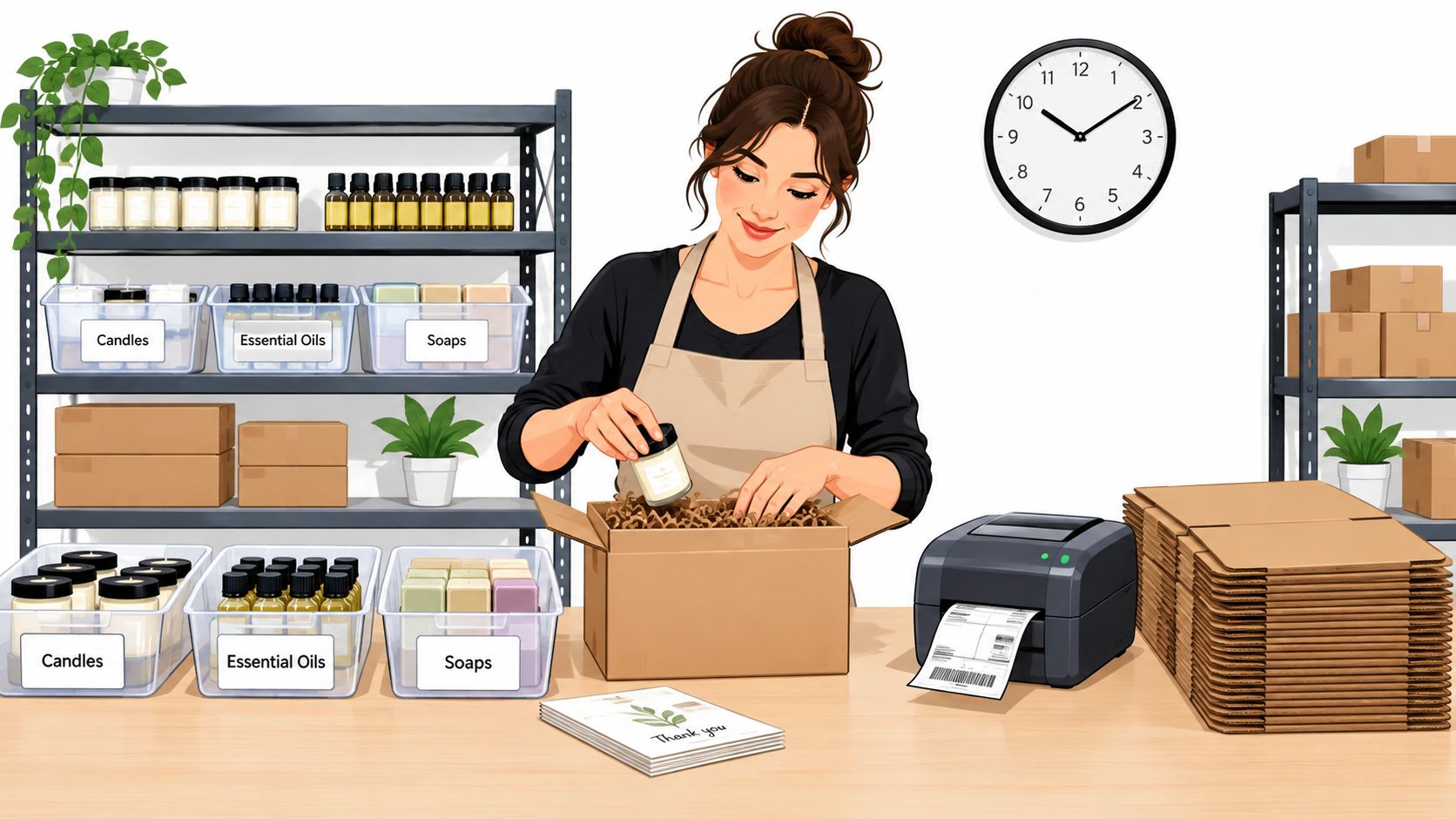
Use a 3PL when fulfillment consistently takes attention away from merchandising, lifecycle marketing, and supplier management. Don't choose on storage price alone. Ask how the partner handles kitting, late substitutions, address changes, subscription holds, damaged goods, returns, inventory counts, and peak-cycle staffing. Request service-level definitions for accuracy, dispatch timing, claims, and reporting.
Shipping zones deserve their own model. Domestic rates may support the offer while international parcels erase the margin through dimensional weight, duties, or replacement complexity. Start with the destinations you can serve reliably, then add regions after testing landed cost and support workload.
Document packaging lead times and order deadlines backward from the promised delivery date. A small buffer of critical components protects the customer experience, but excess inventory can trap cash. A short operational video can help new staff understand the physical sequence, so place this training reference after the written process rather than treating it as a substitute for one.
Retention and Conversion as a Single System
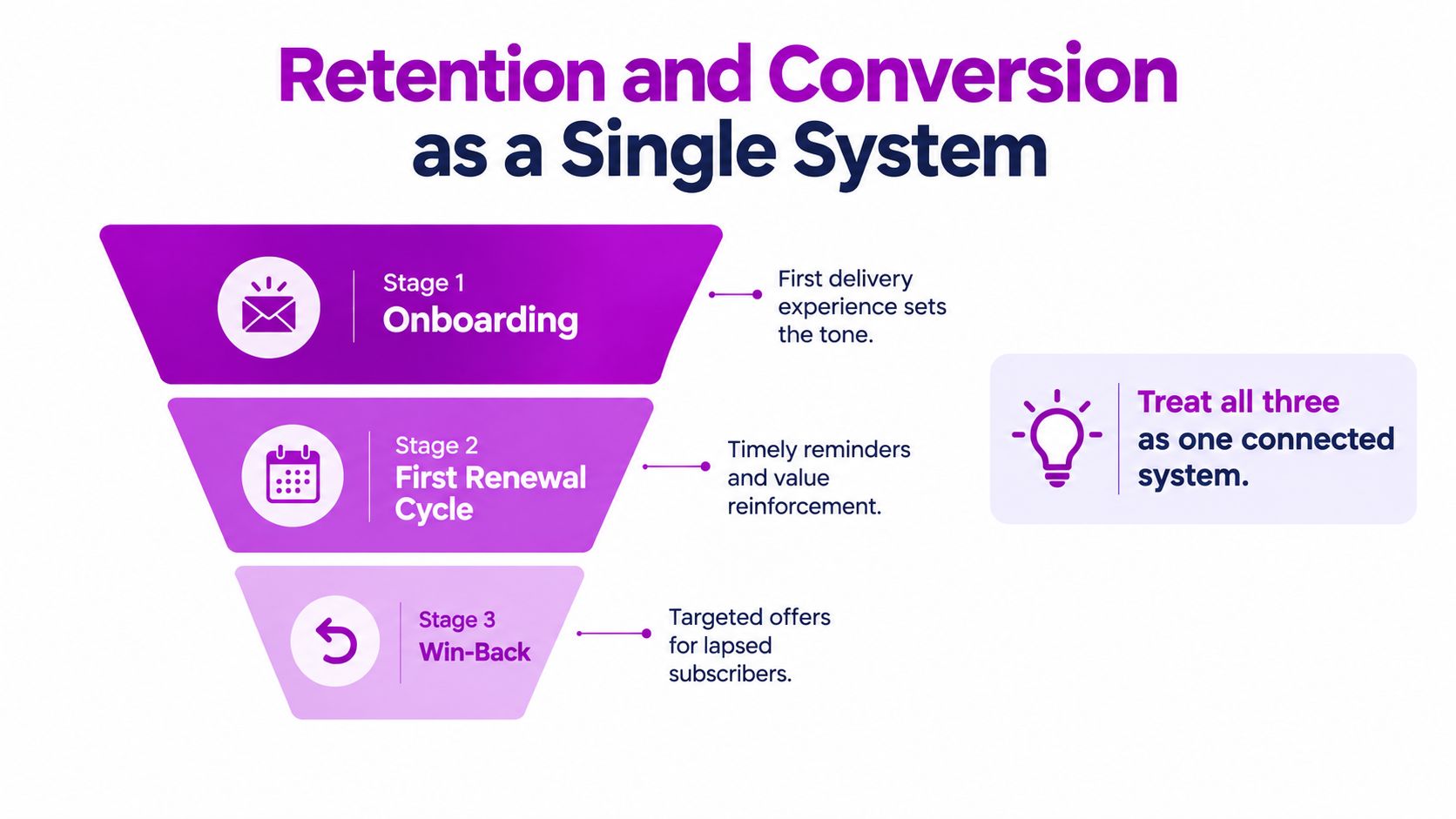
Retention starts before the first box arrives. The confirmation email should explain the delivery window, what the customer can control, and what kind of experience the subscription promises. A welcome series can introduce the curation logic, show how to use the products, and make the next renewal visible without turning every message into a sales pitch.
The first delivery creates the evidence customers use to judge the next payment. Send a short feedback request after enough time has passed for use, separate product feedback from delivery feedback, and tag cancellation reasons in a way the merchandising team can act on. “Too expensive,” “not enough variety,” “too much product,” and “arrived late” require different fixes.
Design the cancellation path around useful choices
A cancellation screen shouldn't trap the customer. Offer a pause, a skip, a cadence change, a smaller box, or a preference update before presenting cancellation. Make the final choice easy, then ask for one reason. A difficult cancellation may reduce an immediate cancellation event while increasing payment disputes and negative word of mouth.
The second-renewal page should reinforce what changes next, what remains consistent, and why the customer should keep the subscription. Show upcoming themes or product categories when disclosure won't destroy discovery. For highly curated boxes, let subscribers set boundaries such as dietary restrictions, scent preferences, sizes, or repeat avoidance without turning the operation into unlimited customization.
Treat win-back as a product signal
A win-back email should reflect the reason the customer left. Someone who paused because of excess inventory needs a different offer from someone who received a damaged parcel. Try a return option that removes the original friction, then measure whether returning customers contribute positively after the incentive and support cost.
Gift subscriptions and referrals can extend the product beyond the original buyer. Let the box itself carry the referral experience through an insert, a shareable reveal, or a gift-ready landing page. The strongest referral incentive usually makes the recipient's first experience better, rather than discounting the referrer.
Retention is not a campaign calendar. It's the combined result of product variety, billing control, delivery reliability, and a clear reason to renew.
Acquisition Channels a New Box Can Actually Run
A new box rarely fails because it lacks possible channels. It fails when acquisition brings in subscribers whose first renewal cannot cover product, fulfillment, support, and payment costs. Measure each channel by contribution margin per cohort, not subscriber count.
The reveal gives a box a usable content format. Short-form video should show the arrival, opening sequence, product details, and the reason the assortment belongs together. Test different hooks with the same box so creative performance stays separate from merchandising changes. Creator partnerships are stronger when the audience already understands the category and the creator can explain who the box suits without sounding scripted.
Paid social should amplify an unboxing angle that already earns organic attention. Run controlled creative tests, then track second-renewal behavior and cohort margin alongside first orders. A low-cost acquisition channel can still be unprofitable if it attracts customers who cancel quickly or develop payment fatigue before the next shipment.
Email and SMS deserve early investment because they preserve access to people who showed intent but are not ready to subscribe. Build the list through a specific waitlist promise, preference quiz, sample reveal, or launch access. Capture the preference as well as the contact, so future messages reflect what each prospect wants to receive.
A practical ninety-day sequence looks like this:
- Early validation: Run creator seeding, a waitlist, direct outreach, and a paid landing-page test.
- First cohort: Turn customer reactions into permission-based UGC, review requests, and referral prompts.
- Post-launch optimization: Shift spend toward channels whose cohorts remain profitable after fulfillment and support costs.
- Controlled expansion: Add one channel at a time, with a defined stop rule and a cohort report attached to every campaign.
A national market estimate puts the U.S. subscription-box market at $9.08 billion in 2024 and projects $25.83 billion by 2033, while reporting that 54% of U.S. online shoppers had tried at least one subscription-box service. The same estimate reports that approximately 44% of cancellations occur within the first 90 days, so acquisition creative must set an accurate expectation for the first renewal, not merely win the click. (Global Market Insights estimate)
Building the Stack on Shopify and Shopify Plus
Your technology stack should make contribution margin per cohort easier to see. If it celebrates gross revenue while hiding churn, failed payments, and fulfillment costs, it encourages decisions that can enlarge an unprofitable subscription base.
A practical Shopify setup has five layers:
- Subscription billing: Choose a platform with recurring charges, customer self-service, skips, pauses, plan changes, failed-payment retries, and clear renewal communication.
- Lifecycle messaging: Connect email and SMS events to subscription status, shipment progress, payment failures, cancellations, and win-back eligibility.
- Inventory and fulfillment: Sync subscription quantities with component inventory, purchase orders, kitting requirements, substitutions, and shipment confirmation.
- Customer experience: Add reviews, preferences, loyalty, and referral features only when each supports a measurable decision.
- Analytics: Combine order, subscription, product, channel, and fulfillment data so contribution margin does not require manual spreadsheet reconstruction.
For implementation guidance, Shopify subscription services can help frame the work across billing, storefront, and operational integrations. App choice matters, but the data model matters more. Before committing, confirm that customer IDs, subscription states, cancellations, skips, refunds, and payment recovery events can flow into your analytics system.
Shopify Plus supports advanced checkout and merchandising tests through Checkout Extensibility and compatible platform tools. Use those capabilities for controlled experiments rather than customizing every customer path. A one-click reorder, clearer plan comparison, or better post-purchase offer earns its place only when the resulting cohort remains profitable.
Build the operating dashboard around decisions
Review these metrics weekly:
- Acquisition cost by channel: Decide which sources deserve more testing.
- First-to-second renewal rate: Check whether the initial promise survives the first delivery.
- Contribution margin per box: See whether growth creates or consumes cash.
- Dunning recovery rate: Measure revenue recovered from payment friction.
- Pause, skip, and cancellation reasons: Separate affordability, product fatigue, and service failure.
Review these metrics monthly:
- Cohort retention curves: Compare customers by acquisition month, offer, channel, and plan.
- Annual-plan conversion: Assess commitment without disguising a weak value proposition.
- Reorder rate: See whether one-time buyers become useful future demand.
- Inventory variance: Compare planned components with actual usage, substitutions, and waste.
- Subscription P&L: Include discounts, support, replacement shipments, fulfillment, payment costs, and allocated acquisition costs.
A one-page report should show cohort size, collected revenue, variable costs, contribution margin, cancellations, failed payments, recovered payments, and the next operational constraint. Keep gross subscriber count visible, but do not let it lead the meeting.
The dashboard should answer one question first: if we acquire more customers under the current offer, will the next cohort improve the business or enlarge the problem?
Use weekly reviews for exceptions and operational fixes. Use monthly reviews for pricing, assortment, cadence, supplier terms, and channel allocation. Change one major variable at a time, or the cohort result will be difficult to interpret.
The worldwide market has been estimated at $27.70 billion in 2025, with a projection of $79.73 billion by 2035 and a reported annual growth rate of 10.7% for 2026 through 2035. Because market researchers use different definitions, treat these figures as directional context rather than a forecast for your store. (Global Market Insights worldwide estimate)
ECORN helps Shopify brands improve subscription journeys through storefront strategy, CRO, Shopify development, Shopify Plus work, and integrations connecting billing, fulfillment, and reporting. If your box subscription business needs a clearer unit-economics dashboard or a more reliable customer flow, visit ECORN to discuss a focused project or ongoing support.


Luxury Skincare Branding Playbook That Converters
10 Best Podcast Ecommerce Shows for Store Growth in 2026

Shopify Developer Hourly Rate: What to Pay in 2026
Critical Shopify Setup Errors That Are Secretly Sabotaging Your Store
Ecommerce Conversion Tracking: The Complete How-To Guide

Shopify Design Agency: How to Pick the Right Partner
Mastering Multi Store Management on Shopify

Scale Shopify Store
10 Shopify App Ideas Worth Building in 2026
Conversion Rate Optimization for Landing Pages: The Playbook
Shopify Plus Automation: A Guide for 2026
10 Social Selling Platforms for Shopify Merchants

Shopify Website Design Examples: 7 Stores Worth Studying
7 Ecommerce Newsletter Examples for Shopify Brands
One Product Shopify Store: Build and Scale
Mobile Pop Up Strategy for Shopify Stores That Converts

Sitemap for Shopify: How to Find, Optimize, and Submit It

7 Single Product Websites Worth Emulating
Product Variants Shopify: The Complete 2026 Guide
Ecommerce Analytics Consulting for Growth

What Is AI Integration for eCommerce
How to Choose the Right eCommerce Website Development Firm
E Business Strategy Implementation
Conversion Tracking Setup for Shopify Stores
BigCommerce vs Shopify Plus Which Enterprise Wins in 2026
Shopify Theme Kit: Setup, Commands, and Migration Guide
Shopify Extension Development: A Practical 2026 Guide

Shopify Speed Score Explained and How to Improve It
Shopify Mobile Optimization: The 2026 Playbook
How to Add Subcategory in Shopify for Better UX
How to Implement Structured Data for Ecommerce in 2026

SEO App Mobile: Shopify Store Optimization Guide
Shopify Plus Support: What It Includes and How to Choose

Google Ads for Shopify: The Complete 2026 Playbook

Shopify New York: How to Find and Hire the Right Agency

Google Search Console for Shopify: The Complete Setup
First Party Data Collection for eCommerce Growth
FAQ Online Store Guide: Build and Measure It Right
Do FB Ads Work for eCommerce in 2026?

One Page Checkout for Shopify: Design and Implementation
Shopify GraphQL vs REST: The 2026 Developer Decision
Shopify Ecommerce Consulting: Strategy, Pricing &

Are Reddit Ads Worth It for eCommerce Brands
Shopify Title and Meta Description: A Practical 2026 Guide

Product Video Best Practices for Shopify Brands
Real-Time Inventory Management: A 2026 Guide

AI Chatbot Integration for Shopify Stores
Affiliate Program Management: A Shopify Guide
10 Best Performance Monitoring Tools for Shopify in 2026
Digital Asset Management for eCommerce Brands in 2026
Every Type of Facebook Ads Explained for eCommerce Growth
Product Information Management Explained for Shopify Brands
Support Ticket System: A Guide for Shopify Stores

10 Best Customer Service Tools for Shopify in 2026

Can I Start a Business with No Money? a 2026 Blueprint

What Sells Good on Etsy: Best Niches for 2026

Shopify Add to Cart Button: A Practical 2026 Guide

Customer Feedback Automation: A Practical eCommerce Guide
Critical Rendering Path: A Guide for Shopify Stores

How to Promote on TikTok for eCommerce in 2026

B2B eCommerce Consulting That Drives Real Revenue
10 Best Practices for Site Navigation in 2026
Return vs Refund for Shopify Stores: A Practical Guide
What Is Customer Lifetime Value and Why It Matters
What Is Voice of Customer Research for eCommerce

SMS Marketing for Ecommerce That Actually Converts

Master How to Improve Email Deliverability in 2026

Top 8 eCommerce Partners NYC for Shopify Brands in 2026
Machine Learning for Ecommerce: Boost Your Shopify Store

Beauty Market Research: Your 2026 Growth Guide

Shopify International Expansion: A 2026 Roadmap

What Does CRO Stand for in Business: Understanding CRO

Shopify Visual Merchandising: A Playbook for Higher Sales

Shopify Landing Page Design: Master Conversion in 2026

10 Best AI SEO Optimization Tools for Shopify in 2026

Agentic AI for Ecommerce: Boost Your Sales in 2026
Mastering Email Marketing Data for eCommerce Growth

Conversion Rate Optimisation Australia: Boost Your Sales
Conversion Rate Optimization AI: Your Shopify Store Guide

10 Product Bundling Strategies for Shopify in 2026
How to Increase Customer Lifetime Value: A Shopify Playbook
AI Customer Service Automation: Shopify Guide 2026

Clean Website Design: A Shopify Conversion Playbook

Omnichannel Retail Strategy: A Shopify Playbook
Product Data Enrichment: A Guide for Shopify Brands
Instagram Shopping Features a Guide for Shopify Stores

What Is Revenue Optimization: A Holistic RevOps Guide

Benefits of Conversion Rate Optimization: Boost Your
WordPress to Shopify Migration: Your 2026 Seamless Switch
Boost Sales: Ecommerce Payment Processing Guide 2026
Unified Commerce Platform: Benefits, KPIs & Shopify Guide
How to Reduce Bounce Rate eCommerce: Your 2026 Guide
Shopify API Integration: A Practical End-to-End Guide

How to Implement Data Governance: A 2026 Guide
Shopify Store Development Cost: A 2026 Breakdown
What Is Server Side Tracking: The Shopify Guide 2026
Marketing Automation Workflows: A Shopify Guide for 2026
Shopify: How to Reduce Technical Debt

Shopify UX Design Change: A Playbook for Growth
User Generated Content Strategy: Shopify Playbook


newsletter in your inbox