

Your storefront says the jacket is available. The warehouse team says it isn't. Customer service has a paid order, a customer waiting for dispatch, and no reliable answer about whether the replacement stock is sellable.
That's the point where multi store inventory management stops being a catalog-sync task. The actual job is controlling what each storefront can promise, who can commit inventory, and how physical movements become trustworthy records.
When the Same Shirt Sells Twice
Consider a hypothetical Shopify brand selling through regional storefronts in the US, Europe, and Australia. The Australian team accepts an order for a denim shirt while the European storefront accepts another order against the same remaining stock. Both checkouts succeed because each storefront is working from a copied quantity rather than a shared commitment.
Customer service discovers the conflict when fulfillment rejects an order. Someone suggests using a returned shirt at another warehouse, but nobody knows whether the returns team has inspected it. The dashboard shows inventory; the people responsible for shipping can't confirm a usable unit.
The failure starts before checkout
It's tempting to blame the synchronization app. That may be part of the problem, but this scenario exposes separate decisions that the business never settled.
- Inventory authority: Which system can declare that stock exists, and which systems merely display its decision?
- Commitment authority: What prevents separate storefronts from promising the same stock before their quantities refresh?
- Disposition authority: Who decides whether a returned product can rejoin the sellable pool?
A faster update won't resolve unclear ownership. Nor will a stop-selling rule help if the quantity feeding it includes goods awaiting inspection.
Practical rule: A stock update tells another system what happened. A reservation determines whether an order is allowed to happen.
Treat the order as an operational test
Before changing settings, trace the rejected order backward. Identify the product mapping, the location that supplied availability, the commitment event, and the last physical verification. Then follow the returned item separately, including its inspection status and storage position.
That exercise should produce more than an explanation for customer service. It should reveal whether the brand needs cleaner master data, a different synchronization model, stronger counting controls, explicit inventory states, or clearer governance.
The useful question isn't whether every storefront displays the same number. It's whether each storefront can make a promise that the fulfillment team can keep.
The Core Concepts You Need to Share
Think of the operation as a transport network. The catalog identifies the cargo, locations tell you where it sits, and allocation determines which shipment gets priority. Agree on that vocabulary before evaluating software.
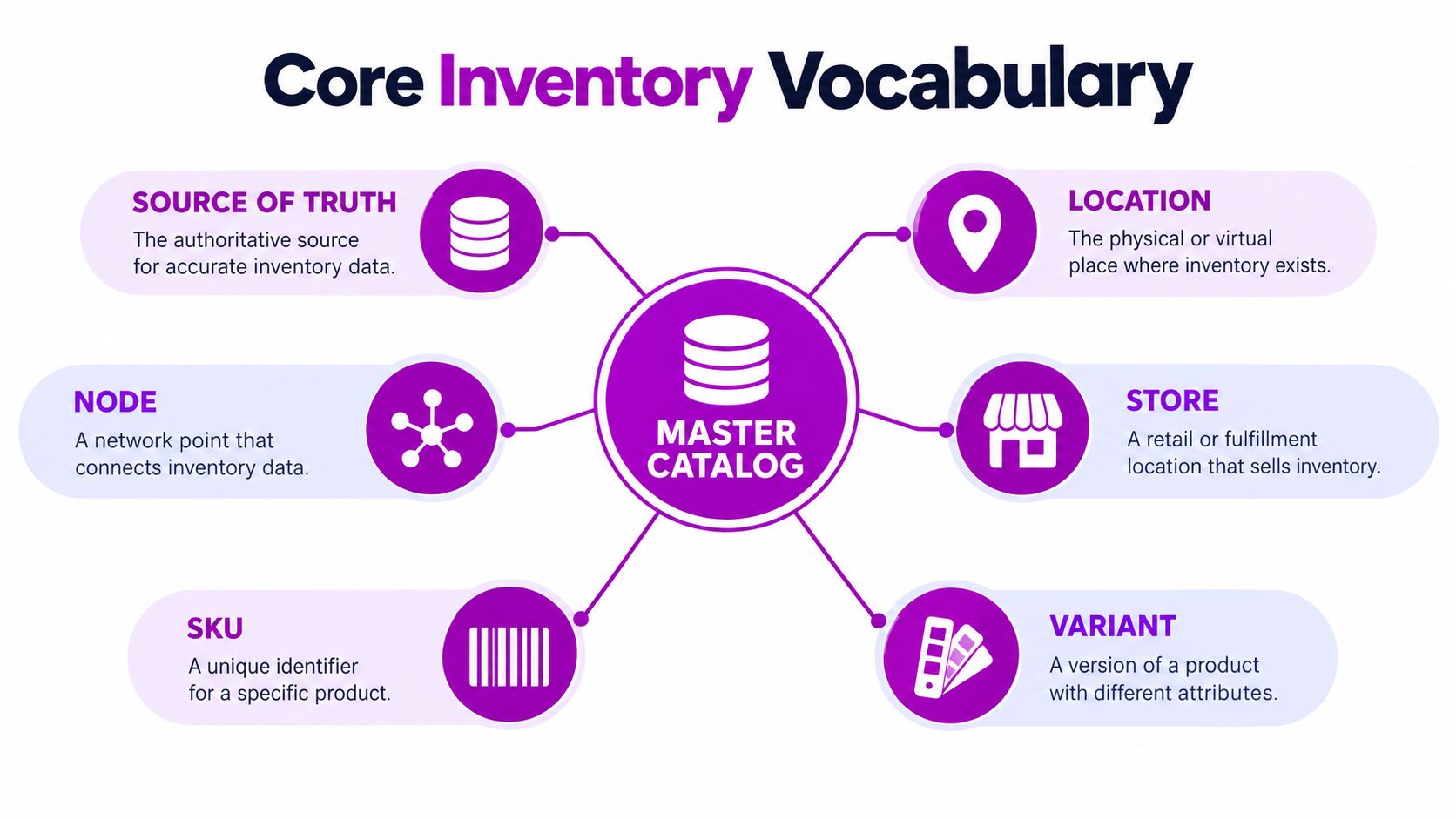
A master catalog is the governed product reference, not necessarily the system that owns stock. A variant describes a purchasable configuration, such as a denim shirt in a particular size and color; its SKU is the operational identifier used to match it across systems.
Separate identity, position, and permission
- Source of truth: The designated authority for a particular record. Your product information system might own descriptions while an inventory ledger owns stock movements.
- Store: The customer-facing Shopify storefront. Don't use this interchangeably with a physical shop or warehouse.
- Location: The stock-holding or fulfillment location represented in your setup.
- Node: The operational endpoint used by an order management system, or OMS, when routing orders. Map it explicitly to Shopify locations rather than assuming the records match.
- Allocation: The assignment of stock to a channel, region, or order.
- Available-to-promise: The quantity your rules permit a storefront to offer, rather than everything physically present.
- Safety stock: A deliberate buffer withheld to protect against uncertainty.
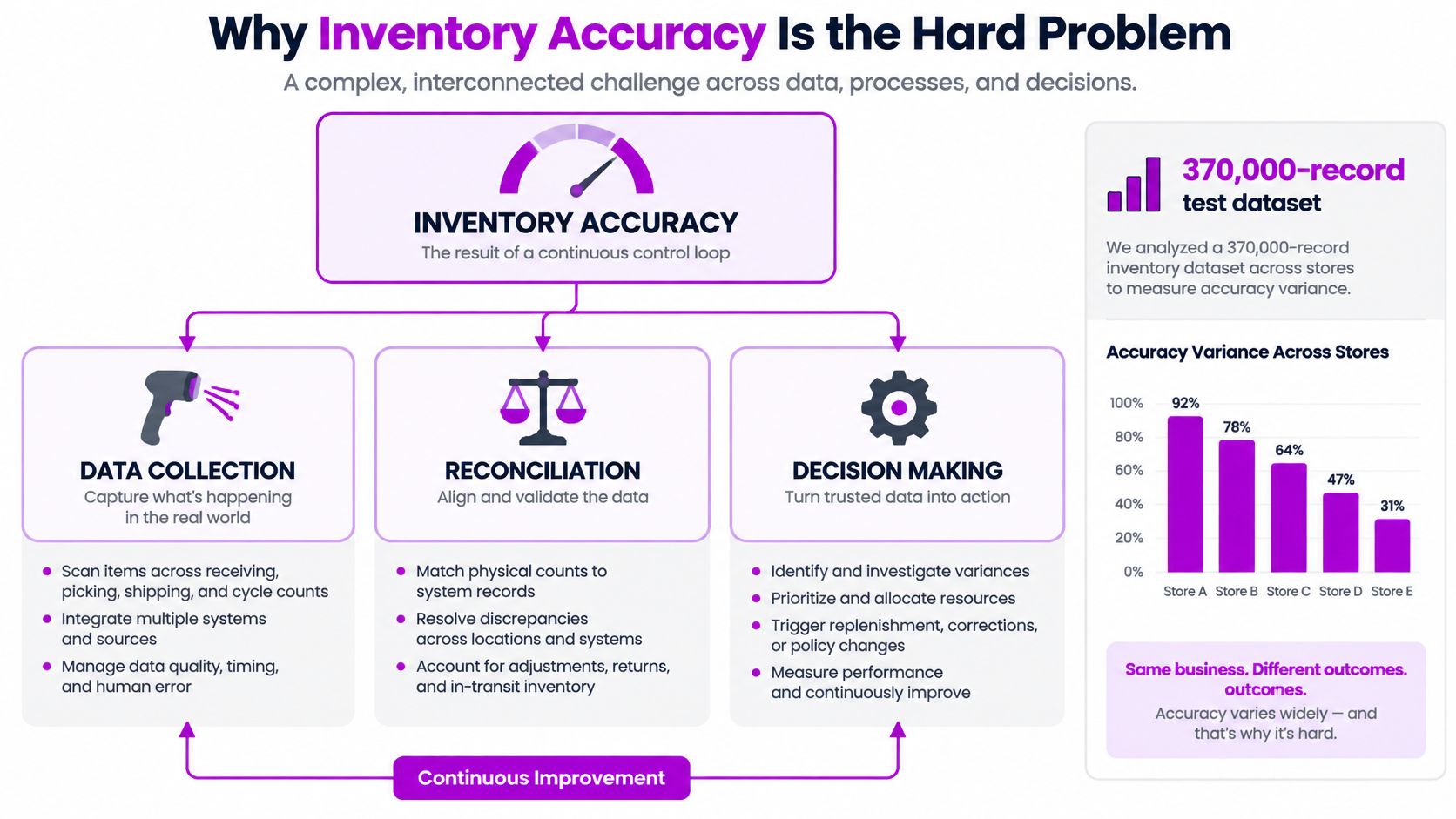
These distinctions matter because inventory records aren't automatically reliable. Researchers examining nearly 370,000 records across 37 stores found 65% were inaccurate, with differences associated with both product and store characteristics; that was a specific retailer's historical dataset, not a universal current rate (Harvard Business School study summary).
Define what “real time” actually means
Ask vendors to define event latency, reconciliation frequency, and stale-data behavior. A frequent refresh and an immediate stock commitment solve different problems.
For an initial logistics-software shortlist, the top picks from Routelink provide a starting point. Take this vocabulary into the evaluation, then ask each vendor to demonstrate the exact records and permissions behind its availability figure.
Choosing the Right Sync Model for Your Stores
Choose the model around who can commit stock, not around which integration has the shortest installation guide. The following are architectural patterns, not mutually exclusive product categories. A brand can centralize product data while distributing fulfillment.
Sync Model Comparison for Shopify Multi-Store Brands
| Sync Model | Best For | Key Strength | Main Risk |
|---|---|---|---|
| Centralized master with per-store allocation | Brands protecting stock by market or channel | Clear authority and controlled exposure | Stock can remain unavailable to demand elsewhere |
| Hub-and-spoke | Regional storefronts supplied by a common warehouse | Simpler fulfillment ownership | Heavy dependence on the hub and its connection |
| Distributed stores with a shared ledger | Networks using several fulfillment locations | Flexible routing across eligible stock | More demanding commitment and reconciliation logic |
Centralized allocation is a sensible choice when regional protection matters more than unrestricted pooling. Each storefront receives a controlled selling allowance. Adding a market can be administratively straightforward, but someone must govern how allowances change and what happens to unused stock.
Hub-and-spoke fits a business whose storefronts mainly provide localized selling experiences while fulfillment remains concentrated. Checkout reconciliation has a clear destination. Expansion gets harder when a new region introduces local stock, customs constraints, or a fulfillment partner with different operating rules.
A distributed shared ledger supports more flexible fulfillment. However, the ledger must resolve concurrent commitments rather than just aggregate quantities after orders arrive. During an outage, decide whether an affected node stops accepting commitments, uses a protected allowance, or requires manual approval.
Test the failure path
Ask each vendor to demonstrate delayed events, duplicate messages, cancellations, and reconnection after an outage. Adding a region should also include a test of product mapping, fulfillment eligibility, and local exception ownership.
Adjacent industries offer useful evaluation prompts. BenchKey's software for multiple repair stores is a relevant reference when considering multi-location workflows, though a Shopify retailer should validate commerce-specific reservation and routing requirements independently.
Don't choose distributed fulfillment merely because it exposes more inventory. Choose it when the additional availability justifies the operational controls needed to support it.
Why Inventory Accuracy Is the Hard Problem
A synchronized discrepancy is still a discrepancy. Inventory accuracy needs a control loop: observe physical stock, compare it with the ledger, investigate the variance, and change the process that created it.
In the historical dataset discussed earlier, 26.4% of inventory-record inaccuracy variance occurred between product categories, compared with 2.7% between stores (inventory-record inaccuracy research). That supports investigating category and handling differences instead of assuming the weakest store manager explains every problem.
Count according to exposure
Segment SKUs by sales velocity, value, handling complexity, and discrepancy history. Give frequently handled or repeatedly miscounted products more attention than stable stock with little movement. Don't confuse equal counting effort with equal control.
Make counts reproducible. Specify whether staff should pause movements, how they handle an open pick, and whether counters can see the expected quantity. Without consistent instructions, teams can produce different answers while following what each believes is the correct process.
Use metrics that lead to action
- Location-by-SKU accuracy: Compare counted records with expected quantities, preserving the location and product detail.
- Phantom-stockout rate: Track eligible fulfillment attempts where the record showed availability but staff couldn't locate or process the stock.
- Transfer accuracy: Compare dispatched and received quantities, separating discrepancies from transfers that remain legitimately open.
- Inventory adjustment rate: Track corrections against a consistently defined activity base, retaining both adjustment direction and reason.
Define denominators before comparing teams. A location that investigates discrepancies thoroughly may initially report more adjustments than one that leaves problems unresolved.
Don't reward a clean dashboard if the team achieves it by closing exceptions without evidence.
Every variance should carry a reason code, an owner, and supporting context. Repeated receiving errors call for a different intervention than misplaced returns or incorrect variant labels. Counting earns its keep when those findings change the underlying workflow.
Designing an Inventory State Model That Holds
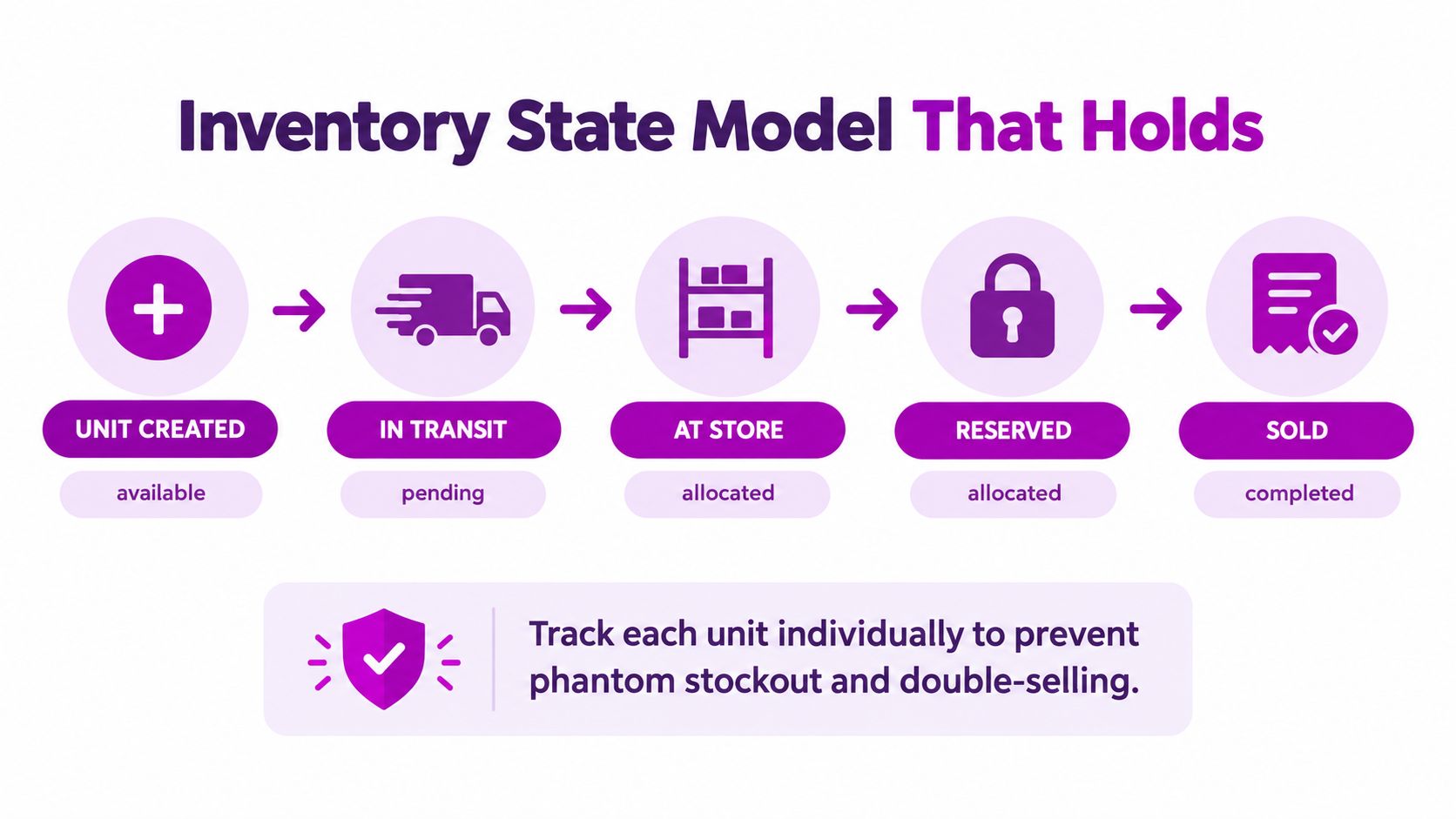
On-hand is a physical quantity, not permission to sell. Build the model so physical possession, condition, and order commitment remain distinguishable. These dimensions overlap, so they shouldn't all become additive buckets.
Research discussing retail record discrepancies describes roughly 50–70% of SKUs as potentially affected and identifies congestion and distributed stock as contributors to phantom stockouts (omnichannel inventory research). The practical response is to track why a unit is or isn't eligible, not merely whether it exists.
Define the states without double subtraction
| State or measure | Operational meaning |
|---|---|
| On-hand | Physically held at the location, including unsellable goods |
| Sellable | Meets condition and channel-eligibility rules |
| Reserved | Temporarily committed while an order decision completes |
| Allocated | Assigned to confirmed fulfillment work |
| In-transit | Dispatched but not yet received |
| Returned-awaiting-inspection | Received back without an approved disposition |
| Damaged | Excluded from normal selling |
| Lost/unknown | Under investigation and unavailable to promise |
Document whether “sellable” means eligible before commitments or remaining after them. Otherwise, an integration may subtract reservations from a quantity that already excludes them.
Make transitions explicit
In a hypothetical US order flow, the commitment service reserves eligible stock, then converts that reservation into an allocation when the order meets your acceptance rules. A cancellation releases the existing commitment through a traceable event rather than adding stock blindly.
A warehouse transfer removes source availability at dispatch and stays in-transit until receipt. A return at the European warehouse enters awaiting-inspection; an authorized disposition moves it into sellable, damaged, or another controlled outcome.
Require each transition to retain:
- Identity: SKU, location, quantity, and relevant order or transfer reference.
- Evidence: Actor, event identifier, occurrence time, and processing time.
- Recovery behavior: Duplicate-message handling, reversal rules, and exception ownership.
Use Shopify Flow for suitable orchestration, but verify which system enforces the stock commitment itself. A workflow notification isn't a substitute for an atomic reservation.
The Uncomfortable Truth About Fragmented Systems
Buying forecasting software before reconciling operational data is an expensive way to make uncertain inputs look authoritative. A recommendation can be mathematically complex and still depend on the wrong product mapping.
A retail survey found that 27% of respondents had an integrated POS, inventory, and finance system, while 73% operated with disconnected systems and inconsistent cross-functional data (Priority retail survey report). Treat that as a finding about the surveyed retailers, not proof that your own architecture needs replacement.
Follow the data into the recommendation
Suppose regional storefronts use different identifiers for the same variant. A forecasting tool may treat their demand histories as unrelated. If a transfer is recorded as an adjustment, the same tool may also interpret a stock movement as unexplained inventory loss.
Delayed POS feeds create another decision problem: planners must distinguish genuinely weak demand from incomplete reporting. Store calendars matter too, especially when operating days, time zones, and reporting cutoffs differ.
A smaller ledger that operators can audit is a better foundation than a sophisticated prediction nobody can reconcile.
Set prerequisites before adding automation
- Canonical identifiers: Maintain governed SKU and location mappings, including retired identifiers.
- Event semantics: Distinguish a sale, return, receipt, transfer, and adjustment.
- Time conventions: Preserve when an event happened and when each system processed it.
- Reconciliation ownership: Assign who resolves differences between commerce, warehouse, and finance records.
- Human overrides: Require a reason, an owner, and an expiry or review condition.
Spreadsheets and scheduled reconciliation can remain acceptable when commitments are separated, activity is manageable, and an accountable operator can resolve exceptions before the next selling decision. They're a poor fit when concurrent storefronts compete for shared stock.
Consider an OMS when order commitments and routing need centralized control. Consider an ERP when purchasing, valuation, finance, and inventory governance need broader coordination. Neither label guarantees a sound implementation; test the actual workflows.
Common Pitfalls and How to Prevent Them
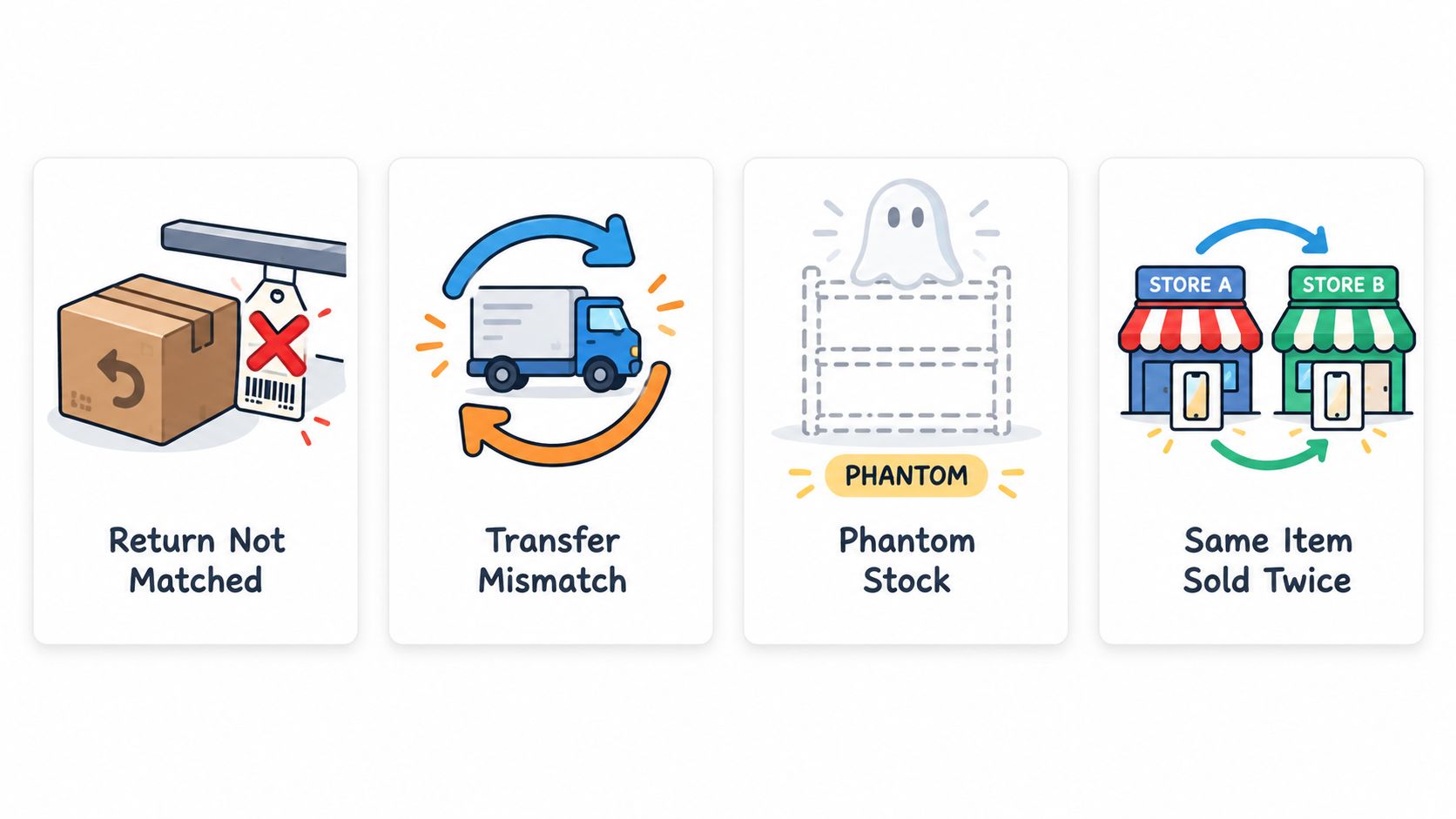
Use the following hypothetical incidents as diagnostic patterns, not case studies. Each starts with a plausible customer-facing symptom and ends with a control someone must own.
Recognize the incident behind the symptom
A returned item gets ordered before inspection. Customer service sees a fulfillment rejection after a refund. The event history shows that refund processing also triggered restocking, despite no inspection decision. Separate those permissions and make the returns lead responsible for disposition.
A transfer remains open after delivery. Planning recommends replenishment while destination staff say the cartons arrived. Compare dispatch records with receiving evidence, then route unresolved differences to the receiving lead rather than closing the transfer without review.
Stock exists but nobody can pick it. The unit is in an unlabelled backroom container. Cedar & Lily Clothier's best ways to organize your closet offers a consumer-scale organizational reference; warehouse operations need the stricter equivalent of assigned bins, status zones, and controlled put-away.
Competing orders claim the same unit. The integration shows successful quantity updates after both orders. The missing control is commitment arbitration, not necessarily update delivery.
Give every exception an owner
- Returns lead: Monitor rejected picks involving recently returned stock.
- Receiving lead: Investigate aged transfers and shipment-to-receipt differences.
- Warehouse supervisor: Review missing-bin and unsuccessful-pick exceptions.
- Commerce engineering: Investigate conflicting commitments and replay behavior.
RFID can support physical identification: a retail white paper reports accuracy reaching 99% in studied programs and a 15% shrink reduction for one retailer, but those results aren't guarantees for another network (retail inventory visibility white paper).
For broader process work, use these inventory management best practices alongside an exception register. Technology investment should follow the error pattern you can demonstrate.
An Operator's Checklist to Apply This Week
Start with a contained product group and trace its full operating path. Include a clean sale, a cancellation, a transfer, and a returned item. The aim is to prove that the records explain reality before expanding the scope.
Sequence the work by dependency
Establish the canonical model. Resolve product and location mappings across Shopify storefronts, fulfillment partners, and back-office systems. You're ready to proceed when an operator can trace a variant across those systems without guessing.
Name the ledger and its authority. Document which system owns each event and which systems consume it. The maturity signal is a clear answer to conflicting records, including the evidence required to correct them.
Validate state transitions. Test the model against cancellations, partial receipts, failed inspections, and delayed messages. Proceed when replaying an event doesn't create another movement or commitment.
Reconcile operational and financial views. Compare sales, receipts, returns, transfers, and adjustments with their corresponding warehouse and finance records. Require explanations for differences rather than forcing all reports to display the same total.
Automate bounded decisions. Introduce routing and replenishment rules with explicit exception paths. Readiness means operators can explain the decision, stop it safely, and recover without losing the audit trail.
Add forecasting with review controls. Use the guidance on demand forecasting for eCommerce to shape planning after the inputs are dependable. Define acceptable adjustment levels, forecast bias, and service outcomes for your business instead of borrowing an arbitrary readiness threshold.
Choose a realistic scope
Don't turn the initial review into an uncontrolled platform migration. A targeted audit or integration project may resolve a specific authority gap; ongoing operational changes may need recurring support and a maintained backlog.
The durable result isn't another dashboard. It's a network where operators can explain what is owned, what is usable, what is committed, and what still needs investigation.
ECORN offers subscription-based Shopify support, single-project engagements, and Shopify Plus expertise for brands scaling across markets. Visit ECORN to discuss a focused inventory-workflow audit or integration project, bringing your storefront map, system owners, and a recent failed-order example.


SEO Consulting for Ecommerce: A Practical Guide

Shopify Theme Updater App: A Safe Update Playbook
Shopify Git Integration: A Developer's Guide to 2026
Headless Ecommerce Development Services Explained

How to Build a Shopify Clothing Website That Converts

How to Launch a Box Subscription Business in 2026

Luxury Skincare Branding Playbook That Converters

10 Best Podcast Ecommerce Shows for Store Growth in 2026
Shopify Developer Hourly Rate: What to Pay in 2026
Critical Shopify Setup Errors That Are Secretly Sabotaging Your Store
Ecommerce Conversion Tracking: The Complete How-To Guide

Shopify Design Agency: How to Pick the Right Partner
Mastering Multi Store Management on Shopify

Scale Shopify Store

10 Shopify App Ideas Worth Building in 2026

Conversion Rate Optimization for Landing Pages: The Playbook
Shopify Plus Automation: A Guide for 2026
10 Social Selling Platforms for Shopify Merchants

Shopify Website Design Examples: 7 Stores Worth Studying

7 Ecommerce Newsletter Examples for Shopify Brands

One Product Shopify Store: Build and Scale

Mobile Pop Up Strategy for Shopify Stores That Converts

Sitemap for Shopify: How to Find, Optimize, and Submit It

7 Single Product Websites Worth Emulating
Product Variants Shopify: The Complete 2026 Guide

Ecommerce Analytics Consulting for Growth

What Is AI Integration for eCommerce

How to Choose the Right eCommerce Website Development Firm
E Business Strategy Implementation
Conversion Tracking Setup for Shopify Stores
BigCommerce vs Shopify Plus Which Enterprise Wins in 2026
Shopify Theme Kit: Setup, Commands, and Migration Guide

Shopify Extension Development: A Practical 2026 Guide

Shopify Speed Score Explained and How to Improve It
Shopify Mobile Optimization: The 2026 Playbook

How to Add Subcategory in Shopify for Better UX
How to Implement Structured Data for Ecommerce in 2026

SEO App Mobile: Shopify Store Optimization Guide

Shopify Plus Support: What It Includes and How to Choose

Google Ads for Shopify: The Complete 2026 Playbook

Shopify New York: How to Find and Hire the Right Agency

Google Search Console for Shopify: The Complete Setup

First Party Data Collection for eCommerce Growth

FAQ Online Store Guide: Build and Measure It Right
Do FB Ads Work for eCommerce in 2026?

One Page Checkout for Shopify: Design and Implementation
Shopify GraphQL vs REST: The 2026 Developer Decision
Shopify Ecommerce Consulting: Strategy, Pricing &

Are Reddit Ads Worth It for eCommerce Brands

Shopify Title and Meta Description: A Practical 2026 Guide

Product Video Best Practices for Shopify Brands
Real-Time Inventory Management: A 2026 Guide

AI Chatbot Integration for Shopify Stores
Affiliate Program Management: A Shopify Guide
10 Best Performance Monitoring Tools for Shopify in 2026

Digital Asset Management for eCommerce Brands in 2026

Every Type of Facebook Ads Explained for eCommerce Growth
Product Information Management Explained for Shopify Brands
Support Ticket System: A Guide for Shopify Stores

10 Best Customer Service Tools for Shopify in 2026

Can I Start a Business with No Money? a 2026 Blueprint

What Sells Good on Etsy: Best Niches for 2026

Shopify Add to Cart Button: A Practical 2026 Guide

Customer Feedback Automation: A Practical eCommerce Guide
Critical Rendering Path: A Guide for Shopify Stores

How to Promote on TikTok for eCommerce in 2026

B2B eCommerce Consulting That Drives Real Revenue

10 Best Practices for Site Navigation in 2026
Return vs Refund for Shopify Stores: A Practical Guide

What Is Customer Lifetime Value and Why It Matters

What Is Voice of Customer Research for eCommerce

SMS Marketing for Ecommerce That Actually Converts

Master How to Improve Email Deliverability in 2026

Top 8 eCommerce Partners NYC for Shopify Brands in 2026

Machine Learning for Ecommerce: Boost Your Shopify Store

Beauty Market Research: Your 2026 Growth Guide

Shopify International Expansion: A 2026 Roadmap

What Does CRO Stand for in Business: Understanding CRO

Shopify Visual Merchandising: A Playbook for Higher Sales

Shopify Landing Page Design: Master Conversion in 2026

10 Best AI SEO Optimization Tools for Shopify in 2026

Agentic AI for Ecommerce: Boost Your Sales in 2026
Mastering Email Marketing Data for eCommerce Growth

Conversion Rate Optimisation Australia: Boost Your Sales

Conversion Rate Optimization AI: Your Shopify Store Guide

10 Product Bundling Strategies for Shopify in 2026

How to Increase Customer Lifetime Value: A Shopify Playbook
AI Customer Service Automation: Shopify Guide 2026

Clean Website Design: A Shopify Conversion Playbook

Omnichannel Retail Strategy: A Shopify Playbook

Product Data Enrichment: A Guide for Shopify Brands

Instagram Shopping Features a Guide for Shopify Stores

What Is Revenue Optimization: A Holistic RevOps Guide

Benefits of Conversion Rate Optimization: Boost Your
WordPress to Shopify Migration: Your 2026 Seamless Switch
Boost Sales: Ecommerce Payment Processing Guide 2026

Unified Commerce Platform: Benefits, KPIs & Shopify Guide

How to Reduce Bounce Rate eCommerce: Your 2026 Guide
Shopify API Integration: A Practical End-to-End Guide
How to Implement Data Governance: A 2026 Guide


newsletter in your inbox