


You've opened three agency proposals, and each seems to describe a different project. One promises a polished theme, another includes checkout and integrations, and the third adds migration, localisation and ongoing optimisation. The prices aren't comparable because the work isn't comparable.
Choosing a Shopify Plus web design agency starts with normalising scope, not ranking portfolios. You need to know what each team will deliver, what your own staff must supply, and what happens when checkout, data or market requirements turn out to be more complicated than expected.
Define Your Scope Before You Request Proposals
Say a founder receives three proposals for a storefront rebuild. The cheapest excludes integration testing; the most expensive includes a migration rehearsal and market-specific checkout validation. Neither price tells you much until those differences are visible.
Start with the business problem. Moving to Plus doesn't automatically require a complete redesign, and rising mobile abandonment doesn't automatically justify replatforming.
Scope and Team by Business Stage
Use these team compositions as planning starting points, not mandatory staffing packages. Ask agencies to explain who covers each responsibility and whether that person is actually allocated to your project.
| Business stage | Typical trigger | What to request | Team to expect |
|---|---|---|---|
| Growing brand moving to Plus | Checkout limits, wholesale or B2B needs | Theme build, checkout extensibility, app audit | Designer, developer, part-time CRO analyst |
| Established brand with heavy traffic | Slow pages, rising mobile abandonment | UX audit, design system, performance budgets | Project lead, UX designer, paired developers |
| Multi-market brand | New countries, currencies, languages | Market governance, shared components, regional analytics | Engagement lead, localisation specialist, technical architect |
| Replatform from Magento or WooCommerce | Hosting cost, maintenance burden, slow releases | Data migration, SEO redirects, integration rebuild, QA | Migration lead, data engineer, QA specialist |
A growing wholesale business may need customer-specific purchasing rules more than new product-page layouts. If UK business purchasing is in scope, TaxID's guidance on how to validate UK VAT numbers at checkout gives you a concrete workflow to discuss with the technical lead. Ask who owns validation, failure handling and testing rather than leaving tax-related behaviour under a vague integrations allowance.
Write a Brief Agencies Can Actually Price
- Document the problem. Record your current conversion rate, mobile performance and checkout errors using your own analytics. Include definitions and reporting periods.
- Choose the main project stage. Identify the primary outcome, even if the project crosses categories.
- List connected systems. Name the ERP, OMS, PIM, CRM and email platform, including the owner of each integration.
- Defend the constraints. Explain the budget band and launch deadline, including any trading event behind that date.
- Define exclusions. State which branding, content, systems and markets won't change.
Put this into a one-page brief, with supporting technical detail attached. Give every agency the same version, including the same assumptions about content entry, product data, approvals and internal availability.
Otherwise, you're comparing how agencies interpreted an incomplete request, not how well they can deliver it.
Score Agencies and Spot Red Flags
A polished portfolio can hide a weak delivery plan. It doesn't show whether an agency can protect search visibility during migration, diagnose payment failures or run regional storefronts without creating codebases that are costly to maintain.
Use a scorecard before presentations begin. Rate each criterion from weak evidence to strong, relevant proof, then agree internally which capabilities matter most. That keeps a persuasive pitch from changing the priorities halfway through the comparison.
Six Criteria, What Good Looks Like and the Red Flag
| Criterion | What good looks like | Proof to request | Red flag |
|---|---|---|---|
| Shopify Plus expertise | Appropriate use of checkout extensibility, relevant Plus capabilities and Shopify Functions | Live Plus stores, named developers and a clear account of their contribution | Portfolio is mostly standard Shopify plans |
| Migration experience | Written data mapping, redirect plan and rollback procedure | A migration case with traffic and ranking results | Migration treated as a theme copy |
| CRO practice | Audits tied to funnel metrics and tests with stated hypotheses | Before-and-after funnel data with measurement context | Conversion promised without a test plan |
| Multi-store governance | Shared component library, market exception rules and regional analytics | A redacted governance document from a multi-market project | One theme copied per country |
| App and integration judgement | Deliberate app selection, custom code where justified and script auditing | An app-stack review explaining retention and removal decisions | Apps added by default for every feature |
| AI integration | A defined search, content or support use case measured by outcome | A deployed example with evaluation criteria and operating costs | AI presented as a feature without evidence |
Weight CRO above portfolio polish. For a replatform, prioritise migration and platform expertise. For international expansion, give governance more weight than a visually impressive domestic storefront.
A credible agency may recommend against AI. Better product attributes and search configuration may be a better starting point than AI search. Ask how the team evaluates output quality, customer-data exposure, fallback behaviour and ongoing costs.
Multi-Market Work Needs Operating Rules
A shared architecture should define what remains common and what local teams can change. Product-card behaviour, accessibility patterns and analytics events may be shared. Delivery messaging and merchandising may require controlled market exceptions.
Assign owners for pricing, tax configuration, delivery promises, consent, translations and local promotions. The agency should document who approves each change and how it reaches production.
Baymard's post-checkout UX guidance discusses how unexpected costs, including shipping, taxes and fees, can contribute to checkout abandonment. Ask how customers will see applicable costs and delivery information before committing to purchase. Translated templates alone do not account for local fulfilment rules.
A single Plus store with market-specific experiences can work when teams share a catalogue, operating model and release process. Separate stores may make sense when legal entities, catalogue ownership, integrations or independent trading requirements call for genuine separation.
Ask for an architecture decision document, not a blanket recommendation. It should explain app duplication, tracking ownership, deployment overhead and how regional experiments will coexist with shared changes.
Practical rule: A new storefront should have an operational reason to exist, not just a different language.
Test the Design System and Release Process
Ask the agency to show its component documentation. Check for semantic colour tokens, spacing and typography rules, interaction states, reusable Shopify sections, accessibility requirements, image and video budgets, and documented breakpoints.
These decisions affect day-to-day merchandising. If only the original designer can safely change a layout, the system is difficult to hand over.
Baymard's mobile ecommerce usability benchmark covers checkout usability. Use mobile review as an acceptance requirement, not a final visual check.
Require every template to pass mobile usability review, checkout regression testing and agreed performance budgets. Release evidence should include Core Web Vitals, JavaScript errors, accessibility checks, search visibility checks and conversion-event validation across representative devices and markets.
Composite example, not a client case: A fashion retailer launches regional stores with consistent design. Local teams then add separate review widgets, oversized campaign videos and translated delivery text that conflicts with local fulfilment rules.
Customers face slow variant selection and unclear delivery promises, while regional funnel reports show lower purchase completion. The remedy is operational: set script controls, assign content owners and test regional experiences before release.
Know When to Stop the Conversation
Some gaps need clarification. Others point to an unsuitable delivery model.
- Design before diagnosis. No audit or access review before creative work begins.
- Unqualified fixed pricing. A firm build price without discovery, assumptions or exclusions.
- Unverifiable results. Screenshots without measurement context or a reference.
- Unclear staffing. No named lead developer or accountable delivery owner.
- Default app installation. Every requirement produces another subscription.
- Restricted ownership. Resistance to handing over repositories, documentation or appropriate admin access.
A fixed price is not a warning sign by itself. The risk is a fixed price that hides unresolved technical questions or leaves scope unclear.
Interview Questions That Expose Weak Proposals
A confident presentation isn't evidence of a controlled project. Ask questions that force the team to explain decisions, show artefacts and identify boundaries.
Ask for Decisions, Not Reassurance
Show a checkout you changed and the funnel metric before and after. Look for the denominator, reporting period, traffic context and an honest distinction between correlation and a controlled result.
Which parts of our store would you leave alone? Strong answers protect working functionality and reserve budget for diagnosed problems.
How do you handle a change request after build starts? Expect written assessment of cost, schedule and acceptance criteria before approval, not an informal promise to accommodate it.
Who works on this day to day, and what capacity is reserved? Request named roles, availability, escalation routes and the process for replacing staff.
What will you audit before designing anything? Listen for analytics integrity, customer journeys, apps, integrations, accessibility and checkout behaviour.
How do you set performance budgets and test mobile? Ask for representative devices, test conditions and a sample release report, not just a desktop Lighthouse screenshot.
Which apps would you remove or keep? A responsible answer starts with permissions, scripts, usage and dependencies. Immediate removal recommendations without access deserve scrutiny.
What happens to data, redirects and tracking if we leave? Your contract should cover exports, repositories, credentials, documentation and handover assistance.
Put the Answers Into the RFP
Request a response against your one-page brief, a written audit scope, named staff, a milestone plan, fixed-price discovery and a sample governance document. Ask agencies to identify exclusions explicitly rather than bury them in general terms.
The audit should map landing page to purchase, segment findings by device, market, traffic source and customer type, then prioritise fixes by revenue impact, effort and confidence. It should examine navigation, product discovery, cart, payments, shipping and error recovery.
In its benchmark of 344 leading US and European ecommerce sites, Baymard Institute found 65% had mediocre-or-worse checkout usability. That's a reason to investigate your funnel, not permission for an agency to promise a particular uplift.
An audit is useful when it changes the build backlog. A presentation of generic best practices isn't enough.
Require each priority issue to include evidence, a proposed intervention and a validation method. Checkout errors, payment failures, funnel completion and revenue per session belong in the acceptance conversation alongside design quality.
Pricing Models and Typical Budget Benchmarks
| Model | How it is billed | Best fit | Watch for |
|---|---|---|---|
| Fixed-price discovery or audit | One-off fee for audit and roadmap | Brands unsure of scope | Audit ends without a prioritised list |
| Fixed-scope project | Milestone payments against agreed deliverables | Defined redesign or new storefront | Change orders outside the agreed scope |
| Time and materials | Blended hourly rate supported by timesheets | Discovery-heavy or evolving work | No hours cap or weekly reporting |
| Monthly retainer | Reserved monthly capacity for ongoing work | Continuous testing and releases | Unclear rollover or response times |
| Replatform or migration | Fixed or hybrid, beginning with data mapping | Magento, BigCommerce or WooCommerce exits | Redirects, data and tracking excluded |
A fair price buys an explicit set of responsibilities. There isn't a defensible universal budget range without knowing the templates, checkout requirements, markets, integrations and migration objects involved.
Treat the ranges in this visual as prompts to verify with current proposals, not established market benchmarks. Hourly, monthly and total-project prices also aren't equivalent budget units.
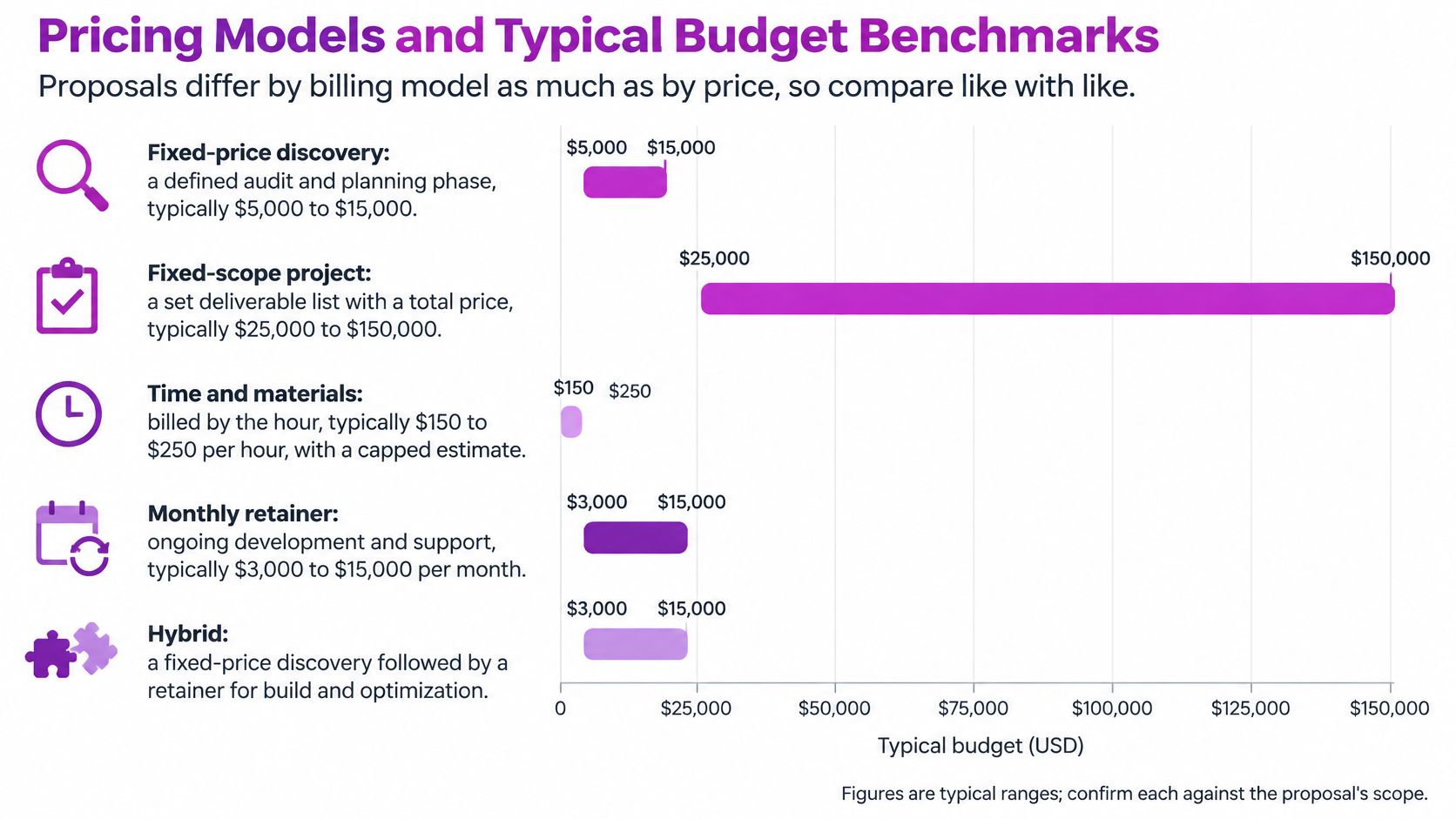
Normalise the Commercial Terms
Build a comparison sheet with matching rows for discovery, design, development, integrations, migration, QA, launch and support. Mark each item included, excluded or allowance, and ask agencies to price missing work.
Time and materials without an agreed cap leaves your budget open. A retainer should define available capacity, rollover, response times and whether meetings, QA and project management consume the allocation.
Use the Shopify developer hourly-rate guide to frame questions about rate composition. A lower rate doesn't guarantee a lower total if senior review, testing and delivery management are billed separately.
Commercial check: Compare the cost of reaching the same accepted outcome, not the number at the bottom of each PDF.
Test the Return Without Promising It
According to Baymard Institute's ecommerce UX statistics, the average large ecommerce site could increase conversion by 35.26% through checkout redesign. That's research potential across the studied context, not a forecast for your store.
For a clearly hypothetical calculation, suppose monthly checkout revenue is $400,000 and you model a 2% relative revenue lift with traffic and order value unchanged. That produces $8,000 in additional monthly revenue, or $96,000 annually.
Those figures are assumptions and arithmetic, not agency benchmarks. Apply contribution margin, ongoing fees and implementation costs before calculating payback: additional revenue isn't the same as additional profit.
Have each finalist explain the commercial case using your actual funnel. Judge the engagement against measurable customer outcomes, not design approval alone.
Onboarding and Project Governance From Kickoff to Launch
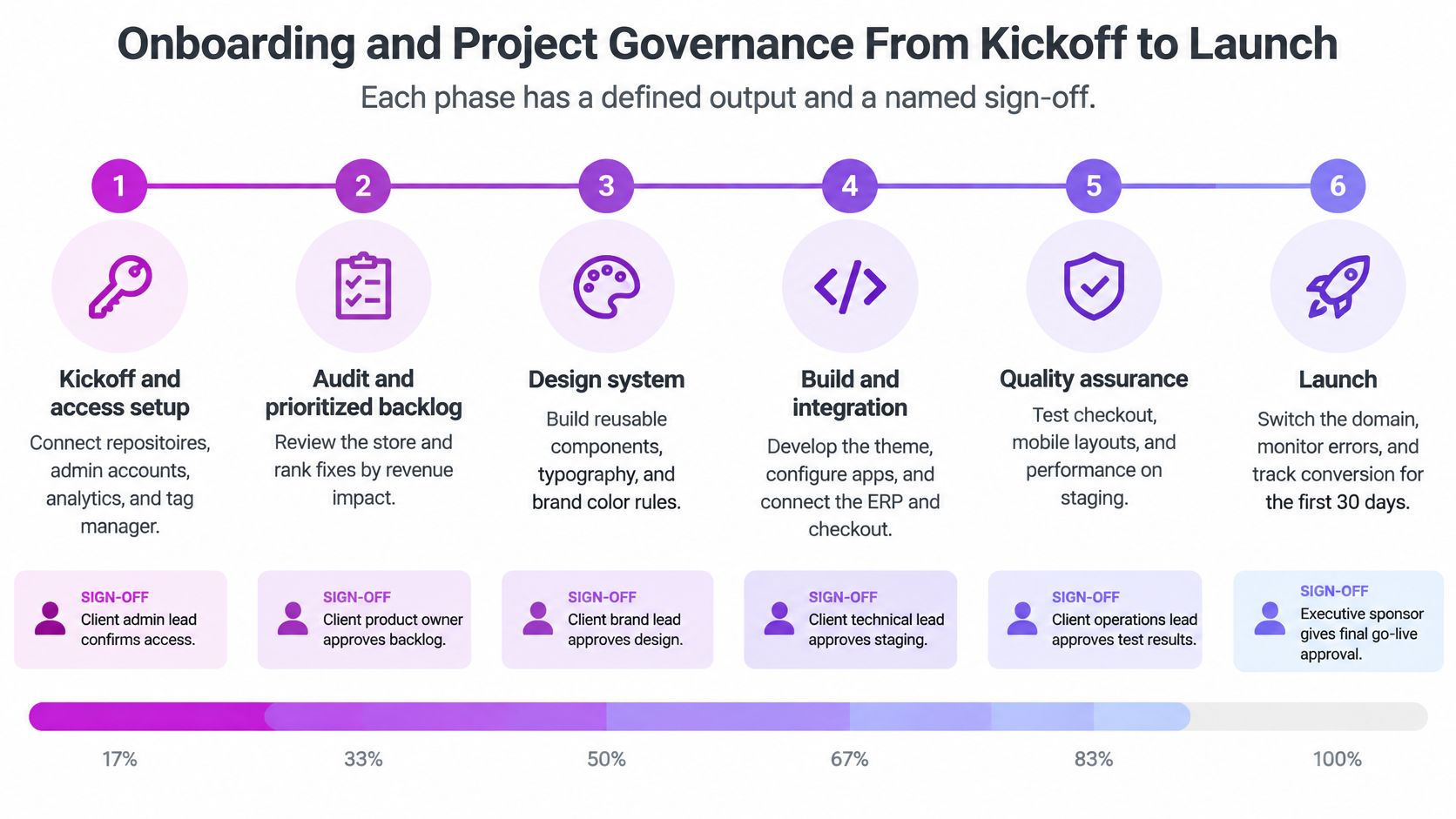
Kickoff and access. Connect client-owned repositories, Shopify admin, analytics and tag manager using appropriate permissions. Your admin lead confirms access and ownership.
Audit and backlog. The agency documents findings, dependencies and priorities. Your product owner approves the backlog and exclusions.
Design system and prototypes. Test product discovery, product selection and purchasing journeys on mobile. The brand lead approves the system and key flows.
Build and integration. Begin checkout, payment and business-system work early, alongside theme development. Your technical lead approves staging against documented requirements.
Staged testing. QA covers devices, markets, discounts, inventory, payments, refunds and tracking. Operations signs off the test results and unresolved exceptions.
Launch and rollback. Agree deployment ownership, monitoring and rollback triggers before go-live. The executive sponsor authorises launch.
Post-launch measurement. Separate defect correction from new optimisation work. The ecommerce owner reviews customer behaviour and operational exceptions before approving further experiments.
The visual summarises the core delivery sequence. Keep post-launch measurement as an explicit contractual responsibility rather than assuming it's included.
Keep Approvals and Changes Visible
Use a weekly steering note covering decisions, blockers, spend and the next release. Assign a single brand-side backlog owner, maintain a change-request log with cost and schedule effects, and publish a release calendar.
A workable ecommerce project-management process makes approval responsibilities visible before work queues up. Feedback from merchandising, finance and operations should reach the agency as one resolved decision.
Sample Shopify Plus Project Timelines
These are hypothetical planning scenarios, not measured industry durations. They illustrate schedules a buyer might ask an agency to validate, assuming consolidated feedback within two business days.
| Project type | Main phases | Illustrative duration | Main risk |
|---|---|---|---|
| Focused storefront redesign | Audit, design, build, test, launch | 8 to 12 weeks | Late design approval stalls build |
| Replatform from Magento or WooCommerce | Data mapping, design, build, migration, parallel testing, launch | 16 to 24 weeks | Incomplete redirects or data reconciliation |
| Multi-market expansion per added market | Localisation, payment and tax validation, market testing | 3 to 6 weeks per market | Untested local checkout and delivery rules |
Do not just multiply the market allowance: shared implementation can overlap, while local dependencies can block an individual launch. Request a schedule showing dependencies, client inputs and contingency.
Checkout and payment work belongs near the start because it can expose architectural constraints. Discovering an unsupported payment requirement during final QA leaves you choosing between delayed launch and an incomplete purchasing journey.
Shortlist Three Agencies and Book a Paid Discovery
- Source candidates deliberately. Start with Shopify Partner directory listings, then verify Plus experience through named live stores and the developers' actual contributions.
- Apply the rejection criteria. Keep only agencies willing to disclose ownership, staffing, delivery boundaries and relevant evidence.
- Prepare the decision pack. Include your business stage, measured pain points, budget band, weighted scorecard and interview questions.
- Request matching proposals. Send the same scope and ask finalists to separate inclusions, exclusions and assumptions.
- Check a relevant reference. Speak with a client whose operational complexity resembles yours, not merely a recognisable brand.
Choose the agency that scores highest on the criteria matching your project, not the cheapest proposal or the strongest presentation. A migration specialist may be the right choice for a complex platform exit and the wrong choice for a tightly focused experimentation programme.
Make Discovery a Decision Point
Book a paid, time-boxed discovery before committing to the full build. Require written outputs: the audit, architecture decisions, prioritised backlog, delivery estimate, responsibilities and unresolved risks.
Discovery should leave you able to approve, reduce, postpone or reject the build. Confirm that you own its deliverables and can use them with another implementation partner if the working relationship doesn't fit.
Ask the reference client about change control, staffing continuity and the condition of the handover. Whether the agency handled disagreement constructively tells you more than whether the launch looked good.
A single project can test fit before a longer commitment; ongoing CRO and Plus development may suit a monthly arrangement once priorities and delivery capacity are clear. Don't sign a continuing package just because its monthly fee looks easier to approve.
Send the same brief to three qualified agencies this week, book the calls and set a scorecard review date. Make that review the point where your team chooses a discovery partner, not an excuse to restart an open-ended portfolio search.
ECORN offers Shopify UI/UX design, Plus development and CRO through individual projects and monthly packages. Visit ECORN with your one-page brief and ask for a discovery scope that separates storefront design, checkout, integrations and multi-market responsibilities before you commit to a build.


Shopify Plus Ecommerce Agency: How to Pick the Right One

Shopify Themes Retina: How to Serve 2x Images

How to Cross Sell on Shopify Without Friction

Best Shopify Theme for Custom Products Compared
Multi Store Inventory Management: A Practical Guide

SEO Consulting for Ecommerce: A Practical Guide

Shopify Theme Updater App: A Safe Update Playbook
Shopify Git Integration: A Developer's Guide to 2026
Headless Ecommerce Development Services Explained

How to Build a Shopify Clothing Website That Converts

How to Launch a Box Subscription Business in 2026

Luxury Skincare Branding Playbook That Converters

10 Best Podcast Ecommerce Shows for Store Growth in 2026
Shopify Developer Hourly Rate: What to Pay in 2026
Critical Shopify Setup Errors That Are Secretly Sabotaging Your Store
Ecommerce Conversion Tracking: The Complete How-To Guide
Shopify Design Agency: How to Pick the Right Partner
Mastering Multi Store Management on Shopify

Scale Shopify Store

10 Shopify App Ideas Worth Building in 2026
Conversion Rate Optimization for Landing Pages: The Playbook
Shopify Plus Automation: A Guide for 2026
10 Social Selling Platforms for Shopify Merchants

Shopify Website Design Examples: 7 Stores Worth Studying

7 Ecommerce Newsletter Examples for Shopify Brands
One Product Shopify Store: Build and Scale

Mobile Pop Up Strategy for Shopify Stores That Converts

Sitemap for Shopify: How to Find, Optimize, and Submit It

7 Single Product Websites Worth Emulating
Product Variants Shopify: The Complete 2026 Guide

Ecommerce Analytics Consulting for Growth

What Is AI Integration for eCommerce

How to Choose the Right eCommerce Website Development Firm
E Business Strategy Implementation
Conversion Tracking Setup for Shopify Stores
BigCommerce vs Shopify Plus Which Enterprise Wins in 2026
Shopify Theme Kit: Setup, Commands, and Migration Guide
Shopify Extension Development: A Practical 2026 Guide
Shopify Speed Score Explained and How to Improve It
Shopify Mobile Optimization: The 2026 Playbook

How to Add Subcategory in Shopify for Better UX
How to Implement Structured Data for Ecommerce in 2026

SEO App Mobile: Shopify Store Optimization Guide

Shopify Plus Support: What It Includes and How to Choose

Google Ads for Shopify: The Complete 2026 Playbook

Shopify New York: How to Find and Hire the Right Agency
Google Search Console for Shopify: The Complete Setup

First Party Data Collection for eCommerce Growth
FAQ Online Store Guide: Build and Measure It Right
Do FB Ads Work for eCommerce in 2026?
One Page Checkout for Shopify: Design and Implementation
Shopify GraphQL vs REST: The 2026 Developer Decision
Shopify Ecommerce Consulting: Strategy, Pricing &

Are Reddit Ads Worth It for eCommerce Brands

Shopify Title and Meta Description: A Practical 2026 Guide

Product Video Best Practices for Shopify Brands
Real-Time Inventory Management: A 2026 Guide

AI Chatbot Integration for Shopify Stores
Affiliate Program Management: A Shopify Guide
10 Best Performance Monitoring Tools for Shopify in 2026

Digital Asset Management for eCommerce Brands in 2026

Every Type of Facebook Ads Explained for eCommerce Growth
Product Information Management Explained for Shopify Brands
Support Ticket System: A Guide for Shopify Stores

10 Best Customer Service Tools for Shopify in 2026

Can I Start a Business with No Money? a 2026 Blueprint

What Sells Good on Etsy: Best Niches for 2026

Shopify Add to Cart Button: A Practical 2026 Guide

Customer Feedback Automation: A Practical eCommerce Guide
Critical Rendering Path: A Guide for Shopify Stores

How to Promote on TikTok for eCommerce in 2026

B2B eCommerce Consulting That Drives Real Revenue
10 Best Practices for Site Navigation in 2026
Return vs Refund for Shopify Stores: A Practical Guide

What Is Customer Lifetime Value and Why It Matters

What Is Voice of Customer Research for eCommerce

SMS Marketing for Ecommerce That Actually Converts

Master How to Improve Email Deliverability in 2026

Top 8 eCommerce Partners NYC for Shopify Brands in 2026

Machine Learning for Ecommerce: Boost Your Shopify Store

Beauty Market Research: Your 2026 Growth Guide

Shopify International Expansion: A 2026 Roadmap

What Does CRO Stand for in Business: Understanding CRO

Shopify Visual Merchandising: A Playbook for Higher Sales

Shopify Landing Page Design: Master Conversion in 2026

10 Best AI SEO Optimization Tools for Shopify in 2026

Agentic AI for Ecommerce: Boost Your Sales in 2026
Mastering Email Marketing Data for eCommerce Growth

Conversion Rate Optimisation Australia: Boost Your Sales

Conversion Rate Optimization AI: Your Shopify Store Guide

10 Product Bundling Strategies for Shopify in 2026

How to Increase Customer Lifetime Value: A Shopify Playbook
AI Customer Service Automation: Shopify Guide 2026

Clean Website Design: A Shopify Conversion Playbook

Omnichannel Retail Strategy: A Shopify Playbook
Product Data Enrichment: A Guide for Shopify Brands

Instagram Shopping Features a Guide for Shopify Stores
What Is Revenue Optimization: A Holistic RevOps Guide

Benefits of Conversion Rate Optimization: Boost Your
WordPress to Shopify Migration: Your 2026 Seamless Switch


newsletter in your inbox