


Approximately 76% of Shopify's total revenue came from merchant solutions in 2025, with that segment reaching $8.8 billion, according to its 2025 annual-report figures. That's a useful way to rethink hiring: a Shopify store isn't just a website. It's part of the system through which a brand takes payments, manages orders, and serves customers.
Choosing a Shopify development company in the USA therefore means evaluating more than design taste. You need a commercial model that fits your workload, evidence that the team can solve your operational problems, and clear standards for checkout, product data, and ongoing support.
What a Shopify Development Company in the USA Does
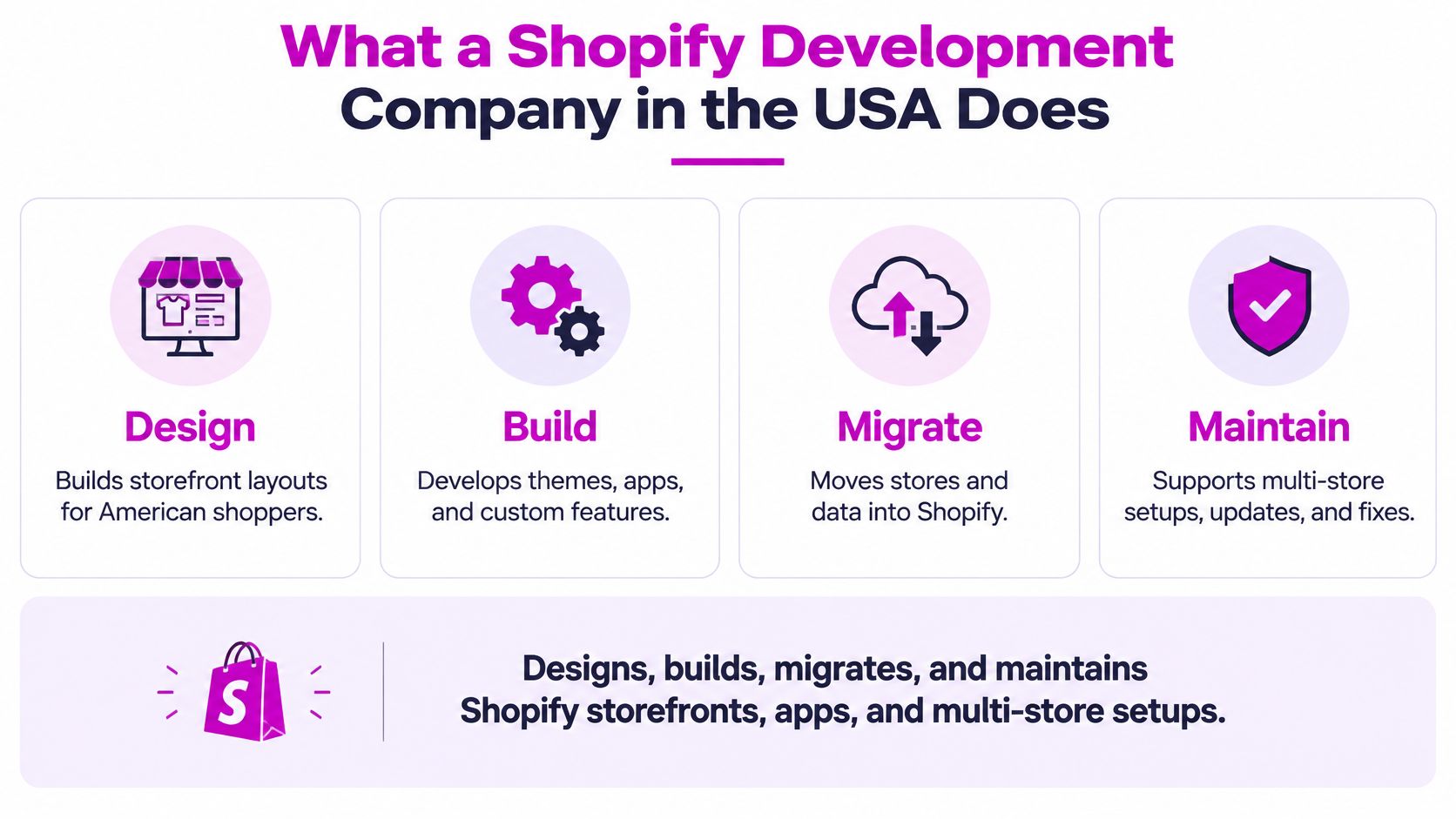
A Shopify development company in the USA designs, builds, migrates, and maintains Shopify storefronts, apps, and multi-store setups for brands selling to American shoppers. Its job includes the customer-facing experience and the connections that keep orders moving behind the scenes.
Shopify reported that 45% of its merchants were located in the United States as of December 31, 2024, and more than 57% of its 2024 gross merchandise volume originated there, in its 2024 annual filing. That concentration makes US commerce operations a central capability, not a minor localization service.
Say a clothing brand launches a seasonal collection. The partner might build collection templates, connect inventory to fulfillment, configure payment methods, and check that shipping information appears before customers commit to an order.
The work behind the shop window
The storefront is the shop window. The development company is the crew keeping the registers, tax tables, and inventory working during a holiday rush.
A useful scope should identify responsibility for:
- Commerce operations: Localized checkout, payment integration, sales-tax configuration, and technical compliance support coordinated with qualified advisers.
- Connected systems: Fulfillment, inventory, analytics, and multi-store architecture.
- Continuous improvement: Conversion-rate optimization, maintenance, and testing after releases.
The hiring decision should connect those responsibilities to a pricing model, verifiable project evidence, and written acceptance criteria. A polished homepage alone won't tell you whether the team can maintain the business behind it.
Engagement Models and Published Price Anchors
Start with hourly single-project work when you want to test a partner on a bounded task. At ECORN, single-project work on Shopify and Shopify Plus costs $69 per hour, with no minimum or maximum project size. A theme slice, migration phase, or isolated feature gives both sides something concrete to estimate, deliver, and review.
Hourly work becomes difficult when nobody owns the backlog. If stakeholders keep adding requests, a low rate won't prevent an uncontrolled bill. Define the deliverable, acceptance conditions, and person authorized to approve extra work before development starts.
Shopify engagement models for US brands
| Model | Best stage | Commercial shape | Included work | Main risk |
|---|---|---|---|---|
| Hourly single project | Testing a partner or commissioning a bounded build | $69 per hour, no minimum or maximum project size | Theme slice, migration phase, or feature on Shopify or Plus | Scope drift without a backlog owner |
| Monthly expertise | Emerging brand needing steady maintenance | From 35 hours per month; confirm the package fee in writing | Dedicated Shopify specialists maintaining and improving the store | Too little capacity for a multi-store rebuild |
| Monthly Shopify pack | Scaling brand around $100k per month, on Plus or operating several stores | $6,400 per month for 160 team hours | Front-end and back-end development, design, CRO, multi-store support, and project management | Peak-season requests can exceed capacity |
| Outstaffing | Brand with an internal product owner | Augmented Shopify specialists; agree the staffing rate and allocation | Development and maintenance inside the client's process | Client must set priorities |
| Custom or public app | Workflow a theme and available apps can't cover | Separately scoped project or hourly engagement; confirm app-specific terms | Full-stack Shopify app design and development | Maintenance continues after launch |
Monthly expertise makes sense when work arrives continuously rather than as a single build. Our Shopify Expertise packages start from 35 hours per month. That can support an improvement backlog, but it shouldn't be treated as enough capacity for a complex replatform without an estimate.
The Shopify pack provides 160 hours of the eCommerce team for $6,400 per month and is intended for scaling brands around $100k per month, on Shopify Plus or with multiple storefronts. All three monthly packs include development and design, dedicated Shopify experts, project management, and fast turnaround. Confirm how meetings, QA, design revisions, and production fixes consume the hour pool.
Budget rule: Buy capacity against an estimated backlog, not against an optimistic list of everything you'd like to improve.
When staffing or app development fits better
Outstaffing suits a brand that already has someone to prioritize work, clarify requirements, and accept releases. Our augmented Shopify specialists develop and maintain the store, while your product owner directs the queue.
Custom or public app development is a different decision. We offer Shopify app development and full-stack public-app expertise, but a workflow should justify that extra software before you commission it. Document why native functionality or an existing app won't meet the requirement.
Use our Shopify developer hourly rate guide to frame the commercial discussion. Then choose a primary engagement model and compare delivery evidence, rather than shopping on rate alone.
Scorecard for Partner Proof and Support
A logo wall tells you which brands an agency wants to be associated with. It doesn't tell you what the agency delivered, who did the work, or whether the engagement resembles yours.
Treat the sales call as an evidence review. Open a live store together, ask the agency to explain a relevant implementation, and record what it can substantiate. A team that clearly separates its own contribution from another vendor's work is easier to evaluate than one claiming responsibility for everything.
Partner proof scorecard
| Criterion | Good evidence | Red flag | Weight for a growing brand |
|---|---|---|---|
| Shopify Partner status | Named official partner agency with a verifiable record | Only a freelance profile and no partner record | Required baseline |
| Shopify Plus experience | Live Plus or high-volume build with the team's role stated | Plus described only as a future capability | High if revenue is scaling |
| Case studies | Store job, team composition, and a relevant metric | Homepage screenshots only | High |
| Pricing clarity | Written hourly rate or monthly hour allocation | Quote with no defined unit of work | High |
| Support after launch | Named channel, owner, and turnaround expectations | No owner once the store launches | High |
| US commerce operations | Tax, payments, and fulfillment explained through past work | Theme-only portfolio | High for US selling |
| Data and B2B conversation | Willingness to discuss catalogs, price lists, and attribution | AI treated only as a plugin | Medium until technical validation |
Official Shopify Partner status is a baseline credential, not a quality score. Verify the agency's identity rather than relying on a badge pasted into a proposal. Then assess the work that matters to your business.
For a growing brand, relevant Plus or multi-store experience should outweigh design awards. Ask the team to explain how it handled account permissions, stock synchronization, deployment, or a failed integration. Those answers reveal technical judgment that a homepage gallery can't show.
Make the evidence specific
A useful case study identifies the original problem, the work delivered, and who performed it. If the agency reports improved conversion or revenue per session, request the measurement period, analytics source, and any other changes that happened during the comparison. Don't treat an unexplained before-and-after chart as proof of causation.
Support deserves equally concrete language. A named communication channel isn't enough unless you also know who monitors it, how urgent incidents are classified, and what happens when the usual developer is unavailable.
- Commercial clarity: Establish who owns project management, what counts as billable work, and how scope changes are approved.
- Operational relevance: Have the team walk through a payment, tax, or fulfillment requirement similar to yours.
- Delivery continuity: Require ownership of launch checks, bug triage, access handover, and documentation.
Advance only agencies that clear the partner-status baseline, present a relevant case, and provide a written support model.
That rule doesn't guarantee a successful engagement. It prevents you from committing before the agency has demonstrated the minimum evidence needed for a serious comparison.
Checkout and Mobile Tests to Put in Scope
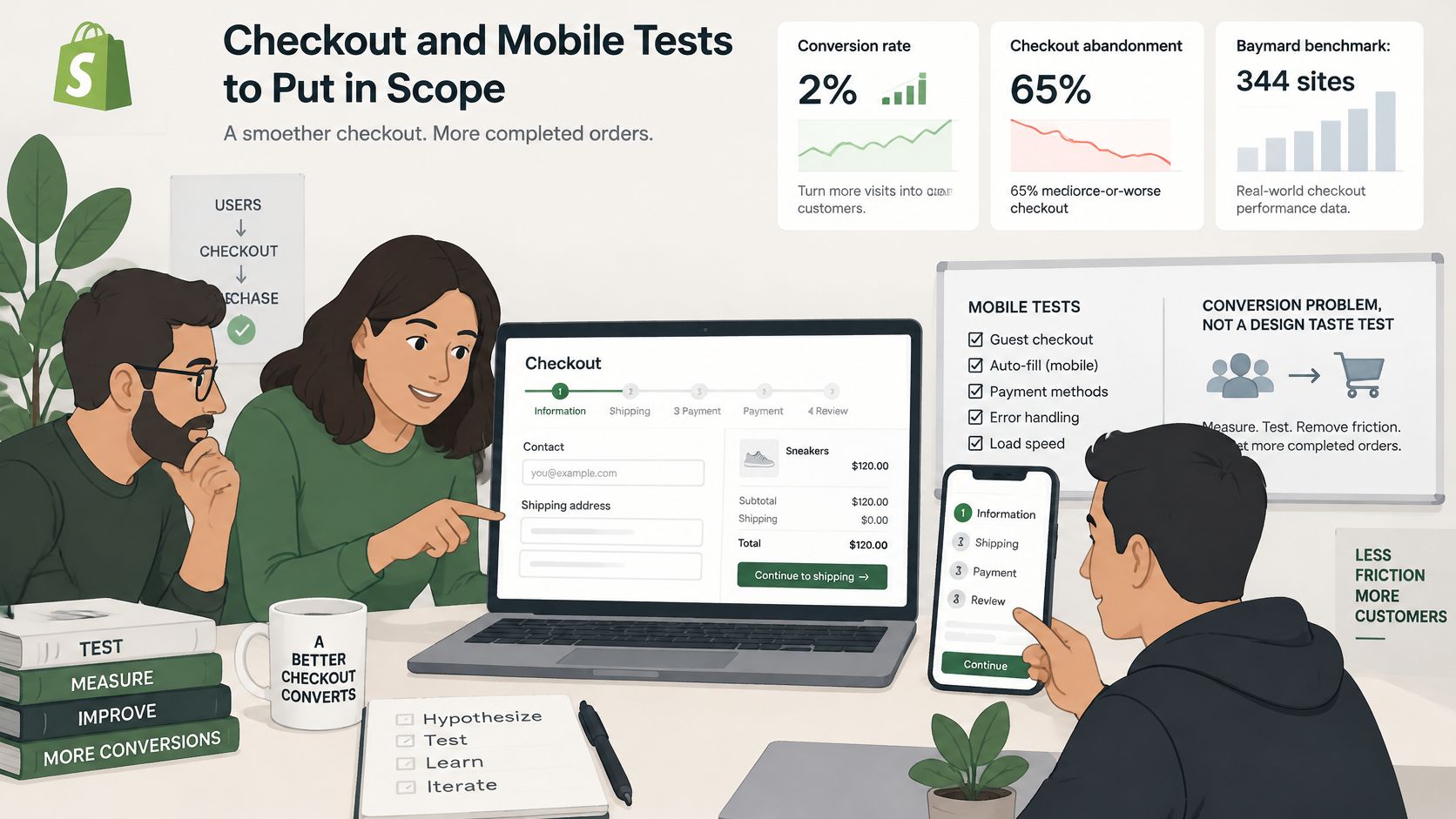
65% of the 344 leading US and European ecommerce sites in Baymard's benchmark had mediocre-or-worse checkout performance, according to its checkout usability assessment. Treat checkout as an engineering and conversion problem, not a visual approval exercise.
A pretty checkout that hides shipping cost is a restaurant menu with the bill printed on the back. Customers need enough information to decide before they reach payment.
Turn friction into testable requirements
Put the following checks into the statement of work:
- Purchase conditions: Show total cost, shipping speed, delivery restrictions, return information, and account requirements before payment.
- Form necessity: Remove fields the order doesn't need where Shopify's supported configuration permits it. Make guest checkout understandable.
- Error recovery: Keep valid entries after an error and explain how the shopper can correct the invalid field.
- Payment completion: Test supported accelerated payment methods alongside the standard payment flow.
Don't accept a promise to customize anything you request. Have the developer distinguish between theme work, supported checkout extensions, app behavior, and platform-controlled functionality before estimating.
Mobile needs its own acceptance pass. Baymard found that 61% of mobile sites failed to use the correct keyboard layout for at least one form field, in its mobile checkout forms assessment. That's the kind of small implementation detail a desktop design review can miss.
Use email and telephone input types appropriately, and select input modes that match the information requested. Don't force postal codes into a numeric field if doing so could strip leading zeros or reject valid formats.
Measure completion, not design approval
Test on physical iOS and Android devices. Include common US address formats, ZIP-plus-four entry, mobile wallets, keyboard navigation, screen-reader use, and a slow cellular connection. Check that controls aren't crowded and that opening the keyboard doesn't hide the active field or cause disruptive layout changes.
Use our Shopify mobile optimization guide to organize the mobile review. Pair device testing with real-user tasks, such as applying a discount and correcting a mistyped address.
Acceptance should include completed-checkout rate, payment-step abandonment, error frequency, and revenue per session, segmented by device and checkout step. Agree on event definitions and capture a baseline before the release.
A developer can guarantee that an agreed interaction works. They shouldn't guarantee a conversion lift without a measurement plan. Put both functional checks and business metrics into the statement of work instead of approving a Figma file alone.
AI Commerce and B2B Readiness Before You Sign
Shopify reported that B2B gross merchandise volume grew 96% in 2025 and that orders arriving from AI search increased 15-fold from January 2025, in its Q4 2025 earnings-call transcript. Those figures justify asking about channel readiness, but they don't establish what your own store will earn from AI referrals.
The selection gap is practical: theme design, migration history, and app lists don't establish whether a partner can manage product data, wholesale permissions, or attribution. The readiness checks connect those responsibilities.
Ask about data before asking about AI tools
Start with the catalog. Can the partner maintain consistent product titles, variant identifiers, attributes, and availability across storefront content and feeds? Machine-readable data helps external systems interpret products accurately, but no agency can guarantee that an AI interface will never misrepresent them.
For a complementary search-workstream reference, review AY Rank's ecommerce SEO services while assigning responsibility for catalog content and technical discovery. Keep search deliverables separate from unsupported promises of AI-generated sales.
Next, test the wholesale workflow. Can the proposed architecture connect your ERP or inventory system with customer-specific price lists and order-approval rules? Have the team explain what happens when a synchronization fails, not just how the successful path works.
Validate measurement and control
Your remaining questions should expose ownership:
- Attribution: How will the team distinguish identifiable AI referrals from search, email, and paid traffic? How will it document referrals that can't be reliably classified?
- Governance: Who approves AI-generated merchandising before publication, and who owns product data, feed mappings, and account access when the contract ends?
Say a wholesale buyer arrives from a chat tool and signs into an approved account. The store should apply that buyer's authorized price list and purchasing rules, rather than carrying a consumer price into the order. The partner needs to explain authentication, pricing, and approval behavior across that journey.
Signing threshold: Don't buy a growth retainer from a team that can't describe data ownership and a human approval step.
AI visibility isn't automatically a growth channel. Incorrect inventory, incomplete feeds, and untracked referrals can create customer-service and measurement problems. Commission a readiness audit with named owners and test cases before adding automation.
Use the following video as a discussion prompt, then require the agency to translate any proposed approach into your actual workflows.
What a Custom Theme Project Actually Included
BAGWORKSNY provides a concrete example of what to inspect beneath the label custom build. Our engagement covered Shopify store design and development, with a project manager and a Shopify developer on the team.
We designed and built a fully custom Shopify theme, rather than reskinning a free theme. That distinction matters when evaluating the scope, but custom isn't automatically the better purchase. A brand should pay for it when its layout, product storytelling, and buying journey justify the additional design and development work.
The content model was part of the build
For BAGWORKSNY, we added custom metafields and structured content to display extra product and collection information across the site. The deliverable wasn't only the arrangement of pixels. It also included a way to organize information behind those pages.
Metafields are labeled shelves in a stockroom. A single description box is an overflowing bin.
For example, a bag catalog might need separate fields for materials, dimensions, care instructions, and intended use. This is an illustrative content model, not a claim about the particular fields delivered for BAGWORKSNY. Separating those values lets a theme display them consistently instead of requiring a merchandiser to manually rebuild the same formatting in every description.
- Merchant editing: Define which fields the team can update without touching theme code.
- Display rules: Decide what happens when a field is empty, contains an unexpected value, or applies only to certain products.
- Reuse: Map structured values to search, advertising feeds, or machine-readable product output where those integrations are in scope.
Separate implementation proof from outcome proof
The BAGWORKSNY example demonstrates design, development, and structured-content work. It doesn't establish a published conversion lift, so don't read one into the project description.
For your own build, agree on the outcome measurement before implementation. Also request an editing demonstration using a realistic product, including an incomplete record, so the handover tests daily merchant work rather than only the ideal presentation.
Close any case-study discussion with these questions:
- Who delivered it? Identify the team roles and responsibility for decisions.
- What was custom? Separate theme code, native configuration, and third-party apps.
- What can the merchant edit alone? Require a demonstration of routine changes after launch.
Go or No-Go Decision for Emerging and Growing Brands
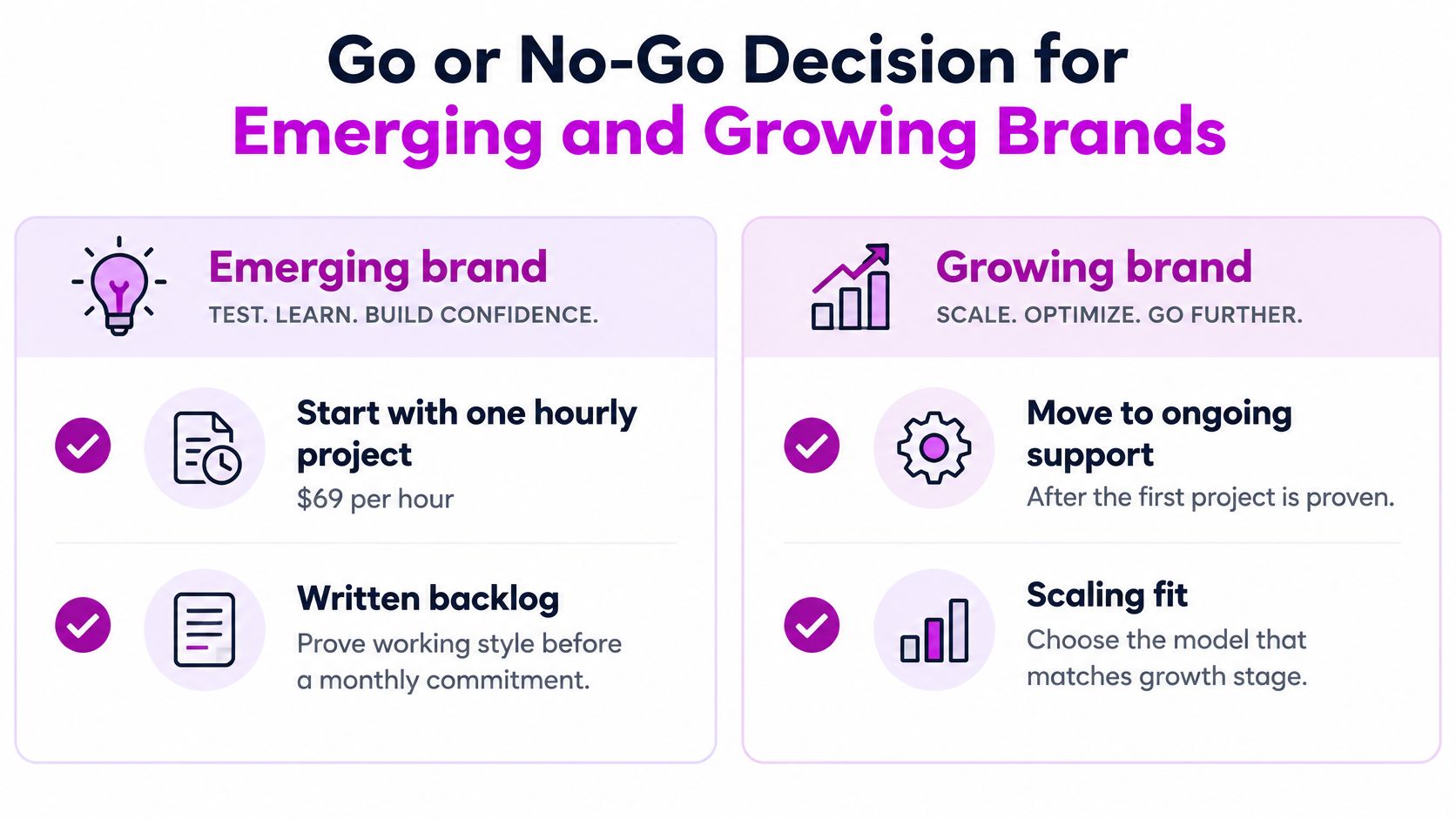
An emerging brand should usually prove the relationship through a bounded project before committing to recurring capacity. Bring a written backlog, a clear acceptance condition, and a decision-maker who can resolve questions promptly.
A growing brand should move to ongoing support when it has enough prioritized work to use the allocation responsibly. Revenue stage helps frame the choice, but store count, integration complexity, and release workload determine whether the proposed team can cover it.
Apply the contract gates
- Proof gate: Proceed only with verifiable Shopify Partner status, a relevant case, and a written support model.
- Acceptance gate: Require checkout and mobile testing in the statement of work, with measurement responsibilities assigned.
- Readiness gate: Require credible answers about catalog data, wholesale workflows, attribution, ownership, and human approval.
Stop at any failed gate. A small initial engagement is useful only if it tests the working relationship, not if it postpones unresolved questions.
Before the first meeting, prepare your revenue stage, store count, current systems, and the business metric you want to move. Use the first project or month to assess estimation, communication, QA, and handover. ECORN is an official Shopify Partner Agency and is one option to evaluate against these same requirements.
We offer Shopify design, development, CRO, app development, and ongoing support through single-project and monthly engagements. Visit ECORN and select Shopify Development in the contact form, then bring your prioritized backlog, store setup, and target metric so we can discuss an appropriate engagement.


Shopify Inventory Tracking App: How to Set It Up Right
Shopify Volume Pricing: How to Set Up Tiered Discounts
How Does Shopify Work for Sellers? a Practical Guide

Shopify Theme ZIP: How to Upload and Install It
Shopify Plus Organization Admin: Roles and Access Guide
How to Build a Drop Down Menu in Shopify: Steps and Fixes
Shopify Plus Integration Services Guide
Shopify Customer Experience: A 2026 Guide
Shopify Plus Expansion Stores: Limits and Setup
Shopify Theme Update: Safe Steps, Backups and Rollback

Shopify Website Design Packages: What You Actually Get

How to Choose a Shopify Plus Web Design Agency in 2026
Shopify Plus Ecommerce Agency: How to Pick the Right One
Shopify Themes Retina: How to Serve 2x Images

How to Cross Sell on Shopify Without Friction

Best Shopify Theme for Custom Products Compared
Multi Store Inventory Management: A Practical Guide

SEO Consulting for Ecommerce: A Practical Guide
Shopify Theme Updater App: A Safe Update Playbook
Shopify Git Integration: A Developer's Guide to 2026
Headless Ecommerce Development Services Explained

How to Build a Shopify Clothing Website That Converts

How to Launch a Box Subscription Business in 2026

Luxury Skincare Branding Playbook That Converters
10 Best Podcast Ecommerce Shows for Store Growth in 2026
Shopify Developer Hourly Rate: What to Pay in 2026
Critical Shopify Setup Errors That Are Secretly Sabotaging Your Store
Ecommerce Conversion Tracking: The Complete How-To Guide

Shopify Design Agency: How to Pick the Right Partner
Mastering Multi Store Management on Shopify
Scale Shopify Store
10 Shopify App Ideas Worth Building in 2026
Conversion Rate Optimization for Landing Pages: The Playbook
Shopify Plus Automation: A Guide for 2026
10 Social Selling Platforms for Shopify Merchants

Shopify Website Design Examples: 7 Stores Worth Studying
7 Ecommerce Newsletter Examples for Shopify Brands
One Product Shopify Store: Build and Scale
Mobile Pop Up Strategy for Shopify Stores That Converts
Sitemap for Shopify: How to Find, Optimize, and Submit It
7 Single Product Websites Worth Emulating
Product Variants Shopify: The Complete 2026 Guide
Ecommerce Analytics Consulting for Growth
What Is AI Integration for eCommerce
How to Choose the Right eCommerce Website Development Firm
E Business Strategy Implementation
Conversion Tracking Setup for Shopify Stores
BigCommerce vs Shopify Plus Which Enterprise Wins in 2026
Shopify Theme Kit: Setup, Commands, and Migration Guide
Shopify Extension Development: A Practical 2026 Guide
Shopify Speed Score Explained and How to Improve It
Shopify Mobile Optimization: The 2026 Playbook
How to Add Subcategory in Shopify for Better UX
How to Implement Structured Data for Ecommerce in 2026
SEO App Mobile: Shopify Store Optimization Guide
Shopify Plus Support: What It Includes and How to Choose

Google Ads for Shopify: The Complete 2026 Playbook

Shopify New York: How to Find and Hire the Right Agency
Google Search Console for Shopify: The Complete Setup
First Party Data Collection for eCommerce Growth
FAQ Online Store Guide: Build and Measure It Right
Do FB Ads Work for eCommerce in 2026?
One Page Checkout for Shopify: Design and Implementation
Shopify GraphQL vs REST: The 2026 Developer Decision
Shopify Ecommerce Consulting: Strategy, Pricing &

Are Reddit Ads Worth It for eCommerce Brands
Shopify Title and Meta Description: A Practical 2026 Guide

Product Video Best Practices for Shopify Brands
Real-Time Inventory Management: A 2026 Guide
AI Chatbot Integration for Shopify Stores
Affiliate Program Management: A Shopify Guide
10 Best Performance Monitoring Tools for Shopify in 2026
Digital Asset Management for eCommerce Brands in 2026
Every Type of Facebook Ads Explained for eCommerce Growth
Product Information Management Explained for Shopify Brands
Support Ticket System: A Guide for Shopify Stores

10 Best Customer Service Tools for Shopify in 2026

Can I Start a Business with No Money? a 2026 Blueprint

What Sells Good on Etsy: Best Niches for 2026

Shopify Add to Cart Button: A Practical 2026 Guide

Customer Feedback Automation: A Practical eCommerce Guide
Critical Rendering Path: A Guide for Shopify Stores

How to Promote on TikTok for eCommerce in 2026

B2B eCommerce Consulting That Drives Real Revenue
10 Best Practices for Site Navigation in 2026
Return vs Refund for Shopify Stores: A Practical Guide

What Is Customer Lifetime Value and Why It Matters
What Is Voice of Customer Research for eCommerce

SMS Marketing for Ecommerce That Actually Converts

Master How to Improve Email Deliverability in 2026

Top 8 eCommerce Partners NYC for Shopify Brands in 2026

Machine Learning for Ecommerce: Boost Your Shopify Store

Beauty Market Research: Your 2026 Growth Guide

Shopify International Expansion: A 2026 Roadmap

What Does CRO Stand for in Business: Understanding CRO

Shopify Visual Merchandising: A Playbook for Higher Sales
Shopify Landing Page Design: Master Conversion in 2026
10 Best AI SEO Optimization Tools for Shopify in 2026

Agentic AI for Ecommerce: Boost Your Sales in 2026
Mastering Email Marketing Data for eCommerce Growth


newsletter in your inbox