

Most independent Shopify developers in 2026 charge $25 to $95 per hour, depending on experience and specialization. U.S. Shopify agencies typically bill $100 to $200 per hour, while Shopify Plus specialists usually start near $150 per hour.
Those figures are useful only if you know what you're buying. A low hourly quote for a developer who needs twice as long, misses integration risks, or creates rework can cost more than a premium specialist who delivers a clean result. The right question isn't “What's the Shopify developer hourly rate?” It's “What will this outcome cost, and who can deliver it without expensive corrections?”
What a Shopify Developer Hourly Rate Actually Covers in 2026
A Shopify developer hourly rate is a planning benchmark, not a project budget. Worldwide marketplace contracts commonly sit around $15 to $29 per hour, with historical experience tiers ranging from about $15 for beginners to $33 for intermediate developers and up to $95 for experts, according to Upwork's Shopify developer cost data. Those figures reflect selected historical contracts, not guaranteed prices.
The same label can describe radically different work. A developer might spend one hour adjusting CSS, or several weeks rebuilding a Liquid theme, connecting an ERP, testing checkout behavior, and managing a production launch. Both are “Shopify development,” but they carry different technical risk and require different judgment.
The variables that move a quote
Your quote changes with more than seniority. Ask the vendor to identify:
- Storefront architecture: Standard Liquid work is different from Hydrogen or a headless storefront.
- Integration depth: A simple app installation isn't comparable to a bidirectional ERP or CRM data connection.
- Data migration: Product, customer, order, metafield, redirect, and content migration require planning and validation.
- Platform requirements: Shopify Plus work can involve multi-store structures, advanced checkout extensibility, Functions, B2B workflows, and international operations.
- Delivery responsibility: Discovery, project management, QA, deployment, documentation, and post-launch support may or may not be included.
Practical rule: Never compare hourly rates until every proposal names the deliverables, assumptions, exclusions, acceptance criteria, and support terms.
A freelancer's billed rate also isn't the same as an agency's fully loaded cost. Agencies may include strategy, design, QA, account management, and backup coverage, while an independent contractor may bill only for hands-on implementation. Use the rate to understand the commercial model, then judge the quote by cost per completed outcome.
Shopify Developer Rates by Experience Level
Experience matters because each tier owns a different class of decision. A published framework places junior Shopify work at roughly $40 to $75 per hour, mid-level implementation at $75 to $125 per hour, and senior or expert work at $125 to $200 or more per hour. It also places a 25% to 35% premium on custom app or headless work compared with standard Liquid work, as outlined in this Shopify developer rate framework.
| Experience level | Hourly rate band | Typical deliverables |
|---|---|---|
| Junior | $40 to $75 per hour | Theme settings, Liquid edits, app installation, content updates, minor CSS and JavaScript fixes |
| Mid-level | $75 to $125 per hour | Reusable Liquid sections, theme customization, app integrations, store migrations, structured QA |
| Senior or expert | $125 to $200+ per hour | Custom themes, private apps, complex integrations, performance engineering, architecture, Shopify Plus, Hydrogen and headless work |
Junior developers
Junior talent fits well-defined, low-risk tasks. Give this tier a clear ticket, an approved theme, and a test environment. They can often handle navigation changes, product template updates, app configuration, and small styling adjustments.
Don't put a junior developer in charge of an ERP migration, checkout architecture, or a production replatform. The cheaper rate won't protect you from weak assumptions or incomplete testing.
Mid-level developers
Mid-level developers are the practical choice for many growing brands. They can translate a design into reusable Liquid components, configure integrations, work through migration details, and troubleshoot issues across a real storefront.
They should be able to explain how their changes affect theme performance, app conflicts, responsive behavior, and future maintenance. If your scope includes more than isolated edits, this is usually the minimum sensible tier.
Senior developers
Senior specialists earn their rate by reducing uncertainty. They make architectural decisions, identify integration failure points, review code, guide other contributors, and take responsibility for launch readiness. Their work often includes custom app development, complex API behavior, performance engineering, Shopify Plus, or Hydrogen.
If you're comparing hiring models as well as freelancer quotes, budgeting for your first engineering hire can help you separate salary, contractor, and delivery-cost considerations. The same principle applies here: buy the capability your project requires, not the cheapest title.
How Region Changes Shopify Developer Pricing
Geography changes the starting point, but it doesn't determine the value of the work. Worldwide Upwork marketplace rates typically fall between $15 and $29 per hour, while typical U.S. rates sit between $27 and $59 per hour. Individual U.S. profiles on the platform can list rates of $75 or $160 per hour, according to Upwork's U.S. Shopify developer pricing.
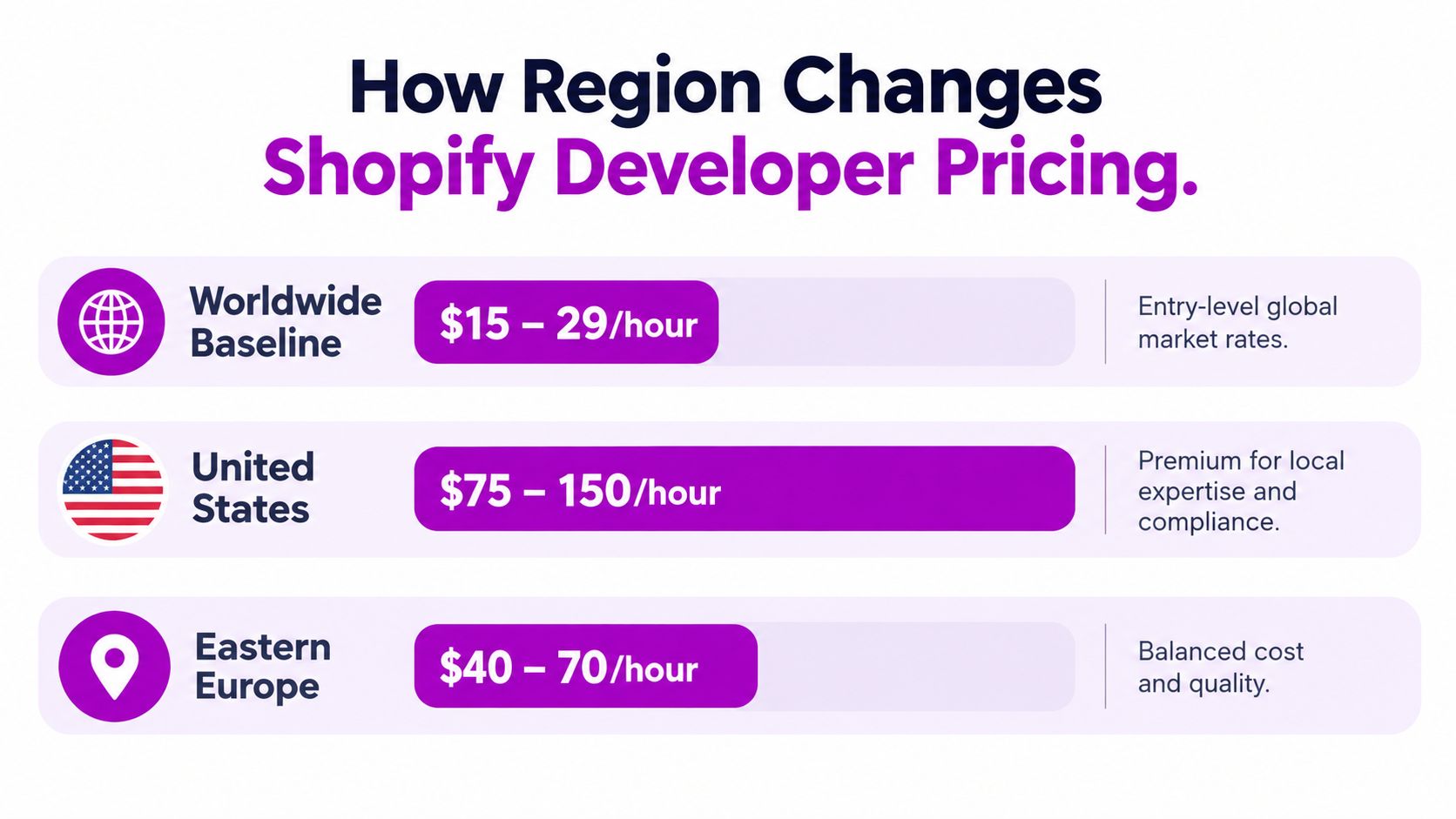
That spread makes regional screening useful, but country labels are a poor substitute for technical evidence. A developer in a lower-cost market may be excellent at Liquid and still be the wrong choice for a complex headless build. A U.S. developer may charge a premium while offering only routine theme work.
What to evaluate beyond location
- Time-zone overlap: A lower rate loses appeal when every approval takes a full business day.
- Communication quality: Clear written specifications and fast issue escalation reduce coordination cost.
- Platform specialization: Shopify Plus, Hydrogen, Functions, and custom app experience can outweigh regional differences.
- Compliance and commercial context: Local knowledge may matter for taxes, payments, privacy, fulfillment, and procurement.
- Portfolio relevance: Ask for work similar to your architecture, catalog complexity, and integration environment.
Use geography to build a shortlist, not to make the final decision. A remote developer who has shipped the exact type of migration you need can be a better choice than a local generalist. Conversely, a local specialist may justify a premium when launch coordination, stakeholder access, and compliance requirements are central to the project.
The defensible comparison is effective cost per deliverable. Include meetings, handoffs, revision cycles, QA, time-zone delays, and post-launch fixes. A rate difference matters only after you understand how much usable work each hour produces.
Freelancer vs Agency vs Retainer
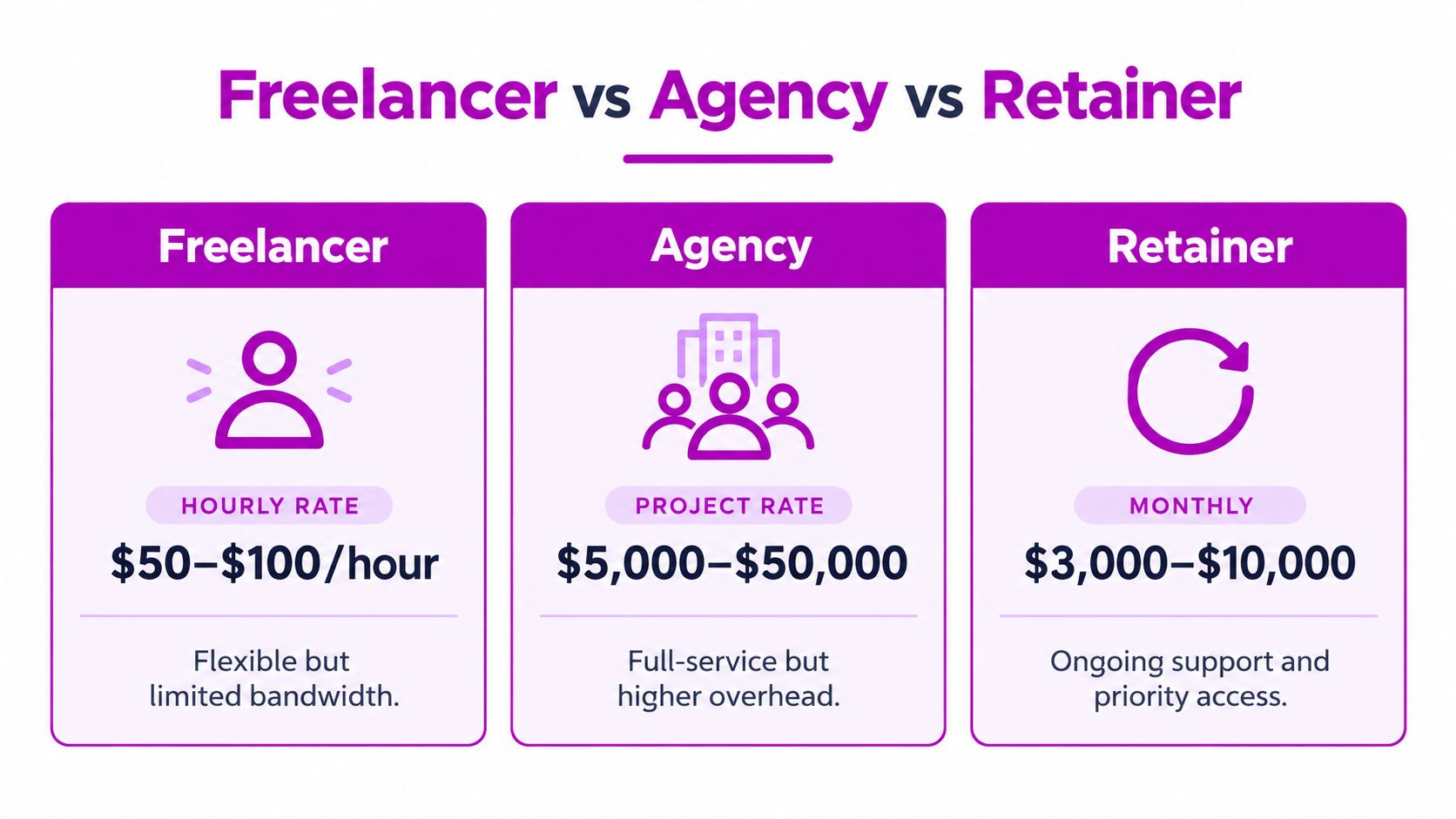
The hiring model changes what the hourly figure includes. Global marketplace contracts can sit around $15 to $29 per hour, mid-level U.S. freelance or contract work around $62 to $100 per hour, and the reported U.S. median employee wage for web developers and digital designers is $47.85 per hour. These categories aren't interchangeable, and the comparison of Shopify developer cost models explains why agency billing generally sits above them.
Freelancer
A freelancer is usually the most flexible option for a contained task. You can hire one person for a theme fix, an app configuration, or a tightly scoped enhancement without paying for a broader delivery structure.
The tradeoff is concentration risk. One person may own discovery, development, QA, deployment, and support. If they misunderstand the requirement or become unavailable, your project absorbs the delay.
Agency
An agency charges more because you're buying a team and a delivery system. That can include a strategist, designer, developer, QA specialist, project manager, and replacement coverage. The hourly rate alone doesn't tell you whether those roles are included.
Agency pricing makes sense when the project has multiple workstreams, a hard launch date, several stakeholders, or meaningful commercial risk. It makes less sense for a simple content change that an experienced freelancer can complete safely.
Retainer
A retainer suits brands with an ongoing queue of improvements. It can provide predictable access for experiments, fixes, CRO implementation, merchandising changes, and technical maintenance. It also reduces the friction of repeatedly sourcing and onboarding talent.
Don't buy a retainer before defining how unused capacity, urgent requests, QA, and prioritization work. A recurring commitment with vague output becomes an expensive holding pattern.
Buyer's rule: Choose a freelancer for a bounded task, an agency for coordinated delivery, and a retainer when you have a sustained pipeline of prioritized work.
For broader hiring economics, recruitment agency costs explained offers useful context on why sourcing and placement services add costs beyond a person's direct compensation. Apply that same discipline to Shopify proposals by asking which overheads are included and which remain yours.
Shopify Plus Specialist Pricing
Shopify Plus isn't just standard Shopify with a higher hourly rate. It introduces more demanding decisions around multi-store architecture, checkout extensibility, Shopify Functions, B2B workflows, advanced APIs, international operations, and enterprise integrations.
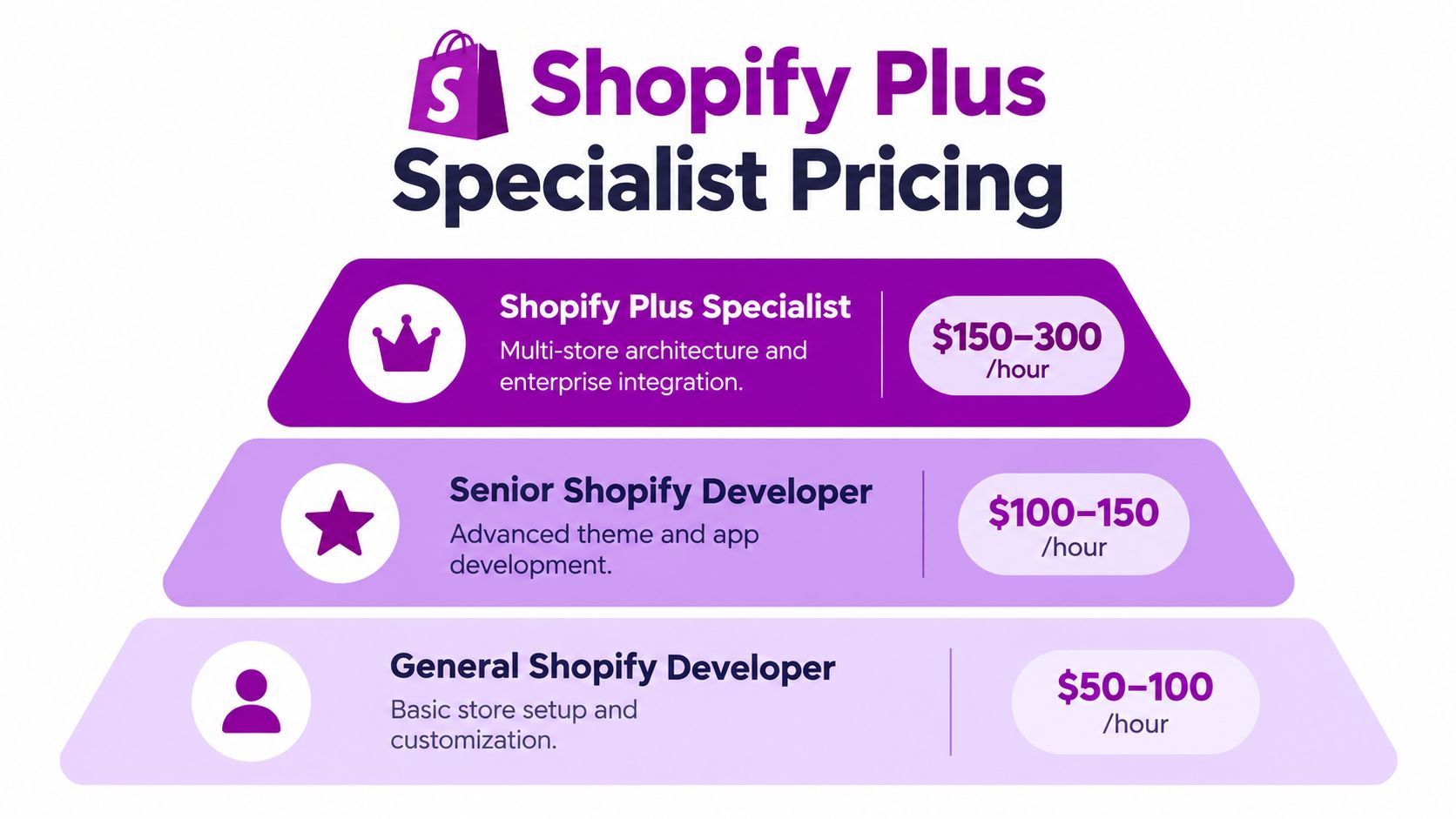
A senior Shopify developer may be entirely appropriate for a custom theme, a controlled migration, or a focused app integration. Bring in a Plus specialist when the project affects several storefronts, complex checkout behavior, B2B catalog logic, ERP and CRM synchronization, or a headless architecture.
What the premium should buy
A Plus specialist should do more than write Liquid quickly. Their value should appear in:
- Architecture: They define boundaries between Shopify, apps, middleware, ERP, CRM, and storefront layers.
- Risk control: They identify data, checkout, deployment, and operational failure points before implementation.
- Integration judgment: They choose appropriate APIs, event flows, retry behavior, and ownership of business rules.
- Launch governance: They establish testing, rollback, monitoring, documentation, and handoff procedures.
Custom app and headless work carries a published 25% to 35% premium over standard Liquid development, based on the specialist rate framework cited earlier. That premium is defensible when the consultant owns architecture and integration consequences, not when a vendor merely labels routine theme work "enterprise."
Treat $150 per hour and above as a specialist conversation, not automatic proof of expertise. Ask what the person personally shipped, what parts they will own, and how they'll validate the implementation. If they can't discuss failure modes in concrete terms, the rate is not justified.
Sample Project Costs for Common Shopify Builds
Hourly rates become useful only after you attach them to a defined deliverable. The examples below are budgeting scenarios, not market facts or quotations. Calculate each project by multiplying the hours your scope requires by the selected experience band, then add any separate discovery, QA, project management, and support costs.
| Project type | Planning approach | Appropriate capability |
|---|---|---|
| Liquid theme customization | Estimate the specific templates, sections, responsive states, and QA cases | Junior or mid-level |
| Custom theme build | Scope design implementation, reusable components, content modeling, accessibility, and performance review | Mid-level or senior |
| App or third-party integration | Define data direction, authentication, webhooks, error handling, and reconciliation | Mid-level or senior |
| Replatforming migration | Map products, customers, orders, redirects, content, integrations, testing, and launch support | Senior |
| Shopify Plus checkout extension | Define checkout behavior, Functions, permissions, testing, and rollback | Senior or Plus specialist |
| Multi-store rollout | Plan localization, catalogs, markets, integrations, governance, and deployment sequencing | Plus specialist or senior team |
A useful proposal should show the work behind the number. For example, a migration quote that lists only “development hours” may exclude data cleanup, redirect mapping, integration testing, stakeholder review, and launch-day monitoring. Those omissions don't make the project cheaper. They move the cost into change requests and emergency fixes.
Budget lines buyers commonly miss
- Discovery: Requirements, technical audits, solution design, and dependency mapping.
- Quality assurance: Browser testing, mobile testing, regression checks, and integration validation.
- Content and data preparation: Cleanup and formatting may require business-side work before migration.
- Post-launch support: Defect correction, monitoring, rollback readiness, and training need explicit terms.
- Revisions: Define how many review cycles are included and what qualifies as a change request.
For another buyer-oriented perspective on Shopify store development cost, compare the assumptions behind the estimate rather than copying a headline project figure. The best budget is the one that makes responsibilities visible.
Why Cost Per Outcome Beats Cost Per Hour
Hourly price is a weak proxy for value. A developer charging $30 per hour but requiring twice the hours can cost more than a specialist charging $90 per hour. Rework makes the gap wider because you pay for diagnosis, correction, regression testing, and delayed launch coordination.
The comparison should start with the outcome:
- Conversion-focused theme change: Is the approved component live, responsive, accessible, tested, and connected to the right content model?
- Migration: Are products, customers, orders, redirects, and integrations transferred and validated without operational gaps?
- Plus integration: Does the connection handle the required workflows, errors, permissions, monitoring, and future maintenance?
Ask vendors to price the work you can inspect
Request three things in every proposal:
- A deliverable definition: State what will exist at completion.
- Acceptance criteria: Specify how your team will approve the work.
- An effort boundary: Use a fixed price, capped hours, or a documented range with change-control rules.
This approach gives you flexibility without forcing every vendor into the same commercial model. A specialist may quote a higher rate but fewer hours. An agency may quote a project total that includes QA and management. A freelancer may quote a lower number while leaving those responsibilities with you.
The useful negotiation question isn't “Can you lower your rate?” It's “What will be delivered, what will I own, and what could still create extra cost?”
Compare proposals at the level of completed outcomes. If one vendor includes discovery and launch support while another bills only coding, their hourly rates aren't comparable. Push back on unexplained hours, vague “development support,” and retainers without a prioritized backlog.
How AI Is Reshaping Shopify Developer Rates
AI-assisted development changes the work mix, not the need for technical judgment. Shopify's Winter '26 Edition development announcement describes AI agents supporting app scaffolding, GraphQL operations, and validated code generation across Admin, UI extensions, Liquid, and Hydrogen. It also describes broader commerce availability across major AI channels and an open standard co-developed with Google announced in January 2026.
Work that is becoming more routine
AI can make boilerplate implementation faster. Routine theme edits, standard app setup, repetitive GraphQL operations, and initial scaffolding are increasingly suitable for assisted workflows. Buyers should question a premium rate when the assignment is mostly predictable implementation and the developer can't explain how AI reduces effort.
That doesn't mean you should demand an arbitrary discount. Ask for a transparent estimate that separates generation, adaptation, testing, review, and deployment. Faster code production doesn't remove the need to verify the result.
Work that deserves a stronger premium
AI increases the value of people who can supervise the whole system:
- Architecture: Choosing where logic belongs remains a business and technical decision.
- Code review: Generated code can be syntactically valid while still creating performance, security, or maintenance problems.
- Integration design: AI doesn't own your ERP data model, fulfillment rules, customer permissions, or operational exceptions.
- Quality governance: Someone must define tests, inspect outputs, protect data, and approve production changes.
- Optimization: A merchant still needs a clear hypothesis, measurement plan, and prioritization process.
For Plus brands and multi-store operators, a small error can spread across shared processes, markets, or storefronts. Pay for accountable review and governance, not just for a developer who says they use AI. The right question is how many hours the workflow saves and which new review responsibilities the vendor has included.
How to Negotiate and Package a Shopify Development Engagement
A strong statement of work prevents rate disputes from becoming delivery disputes. Start by defining the platform tier, storefront architecture, integrations, data responsibilities, performance requirements, testing scope, and acceptance criteria before discussing the final commercial model.
Build the scope around decisions
Name every system that touches the project. List Shopify, the theme, Hydrogen if applicable, APIs, ERP, CRM, fulfillment tools, subscription services, analytics, and middleware. Specify whether the developer owns configuration, custom code, data mapping, testing, deployment, and documentation.
Then separate the work into phases:
- Discovery and solution design: Document requirements, risks, dependencies, and the proposed architecture.
- Implementation: Build the approved functionality within the stated scope.
- QA and acceptance: Test agreed scenarios and resolve defects.
- Launch and support: Deploy, monitor, train, and correct covered post-launch issues.
This prevents a low development estimate from hiding essential work. It also lets you assign the right capability. A contained Liquid task may fit a junior or mid-level developer, while architecture, integrations, and Plus work need senior oversight.
Choose the commercial model deliberately
Use a fixed price when the requirements and acceptance tests are stable. Use capped hours when discovery may uncover technical uncertainty but you still need budget control. Use a retainer only when you have a recurring backlog and a clear prioritization process.
Before signing, confirm:
- What counts as a revision or change request.
- Who supplies design, copy, product data, and credentials.
- How code review and QA are handled.
- What happens when an integration behaves differently in production.
- How post-launch defects differ from new requests.
- Who owns the code, documentation, accounts, and deployment access.
For a practical checklist on evaluating candidates and structuring the engagement, use this guide to hiring a Shopify expert developer. Treat the first call as a technical scoping session, not just a rate negotiation.
Quick Reference for Shopify Developer Rates in 2026
Use the table below as a starting point, then adjust for geography, architecture, integration risk, and the amount of ownership you need. The rate band alone doesn't tell you whether the work is correctly priced.
| Project type | Typical rate band | Recommended engagement |
|---|---|---|
| Routine theme edits and configuration | $40 to $75 per hour | Freelancer or capped hours |
| Custom Liquid sections and theme work | $75 to $125 per hour | Mid-level freelancer or focused agency |
| Store migration with integrations | $75 to $200+ per hour | Senior-led project with fixed phases |
| Custom app development | $125 to $200+ per hour | Senior specialist or technical pod |
| Hydrogen or headless implementation | $125 to $200+ per hour, with custom-work premium | Senior specialist or agency |
| Shopify Plus architecture and multi-store work | Near $150 per hour and upward | Plus specialist, agency, or scoped pod |
| Ongoing optimization and maintenance | Depends on backlog and ownership | Retainer with defined monthly priorities |
Worldwide marketplace benchmarks can be useful for independent, narrowly scoped work, while U.S. pricing tends to run higher and agency billing includes broader delivery overhead. Buyers researching job marketplace pricing should still normalize the comparison by seniority, geography, specialization, included services, and expected hours.
Escalate to a Shopify Plus specialist when the scope includes checkout extensibility, Shopify Functions, complex B2B workflows, multi-store architecture, headless delivery, or critical ERP and CRM integration. Stay with a capable standard Shopify developer when the work is limited to theme customization, routine configuration, content structure, or contained app setup.
The rate you should approve is the one attached to a measurable result, a credible delivery plan, and clear ownership. ECORN provides Shopify and Shopify Plus design, development, CRO, consulting, and flexible project or monthly support options for brands that need that structure. Visit ECORN to discuss your scope, define the right specialist level, and package the work around the outcome rather than the hourly number.


Ecommerce Conversion Tracking: The Complete How-To Guide

Shopify Design Agency: How to Pick the Right Partner
Mastering Multi Store Management on Shopify

Scale Shopify Store

10 Shopify App Ideas Worth Building in 2026

Conversion Rate Optimization for Landing Pages: The Playbook

Shopify Plus Automation: A Guide for 2026

10 Social Selling Platforms for Shopify Merchants

Shopify Website Design Examples: 7 Stores Worth Studying

7 Ecommerce Newsletter Examples for Shopify Brands

One Product Shopify Store: Build and Scale

Mobile Pop Up Strategy for Shopify Stores That Converts

Sitemap for Shopify: How to Find, Optimize, and Submit It

7 Single Product Websites Worth Emulating

Product Variants Shopify: The Complete 2026 Guide

Ecommerce Analytics Consulting for Growth

What Is AI Integration for eCommerce

How to Choose the Right eCommerce Website Development Firm

E Business Strategy Implementation
Conversion Tracking Setup for Shopify Stores

BigCommerce vs Shopify Plus Which Enterprise Wins in 2026
Shopify Theme Kit: Setup, Commands, and Migration Guide

Shopify Extension Development: A Practical 2026 Guide

Shopify Speed Score Explained and How to Improve It

Shopify Mobile Optimization: The 2026 Playbook

How to Add Subcategory in Shopify for Better UX
How to Implement Structured Data for Ecommerce in 2026

SEO App Mobile: Shopify Store Optimization Guide

Shopify Plus Support: What It Includes and How to Choose

Google Ads for Shopify: The Complete 2026 Playbook

Shopify New York: How to Find and Hire the Right Agency

Google Search Console for Shopify: The Complete Setup

First Party Data Collection for eCommerce Growth

FAQ Online Store Guide: Build and Measure It Right

Do FB Ads Work for eCommerce in 2026?

One Page Checkout for Shopify: Design and Implementation
Shopify GraphQL vs REST: The 2026 Developer Decision

Shopify Ecommerce Consulting: Strategy, Pricing &

Are Reddit Ads Worth It for eCommerce Brands

Shopify Title and Meta Description: A Practical 2026 Guide

Product Video Best Practices for Shopify Brands

Real-Time Inventory Management: A 2026 Guide

AI Chatbot Integration for Shopify Stores

Affiliate Program Management: A Shopify Guide
10 Best Performance Monitoring Tools for Shopify in 2026

Digital Asset Management for eCommerce Brands in 2026

Every Type of Facebook Ads Explained for eCommerce Growth

Product Information Management Explained for Shopify Brands

Support Ticket System: A Guide for Shopify Stores

10 Best Customer Service Tools for Shopify in 2026

Can I Start a Business with No Money? a 2026 Blueprint

What Sells Good on Etsy: Best Niches for 2026

Shopify Add to Cart Button: A Practical 2026 Guide

Customer Feedback Automation: A Practical eCommerce Guide

Critical Rendering Path: A Guide for Shopify Stores

How to Promote on TikTok for eCommerce in 2026

B2B eCommerce Consulting That Drives Real Revenue

10 Best Practices for Site Navigation in 2026

Return vs Refund for Shopify Stores: A Practical Guide

What Is Customer Lifetime Value and Why It Matters

What Is Voice of Customer Research for eCommerce

SMS Marketing for Ecommerce That Actually Converts

Master How to Improve Email Deliverability in 2026

Top 7 eCommerce Partners NYC for Shopify Brands in 2026

Machine Learning for Ecommerce: Boost Your Shopify Store

Beauty Market Research: Your 2026 Growth Guide

Shopify International Expansion: A 2026 Roadmap

What Does CRO Stand for in Business: Understanding CRO

Shopify Visual Merchandising: A Playbook for Higher Sales

Shopify Landing Page Design: Master Conversion in 2026

10 Best AI SEO Optimization Tools for Shopify in 2026

Agentic AI for Ecommerce: Boost Your Sales in 2026
Mastering Email Marketing Data for eCommerce Growth

Conversion Rate Optimisation Australia: Boost Your Sales

Conversion Rate Optimization AI: Your Shopify Store Guide

10 Product Bundling Strategies for Shopify in 2026

How to Increase Customer Lifetime Value: A Shopify Playbook

AI Customer Service Automation: Shopify Guide 2026

Clean Website Design: A Shopify Conversion Playbook

Omnichannel Retail Strategy: A Shopify Playbook

Product Data Enrichment: A Guide for Shopify Brands

Instagram Shopping Features a Guide for Shopify Stores

What Is Revenue Optimization: A Holistic RevOps Guide

Benefits of Conversion Rate Optimization: Boost Your

WordPress to Shopify Migration: Your 2026 Seamless Switch

Boost Sales: Ecommerce Payment Processing Guide 2026

Unified Commerce Platform: Benefits, KPIs & Shopify Guide

How to Reduce Bounce Rate eCommerce: Your 2026 Guide
Shopify API Integration: A Practical End-to-End Guide

How to Implement Data Governance: A 2026 Guide

Shopify Store Development Cost: A 2026 Breakdown
What Is Server Side Tracking: The Shopify Guide 2026

Marketing Automation Workflows: A Shopify Guide for 2026

Shopify: How to Reduce Technical Debt

Shopify UX Design Change: A Playbook for Growth

User Generated Content Strategy: Shopify Playbook

Shopify Pause and Build Plan Cost: A Complete 2026 Guide

Compare at Price on Shopify: A Complete Guide for 2026

Where Can I Sell My Prints? 10 Best Platforms for 2026

Shopify Order Management System: The Ultimate Guide 2026


newsletter in your inbox