


Your Shopify team opens the monthly SEO report. Rankings are improving, organic sessions look healthier, and more articles are appearing in search. Yet orders haven't followed, and the finance team still wants to know what the investment is producing.
That gap is where SEO consulting for ecommerce should begin. The job isn't to attract visitors. It's to connect product discovery with a useful shopping experience, workable margins, and results your team can explain.
Why Ecommerce SEO Needs a Commercial Lens
Consider a hypothetical store selling outdoor clothing. Its buying guides attract readers researching hiking, but its waterproof jacket collections remain hard to browse. Marketing celebrates visibility while merchandising sees little movement in the products it needs to sell.
Neither team necessarily has bad data. They're answering different questions. Rankings describe search visibility, while commercial performance depends on whether the right shoppers reach suitable products and find a compelling reason to buy.
Start with the catalog economics
The opportunity is substantial. The U.S. Census Bureau estimated 2024 retail ecommerce sales at $1.1926 trillion, up 8.1% from the previous year, with ecommerce representing 16.1% of retail sales versus 15.3% in 2023 (Census retail ecommerce estimates). For an individual merchant, however, market size doesn't tell you which optimization deserves funding.
A consultant should first understand:
- Product economics: Which categories have viable margins after discounts, fulfillment, and returns?
- Commercial priorities: Which products have reliable stock, strategic importance, or seasonal demand?
- Customer decisions: What must shoppers understand before they can confidently choose?
- Operating constraints: Which changes can merchandising, content, and development teams deliver?
These answers might justify improving a profitable collection before publishing another broad educational guide. They might also reveal that traffic isn't the immediate constraint.
Practical rule: Ask what business decision a recommendation supports before asking which keyword it targets.
For teams reassessing an existing retainer, Come Together Media LLC's resource on how to stop burning cash on SEO offers a useful starting point for that conversation. Evaluate proposed work against your store's economics, not just the volume of deliverables.
What Ecommerce SEO Consulting Includes
Think of your store as both a customer-facing catalog and a system that search engines must interpret. A shopper needs clear categories, useful specifications, and a sensible route to purchase. A consultant must connect those needs with how pages are discovered, organized, maintained, and measured.
That requires more than a publishing calendar. Research should identify commercially relevant searches, technical work should address accessibility, and content should help customers make decisions.
Ecommerce SEO Consulting Service Map
| Service area | What the consultant examines | Business value |
|---|---|---|
| Commercial research | Search intent, category demand, margins, competitive search results | Decides which opportunities deserve investment |
| Technical health | Crawling, indexation, redirects, rendering, template behavior | Identifies barriers to product discovery |
| Catalog architecture | Collections, navigation, filters, internal links | Organizes the shopping journey |
| On-page content | Collection copy, product information, comparisons, guides | Matches landing pages to customer needs |
| Product data | Structured markup and feed consistency | Supports accurate interpretation of products |
| International targeting | Market URLs, language targeting, regional offers | Aligns discovery with the appropriate storefront |
| CRO and measurement | Shopping behavior, friction, attribution | Connects implementation with commercial evaluation |
Keyword research belongs inside this system, not ahead of it as an isolated spreadsheet. A practical way to assess opportunities is to prioritize keywords by margin and SERP, using SemDash's resource as a reference while reviewing your own profitability and the pages appearing in search results.
The distinction matters. A commercially attractive phrase may require a comparison page rather than a product page. Another may describe a category your store can't profitably serve.
Separate recommendations from delivery
Consulting, implementation, and monitoring are different responsibilities. An audit may diagnose a problem without including the development work needed to fix it. A content strategy may specify page requirements without covering writing, product photography, or merchandising approval.
Before comparing proposals, ask for explicit answers:
- Advice: Will you receive findings, specifications, and an ordered backlog?
- Execution: Who edits templates, writes copy, updates feeds, and deploys changes?
- Validation: Who checks the live result and investigates unexpected behavior?
- Ongoing support: Does the engagement include release reviews and reprioritization?
A useful scope makes handoffs visible. Otherwise, you can buy a thorough strategy and discover that nobody has the capacity or authority to implement it.
How an Ecommerce SEO Audit Works
A useful audit begins with business context and ends with decisions. It shouldn't begin with a crawler export and end with every warning marked urgent.
The starting sequence should connect commercial goals, margin constraints, demand, seasonality, analytics, and current performance.
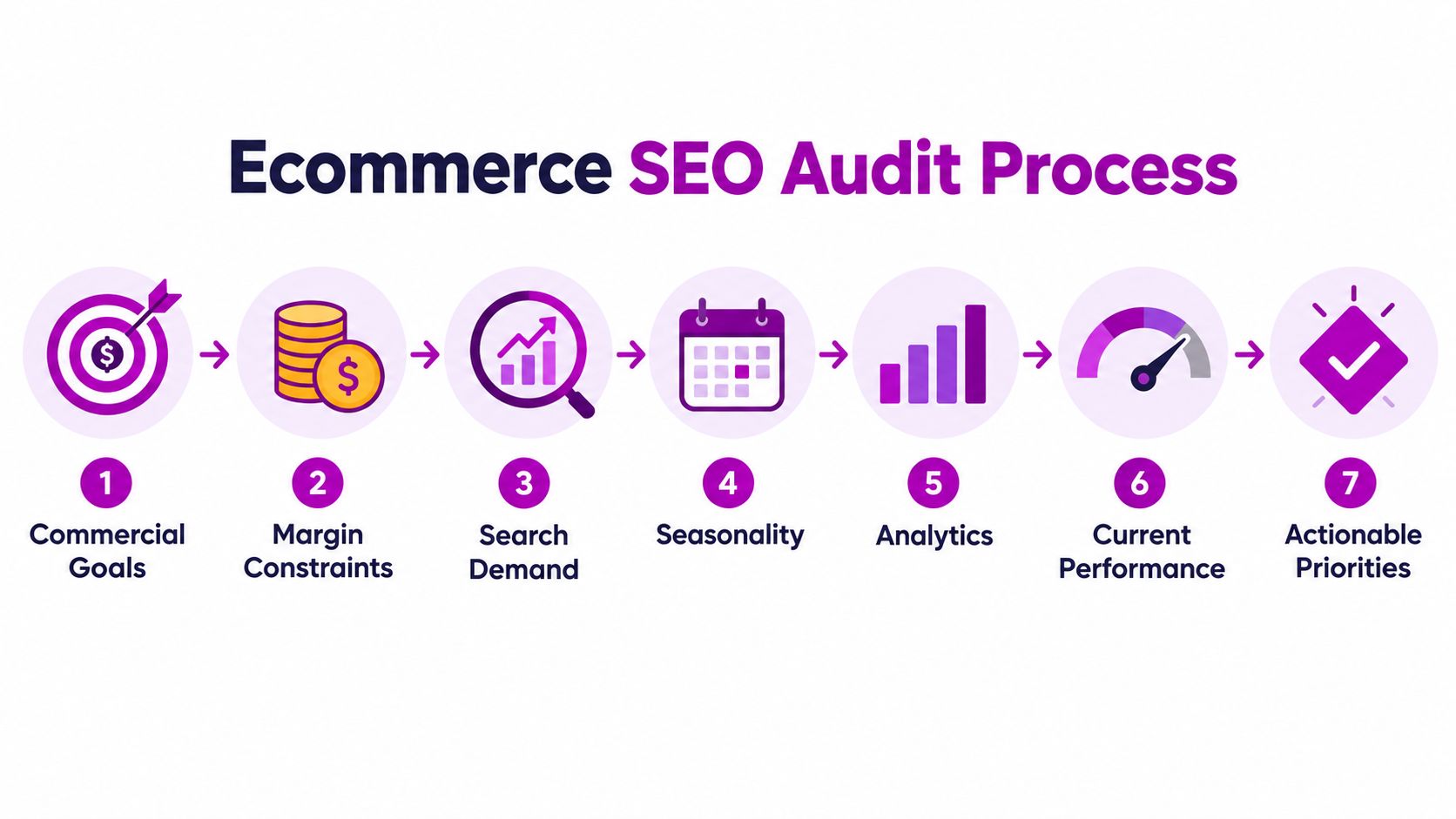
Historical context shows why flexibility matters. During the second quarter of 2020, seasonally adjusted U.S. retail ecommerce sales reached $211.5 billion, rising 31.8% from the previous quarter and accounting for 16.1% of retail sales (Census historical ecommerce release). The practical lesson is to examine whether your storefront can handle changing demand and availability without requiring improvised fixes.
Investigate causes, not just symptoms
Give the consultant access to Search Console, analytics, relevant Shopify reporting, and deployment history. Add information that those systems can't supply: upcoming launches, stock constraints, discontinued ranges, and merchandising priorities.
The technical investigation should then trace important customer journeys. Can search engines reach a collection? Is its intended landing page indexed? Do internal links lead to available products? Does the destination answer the query that brought the shopper there?
For a broader preparation checklist, use this ecommerce SEO audit guide to organize access and investigation areas before the engagement starts.
Require actionable findings
Each recommendation should function as an implementation ticket rather than a vague instruction.
- Evidence: Include affected URLs, observed behavior, and the method used to verify it.
- Scope: Identify the template, collection, market, or product group involved.
- Commercial hypothesis: Explain what customer or discovery problem the change should address.
- Delivery requirements: Name the owner, dependencies, estimated effort, and approval needs.
- Validation: Specify how the team will confirm the fix and monitor the outcome.
For example, “improve internal linking” isn't ready for development. “Add contextual links from relevant buying guides to the designated collection, then verify the rendered links and destination behavior” is much closer.
A valuable audit reduces uncertainty about what to do next. A longer issue list doesn't necessarily do that.
Prioritize by likely commercial impact, confidence, effort, and dependencies. A substantial opportunity may need to wait for a template release; a smaller, well-supported fix may be ready immediately.
Technical and Content SEO for Shopify
Start with a representative journey: a shopper searches for a linen shirt in a particular color, reaches your store, and selects a size. Your technical implementation and customer-facing information should describe the same product throughout that journey.
Review the storefront through these connected layers rather than inspecting every product independently.
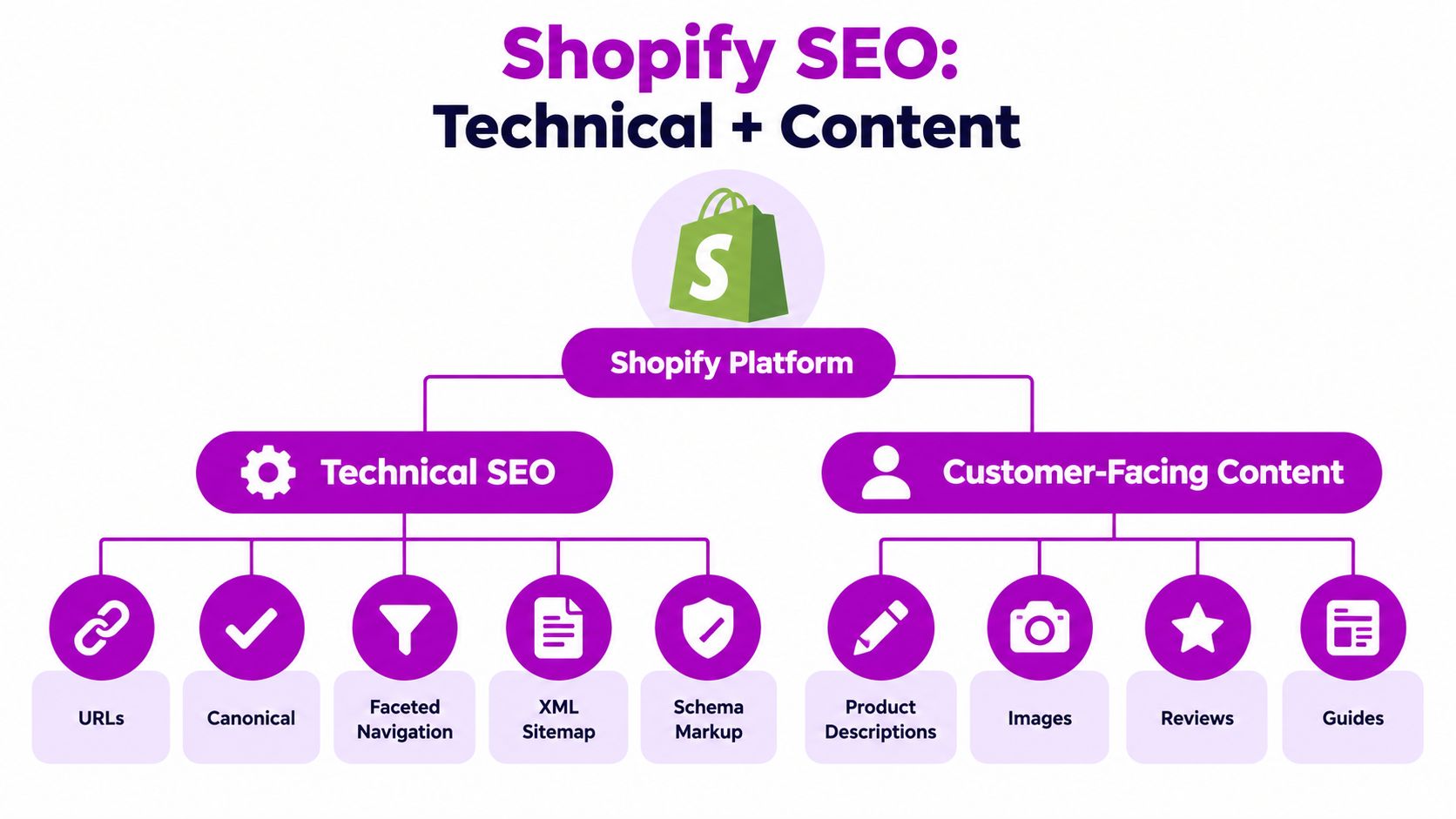
Verify URL and variant behavior
For product variants, Google's guidance uses ProductGroup, productGroupID, variesBy, and hasVariant to connect the parent group with individual options. Each selectable variant should have a distinct identifier and crawlable URL, and implementation should be tested on a subset, validated, and supported by an XML sitemap (Google product structured-data guidance).
Translate that into storefront checks. Open a variant URL directly and confirm that it selects the intended option. Check whether search engines can access it without authentication and whether robots directives or noindex prevent discovery.
Don't confuse crawlability with a promise that every variant will be indexed or shown separately. Also inspect canonical behavior, which indicates the preferred representative URL, alongside the broader variant configuration rather than making blanket changes.
- Faceted navigation: Decide which filtered combinations merit dedicated landing pages and which are shopping utilities.
- XML sitemaps: Check that intended commercial URLs are represented and accessible.
- Redirects and templates: Test discontinued products, changed handles, and app-generated destinations.
- International storefronts: Review language and regional targeting alongside the offer available in each market.
Give each page a customer job
Assign content according to the decision a shopper is making. A collection helps customers explore a range; a product page explains a specific item; a comparison helps distinguish alternatives; a guide answers a broader selection question.
For the linen shirt example, a collection might explain fit options and available styles. The product page should provide material details, sizing guidance, care instructions, and relevant imagery. A comparison page could explain how linen and cotton differ for the intended use, provided your team can substantiate those statements.
Avoid publishing near-identical pages merely to target wording variations. Ask whether each proposed page offers a different selection or decision aid.
Finally, reconcile visible price, availability, variant identity, on-page markup, and Merchant Center information. Investigate discrepancies before expanding the implementation across the catalog.
Audit by template, then verify exceptions. Review representative products with different option structures, inventory states, and market configurations. That approach creates reusable acceptance criteria while still accounting for products that don't fit the standard pattern.
How SEO and CRO Work Together
Suppose a collection starts attracting shoppers searching for lightweight travel bags. They arrive, but the product grid doesn't show capacity clearly, delivery information is hard to find, and the most prominent products are unavailable. More visibility hasn't resolved the purchase problem.
The customer journey connects discovery with selection and checkout.

Conversion rate optimization, or CRO, should investigate that gap using the shopper's intent. For this collection, a useful hypothesis might involve showing capacity and dimensions earlier, clarifying delivery eligibility, or adjusting how unavailable products appear. Changing a button color would be a weaker starting point unless behavioral evidence supported it.
Diagnose performance in the real storefront
The supplied HTTP Archive ecommerce benchmark reports Shopify origins at 92% good LCP, 99% good INP, 82% good CLS, and 76% passing all Core Web Vitals (HTTP Archive ecommerce performance benchmark). These aggregate results aren't a verdict on your theme, apps, or customer experience.
Use real-user field data, segmented by device and template. LCP concerns primary-content loading, INP concerns interaction responsiveness, and CLS concerns visual stability.
Match remediation to the observed problem:
- Slow primary content: Investigate above-the-fold imagery and product-grid rendering.
- Delayed interactions: Examine main-thread work and third-party JavaScript.
- Moving layouts: Reserve space for media, promotional banners, and recommendation modules.
For a practical framework connecting these investigations to shopping behavior, consult this guide to conversion rate optimization for ecommerce.
Use the video below as an additional discussion resource for your optimization team.
Evaluate changes against the affected audience, not only the sitewide average. Compare relevant landing-page cohorts, device groups, and purchase-intent segments, while recording promotions and merchandising changes that could alter the result.
The objective is profitable customer progress, not an isolated improvement in a speed score or conversion metric.
How to Measure SEO Consulting Results
Build a scorecard that distinguishes implementation progress from customer and commercial outcomes. A page becoming accessible is useful evidence that a fix worked, but it isn't proof of incremental revenue.
The dashboard below illustrates measurement categories. Its displayed figures are illustrative, not verified performance results.
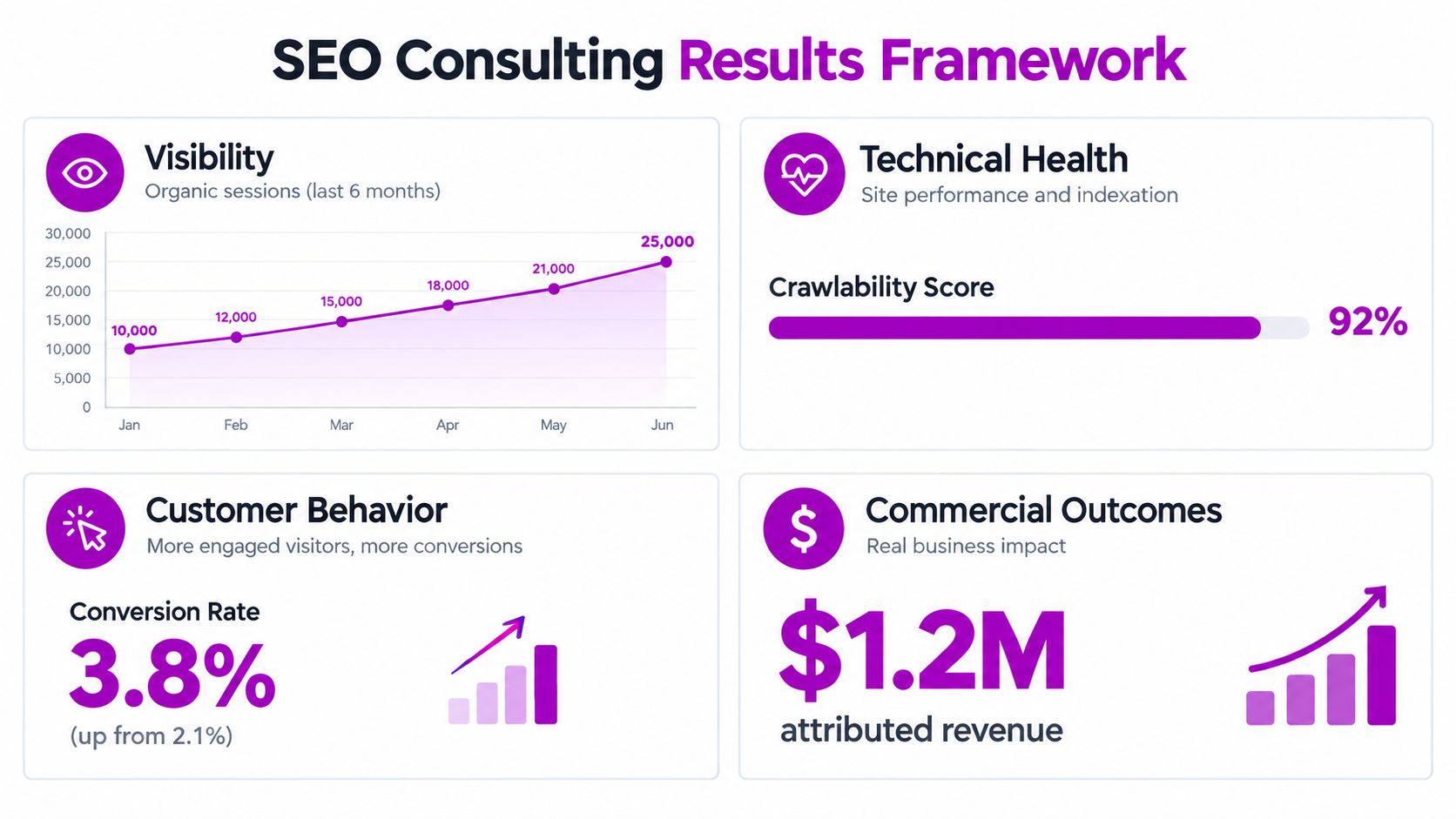
Use a balanced scorecard
| Measurement layer | What to monitor | What it helps explain |
|---|---|---|
| Visibility | Relevant queries, impressions, branded versus non-branded clicks | Whether discovery is changing |
| Technical health | Intended index coverage, validated fixes, recurring errors | Whether delivery conditions are improving |
| Customer behavior | Product views, add-to-cart actions, checkout progression | Where qualified visitors encounter friction |
| Commercial outcomes | Revenue, assisted conversions, contribution profit where available | Whether activity supports the business |
Establish baseline periods and annotate launches, promotions, stock changes, tracking updates, and deployments. Compare equivalent categories and seasonal conditions where possible rather than treating every movement as an SEO effect.
Engagement models should reflect these responsibilities. A focused project can be judged on diagnosis, implementation, and validation. Recurring consulting should also show how priorities change with evidence. A broader delivery partnership needs shared accountability for execution and commercial interpretation, without pretending attribution can isolate every influence perfectly.
Add AI and zero-click measurement carefully
The verified research summary describes an analysis of 973 ecommerce websites representing $20 billion in revenue, where ChatGPT referrals represented about 0.2% of sessions, alongside a separate analysis of 94 larger brands, where those visits converted at 1.81% but represented 1.48% of organic revenue (AI referral traffic research context). Different samples shouldn't be treated as a universal benchmark.
Create a separate view for identifiable AI referrals, product mentions, assisted conversions, and revenue per session. Keep branded organic distinct so you don't automatically credit AI exposure for existing brand demand.
For zero-click exposure, compare query groups and search appearances with changes in clicks and downstream value. Informational visibility and commercial landing-page performance deserve different interpretations.
Track emerging channels without allowing a small referral segment to displace a larger, commercially justified organic-search backlog.
Choosing the Right SEO Consulting Partner
Ask prospective partners to work through a real storefront problem. Share a collection with weak commercial performance and ask what they would investigate before recommending a fix.
A credible response should distinguish what they know, what they suspect, and what requires access. Be cautious if the answer immediately becomes a fixed article quota or a promise about rankings.
Match the engagement to your constraint
A focused audit suits a team that needs diagnosis and has execution capacity. Recurring advisory work fits an internal team that needs prioritization and specialist review. Execution support is more appropriate when the backlog is understood but development or content capacity is missing.
An integrated SEO-CRO partnership makes sense when discovery and shopping friction need coordinated investigation. It still needs clear boundaries, especially around development, merchandising, and reporting.
Before signing, ask:
- Prioritization: Can you show an anonymized recommendation with evidence, dependencies, and validation criteria?
- Delivery: Who writes tickets, coordinates developers, approves content, and checks releases?
- Access: Which systems do you need, and can permissions be limited to the work?
- Reporting: How will you distinguish observed change from a causal claim?
- Governance: Who decides when commercial priorities conflict with SEO recommendations?
Test their judgment about evidence
One 2025 dataset found $3.65 in revenue per session for ChatGPT visitors versus $3.30 for non-branded organic visitors (Digital Commerce 360's ecommerce search analysis). Ask a prospect what they'd need to know before using that finding to recommend budget changes. A useful answer should consider sample differences, channel scale, attribution, and your margins.
Customer research can complement analytics. For example, Formbricks ecommerce survey tools are an option to explore when gathering direct feedback about product information or purchasing obstacles. Survey responses should inform hypotheses, not automatically establish how widespread a problem is.
Buying test: Choose a partner who can explain what would change their recommendation, not just defend it.
The first working session should produce an agreed objective, access requirements, decision owners, and an initial investigation plan.
Build Your Ecommerce SEO Consulting Plan
Write a short commercial brief before requesting proposals. Name the category or customer journey you want to improve, explain why it matters, and describe the constraint you suspect. “Improve discovery for our profitable travel range” gives a consultant a clearer starting point than “grow organic traffic.”
Choose the smallest engagement capable of testing that need. If uncertainty is high, begin with diagnosis. If the evidence is already clear, commission implementation with explicit acceptance criteria rather than paying to rediscover the same issue.
Prepare the working agreement
Assemble baseline reporting, relevant platform access, launch plans, and a named internal owner. Ask the consultant to propose an initial set of initiatives with evidence, dependencies, and a method for evaluating each result.
Your pre-contract checklist should cover:
- Scope: Specify deliverables, exclusions, and what constitutes completion.
- Ownership: Name who recommends, implements, reviews, and approves.
- KPIs: Connect leading indicators with the business outcome you're pursuing.
- Implementation access: Confirm permissions, staging requirements, and release procedures.
- Communication: Agree on reporting, escalation, and backlog review.
- Decision rights: Establish who can change priorities when stock, margins, or launches shift.
Build reusable specifications as work progresses. A validated product-template improvement should become a requirement for future releases, not a fix your team has to rediscover.
Technical SEO, content, CRO, and commercial analysis belong in the same operating plan. You don't need to fund every discipline equally from the start. You do need a shared objective and accountable next actions so that each investment supports the customer journey you're trying to improve.
ECORN offers Shopify consulting, development, design, and CRO through project-based and subscription engagements. Visit to discuss your priority category, current measurement gaps, and implementation capacity, then identify a practical starting scope for connecting organic discovery with a stronger shopping experience.



Shopify Theme Updater App: A Safe Update Playbook

Shopify Git Integration: A Developer's Guide to 2026
Headless Ecommerce Development Services Explained

How to Build a Shopify Clothing Website That Converts

How to Launch a Box Subscription Business in 2026

Luxury Skincare Branding Playbook That Converters

10 Best Podcast Ecommerce Shows for Store Growth in 2026
Shopify Developer Hourly Rate: What to Pay in 2026
Critical Shopify Setup Errors That Are Secretly Sabotaging Your Store
Ecommerce Conversion Tracking: The Complete How-To Guide

Shopify Design Agency: How to Pick the Right Partner
Mastering Multi Store Management on Shopify

Scale Shopify Store

10 Shopify App Ideas Worth Building in 2026
Conversion Rate Optimization for Landing Pages: The Playbook
Shopify Plus Automation: A Guide for 2026
10 Social Selling Platforms for Shopify Merchants

Shopify Website Design Examples: 7 Stores Worth Studying
7 Ecommerce Newsletter Examples for Shopify Brands
One Product Shopify Store: Build and Scale

Mobile Pop Up Strategy for Shopify Stores That Converts
Sitemap for Shopify: How to Find, Optimize, and Submit It
7 Single Product Websites Worth Emulating
Product Variants Shopify: The Complete 2026 Guide
Ecommerce Analytics Consulting for Growth
What Is AI Integration for eCommerce

How to Choose the Right eCommerce Website Development Firm

E Business Strategy Implementation
Conversion Tracking Setup for Shopify Stores
BigCommerce vs Shopify Plus Which Enterprise Wins in 2026
Shopify Theme Kit: Setup, Commands, and Migration Guide

Shopify Extension Development: A Practical 2026 Guide
Shopify Speed Score Explained and How to Improve It
Shopify Mobile Optimization: The 2026 Playbook

How to Add Subcategory in Shopify for Better UX
How to Implement Structured Data for Ecommerce in 2026

SEO App Mobile: Shopify Store Optimization Guide
Shopify Plus Support: What It Includes and How to Choose

Google Ads for Shopify: The Complete 2026 Playbook

Shopify New York: How to Find and Hire the Right Agency
Google Search Console for Shopify: The Complete Setup

First Party Data Collection for eCommerce Growth
FAQ Online Store Guide: Build and Measure It Right
Do FB Ads Work for eCommerce in 2026?
One Page Checkout for Shopify: Design and Implementation
Shopify GraphQL vs REST: The 2026 Developer Decision
Shopify Ecommerce Consulting: Strategy, Pricing &

Are Reddit Ads Worth It for eCommerce Brands
Shopify Title and Meta Description: A Practical 2026 Guide

Product Video Best Practices for Shopify Brands

Real-Time Inventory Management: A 2026 Guide

AI Chatbot Integration for Shopify Stores
Affiliate Program Management: A Shopify Guide
10 Best Performance Monitoring Tools for Shopify in 2026

Digital Asset Management for eCommerce Brands in 2026
Every Type of Facebook Ads Explained for eCommerce Growth
Product Information Management Explained for Shopify Brands
Support Ticket System: A Guide for Shopify Stores

10 Best Customer Service Tools for Shopify in 2026

Can I Start a Business with No Money? a 2026 Blueprint

What Sells Good on Etsy: Best Niches for 2026

Shopify Add to Cart Button: A Practical 2026 Guide

Customer Feedback Automation: A Practical eCommerce Guide
Critical Rendering Path: A Guide for Shopify Stores

How to Promote on TikTok for eCommerce in 2026

B2B eCommerce Consulting That Drives Real Revenue
10 Best Practices for Site Navigation in 2026
Return vs Refund for Shopify Stores: A Practical Guide
What Is Customer Lifetime Value and Why It Matters
What Is Voice of Customer Research for eCommerce

SMS Marketing for Ecommerce That Actually Converts

Master How to Improve Email Deliverability in 2026

Top 8 eCommerce Partners NYC for Shopify Brands in 2026

Machine Learning for Ecommerce: Boost Your Shopify Store

Beauty Market Research: Your 2026 Growth Guide

Shopify International Expansion: A 2026 Roadmap
What Does CRO Stand for in Business: Understanding CRO

Shopify Visual Merchandising: A Playbook for Higher Sales

Shopify Landing Page Design: Master Conversion in 2026
10 Best AI SEO Optimization Tools for Shopify in 2026

Agentic AI for Ecommerce: Boost Your Sales in 2026
Mastering Email Marketing Data for eCommerce Growth

Conversion Rate Optimisation Australia: Boost Your Sales
Conversion Rate Optimization AI: Your Shopify Store Guide

10 Product Bundling Strategies for Shopify in 2026
How to Increase Customer Lifetime Value: A Shopify Playbook
AI Customer Service Automation: Shopify Guide 2026

Clean Website Design: A Shopify Conversion Playbook

Omnichannel Retail Strategy: A Shopify Playbook
Product Data Enrichment: A Guide for Shopify Brands

Instagram Shopping Features a Guide for Shopify Stores
What Is Revenue Optimization: A Holistic RevOps Guide

Benefits of Conversion Rate Optimization: Boost Your
WordPress to Shopify Migration: Your 2026 Seamless Switch
Boost Sales: Ecommerce Payment Processing Guide 2026
Unified Commerce Platform: Benefits, KPIs & Shopify Guide

How to Reduce Bounce Rate eCommerce: Your 2026 Guide
Shopify API Integration: A Practical End-to-End Guide

How to Implement Data Governance: A 2026 Guide

Shopify Store Development Cost: A 2026 Breakdown


newsletter in your inbox