

“Just clone the store” is some of the most expensive advice in ecommerce. A new Shopify storefront adds more than a domain and a theme. It can create another catalog, customer record, promotion calendar, inventory promise, returns process, tax treatment, and team workflow. Without clear ownership, multi store management turns growth into a collection of storefronts that disagree with one another.
The right question isn't how quickly you can launch another store. It's which decisions should be shared, which should be localized, and who controls the exceptions. A scalable Shopify Plus operation connects storefronts through governed data and deliberate allocation rules, while still allowing each market to sell in a way that reflects its customers.
The Hidden Complexity of Multi Store Management
Adding storefronts is often treated as a cloning exercise. Copy the products, copy the theme, connect payments, and repeat. That model fails as soon as markets differ in customer expectations, assortment, pricing, fulfillment, or compliance. The storefront count is visible. The governance burden is not.
Each new storefront creates another point where product data can drift, customer identities can split, and promotional teams can publish conflicting offers. A customer may purchase through one regional store, contact another support team, and receive a discount that applies to neither. Operations then reconcile records instead of improving availability, service, and retention.
Historical multichannel research shows why coordination matters. A 2004 Aberdeen Group survey found that 44.7% of retailers used three channels, while 50.5% used at least two channels. Customers using stores, catalogs, and websites spent an average of $887 per year, compared with $157 for website-only customers, according to the historical customer-value analysis in this study of multichannel retailing.
The operating model matters more than the storefront count
These figures do not show that adding channels automatically creates value. They show that cross-channel customers can become more valuable when the business recognizes one customer and coordinates the experience. A separate Shopify store without shared customer logic can instead divide purchase history, consent records, loyalty status, and service context.
Practical rule: Treat each storefront as a customer-facing expression of one commercial system, unless the operating model requires operational separation.
The same principle applies to physical expansion. Operators reviewing Franchise Foundry on multi-unit growth should separate the visible footprint from the control model behind it. More locations require defined standards, reporting lines, and exception handling. Digital stores create the same requirement without physical premises.
What breaks first
Marketing fragmentation usually appears before technical failures. Regional teams create different bundles, product claims, or discount codes, while central teams lack a dependable view of which customers saw or used each offer. Customer service inherits the confusion through refund requests, price-match demands, and questions about unavailable products.
Inventory adds a more expensive failure mode. If each storefront publishes its own quantity, one channel can promise units already reserved elsewhere. If a central feed publishes identical availability everywhere without allocation rules, every channel competes for the same scarce stock. Synchronization keeps records aligned. It does not decide which market receives limited inventory.
A durable multi store management model defines shared identity, product governance, inventory events, promotion rules, and ownership. It also preserves deliberate variation. Product availability, pricing, campaigns, service policies, and fulfillment promises should not be standardized across markets merely because the platform makes central control convenient. Standardize the rules for making those decisions, then allow approved market differences where customer demand and operational constraints require them.
Choosing Your Shopify Architecture
Shopify Markets and multiple Shopify Plus storefronts solve different problems. A single store is usually easier to maintain because products, customers, apps, and core workflows live together. Separate storefronts create room for genuine operational independence, but they also create more administration and more opportunities for data divergence.
Shopify Plus organization management can centralize administration, permissions, and oversight, but it doesn't erase the separation between underlying stores. Separate stores have independent catalogs, domains, customer lists, themes, apps, and billing, as described in this overview of Shopify's multi-store structure.
A practical comparison
| Feature | Single Store with Shopify Markets | Multiple Storefronts with Shopify Plus |
|---|---|---|
| Catalog | Shared catalog with market-specific presentation and availability rules | Independent catalogs that require product governance |
| Customer records | More naturally consolidated in one store | Separate store records require identity resolution |
| Localization | Suitable for localized domains, pricing, languages, and market settings | Better for materially different assortments, checkout, or operating policies |
| Themes and apps | Shared technical foundation, with market-specific configuration where supported | Independent themes and app stacks, with higher maintenance overhead |
| Billing and administration | Simpler store-level administration | Centralized organization oversight, but separate storefront operations |
| Compliance and policies | Efficient when requirements are broadly aligned | Useful when legal, tax, payment, or returns requirements demand separation |
| Technical debt | Lower if the model fits the business | Higher unless integrations and ownership are tightly governed |
A single store with Markets is often the cleaner choice when the assortment is broadly shared, customer service can follow common policies, and localization mainly concerns currency, language, domain, and market pricing. It keeps reporting and merchandising closer together and reduces the number of integrations that need testing after every change.
Multiple storefronts become more defensible when a market needs a distinct catalog, a separate B2B or wholesale experience, a different brand identity, or operational controls that shouldn't affect other regions. Separate stores can isolate those requirements, but they also require an explicit data model for products, customers, orders, returns, and inventory.
Decide by operational separation
Don't choose expansion stores because the organization expects them to feel more enterprise. Choose them when separation has a business purpose. A useful architectural review should ask:
- Catalog difference: Does the market sell a meaningfully different assortment, not merely translated content?
- Commercial difference: Does it need separate price architecture, promotions, or customer segments?
- Operational difference: Do fulfillment, returns, tax, or payment workflows require independent control?
- Governance cost: Can the team maintain another theme, app stack, analytics layer, and release process?
- Future flexibility: Will separating now prevent costly replatforming if the market later needs autonomy?
For a deeper implementation view, compare the trade-offs in Shopify multiple storefronts before committing to a structure. The strongest architecture is usually hybrid. Keep common operations centralized where consistency reduces risk, and create separate storefronts only where the customer or legal experience requires a different operating model.
Inventory Allocation and Profitability Risks
Shared inventory creates a governance decision before it creates a synchronization problem: which channel should receive the next unit when supply is constrained? Stock visibility only answers what each storefront can see. It does not decide whose demand takes priority.
A direct-to-consumer storefront, a regional store, and a wholesale channel may draw from the same pool while producing different commercial outcomes. One may generate higher gross margin, another may carry a contractual delivery promise, and a third may cost more to serve because the order crosses a border. Giving every storefront unrestricted access can prevent overselling while still reducing contribution margin.
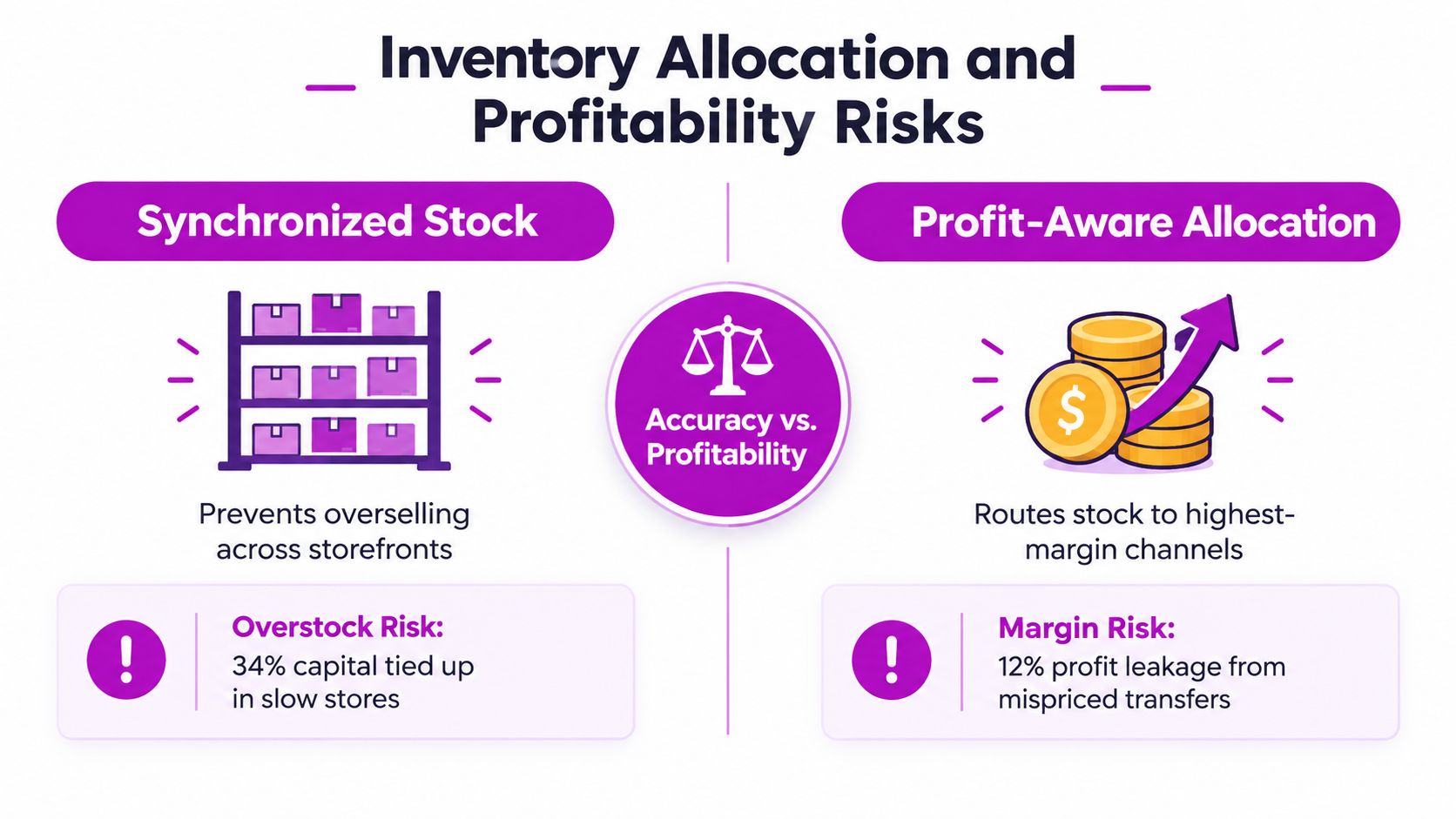
Shopify's retail guidance supports multi-location visibility, but visibility alone does not create a profitable allocation policy. Perfect synchronization may increase lost sales if every storefront can claim the same stock without demand prioritization, because preventing an oversell does not maximize contribution margin when channels compete for scarce units. The Shopify guidance on multi-store POS and inventory provides a useful starting point. The allocation rules still belong to the business.
Build an allocation hierarchy
Define demand priorities before the first shortage exposes conflicting decisions. “First order wins” may work for interchangeable demand, but it ignores margin, customer commitments, fulfillment cost, and markdown risk.
A practical allocation model can rank orders and reservations by:
- Contribution margin: Protect channels that retain more value after discounts, payment fees, fulfillment, and returns.
- Delivery commitment: Reserve stock for orders with a promised service level, especially where missing it could cause material customer or contractual damage.
- Sell-through evidence: Give more weight to channels that reliably convert the item instead of accumulating slow-moving inventory.
- Fulfillment economics: Include split shipments, transfer costs, cross-border duties, and the distance between stock and customer.
- Markdown exposure: Direct inventory toward channels with a credible path to selling it before demand declines.
Set reservation expiry as part of the policy. A cart hold, wholesale allocation, store transfer, and paid order represent different commitments. Each requires a status, an owner, and a release rule. Without those controls, teams count safety stock differently and the same unit can appear available to multiple decision-makers.
Pool carefully, reserve deliberately
Global pooling can improve availability when demand is interchangeable and fulfillment remains flexible. Regional reservations provide better control when delivery promises, tax treatment, import rules, or customer expectations make cross-border fulfillment unattractive. The right rule can vary by SKU. A core product may be pooled, while a regulated, seasonal, or bulky product remains reserved for a specific market.
Track oversell rate, cancellation rate, contribution margin by channel, split-shipment cost, transfer latency, and promised-location fulfillment. A dashboard showing every store as “in sync” says nothing about whether the allocation logic protects profit. Inventory accuracy supports the decision. Allocation governance determines the outcome.
Solving the Inventory Accuracy Problem
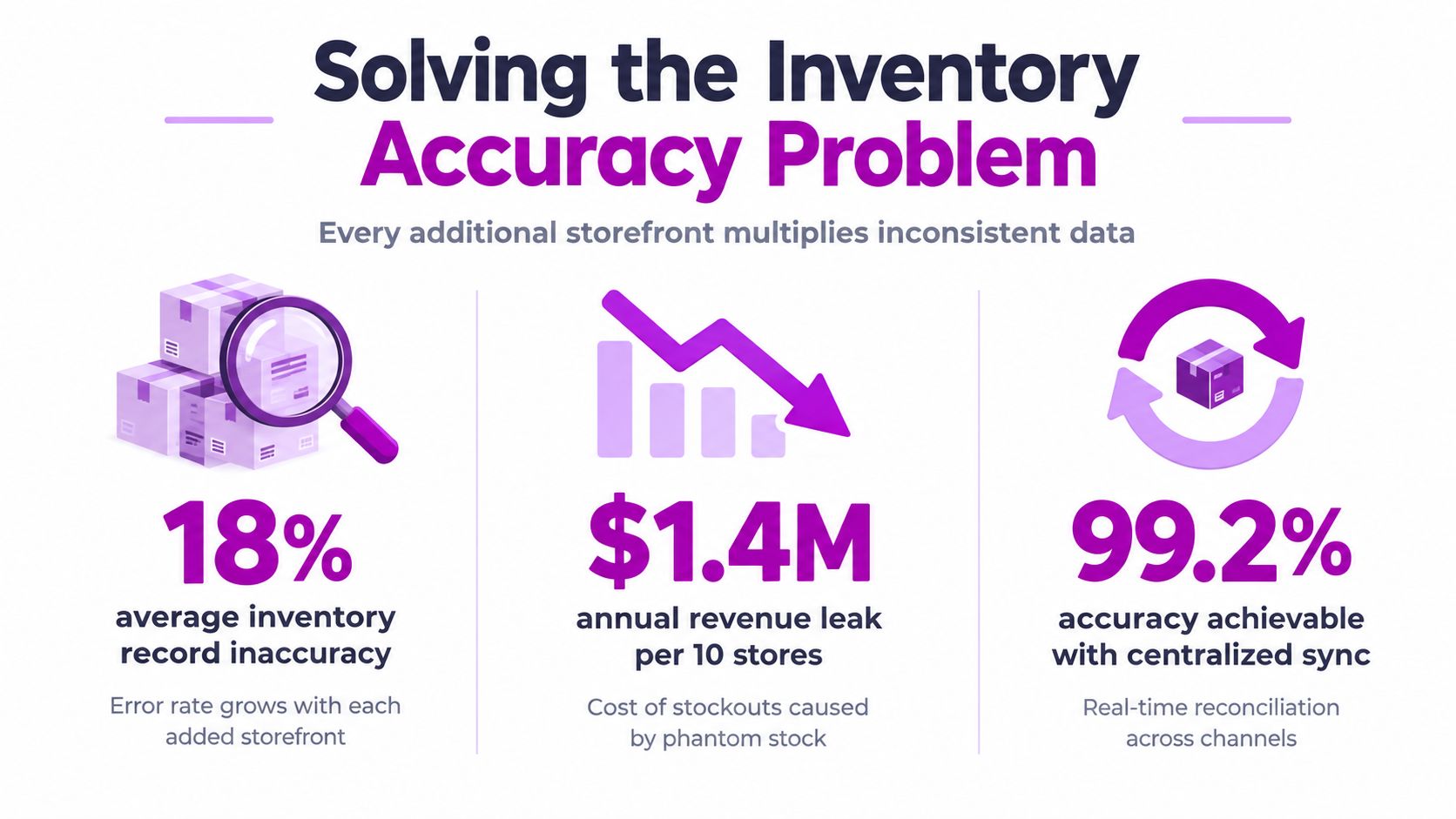
Multi store inventory management is a control-system problem. Every sale, return, reservation, transfer, damage adjustment, and fulfillment event changes what the business can accurately promise a customer. Adding storefronts increases the number of event sources, ownership decisions, and opportunities for one unit to be promised twice.
Global inventory distortion, the combined cost of overstocks and out-of-stocks, was estimated at approximately US$1.77 trillion in 2024, including about US$1.2 trillion attributed to out-of-stocks, according to this inventory management statistics review. The figure shows the scale of the risk, but the response must operate locally. Each store, warehouse, and channel needs dependable event handling and clear rules for which inventory it may expose.
Create one available-to-promise calculation
A central inventory ledger should separate physical stock from sellable stock. A practical available-to-promise calculation is:
Sellable stock = on-hand units minus reservations, safety stock, damaged units, and pending transfers.
Run this calculation from timestamped events rather than repeated overwrites. Each event should be idempotent, so a duplicate webhook cannot remove stock twice. Reconcile the result against physical counts and exception queues. A technically valid event stream can still represent a warehouse process that was executed incorrectly.
Prioritize five connected capabilities:
- Merchandise management governs product, variant, and assortment data.
- Price management keeps market and channel pricing within controlled rules.
- Warehouse or distribution-center management records movement and fulfillment status.
- Out-of-stock alerts surface customer-facing availability risk early.
- Replenishment converts demand signals into constrained purchase or transfer actions.
Measure customer-facing accuracy
Integration status alone does not show whether customers receive accurate promises. Track location-level inventory accuracy, oversell rate, stockout rate, transfer latency, and the percentage of orders fulfilled from the originally promised location.
Control principle: A synchronization dashboard is useful only when it explains the exceptions that customers experience.
Negative inventory should trigger investigation, not automatic correction. Stale updates need an owner and an age threshold. Unexplained variance should connect the ledger to a physical count, transfer document, return inspection, or fulfillment record. Those controls make inventory data dependable enough for allocation decisions, while allowing each market to retain rules that should not be standardized.
Governance and Localization Strategies
Central control and local relevance aren't opposites. The mistake is standardizing the wrong things.
A global team should standardize the product identifiers, measurement conventions, brand guardrails, security practices, data definitions, and escalation paths that make the business comparable. It shouldn't force identical assortments, claims, promotions, delivery promises, or return policies into markets with different commercial conditions.
Separate the global rule from the local decision
A governance register should assign each decision to one of three categories:
- Global standard: The rule applies everywhere unless a documented exception exists. SKU format, core product attributes, accessibility requirements, and analytics definitions usually belong here.
- Local exception: The market team can adapt the rule within stated boundaries. Assortment, payment methods, merchandising emphasis, delivery messaging, and promotional timing often fit this category.
- Approval-required divergence: The market can propose a change, but legal, finance, operations, or brand leadership must approve it. Product claims, tax-sensitive pricing, regulated goods, and high-risk returns policies may require this route.
This structure prevents a common failure mode. A central team copies a global promotion into every store, then local teams change prices, bundles, or stock exposure to compensate. The storefronts look aligned in a launch report, but the customer experience and margin logic have already diverged.
Localize the commercial promise
Localization is more than translation or geolocation. Review the market's assortment, claims, payment preferences, delivery promise, return process, tax treatment, price architecture, and service expectations. A translated product page can still be wrong if the product isn't available, the delivery window is unrealistic, or the return policy conflicts with local practice.
Shopify's separate-store structure is useful when those differences need hard operational boundaries. But a new expansion store also creates another catalog and customer data silo, so the burden of proof should be commercial, not organizational pride.
Test the smallest viable separation
Before creating a storefront, ask whether a separate inventory location, market configuration, or fulfillment rule solves the problem. Use a new store when the customer-facing experience and back-office process both need independent control. Use a localized configuration when the variation is limited to presentation, pricing, or routing.
Give local teams authority over approved exceptions, but require them to record the reason, owner, start date, and review condition. Governance works when people can move quickly inside clear boundaries. It fails when centralization blocks relevant decisions or when localization becomes an excuse for undocumented variation.
Automating Replenishment Across Locations
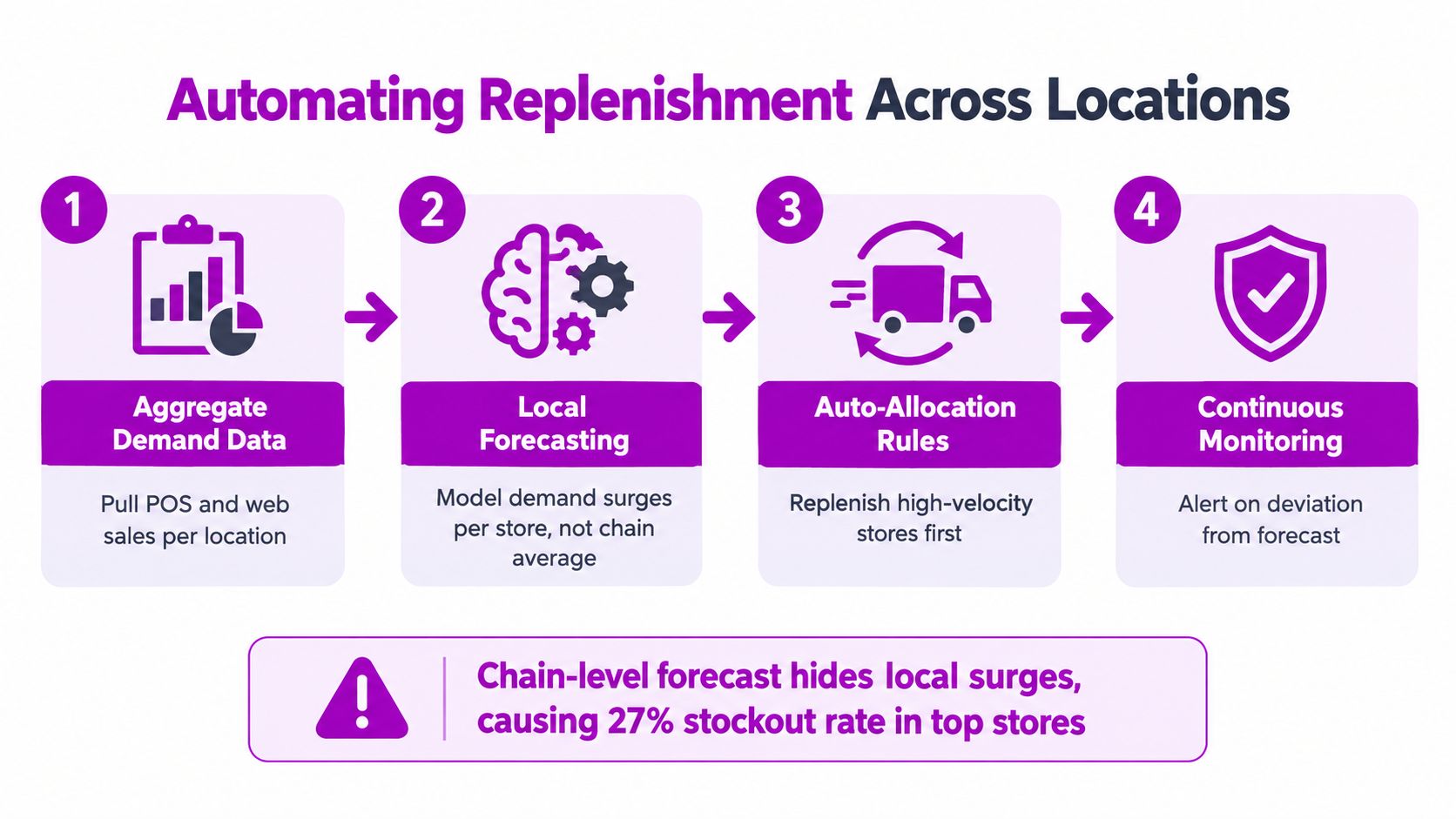
A chain-level forecast can hide a local surge. One store may sell through a promoted SKU quickly while another holds excess units, even though the network appears balanced. Replenishment should therefore start with the SKU, location, channel, and promotion state, not with a single global threshold.
Research covering 115 high-risk SKUs across 98 grocery stores found that distribution-center stockouts, promotions, and high sales velocity worsened store stockout performance, while automated ordering reduced stockouts. The findings are summarized in this research on SKU attributes and retail stockout performance.
Use a location-level replenishment loop
- Collect demand data. Combine web orders, POS sales, returns, transfers, cancellations, and reservations by SKU and location. Flag missing feeds before they influence a purchase recommendation.
- Forecast local demand. Separate baseline demand from promotion uplift, unusual velocity, seasonal effects, and known events. A chain average can provide context, but it shouldn't replace the local signal.
- Calculate the reorder point. Estimate demand during supplier lead time, then add safety stock based on forecast error and the desired service level. Constrain the result by case-pack quantities, minimum order values, transfer capacity, perishability, and markdown exposure.
- Route the action. Decide whether the best response is a supplier order, a distribution-center shipment, or a transfer from a slower location. The cheapest movement isn't always the best decision if it creates a new stockout elsewhere.
- Monitor exceptions. Alert teams when velocity exceeds the forecast, a promotion underperforms or overperforms, a supplier misses its expected date, or a distribution center can't support the recommendation.
Automated ordering should be constrained, not blindly trusted. Merchandisers need to approve unusual orders, while routine replenishment can move through defined thresholds. This balance preserves speed without allowing a faulty feed or one-off promotion to create network-wide excess.
The multi-location inventory management guidance from ECORN provides additional context for connecting location data, allocation, and operational workflows.
A process walkthrough can help teams visualize how demand signals become replenishment decisions:
The useful test isn't whether automation created a purchase order. It's whether the right location received the right quantity at the right time, without hiding a stockout, overloading another store, or ignoring a better transfer.
Your Multi Store Launch Checklist
A new storefront should not go live when the theme looks finished. It should go live when the organization can explain what happens to a product, order, customer, return, and inventory event from creation through resolution.
Start with the data contract. Define the product master, variant rules, SKU format, location IDs, channel identifiers, tax categories, fulfillment statuses, and return reasons before migration. If the new store uses different naming conventions, downstream systems will need translation logic, and every translation becomes another failure point.
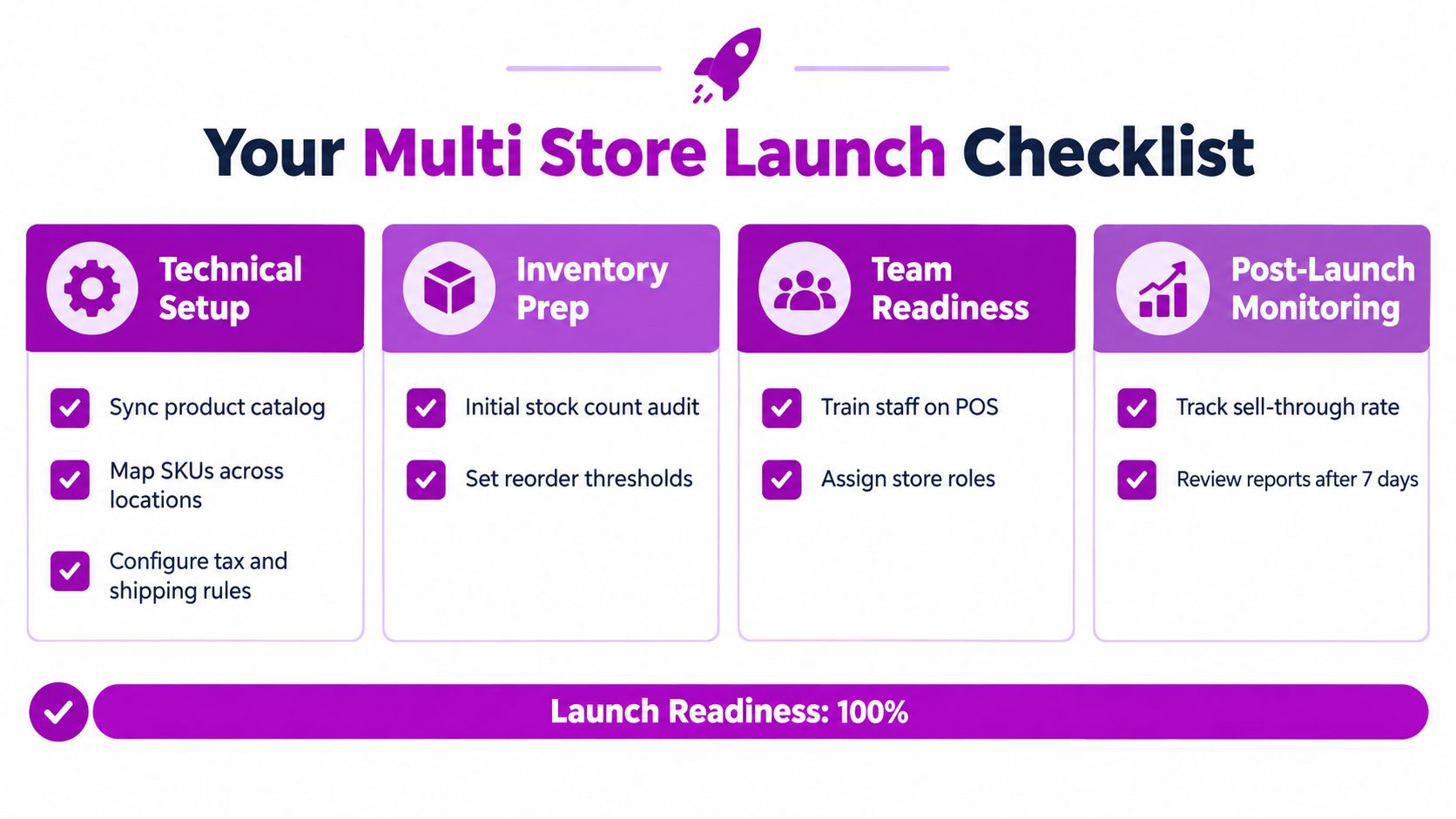
Validate the build before traffic arrives
Use a controlled launch sequence:
- Catalog readiness: Confirm the governed product master feeds the correct titles, variants, attributes, media, pricing, and market restrictions.
- Identity readiness: Decide whether customers remain store-specific or whether a customer data platform will resolve identities across storefronts. Document consent and account-recovery behavior.
- Inventory readiness: Complete an opening count, map every SKU to the correct location, and test reservations, returns, damaged units, transfers, and cancellations.
- Order routing: Place test orders for each fulfillment scenario. Verify that the promised location, shipping method, split-order behavior, and exception path match the allocation policy.
- Promotion controls: Test eligibility, stacking, exclusions, regional timing, and refund calculations. A discount that works in one storefront can still create a margin problem in another.
- Operational roles: Assign ownership for catalog updates, inventory exceptions, customer service, returns, app failures, and emergency stock rebalancing.
- Monitoring: Create dashboards for negative inventory, stale updates, unexplained variance, failed webhooks, order-routing errors, and promise-location misses.
The omnichannel inventory management study from Radial supports the technical foundation: a solid model needs a governed product master, standardized SKU and location IDs, real-time order-allocation rules, and exception dashboards.
Run failure tests, not only happy paths
Sell the last available unit in two channels at nearly the same time. Return an item to a different location. Cancel an order after allocation. Receive a transfer late. Change a product's market eligibility. Pause a fulfillment location. Each test should produce a predictable event, visible status, and accountable owner.
After launch, review operational data frequently enough to catch drift early. Compare promised and actual fulfillment locations, investigate stale inventory, and review local assortment performance against the allocation rules. Don't expand the store network until the team can explain exceptions without relying on manual spreadsheet reconciliation.
A Shopify Plus team such as ECORN can support storefront architecture, development, CRO, and multi-store implementation for brands that need help connecting these workflows. Visit ECORN to discuss your storefront structure, inventory governance, and launch readiness with a Shopify-focused team.


Scale Shopify Store

10 Shopify App Ideas Worth Building in 2026

Conversion Rate Optimization for Landing Pages: The Playbook
Shopify Plus Automation: A Guide for 2026
10 Social Selling Platforms for Shopify Merchants

Shopify Website Design Examples: 7 Stores Worth Studying

7 Ecommerce Newsletter Examples for Shopify Brands
One Product Shopify Store: Build and Scale

Mobile Pop Up Strategy for Shopify Stores That Converts

Sitemap for Shopify: How to Find, Optimize, and Submit It

7 Single Product Websites Worth Emulating

Product Variants Shopify: The Complete 2026 Guide

Ecommerce Analytics Consulting for Growth

What Is AI Integration for eCommerce

How to Choose the Right eCommerce Website Development Firm
E Business Strategy Implementation
Conversion Tracking Setup for Shopify Stores
BigCommerce vs Shopify Plus Which Enterprise Wins in 2026
Shopify Theme Kit: Setup, Commands, and Migration Guide

Shopify Extension Development: A Practical 2026 Guide

Shopify Speed Score Explained and How to Improve It

Shopify Mobile Optimization: The 2026 Playbook

How to Add Subcategory in Shopify for Better UX
How to Implement Structured Data for Ecommerce in 2026

SEO App Mobile: Shopify Store Optimization Guide

Shopify Plus Support: What It Includes and How to Choose

Google Ads for Shopify: The Complete 2026 Playbook

Shopify New York: How to Find and Hire the Right Agency

Google Search Console for Shopify: The Complete Setup
First Party Data Collection for eCommerce Growth

FAQ Online Store Guide: Build and Measure It Right
Do FB Ads Work for eCommerce in 2026?

One Page Checkout for Shopify: Design and Implementation
Shopify GraphQL vs REST: The 2026 Developer Decision
Shopify Ecommerce Consulting: Strategy, Pricing &

Are Reddit Ads Worth It for eCommerce Brands

Shopify Title and Meta Description: A Practical 2026 Guide

Product Video Best Practices for Shopify Brands
Real-Time Inventory Management: A 2026 Guide

AI Chatbot Integration for Shopify Stores
Affiliate Program Management: A Shopify Guide
10 Best Performance Monitoring Tools for Shopify in 2026

Digital Asset Management for eCommerce Brands in 2026

Every Type of Facebook Ads Explained for eCommerce Growth
Product Information Management Explained for Shopify Brands
Support Ticket System: A Guide for Shopify Stores

10 Best Customer Service Tools for Shopify in 2026

Can I Start a Business with No Money? a 2026 Blueprint

What Sells Good on Etsy: Best Niches for 2026

Shopify Add to Cart Button: A Practical 2026 Guide

Customer Feedback Automation: A Practical eCommerce Guide
Critical Rendering Path: A Guide for Shopify Stores

How to Promote on TikTok for eCommerce in 2026

B2B eCommerce Consulting That Drives Real Revenue

10 Best Practices for Site Navigation in 2026
Return vs Refund for Shopify Stores: A Practical Guide

What Is Customer Lifetime Value and Why It Matters

What Is Voice of Customer Research for eCommerce

SMS Marketing for Ecommerce That Actually Converts

Master How to Improve Email Deliverability in 2026

Top 7 eCommerce Partners NYC for Shopify Brands in 2026

Machine Learning for Ecommerce: Boost Your Shopify Store

Beauty Market Research: Your 2026 Growth Guide

Shopify International Expansion: A 2026 Roadmap

What Does CRO Stand for in Business: Understanding CRO

Shopify Visual Merchandising: A Playbook for Higher Sales

Shopify Landing Page Design: Master Conversion in 2026

10 Best AI SEO Optimization Tools for Shopify in 2026

Agentic AI for Ecommerce: Boost Your Sales in 2026
Mastering Email Marketing Data for eCommerce Growth

Conversion Rate Optimisation Australia: Boost Your Sales

Conversion Rate Optimization AI: Your Shopify Store Guide

10 Product Bundling Strategies for Shopify in 2026

How to Increase Customer Lifetime Value: A Shopify Playbook
AI Customer Service Automation: Shopify Guide 2026

Clean Website Design: A Shopify Conversion Playbook

Omnichannel Retail Strategy: A Shopify Playbook

Product Data Enrichment: A Guide for Shopify Brands

Instagram Shopping Features a Guide for Shopify Stores

What Is Revenue Optimization: A Holistic RevOps Guide

Benefits of Conversion Rate Optimization: Boost Your
WordPress to Shopify Migration: Your 2026 Seamless Switch
Boost Sales: Ecommerce Payment Processing Guide 2026
Unified Commerce Platform: Benefits, KPIs & Shopify Guide

How to Reduce Bounce Rate eCommerce: Your 2026 Guide
Shopify API Integration: A Practical End-to-End Guide

How to Implement Data Governance: A 2026 Guide
Shopify Store Development Cost: A 2026 Breakdown
What Is Server Side Tracking: The Shopify Guide 2026
Marketing Automation Workflows: A Shopify Guide for 2026
Shopify: How to Reduce Technical Debt

Shopify UX Design Change: A Playbook for Growth

User Generated Content Strategy: Shopify Playbook

Shopify Pause and Build Plan Cost: A Complete 2026 Guide

Compare at Price on Shopify: A Complete Guide for 2026

Where Can I Sell My Prints? 10 Best Platforms for 2026
Shopify Order Management System: The Ultimate Guide 2026
What Is Marketing Attribution? an eCommerce Guide for 2026

10 Best Black Friday Sales Sheets for 2026

Discover the Top Social Media Marketing Agencies For


newsletter in your inbox