


You've added products, increased ad spend, and watched orders rise. Yet the store feels harder to manage every month. Mobile conversion has stopped moving, margins are tightening, support tickets are multiplying, and nobody fully trusts the attribution dashboard. That's the point where “more traffic” stops being a strategy.
To scale a Shopify store, treat growth as a staged investment plan. First establish readiness, then fund the strongest revenue levers, then remove technical and operational constraints. AI commerce and international expansion belong in that plan early, because both can expose weaknesses in catalog governance, checkout, fulfillment, and contribution margin before your marketing team notices them.
Why Most Shopify Growth Advice Fails Real Founders
Most Shopify growth advice assumes a clean stack, reliable reporting, healthy margins, and a team with spare capacity. Real founders usually have none of those conditions. They're answering customer emails between campaign reviews, patching app conflicts after a theme update, and making budget decisions from dashboards that disagree.
A store often hits its first ceiling when volume grows faster than control. Orders increase, but the contribution left after shipping, returns, payment costs, and support gets thinner. The homepage looks polished while mobile shoppers struggle to select variants. A new app promises automation, but adds another subscription, another data connection, and another place for an order to fail.
Shopify's scale shows why the opportunity is substantial. The platform facilitated $378.4 billion in GMV in fiscal 2025, up from $292.3 billion in 2024, according to Shopify's fiscal 2025 filing with the SEC. GMV is the value of orders facilitated through the platform, not Shopify's own revenue. Your store still needs its own economics and operating discipline.
Find the bottleneck before funding the next stage
Use four lenses:
- Readiness metrics: Can you explain conversion, average order value, repeat purchase behavior, contribution margin, refunds, performance, and support workload?
- Growth levers: Is the next dollar better spent on checkout, acquisition, retention, offers, or a new channel?
- Technical scaling: Can your theme, apps, integrations, and automation handle more complexity without slowing the storefront or corrupting data?
- Operational scaling: Can fulfillment, customer service, inventory, and hiring absorb growth without damaging the customer experience?
Your current revenue band matters because each stage has a different constraint. An early store usually needs measurement and funnel discipline. A growth-stage store needs repeatable acquisition, retention, and operational systems. A larger store needs governance across channels, markets, catalogs, teams, and technology.
Practical rule: Don't buy the next platform upgrade to solve a problem you haven't measured. Fix the bottleneck that is already limiting profitable growth.

The Readiness Audit Every Shopify Store Should Run First
Before increasing ad spend or commissioning a rebuild, create a weekly baseline. Shopify Analytics gives you sales, sessions, conversion, average order value, and returning-customer views. Shopify Reports, ShopifyQL where available, Google Analytics, your payment provider, and a helpdesk such as Gorgias or Zendesk fill the gaps.
Track these seven measures separately for mobile and desktop where possible:
- Conversion rate: Record the storewide rate and split it by landing page, device, channel, and new versus returning customer.
- Average order value: Monitor the effect of bundles, merchandising, discounts, and free-shipping thresholds.
- Repeat purchase rate: Track whether first orders create a customer base or only a one-time revenue spike.
- Contribution margin after shipping: Subtract product cost, payment fees, shipping subsidies, discounts, returns, and marketplace costs from order revenue.
- Page-load performance: Use Lighthouse, PageSpeed Insights, and Shopify's performance reports to identify slow templates, scripts, and oversized media.
- Refund rate: Segment refunds by product, variant, acquisition source, and reason. A high-refund SKU can make profitable acquisition look successful when it isn't.
- Support tickets per 100 orders: Tag questions about delivery, sizing, returns, subscriptions, and checkout errors. Repeated questions often identify missing product information or broken processes.
There's no universal conversion threshold that makes a store ready. Readiness means the numbers are stable enough to interpret, margins are positive after variable costs, and the team can explain changes. A store with a lower but reliable conversion rate can scale more safely than one with a higher rate distorted by a short promotion.
Scaling readiness thresholds by revenue band
| Metric | Early-stage ($0-$500K) | Growth stage ($500K-$3M) | Scale stage ($3M+) |
|---|---|---|---|
| Reporting | One trusted weekly dashboard | Channel and cohort reporting | Governed reporting across markets and channels |
| Conversion | Device and source tracking in place | Funnel and landing-page diagnostics | Segmented experimentation and revenue-per-session analysis |
| Margin | Order-level contribution estimate | Margin by product and channel | Margin after market, fulfillment, returns, and service costs |
| Operations | Documented fulfillment and returns process | Exception monitoring and ownership | Integrated inventory, fulfillment, and service workflows |
| Technology | Fast theme and reviewed app stack | Automated recurring tasks | Architecture designed for multiple stores, markets, or complex checkout needs |
Do this audit for several weeks before committing to a major lever. The purpose isn't to create an impressive spreadsheet. It's to identify whether the next investment should improve the funnel, acquire demand, increase customer value, or remove an operational constraint.
High-Impact Growth Levers That Move Revenue
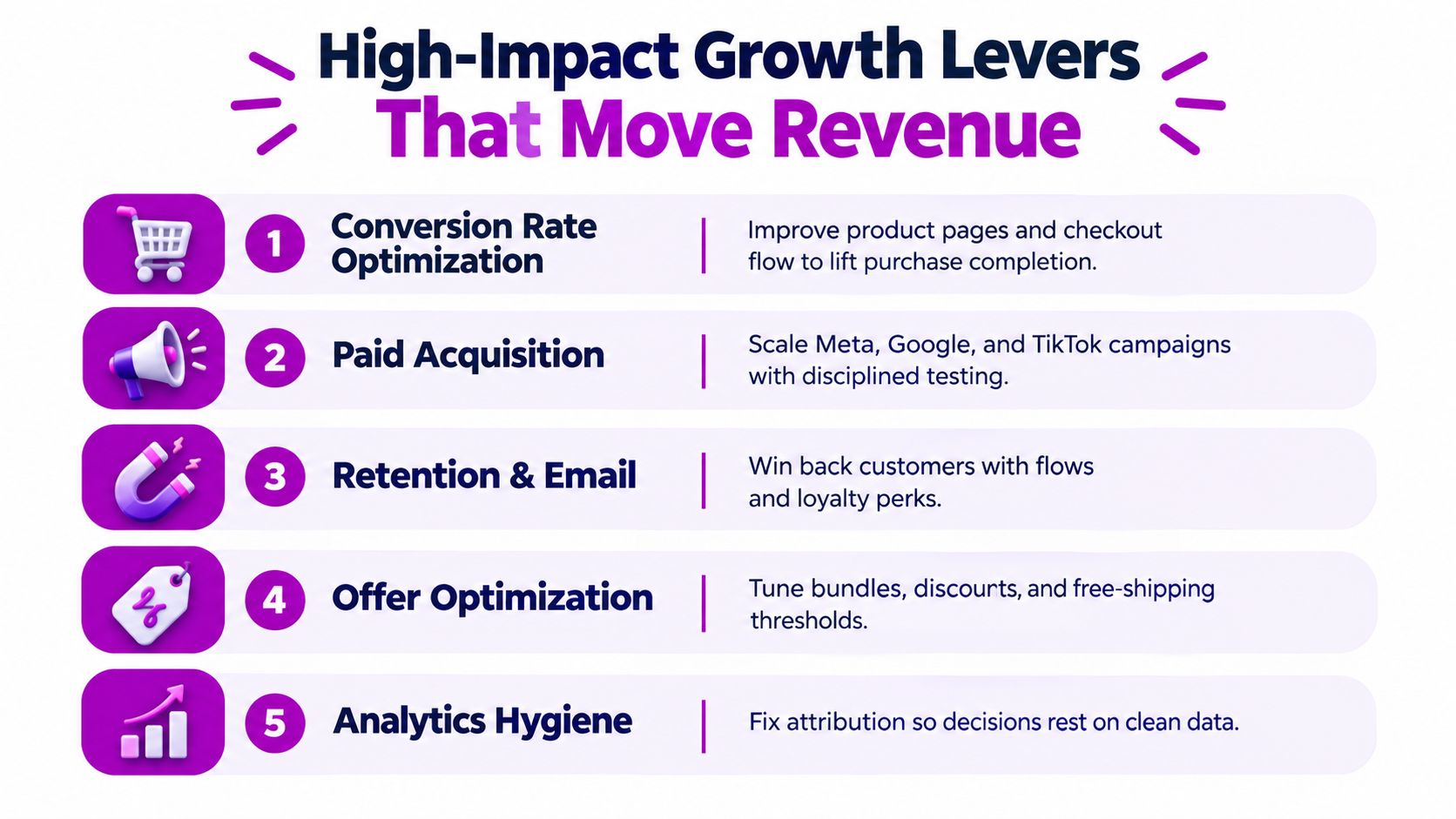
Most stores don't need five new channels. They need two well-funded levers that match the current bottleneck. If mobile shoppers struggle at checkout, paid acquisition only buys more expensive abandonment. If the funnel is healthy but customers don't return, adding another campaign may be less valuable than improving lifecycle marketing.
Start with checkout and product-page friction
Checkout optimization deserves priority because it affects demand you've already paid to generate. Baymard's research across 344 leading US and EU ecommerce sites found that 65% had mediocre-or-worse checkout UX, and its usability testing indicates that the average large ecommerce site has roughly 32 checkout improvements available. Baymard estimates that better checkout UX could produce an approximately 35% conversion-rate increase, as reported in its checkout usability research.
Treat that finding as a reason to investigate, not as a guaranteed result for your store. Baseline product-page conversion, cart-to-checkout rate, checkout completion, average order value, page-load performance, and revenue per session. Then use session recordings, funnel analytics, and moderated usability tests to locate the actual failure.
Prioritize guest checkout visibility, delivery costs before payment, mobile-friendly address and payment entry, clear error recovery, and unnecessary fields. Baymard identifies an ideal checkout structure of as few as 12 form elements, and 17% of US online shoppers report abandoning because checkout is too long or complicated, according to the same research. Test changes by device, customer type, and market instead of relying on one blended result.
Fund acquisition only after the funnel earns it
Meta, Google, and TikTok can scale demand, but each channel needs disciplined creative, audience, landing-page, and incrementality testing. Use contribution margin, not platform-reported revenue alone, to set allowable acquisition cost. Paid traffic is the wrong next move when conversion varies wildly by device, best-selling products are frequently unavailable, or refunds erase the apparent margin.
Retention usually has better economics once you have enough customer data to identify purchase timing and product relationships. Build welcome, post-purchase, replenishment, win-back, and abandoned-cart flows in Klaviyo or another platform that can distinguish customers by product and consent status. SMS should support timely service and offers, not compensate for weak email strategy or poor merchandising.
Offer optimization is often cheaper than a redesign. Test bundles, quantity breaks, subscription options, and free-shipping thresholds against margin and return behavior. Don't train customers to wait for discounts before you understand the value your offer already communicates.
Channel diversification comes last among these priorities. Amazon, TikTok Shop, wholesale, and retail can expand reach, but every channel adds listing rules, inventory synchronization, fulfillment requirements, returns, and reporting work. Add one channel when customer behavior and operational capacity justify it, not because a competitor launched there.
Shopify Technical Scaling From Apps to Plus and Headless
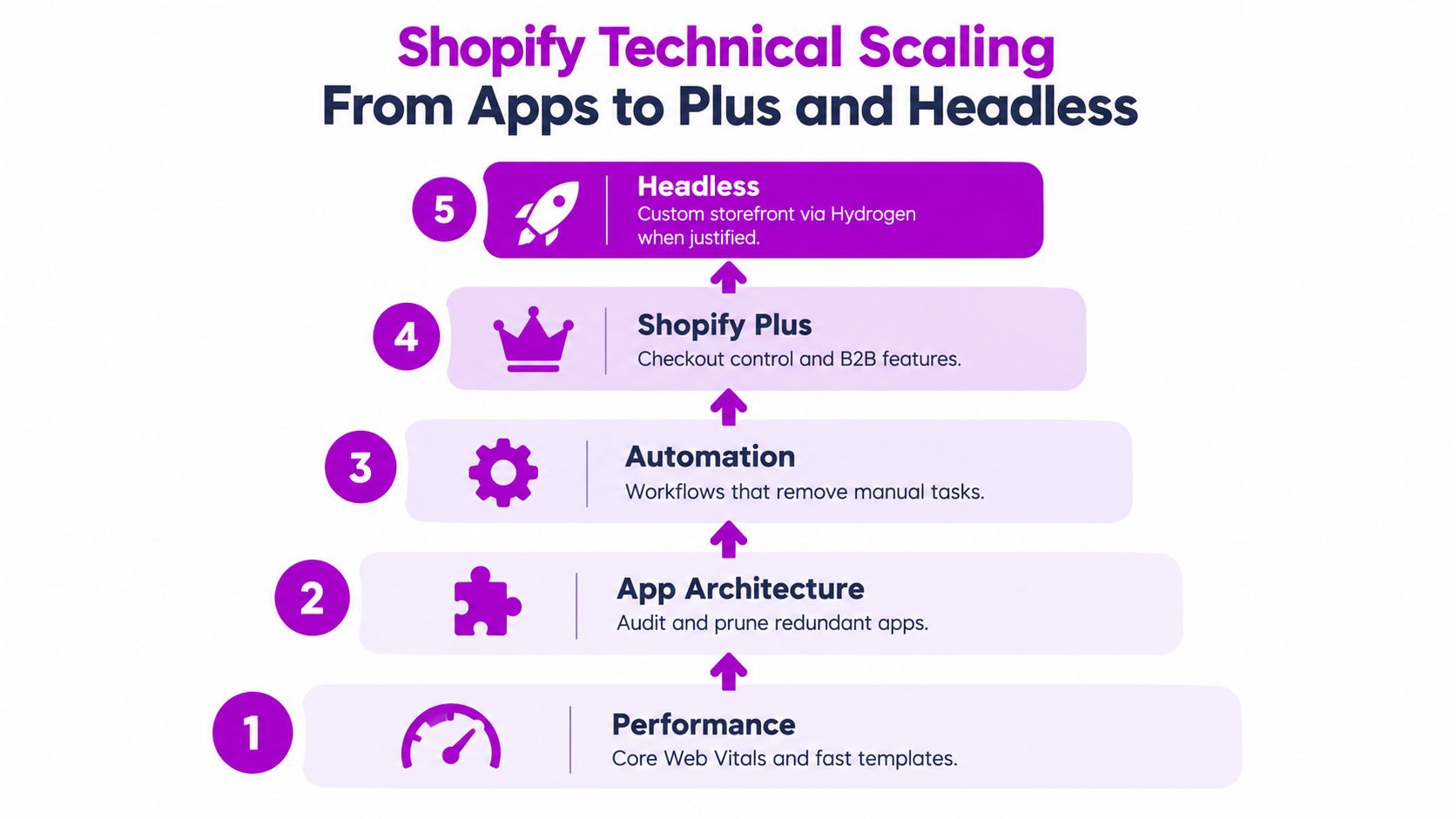
Technical scaling should follow a sequence. Performance comes before replatforming, app governance comes before more automation, and operational need comes before Shopify Plus or headless commerce. A slow theme with too many scripts can waste the value of a advanced architecture.
Fix the foundation first
Start with the theme, images, third-party scripts, tracking tags, and app embeds. Remove apps that duplicate native Shopify features or each other. Review whether every app is still used, whether it injects code into high-value templates, and whether it creates data ownership confusion.
A faster theme and cleaner image pipeline often deliver more value than a new storefront framework. Compress media, defer nonessential scripts, reduce tracking duplication, and test collection, product, cart, and checkout-adjacent experiences on real mobile devices. Performance work should be tied to revenue per session and conversion, not a vanity score alone.
Consolidate before you expand
Once the store has a reliable baseline, map the app stack by function. Identify the system of record for products, customers, inventory, orders, subscriptions, reviews, loyalty, and analytics. Where two tools perform similar jobs, keep the one with stronger data quality, support, and integration behavior.
Automate repetitive work with Shopify Flow, webhooks, ERP connections, and helpdesk workflows. Useful examples include tagging high-risk orders for review, routing wholesale orders, flagging low inventory, escalating delivery exceptions, and assigning support tickets by topic. Automation should reduce decision-making work, not hide failures.
Shopify Plus becomes relevant when the business needs more checkout control, B2B capabilities, organization-level administration, multiple stores, or complex international operations. Don't migrate because another brand has Plus. Document the workflows you need, estimate the revenue or risk attached to them, and compare that value with licensing, implementation, and maintenance costs. ECORN's Shopify Plus development guidance is a useful reference when assessing those capabilities.
Headless commerce, including a Hydrogen storefront, is justified when the buying experience requires custom interaction, content architecture, or frontend behavior that a well-built Shopify theme can't support. It also introduces more deployment, testing, caching, analytics, and merchandising responsibility. If the business can't maintain those systems, headless will make the bottleneck more expensive.
| Trigger | Recommended move |
|---|---|
| Slow templates or script-heavy pages | Optimize theme, media, and app embeds |
| Duplicate apps and conflicting data | Prune and define system ownership |
| Manual repetitive workflows | Add Flow, integrations, and exception handling |
| B2B, complex checkout, or multi-store needs | Evaluate Shopify Plus |
| Strategic frontend requirements | Consider headless only after documenting the operating model |
The Uncomfortable Scaling Constraints Most Founders Skip
AI commerce and international expansion are often treated as content projects. That's the wrong diagnosis. AI readiness is a catalog and transaction-governance problem, while international readiness is a contribution-margin and service problem.
Shopify reported that AI-driven traffic and orders to merchants tripled year over year in Q2 2026, while new-buyer orders from AI channels converted at nearly twice the rate of other channels, as summarized in coverage of Shopify and AI-driven ecommerce. Shopify's Universal Commerce Protocol also supports agent actions such as product discovery, cart creation, and checkout through standardized commerce APIs.
That creates practical requirements. Product titles and descriptions alone aren't enough. Agents need accurate structured product data, complete attributes, clean variants, reliable inventory signals, understandable shipping and return policies, valid discounts, and clear subscription rules. Your team also needs API permissions, fraud controls, post-purchase handling, and a human escalation path.
Run an AI-commerce readiness audit
Ask five questions:
- Catalog accuracy: Do every variant, size, material, compatibility detail, and availability signal agree across storefronts and feeds?
- Policy clarity: Can an agent determine delivery, returns, exchanges, subscriptions, and exclusions without guessing?
- Transaction compatibility: Can the selected product move from discovery to cart and checkout without an unsupported option breaking the flow?
- Attribution: Can you identify AI-assisted sessions and orders when referral information is incomplete or obscured?
- Fulfillment reliability: Can the warehouse deliver the promise represented in the catalog?
Generating more copy won't solve missing attributes or unreliable inventory. Govern the data first.

International growth needs the same discipline. Translation and local currency can improve discoverability, but they don't prove that a market deserves investment. Shopify's international ecommerce strategy guidance recommends examining traffic quality, device conversion, checkout abandonment, product and category margin, returns by SKU, operational bottlenecks, and channel fragmentation together.
DHL's 2025 survey covered 24,000 online shoppers across 24 countries, and its findings indicate that poor delivery or returns experiences can cause roughly four in five shoppers to abandon carts, according to DHL's ecommerce delivery and returns research. Treat that as a warning about the commercial importance of logistics, not as a reason to translate every market immediately.
Market-entry rule: Choose fewer markets with strong landed economics over broad localization with weak contribution margin.
For each candidate market, calculate contribution margin after duties, shipping, payment costs, returns, fraud, customer support, and local fulfillment. Review localized checkout completion, repeat purchase behavior, delivery promise, return routing, and service workload. Start cross-border when the economics are proven. Add local inventory or a separate storefront only when demand and operational complexity justify it.
Operational Scaling for Fulfilment Support and Hiring
Marketing can create demand faster than operations can absorb it. The warning signs are familiar: orders sit unfulfilled, inventory counts require manual reconciliation, customers ask where packages are, and the founder becomes the escalation queue.
Keep fulfillment with a capable 3PL when its accuracy, service levels, integrations, and returns process are dependable. Bring more work in-house when the brand needs specialized kitting, strict quality control, unusual packaging, or a level of inventory visibility the 3PL can't provide. Don't make the decision from warehouse rent alone. Compare labor, software, equipment, errors, returns, management time, and the risk of service disruption.
For multichannel growth, establish one source of truth for inventory, orders, and fulfillment status. Shopify should remain authoritative for the storefront, while connected marketplaces and social channels receive controlled updates. A solution such as the ecommerce fulfillment approach can help frame the required workflows before you add channels or warehouses.
Put service systems ahead of service headcount
Introduce a helpdesk when tickets are scattered across email, social messages, and order notes. Create macros for delivery updates, returns, exchanges, sizing, subscription changes, and damaged orders. Route complex cases to someone with authority to resolve them, rather than forcing every customer through a rigid script.
A virtual assistant for ecommerce can handle structured tier-one work such as order-status questions, catalog updates, inbox triage, and returns administration when the process is documented. The ecommerce virtual assistant resource from Virtustant offers context for defining those responsibilities. Keep fraud decisions, product-policy exceptions, and sensitive escalations with trained internal owners.
Hire for the constraint you can't automate
The first high-impact hire is often an operations lead when fulfillment, inventory, returns, and support consume founder time. A senior marketer makes sense when the funnel is measured and acquisition needs ownership. A developer or agency partner becomes urgent when releases are slow, app conflicts persist, or technical debt blocks merchandising and experimentation.
Hiring test: If the same problem appears every week, assign an owner and document the workflow before adding another tool.
Your 90 Day Scaling Plan and Experimentation Framework
Run the next quarter as a sequence of controlled bets. Every experiment needs four fields:
- Hypothesis: State what change should improve and why.
- Metric: Choose one primary measure, such as checkout completion, revenue per session, contribution margin, or support workload.
- Sample requirement: Define the minimum evidence you need before making a decision. Don't stop a test after a handful of noisy results.
- Decision rule: Decide in advance whether you'll roll out, revise, or reject the change.
Days 1 to 30
Build the readiness dashboard. Reconcile Shopify Analytics with payment, advertising, fulfillment, and helpdesk data. Audit mobile and desktop conversion, average order value, repeat purchases, contribution margin after shipping, page performance, refunds, and support tickets.
At the same time, inspect the product page, cart, and checkout path with session recordings and usability tests. Fix obvious errors, delivery ambiguity, variant confusion, and unnecessary fields before launching new acquisition campaigns.
Days 31 to 60
Choose two growth levers. For most stores, that means checkout or product-page optimization plus either retention or one paid channel. Create a test backlog ranked by expected revenue impact, confidence, implementation effort, and operational risk.
Prune redundant apps and automate one recurring process. If international or AI commerce is a priority, complete the catalog, policy, attribution, and market-economics audits before publishing more content or opening more storefronts.
Days 61 to 90
Release the strongest validated changes. Expand only the paid campaigns, offers, or channels that meet your contribution-margin rule. Assign ownership for fulfillment exceptions, support categories, inventory accuracy, and technical releases.
Review the same KPIs monthly, but inspect segments weekly. New and returning customers, mobile and desktop shoppers, major markets, product categories, and acquisition sources can behave differently enough to hide a damaging regression.
Scaling is a sequence of small validated bets, not one big platform decision.
Print this checklist and use it in your next planning meeting:
- Measurement: Can one person explain the weekly numbers?
- Funnel: Is the largest checkout or product-page failure documented?
- Economics: Does the next growth lever improve contribution, not only revenue?
- Technology: Have you optimized and governed the current stack?
- AI commerce: Are catalog, policies, APIs, attribution, and fulfillment agent-ready?
- International: Does each target market work after duties, returns, delivery, and service costs?
- Operations: Can the team absorb added orders without lowering service quality?
- Experimentation: Does every major change have a hypothesis and decision rule?
Start next week by freezing unnecessary app purchases, building the baseline, and selecting one funnel experiment. That discipline will tell you whether your store needs more demand, a better buying experience, stronger retention, or a more reliable operating system.
ECORN helps Shopify brands with development, maintenance, conversion rate optimization, redesigns, and Shopify Plus projects. If you're ready to scale your Shopify store without guessing which constraint to fix next, visit ECORN to discuss a focused audit or implementation project.


10 Shopify App Ideas Worth Building in 2026
Conversion Rate Optimization for Landing Pages: The Playbook
Shopify Plus Automation: A Guide for 2026
10 Social Selling Platforms for Shopify Merchants

Shopify Website Design Examples: 7 Stores Worth Studying
7 Ecommerce Newsletter Examples for Shopify Brands
One Product Shopify Store: Build and Scale

Mobile Pop Up Strategy for Shopify Stores That Converts
Sitemap for Shopify: How to Find, Optimize, and Submit It

7 Single Product Websites Worth Emulating
Product Variants Shopify: The Complete 2026 Guide
Ecommerce Analytics Consulting for Growth
What Is AI Integration for eCommerce
How to Choose the Right eCommerce Website Development Firm
E Business Strategy Implementation
Conversion Tracking Setup for Shopify Stores
BigCommerce vs Shopify Plus Which Enterprise Wins in 2026
Shopify Theme Kit: Setup, Commands, and Migration Guide

Shopify Extension Development: A Practical 2026 Guide
Shopify Speed Score Explained and How to Improve It
Shopify Mobile Optimization: The 2026 Playbook

How to Add Subcategory in Shopify for Better UX
How to Implement Structured Data for Ecommerce in 2026

SEO App Mobile: Shopify Store Optimization Guide

Shopify Plus Support: What It Includes and How to Choose

Google Ads for Shopify: The Complete 2026 Playbook

Shopify New York: How to Find and Hire the Right Agency

Google Search Console for Shopify: The Complete Setup
First Party Data Collection for eCommerce Growth
FAQ Online Store Guide: Build and Measure It Right
Do FB Ads Work for eCommerce in 2026?

One Page Checkout for Shopify: Design and Implementation
Shopify GraphQL vs REST: The 2026 Developer Decision
Shopify Ecommerce Consulting: Strategy, Pricing &

Are Reddit Ads Worth It for eCommerce Brands

Shopify Title and Meta Description: A Practical 2026 Guide

Product Video Best Practices for Shopify Brands
Real-Time Inventory Management: A 2026 Guide

AI Chatbot Integration for Shopify Stores
Affiliate Program Management: A Shopify Guide
10 Best Performance Monitoring Tools for Shopify in 2026
Digital Asset Management for eCommerce Brands in 2026

Every Type of Facebook Ads Explained for eCommerce Growth
Product Information Management Explained for Shopify Brands
Support Ticket System: A Guide for Shopify Stores

10 Best Customer Service Tools for Shopify in 2026

Can I Start a Business with No Money? a 2026 Blueprint

What Sells Good on Etsy: Best Niches for 2026

Shopify Add to Cart Button: A Practical 2026 Guide

Customer Feedback Automation: A Practical eCommerce Guide
Critical Rendering Path: A Guide for Shopify Stores

How to Promote on TikTok for eCommerce in 2026

B2B eCommerce Consulting That Drives Real Revenue
10 Best Practices for Site Navigation in 2026
Return vs Refund for Shopify Stores: A Practical Guide

What Is Customer Lifetime Value and Why It Matters
What Is Voice of Customer Research for eCommerce

SMS Marketing for Ecommerce That Actually Converts

Master How to Improve Email Deliverability in 2026

Top 7 eCommerce Partners NYC for Shopify Brands in 2026

Machine Learning for Ecommerce: Boost Your Shopify Store

Beauty Market Research: Your 2026 Growth Guide

Shopify International Expansion: A 2026 Roadmap

What Does CRO Stand for in Business: Understanding CRO

Shopify Visual Merchandising: A Playbook for Higher Sales

Shopify Landing Page Design: Master Conversion in 2026
10 Best AI SEO Optimization Tools for Shopify in 2026

Agentic AI for Ecommerce: Boost Your Sales in 2026
Mastering Email Marketing Data for eCommerce Growth

Conversion Rate Optimisation Australia: Boost Your Sales
Conversion Rate Optimization AI: Your Shopify Store Guide

10 Product Bundling Strategies for Shopify in 2026
How to Increase Customer Lifetime Value: A Shopify Playbook
AI Customer Service Automation: Shopify Guide 2026

Clean Website Design: A Shopify Conversion Playbook

Omnichannel Retail Strategy: A Shopify Playbook
Product Data Enrichment: A Guide for Shopify Brands

Instagram Shopping Features a Guide for Shopify Stores
What Is Revenue Optimization: A Holistic RevOps Guide

Benefits of Conversion Rate Optimization: Boost Your
WordPress to Shopify Migration: Your 2026 Seamless Switch
Boost Sales: Ecommerce Payment Processing Guide 2026
Unified Commerce Platform: Benefits, KPIs & Shopify Guide

How to Reduce Bounce Rate eCommerce: Your 2026 Guide
Shopify API Integration: A Practical End-to-End Guide
How to Implement Data Governance: A 2026 Guide
Shopify Store Development Cost: A 2026 Breakdown
What Is Server Side Tracking: The Shopify Guide 2026
Marketing Automation Workflows: A Shopify Guide for 2026

Shopify: How to Reduce Technical Debt

Shopify UX Design Change: A Playbook for Growth
User Generated Content Strategy: Shopify Playbook

Shopify Pause and Build Plan Cost: A Complete 2026 Guide

Compare at Price on Shopify: A Complete Guide for 2026

Where Can I Sell My Prints? 10 Best Platforms for 2026
Shopify Order Management System: The Ultimate Guide 2026
What Is Marketing Attribution? an eCommerce Guide for 2026

10 Best Black Friday Sales Sheets for 2026

Discover the Top Social Media Marketing Agencies For
Consumer Confidence Definition for eCommerce in 2026


newsletter in your inbox