

Most merchants ask how to sign up more subscribers. The sharper question is this. What if the subscriptions you lose, and the shipping plans you sell, move profit more than the next acquisition campaign?
A one-time order ends when the parcel leaves the warehouse. Ecommerce subscription services keep billing only while the product, the payment, and the delivery still feel worth the next charge. Convenience pulls people in. An easy exit, or a card that fails, pushes them out just as fast.
In research published by McKinsey in 2018, 15% of online shoppers reported having subscribed to a service that delivered products on a recurring basis, commonly through monthly boxes. The market had expanded by more than 100% annually during the five years before that study. Among active subscribers, the median customer held two subscriptions, and nearly 35% held three or more. Nearly 40% had canceled a subscription at some point.
Demand is real, and so is the exit. Pick the model from how people already buy, then treat failed payments, cancellation control, and delivery cost as operating choices, not afterthoughts.
Subscription Models Compared at a Glance
If the same customer buys the same product on a predictable interval, replenishment usually wins. If they come back for surprise, a curated box is the stronger choice. Membership and a paid delivery program answer different jobs. Mixing them is how a first launch wastes months.
| Model | What the customer gets | Best-fit products | Example |
|---|---|---|---|
| Replenishment | Automatic repeat delivery on a set interval | Groceries, supplements, razors, pet food | Amazon Subscribe & Save (2007) |
| Curated box | Themed products selected each month | Beauty, snacks, hobby goods | Monthly beauty or food boxes |
| Membership and access | Paid perks, early access or member pricing | Apparel, digital goods, premium content | Member-only drops and pricing tiers |
| Delivery and returns program | Free or discounted shipping and returns for a fee | Stores with frequent repeat orders | Paid shipping and returns memberships |
What each row actually sells
Replenishment sells the next unit before the cupboard is empty. You automate a future order the customer would have placed anyway. On May 15, 2007, Amazon launched Subscribe & Save for grocery products. Customers could schedule deliveries at one-month, two-month, three-month, or six-month intervals, with a 15% discount and free shipping. Interval, incentive, and shipping convenience became the pattern other replenishment programs copied, because the products empty on a clock: household supplies, groceries, personal care, and pet goods.
Curated boxes sell an edit, not a refill. The customer pays for themed products chosen each month, and the hook is discovery. Beauty kits, snack assortments, and hobby goods fit, because "what's inside" matters more than running out of last month's SKU.
Membership and access sells a right that stays useful between orders. Early drops, member pricing, or gated content carry the fee. Apparel and digital products fit when the ongoing perk, not a physical refill, is what people pay for.
Delivery and returns programs sell logistics. A fee buys free or cheaper shipping and easier returns. They fit stores whose customers already order often enough that one membership beats paying freight on every checkout.
Practical rule: Write down the purchase interval of your best-selling product before you choose a model. If you can't name that interval in weeks or months, you don't have a replenishment offer yet.
How Recurring Revenue Works for an Online Store
A one-time sale is a concert ticket. The night ends, and the venue starts over. A subscription is closer to a gym membership. The business is paid again every cycle for as long as the member stays.
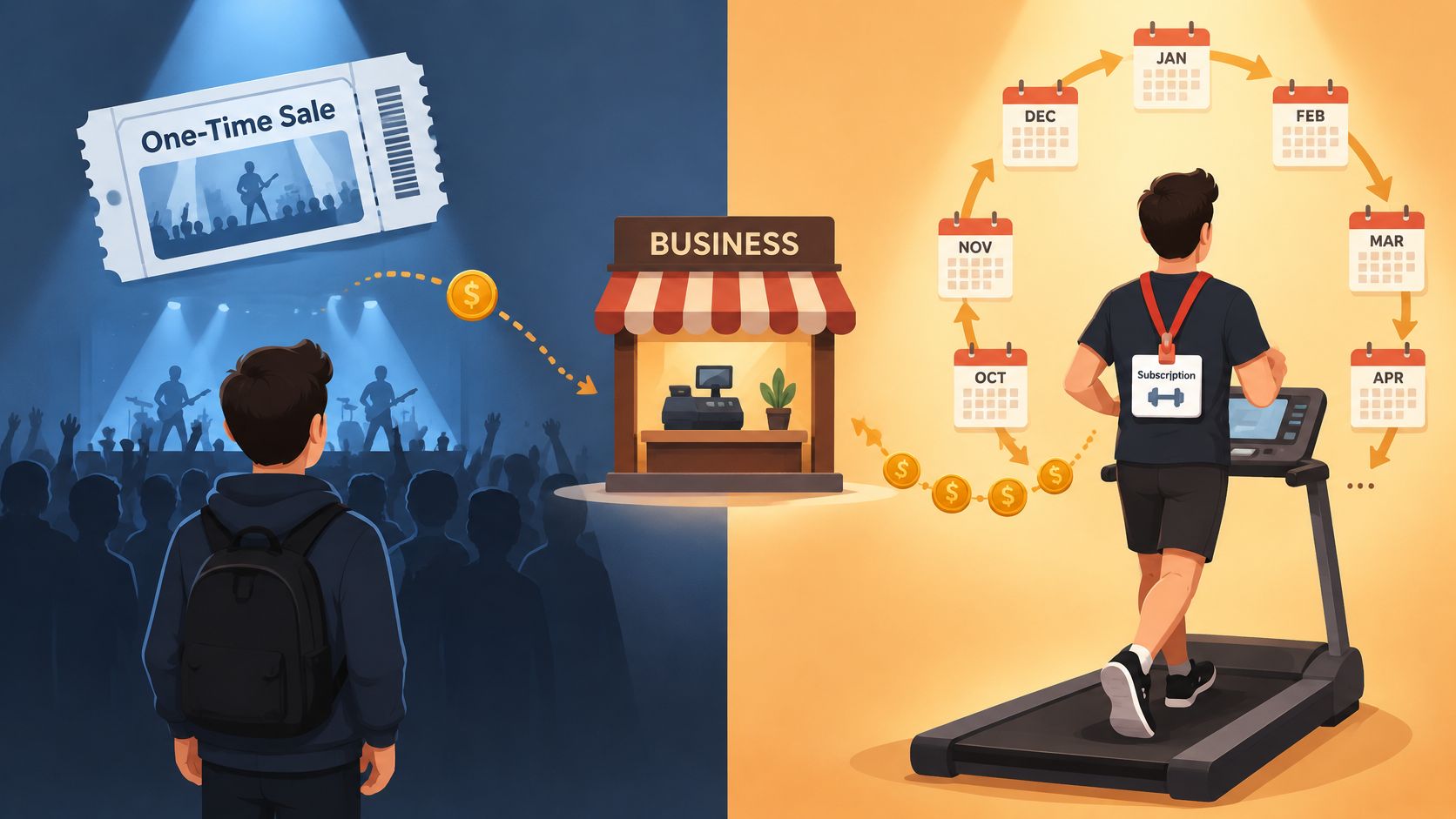
Monthly recurring revenue is active subscribers multiplied by the average recurring price. Say a store has 400 active subscribers paying $30 a month. That is $12,000 of monthly recurring revenue. The same formula is the only one you need. Every change below is just a new input.
What churn does to the stream
Lose 5% of those 400 subscribers in a month and you cancel 20 accounts. At $30 each, $600 of recurring revenue has to be replaced before the store grows at all. New sign-ups that only cover those 20 people look like momentum on a dashboard and leave the total flat.
Payback uses the same price. If a new subscriber costs $60 to acquire and pays $30 a month, acquisition cost comes back in about two months, and profit starts after that. The first cycles matter more than a pretty annual forecast, because a cancel in month one never reaches the profitable months.
The monthly bridge you can run yourself is simple. Starting recurring revenue, plus revenue from new subscribers, minus revenue from cancellations, equals next month's recurring revenue. Run it on the $12,000 store. Add 30 new subscribers ($900) and lose the $600 above, and next month opens at $12,300, not at whatever the ads promised.
Predictable billing also tells operations what to pack. A known cadence is a demand signal a one-off flash sale never gives, so purchasing and fulfilment can staff to a calendar instead of a guess. If you sell discovery boxes, a plain walkthrough of subscription box sign-up and delivery is worth reading beside your own checkout, because the revenue bridge assumes the box goes out on the date you charged for.
Pull the last three months and write your own bridge. If cancellations already eat the new subscribers, fixing the offer beats buying more traffic.
Tracking Retention by Cohort Instead of Blended Churn
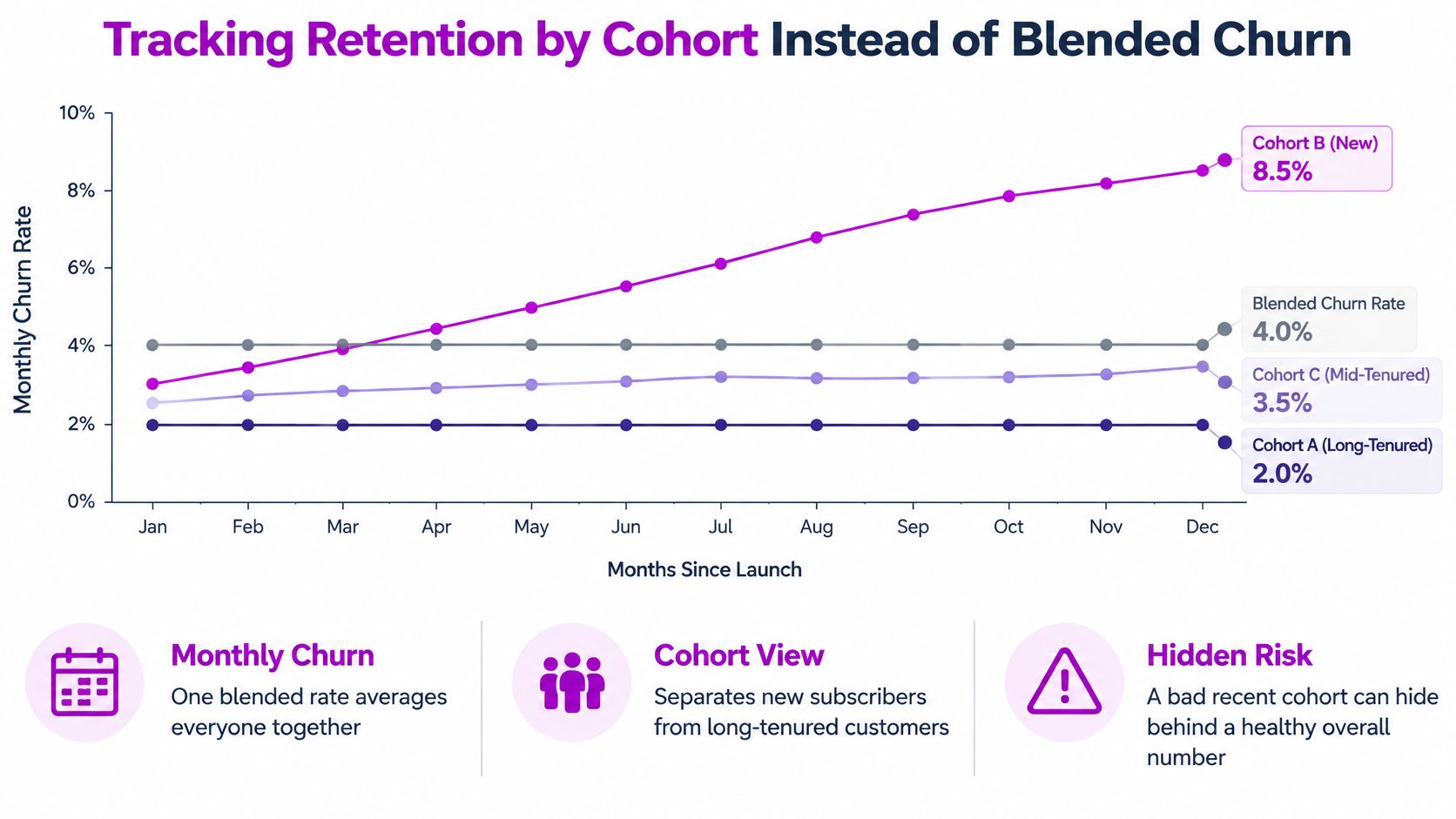
One blended monthly churn rate averages everyone together. Long-tenured customers, who rarely leave, sit in the same number as people who joined on a steep discount last month. The line looks calm while a bad recent group is already gone.
Subscription analytics guidance from Swell treats cohort analysis, not a single churn percentage, as the way to forecast lifetime value and recurring revenue. A daily subscriber record should hold status, plan, recurring-revenue contribution, tenure, and billing events: invoice creation, successful payment, payment failure, pause, resume, cadence change, and cancellation reason.
Build the grid, then read survival
Group people by acquisition month, product or plan, market, and billing cadence. Then calculate survival at 30, 90, 180, and 365 days, and tie each cohort to contribution margin and customer-acquisition cost. Payment failures can go to a recovery workflow. Dissatisfaction needs a product, price, merchandising, or lifecycle change. A blended figure hides that split, because long-tenured accounts are weighted together with new ones.
Say overall churn looks stable for a year. Subscribers acquired in one discount-led month then fall off sharply at 90 days, right when the intro price ends. That is a weak offer, not a storewide retention crisis. Another month, acquired at full price, holds. Spend more to copy the discount month and you buy a cohort that never pays back.
A short walkthrough of how cohort lines diverge from a flat average makes the trap easier to see before you export your own file.
| Checkpoint | What it reveals | Warning sign |
|---|---|---|
| 30 days | Early-life churn from onboarding and first delivery | Sharp drop before the first renewal |
| 90 days | Whether the offer holds after an introductory discount ends | Cohort falls after the discount period |
| 180 days | Stability of mature subscribers and product fit | Steady decline across several cohorts |
| 365 days | Long-term lifetime value and payback on acquisition cost | Cohorts that never recover acquisition cost |
Export billing events for the last six months and build the first grid by acquisition month. If the 90-day column is the one that breaks, the discount, not the whole brand, is what you fix.
Recovering Revenue From Failed Payments
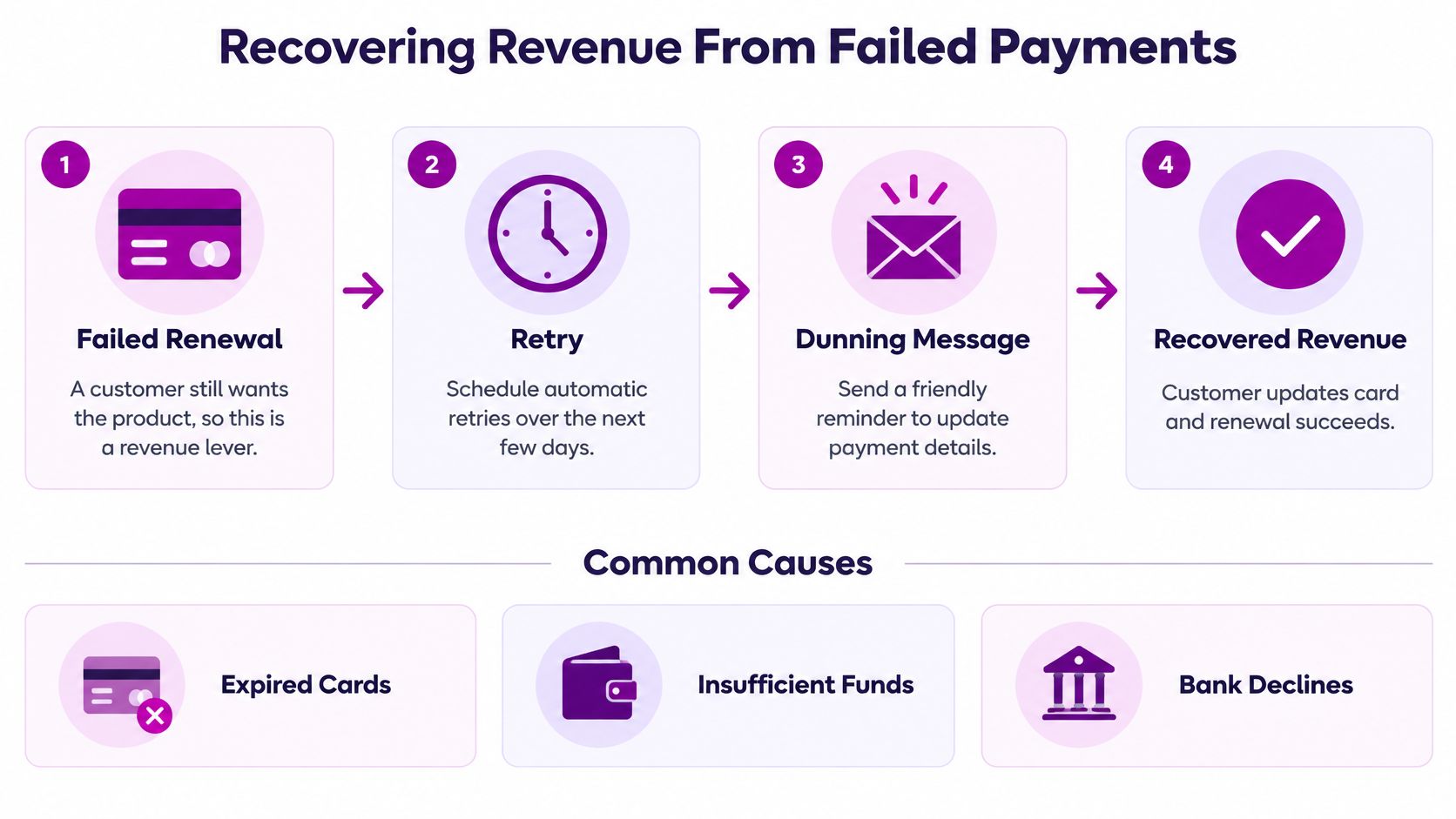
A failed renewal is often a customer who still wants the product. The intent to stay is still there; only the card failed. That single difference is why recovery behaves like a growth lever rather than a finance chore you hand to accounting at month end.
Darkroom's subscription churn observatory places involuntary churn, subscriptions lost after unsuccessful payments and non-recovery, at roughly 20–40% of total churn, and executive surveys on subscription billing attribute a substantial share of the remainder to failed payments. Expired cards, insufficient funds, bank declines, and authentication failures interrupt renewal. Without retries, notices, account updates, or a self-service payment update, a willing subscriber becomes an avoidable cancel.
Dunning is closer to a locked door than a lost customer. Someone standing outside still intends to come in, and your job is to hand them a working key before they give up and walk away.
Six steps that keep the account
- Capture the failure immediately. Emit an
invoice_failedevent as soon as the charge declines, so the account doesn't sit in limbo until someone notices a missing deposit. - Classify the decline. A hard decline and a soft decline need different next moves. A clear primer on hard vs soft card declines keeps the retry logic from treating every "no" the same way.
- Retry to the cause, not the calendar. Insufficient funds often clear after payday. An expired card will not. Adaptive timing beats a fixed three-day loop that hammers the same dead credential.
- Send a localized recovery message. Include a self-service link to update the payment method, in the customer's language and currency context, before you threaten to end the plan.
- Escalate before you terminate. One clear reminder, with the date service stops, is fair. A silent cutoff turns a billing glitch into a support complaint and a lost subscriber who intended to stay.
- Count recoveries apart from quits. An account restored after dunning is not a permanent loss. Folding it into voluntary churn makes the offer look worse than it is.
The KPI is recovered recurring revenue divided by failed-invoice exposure, split by decline reason, country, payment method, and retry attempt. On Shopify, the practical pipe is a billing webhook or platform event into a CRM and a dashboard, with automated escalation before service ends. How you route those events sits alongside the rest of ecommerce payment processing, because recovery fails when the gateway, the app, and the email tool don't share one status.
Check last month's failed invoices and how many came back. If recovered revenue is a sliver of total exposure, fix dunning before you spend on acquiring more subscribers.
Cancellation and Pause Options That Protect Lifetime Value
Easier cancellation can protect revenue. The instinct to hide the cancel button treats every exit as theft, and it trains people to distrust the next charge.
Most subscription advice hammers acquisition, discounts, and payment recovery, and stays quiet on how much control a customer should have. Mastercard and FT Strategies found that 31% of consumers frequently cancel and resubscribe, and 74% are more likely to subscribe when cancellation is simple. In the United States, 57% of subscription businesses rank pausing among their three most effective retention tactics.
Four controls, four situations
Pause fits a temporary life event. A customer traveling for six weeks still likes the product. Freezing billing keeps the relationship without forcing a full quit and a later win-back ad.
Skip fits uneven use. Someone who still has half a bag of coffee doesn't need a guilt shipment. One skipped cycle is cheaper than a refund and a one-star review.
Downgrade fits price sensitivity. A smaller cadence or a lower tier holds contribution when the full plan no longer matches the budget. You keep a paying account instead of a lapsed email address.
Immediate cancellation fits a finished job. If they have clearly stopped wanting the product, friction only creates chargebacks and support tickets. Let them leave, and measure how many come back.
Voluntary churn is "I don't want this." Escape churn is "I couldn't skip, pause, or find the button, so I killed the card." Read cancellation reasons next to support tags. If people mention being trapped, the journey is the leak, not the product.
Track reactivation within 90 days of cancel. A clean exit that returns is worth more than a trapped subscriber who disputes the charge.
Mystery-box and replenishment brands can borrow the same scorecard. A practical set of retention KPIs for mystery box brands shows which repeat signals matter once the first box has shipped, and it pairs with a clear read of customer lifetime value so a pause isn't mistaken for lost profit.
Payment habits aren't universal. Recurring payments sit on one preferred card for 72% of Australian, 70% of UK, 59% of US, and 56% of Brazilian consumers. Tune pause, skip, and recovery copy by market. One global cancel flow copied from a single country will misfire where the card, the language, or the expectation differs.
Delivery and Returns Subscriptions Need Different Math
Merchants buy a paid shipping membership expecting a retention engine. The P&L records a cost structure with a logo on it. Shoppers like the promise at signup. They cancel when the savings, speed, or easy returns they paid for fail to show up, so the fee only holds while the math underneath it does.
In DHL's 2026 e-commerce trends report, 40% of shoppers in Asia-Pacific have used AI shopping tools, and delivery or returns subscriptions are already common: 61% in Australia, 52% in India, 47% in Malaysia, and 42% in Thailand. The same report finds frequent cancellations clustering in the markets with the highest adoption, because retention depends less on novelty than on reliably delivering savings, speed, and easy returns.
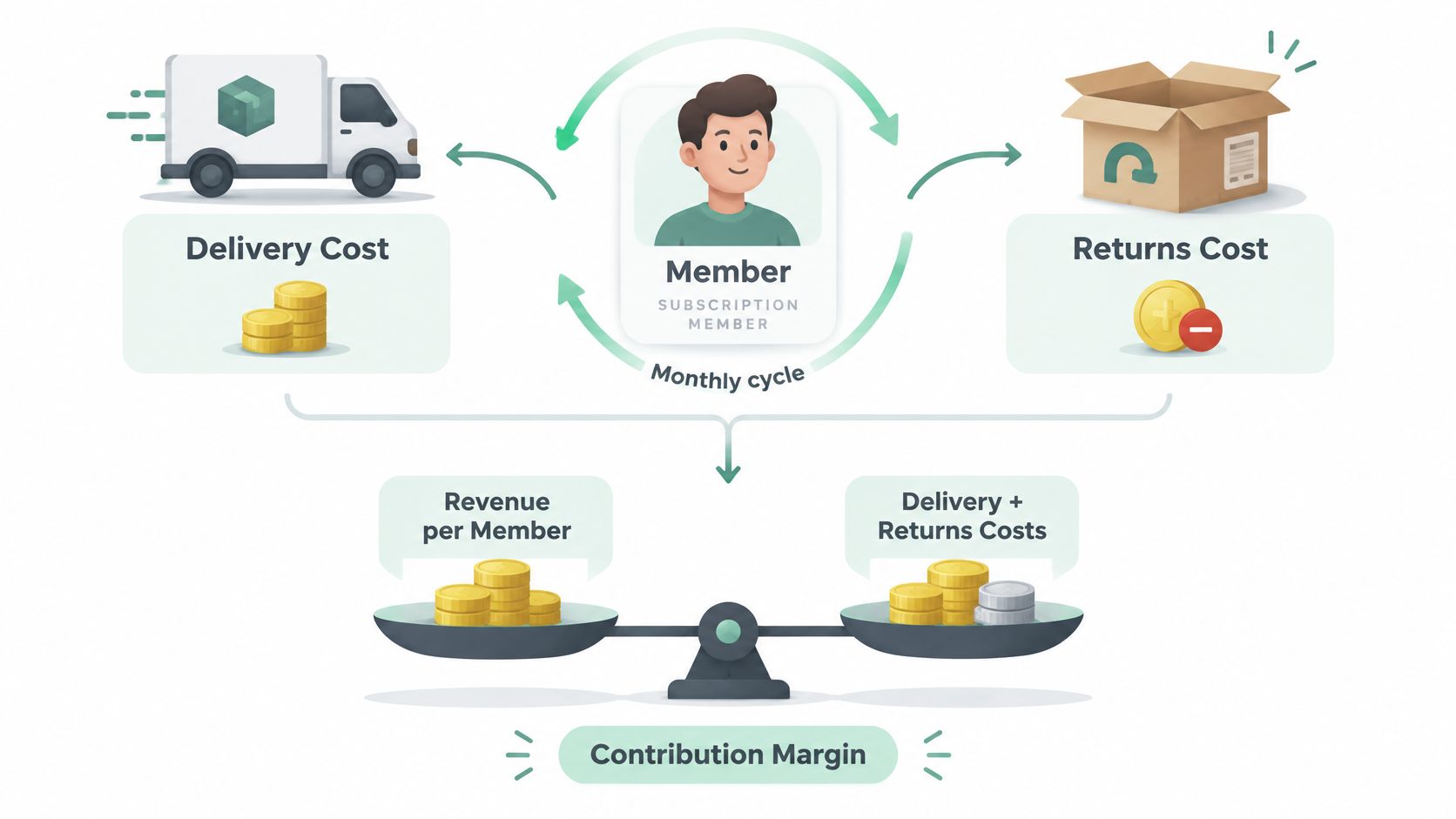
A margin check for one member
Contribution for one member in a month is member orders times average margin per order, minus the shipping subsidy, minus returns handling, minus carrier and program fees. Each order works like a car at a toll booth: it pays a fixed toll in subsidy and expected returns cost before its margin reaches your side.
Say a member places three orders. Margin is $40 each, so product contribution is $120. A $9 shipping subsidy on each order costs $27. A 10% return rate with $12 of handling is about $3.60 across those three orders. Subsidy plus returns is $30.60 before any membership fee you owe a carrier. The member is profitable only while the fee you charge, and the margin you keep, stay above that stack. Drop the order count to one and the same fixed costs take a much larger share: $40 of margin minus the $9 subsidy and about $1.20 of expected returns handling leaves roughly $29.80, so the member's profit shrinks fast once orders fall.
Where the same fee loses money
Geography changes the subsidy. The identical membership can lose money in a distant zone where the carrier charges more, even while the fee on the product page stays flat. A member whose three orders ship across the country can cost more than the fee brings in, while a local member on the same fee stays profitable. Price by market, or cap the promise, before you advertise one national rate.
Speed is the other trap. A faster promised window raises the bar the member holds you to. Miss it and cancellations rise, because the membership sold certainty and the scan history delivered a delay. Promise the window your carrier already hits.
- Order frequency: Count orders per member per month before you set the fee. The example above cleared the stack at three orders and thinned out at one.
- Return rate: Price handling into the month, the way the $3.60 above was priced, rather than discovering it in the warehouse P&L.
- On-time performance: Match the promised window to what the carrier delivers.
- Cost per market: Split subsidy by zone so a cheap domestic member does not fund a remote one.
Run that framework on your current top ten customers before you launch a delivery program. If most of them fail the month, the membership is a loss you paid for in advance.
Choose Your Subscription Setup Based on Revenue Stage
The right setup follows two facts: how much recurring revenue you already have, and whether you can see churn by cohort instead of as one blended rate. Tools don't fix a model you haven't earned yet.
| Revenue stage | Practical setup | Main risk | Capability to add |
|---|---|---|---|
| Early, testing one product | One replenishment plan on a subscription app | Building before demand is proven | One cadence and a manual billing review |
| Growing, under $75k a month | Cohort tracking and failed-payment recovery | Blended churn hiding losses | Daily billing events and dunning |
| $75k a month and up | Multi-market billing plus delivery and returns programs | Migration, billing, and logistics errors | Localized payments and margin by market |
Early stores testing one product should run a single replenishment plan on a subscription app. Don't build custom billing, cohort warehouses, or a delivery membership before repeat demand is proven. A manual review of failed charges is enough while the list is small.
Growing stores under about $75,000 a month should put measurement first. Cohorts by acquisition month, plus a failed-payment workflow, matter more than another landing page. A blended churn rate is the main risk, because it can hide a weak discount cohort or a pile of involuntary cancels.
At $75,000 a month and above, stores usually add multi-market billing, migrations, and delivery or returns programs. The risks shift to billing errors, country-level payment habits, and logistics cost. Our eCommerce subscription team covers research, design, CRO, development, and marketing for that kind of build. Customers can try a single project before a monthly pack. The Basic pack costs $3,200 per month and includes 80 hours, and it fits growing brands at that revenue stage or large jobs such as migrations and store redesigns.
If the purchase interval is predictable, start with replenishment. Add pause, skip, and downgrade before you tighten cancellation. Fund dunning before new acquisition spend. Price a delivery membership only after the contribution-margin check on real orders.
This month's audit is three numbers: cohort survival at 90 days, recovered revenue divided by failed-invoice exposure, and delivery cost per market. Pick the stage row those results match. Then decide whether your own team, or a partner such as ECORN, should build the missing piece.
ECORN builds and supports Shopify subscription programs with research, design, conversion work, development, and marketing in one team, from the first replenishment plan through multi-market billing. If failed payments, cohort gaps, or a delivery membership are the piece you can't staff, start with a single project or a monthly pack and see the fit before you commit. Visit ECORN and tell us which of the three audit numbers you want fixed first.


Ecommerce Ou E-commerce: Which Spelling to Use
Shopify ERP Integration: A Step-by-Step Guide for 2026
Shopify Cart Page Optimization: 7 Ways That Work
Shopify Post Purchase Upsell: Setup, Timing and Results

Ab Test Sample Size
Shopify Social Proof: 7 Apps That Build Buyer Trust
10 Best Shopify Design App Tools for 2026: Pros and Cons
Shopify Local Development: Setup, Workflow and Fixes

Shopify Theme Minimal: How to Design and Build One
Consistent Website Design: A Practical Guide for Stores

Shopify Development Company in USA Hiring Guide
Shopify Inventory Tracking App: How to Set It Up Right
Shopify Volume Pricing: How to Set Up Tiered Discounts
How Does Shopify Work for Sellers? a Practical Guide
Shopify Theme ZIP: How to Upload and Install It
Shopify Plus Organization Admin: Roles and Access Guide
How to Build a Drop Down Menu in Shopify: Steps and Fixes
Shopify Plus Integration Services Guide

Shopify Customer Experience: A 2026 Guide

AI Lead Generation for E-commerce Growth

Shopify Plus Expansion Stores: Limits and Setup
Shopify Theme Update: Safe Steps, Backups and Rollback

Shopify Website Design Packages: What You Actually Get

How to Choose a Shopify Plus Web Design Agency in 2026
Shopify Plus Ecommerce Agency: How to Pick the Right One

Shopify Themes Retina: How to Serve 2x Images

How to Cross Sell on Shopify Without Friction

Best Shopify Theme for Custom Products Compared
Multi Store Inventory Management: A Practical Guide

SEO Consulting for Ecommerce: A Practical Guide
Shopify Theme Updater App: A Safe Update Playbook

Shopify Git Integration: A Developer's Guide to 2026
Headless Ecommerce Development Services Explained

How to Build a Shopify Clothing Website That Converts
How to Launch a Box Subscription Business in 2026

Luxury Skincare Branding Playbook That Converters
11 Best Podcast Ecommerce Shows for Store Growth in 2026
Shopify Developer Hourly Rate: What to Pay in 2026
Critical Shopify Setup Errors That Are Secretly Sabotaging Your Store
Ecommerce Conversion Tracking: The Complete How-To Guide
Shopify Design Agency: How to Pick the Right Partner
Mastering Multi Store Management on Shopify
Scale Shopify Store
10 Shopify App Ideas Worth Building in 2026
Conversion Rate Optimization for Landing Pages: The Playbook
Shopify Plus Automation: A Guide for 2026
10 Social Selling Platforms for Shopify Merchants

Shopify Website Design Examples: 7 Stores Worth Studying
7 Ecommerce Newsletter Examples for Shopify Brands
One Product Shopify Store: Build and Scale
Mobile Pop Up Strategy for Shopify Stores That Converts
Sitemap for Shopify: How to Find, Optimize, and Submit It

7 Single Product Websites Worth Emulating
Product Variants Shopify: The Complete 2026 Guide
Ecommerce Analytics Consulting for Growth

What Is AI Integration for eCommerce
How to Choose the Right eCommerce Website Development Firm
E Business Strategy Implementation
Conversion Tracking Setup for Shopify Stores
BigCommerce vs Shopify Plus Which Enterprise Wins in 2026
Shopify Theme Kit: Setup, Commands, and Migration Guide

Shopify Extension Development: A Practical 2026 Guide

Shopify Speed Score Explained and How to Improve It
Shopify Mobile Optimization: The 2026 Playbook

How to Add Subcategory in Shopify for Better UX
How to Implement Structured Data for Ecommerce in 2026

SEO App Mobile: Shopify Store Optimization Guide

Shopify Plus Support: What It Includes and How to Choose

Google Ads for Shopify: The Complete 2026 Playbook

Shopify New York: How to Find and Hire the Right Agency

Google Search Console for Shopify: The Complete Setup
First Party Data Collection for eCommerce Growth
FAQ Online Store Guide: Build and Measure It Right
Do FB Ads Work for eCommerce in 2026?

One Page Checkout for Shopify: Design and Implementation
Shopify GraphQL vs REST: The 2026 Developer Decision
Shopify Ecommerce Consulting: Strategy, Pricing &

Are Reddit Ads Worth It for eCommerce Brands

Shopify Title and Meta Description: A Practical 2026 Guide

Product Video Best Practices for Shopify Brands
Real-Time Inventory Management: A 2026 Guide

AI Chatbot Integration for Shopify Stores
Affiliate Program Management: A Shopify Guide
10 Best Performance Monitoring Tools for Shopify in 2026
Digital Asset Management for eCommerce Brands in 2026
Every Type of Facebook Ads Explained for eCommerce Growth
Product Information Management Explained for Shopify Brands
Support Ticket System: A Guide for Shopify Stores

10 Best Customer Service Tools for Shopify in 2026

Can I Start a Business with No Money? a 2026 Blueprint

What Sells Good on Etsy: Best Niches for 2026

Shopify Add to Cart Button: A Practical 2026 Guide

Customer Feedback Automation: A Practical eCommerce Guide
Critical Rendering Path: A Guide for Shopify Stores

How to Promote on TikTok for eCommerce in 2026

B2B eCommerce Consulting That Drives Real Revenue
10 Best Practices for Site Navigation in 2026
Return vs Refund for Shopify Stores: A Practical Guide
What Is Customer Lifetime Value and Why It Matters
What Is Voice of Customer Research for eCommerce


newsletter in your inbox